You're back in the lobby after a ranked match that was winnable. Nobody called the rotation, someone spent the final round assigning blame, and the squad fell apart before you could agree on another queue. The aim was there. The teamwork wasn't.
What makes a good teammate is how predictably they help other players make better decisions, especially when the match stops going their way. You can spot much of that before committing to a session, if you know what to look for in clips, profiles, and the lobby.
Table of Contents
- The Five Habits of a Good Teammate
- Clear Communication That Helps the Squad
- Showing Up and Owning Mistakes
- How to Build a Shared Plan Before the Queue
- Adapting to Roles, Skill Gaps and Playstyles
- Keeping Tilt From Spreading Through the Squad
- How to Spot These Habits Before You Queue
- Confirm These Habits Before Your Next Queue
The Five Habits of a Good Teammate
A mechanically strong player can still leave you guessing about their next move. They might win their duel while abandoning the objective, or call for a push after they've already committed. Judge teammate quality by the options someone creates for the squad, not just their individual results.
The useful habits are concrete enough to check during play.
Five teammate habits and what breaks them
| Trait | What It Looks Like in a Match | What Breaks It |
|---|---|---|
| Clear communication | Short, timely calls that change decisions | Silence, or long messages that bury the call |
| Reliability | Shows up on time, stays through the match, owns mistakes | Quitting after one bad round, blaming teammates |
| Adaptability | Takes the role the squad needs | Insisting on one playstyle regardless of the team |
| Team-first habits | Plays for objectives, shares resources, supports the shot-caller | Ego plays, chasing solo kills, ignoring calls |
| Calm under pressure | Resets quickly, keeps feedback specific | Insults, rage-quits, spreading negativity |
These aren't personality labels. An outgoing player can communicate poorly, and a quiet player can keep everyone informed through accurate pings. Someone can be friendly in the lobby but unreliable once they're losing.
In 2024, 64% of U.S. adults said video games can teach teamwork and collaboration skills, according to the Entertainment Software Association and YouGov. That's a public perception finding, not proof that every match teaches teamwork. The practical takeaway is to treat these behaviors as skills to practice, rather than traits you either have or don't.
Self-check: Evaluate the play you made available to your teammates, not just the play you completed yourself.
Look back at your recent squads and score them against the rows. Note which missing habit cost coordination. Include yourself: if everyone had your communication, resource habits, and response to mistakes, would that squad be easier to play with?
Clear Communication That Helps the Squad
Useful communication gives someone a decision they can act on. Before speaking, ask whether your teammate will know what to do next or whether you're narrating your frustration.
Early information leaves room for a response.
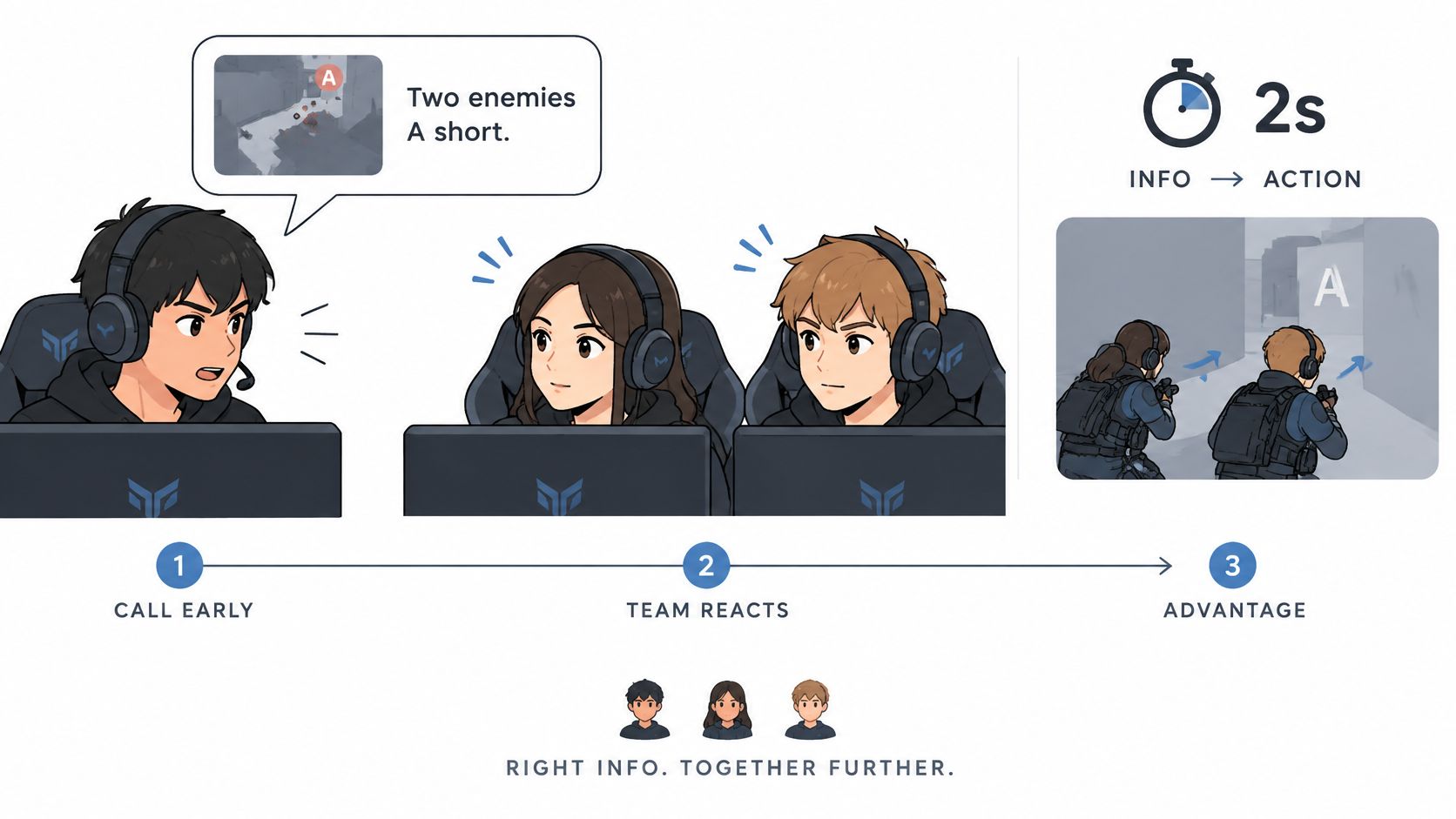
Send information while it still matters
Speak before the commitment. If you see opponents leaving a lane in League of Legends, signal the disappearance while your teammate can still back away. Explaining where everyone went after the death isn't a warning.
Use the channel the moment needs. Ping the doorway instead of delivering a speech about its location. If your mic is off, use short text between engagements, not a paragraph while teammates are trying to survive.
In 2024, 70% of adult players who play online had used communication tools such as in-game text or voice chat, according to the Entertainment Software Association and YouGov's Essential Facts report. Voice isn't the only channel worth taking seriously.
Remove ambiguity without adding noise
- Ask instead of guessing. If the caller names a site but not the route, confirm the route before moving. A short clarification beats splitting the push.
- Leave space for replies. Don't repeat your instruction over someone reporting a flank. Listen for the information that could change your call.
- Separate planning from combat. Put availability, preferred roles, and session expectations in a squad group chat, where they won't compete with live calls.
Don't assume a quiet player has nothing useful to contribute. They may be listening, choosing words in another language, or waiting for an opening in a crowded voice channel.
Use this video as a prompt to assess your own communication habits.
In your next match, notice which calls changed a decision. Keep those, and cut the running commentary that makes them harder to hear.
Showing Up and Owning Mistakes
Reliability means predictable behavior under pressure. Be ready when you agreed to play, say when you need a break, and finish the match you committed to. If your plans change, tell the squad before they spend the evening waiting.
The harder test comes after your mistake. Do you explain what the team needs to know, or spend the next engagement defending yourself?
A systematic review in the Annual Review of Organizational Psychology and Organizational Behavior, covering 185 empirical articles, found that psychological safety supports communication and coordination and has relationships with performance at individual, team, and organizational levels.
Make admitting problems useful
Psychological safety means players can admit mistakes, ask for help, and challenge a call without being mocked or punished. It doesn't mean everyone's decisions were correct or that criticism is forbidden.
Say you leave your position too early. Report the exposed location, your remaining resources, and your next action before explaining why you moved. The squad needs to cover the gap now; it can evaluate the decision afterward.
Accountability starts with making the problem visible while someone can still do something about it.
Review the error without putting someone on trial
After the round, keep the review focused:
- What happened? Describe the sequence, including your own contribution.
- What information was missing? Identify the unseen opponent, unclear call, or unavailable cooldown.
- What adjustment comes next? Choose a change the squad can execute.
For example, an anchor who rotated early might agree to hold until the caller confirms the objective is threatened elsewhere. That's a usable correction. Calling the anchor careless gives them no decision rule for the next round.
Don't demand immediate self-criticism from everyone else while excusing your own errors. After your next lost round, share your mistake first and use the review prompts to agree on the adjustment.
How to Build a Shared Plan Before the Queue
A squad needs a shared operating model: agreement about what it's trying to achieve, who handles each responsibility, and how it resolves conflicting information. Without that, players can make individually reasonable decisions that don't fit together.
McKinsey's research on team effectiveness, covering 110 teams and 905 members across 42 countries, identified trust, communication, creative thinking, and decision-making among the strongest drivers of team health. Those were organizational teams, not ranked squads, but the planning questions translate well.
Use this visual as a reminder to make the agreement explicit.
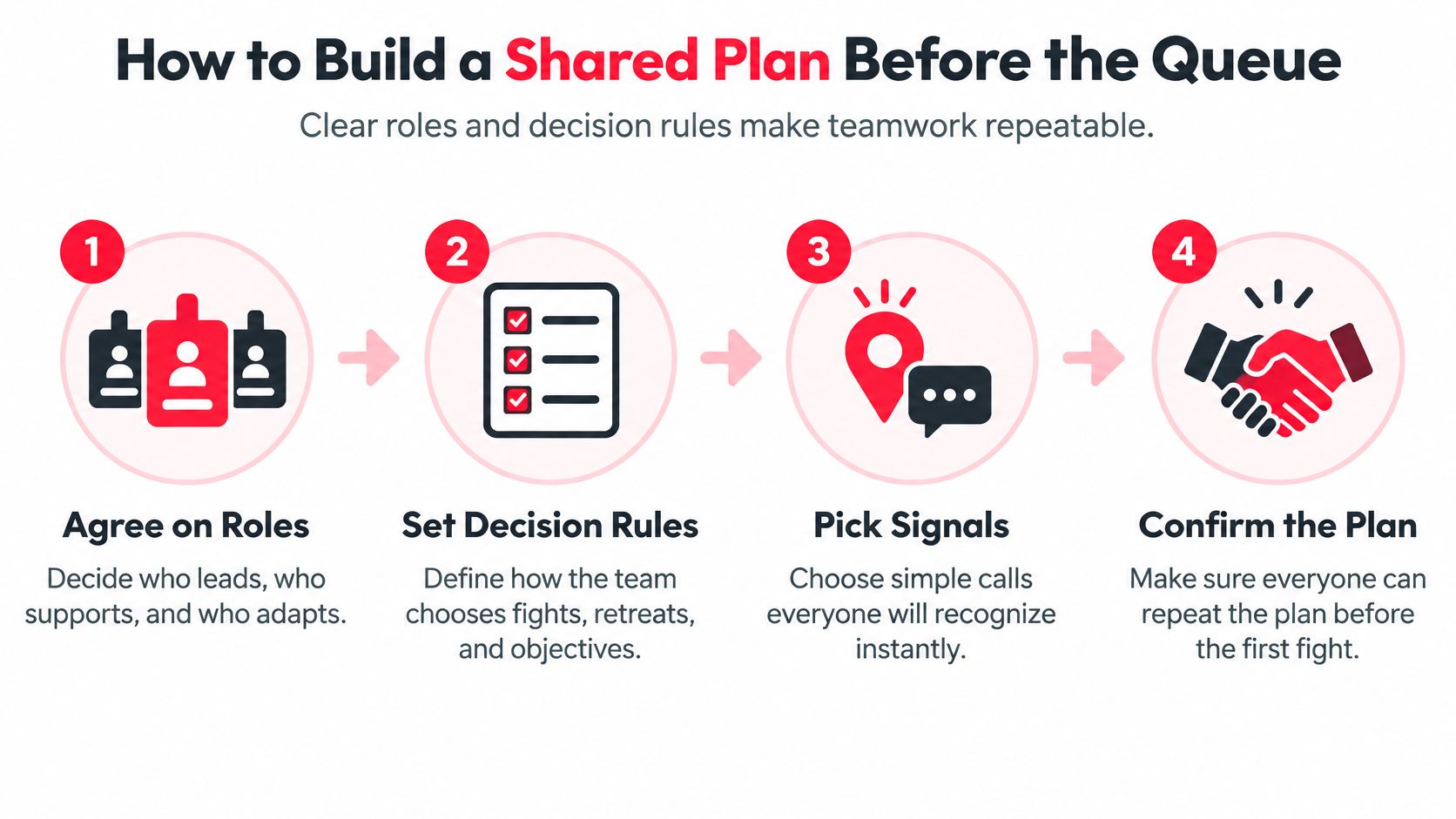
- Agree on the win condition. Choose what the squad will prioritize. In Apex Legends, that might mean securing a playable zone position rather than chasing a distant knock.
- Assign responsibilities. Entry creates the opening, anchor protects space, the shot-caller coordinates commitments, and resource support supplies the utility or sustain needed to execute. Adapt the labels to your game.
- Set the tie-break rule. Decide who makes the final call when opinions conflict. Other players should still report new information, but the squad shouldn't split because competing callers keep issuing instructions.
- Standardize the callout. Use where, what, urgency, action. For example: “two west roof, cracked one, high urgency, swing left.”
Set timing expectations too
Announce rotations before moving, report major cooldowns when they're used, and confirm an unclear instruction instead of interpreting it on your own. Before starting, ask each player to confirm their assignment in their own words.
After a loss, inspect the decision process. Did you lack scouting, commit too late, or follow different callers? Write the setup into squad chat before your next queue so nobody has to reconstruct the agreement mid-fight.
Adapting to Roles, Skill Gaps and Playstyles
Adaptability isn't agreeing to everything. It's changing your contribution when the squad needs something different, while being honest about what you can do well.
Consider the player who usually runs entry but joins a team with another committed entry player. Picking the same role and hoping someone else fills the gap isn't flexibility. Offer to anchor, explain your comfort level, and ask what utility the team needs from that position.
Match your support to the player
With a newer teammate, simplify the instruction rather than raising your voice. Name the destination and immediate job, then save the reasoning for downtime. Too many corrections during a duel can make it harder for them to identify the relevant cue.
A 2025 summary of multiplayer communication findings from PlayStation Universe described controlled settings where adding voice to text increased reported liking and trust. That doesn't make constant voice chat the right choice for every player or task.
- For an unfamiliar role: Explain the responsibility the squad needs covered, not every mistake the player could make.
- For a language difference: Use familiar map names, simple verbs, and matching pings.
- For a quiet teammate: Ask whether they prefer spoken callouts or pings, and agree on how they'll acknowledge instructions.
- For coaching: Ask permission before offering it. A request for tactical information isn't an invitation to narrate someone's mechanics.
Don't interpret a preference as a skill rating. A player may avoid voice because they're streaming, have accessibility needs, or concentrate better without it.
Ask a teammate how they prefer to be supported during your next session. Then make a visible adjustment. Listening to the answer matters more than sounding accommodating in the lobby.
Keeping Tilt From Spreading Through the Squad
Toxicity can spread between players. A 2025 Dota 2 study using 51,771 player-match observations involving 1,358 players found influence from both teammates and opponents, with teammate influence substantially stronger; higher-skill players resisted opponents' influence but remained vulnerable to toxic teammates.
That challenges a familiar ranked excuse: the teammate who insults everyone is worth keeping because they're mechanically strong. Their mechanics don't cancel the way they affect the rest of the squad.
Calm communication is a team responsibility, not a job assigned to whoever tolerates the most abuse.
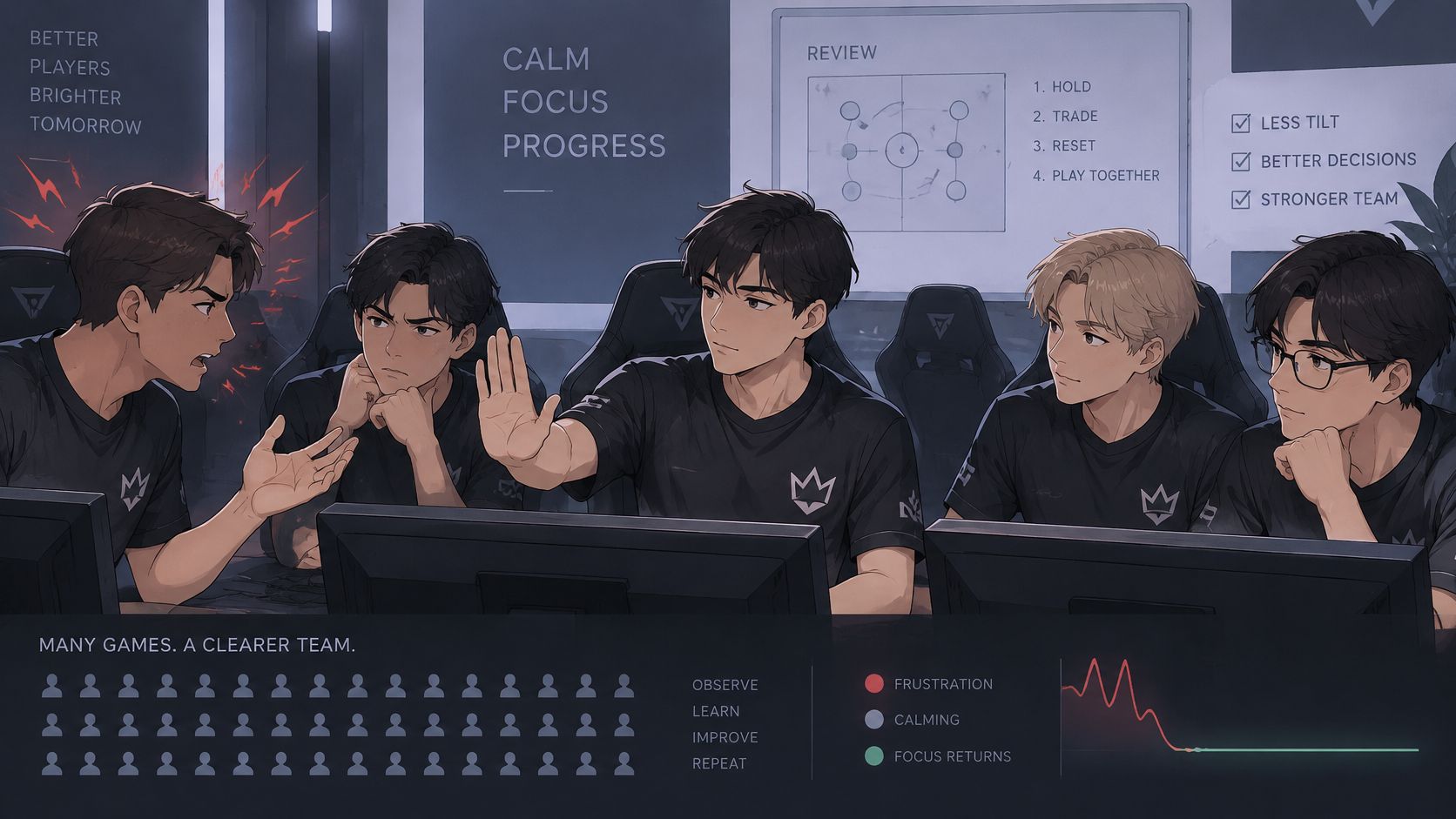
Interrupt the behavior, not the person
You don't need to tell someone they're a negative person. Stop the specific behavior that's interfering with play, then direct attention to the next decision.
- Replace blame with an action. “Reset and play next” is useful when the alternative is replaying an argument during the buy phase.
- Don't join the pile-on. Adding your complaint may feel justified, but it leaves the targeted player facing a squad rather than a correctable mistake.
- Keep boundaries clear. You can acknowledge frustration without accepting insults or harassment.
- End the session deliberately. Finish the active match, then stop queuing if players can't reset.
A teammate doesn't have to enjoy losing. They do need to remain someone the squad can coordinate with while losing.
Building a toxic-free gaming community means making those boundaries normal before conflict starts. Don't make the calmest player responsible for absorbing everyone else's frustration.
Agree on a break rule before the session: anyone can request a pause after the match, without being pressured into another queue. If personal attacks continue, end the session rather than trying to win back everyone's mood through another result.
How to Spot These Habits Before You Queue
You can't prove someone's teammate quality from a profile. You can check whether their visible behavior matches what they promise, then use the lobby to resolve the gaps.
Look for evidence beyond a clean highlight. A player's choices when the clip stops going well are often more useful for assessing compatibility than the final elimination.
Pre-queue signals of a good teammate
| Signal | Good Sign | Red Flag |
|---|---|---|
| Gameplay clips | Calm, team-aware plays and clean resets after deaths | Only highlight reels, or constant rage moments |
| Reaction to losses | Asks what went wrong and moves on | Blames teammates or quits the session |
| Communication style | Short callouts, asks before coaching | Long rants, or no callouts at all |
| Schedule and mic | Clear availability and a mic setting that fits the squad | Vague timing, or ignoring the mic requirement |
| Role flexibility | Willing to take the support or flex role | Insists on one role and ignores team composition |
Read the signals in context
Start with clips that show decisions. Watch for teammate positions, resource sharing, and whether the player abandons a favorable team position to chase damage. Highlight-only profiles leave questions unanswered; they don't automatically prove selfish play.
Next, inspect the response to a loss. Does the player identify a decision they could change, or explain every failure through someone else? Compare winning and losing footage where available.
Listen to communication in context. A silent clip may have no recorded team audio, so confirm preferences rather than assuming the player never calls. In the lobby, check whether they acknowledge other players and answer practical questions.
Then check availability and mic expectations. A clear departure time is more useful than an enthusiastic promise to play all night. Finally, ask about role flexibility before inviting someone into a composition that needs it.
Scouting rule: Treat missing evidence as a question to ask, not a verdict about someone's character.
When you're looking for a group, look for patterns across interactions. If several signals conflict with your requirements, skip the commitment or propose a trial match instead of promising a full session.
Confirm These Habits Before Your Next Queue
Don't turn teammate selection into an interview that lasts longer than the session. Make your requirements clear, inspect the available evidence, and leave room to test the fit through play.
Use a repeatable pre-queue routine
- Name what you need and what you bring. Write down the habit you most want from teammates, then the habit you can reliably offer. Be specific: objective-focused play is clearer than wanting people with a good attitude.
- Set the practical requirements. Choose the game mode, rank range, platform, and whether a mic is needed. On GamerPlug, we let squad posters set those requirements, and squad requirements are checked against players' real stats.
- Check behavior before inviting. Look beyond the bio for how someone makes decisions and handles an unsuccessful play. stankRat says a couple of clips tells them more than any profile bio, a useful reminder to inspect the play rather than stop at the description.
Keep rank and teammate habits separate in your assessment. Rank can help establish a suitable competitive bracket; it doesn't tell you whether someone will respect a departure time or accept a needed role.
After the session, note which behavior made coordination easier and which expectation remained unclear. Use that observation to improve your next post or invitation, rather than deciding that every unsuccessful squad was unlucky.
Run this routine before your next queue. Look for compatible habits, and make sure your own behavior gives teammates a reason to invite you back.
Gamerplug helps you find squadmates through gameplay profiles and squad listings, so you can check more than a username before committing. Visit Gamerplug, set the requirements for your next session, and look for players whose visible habits match the squad you want to build.