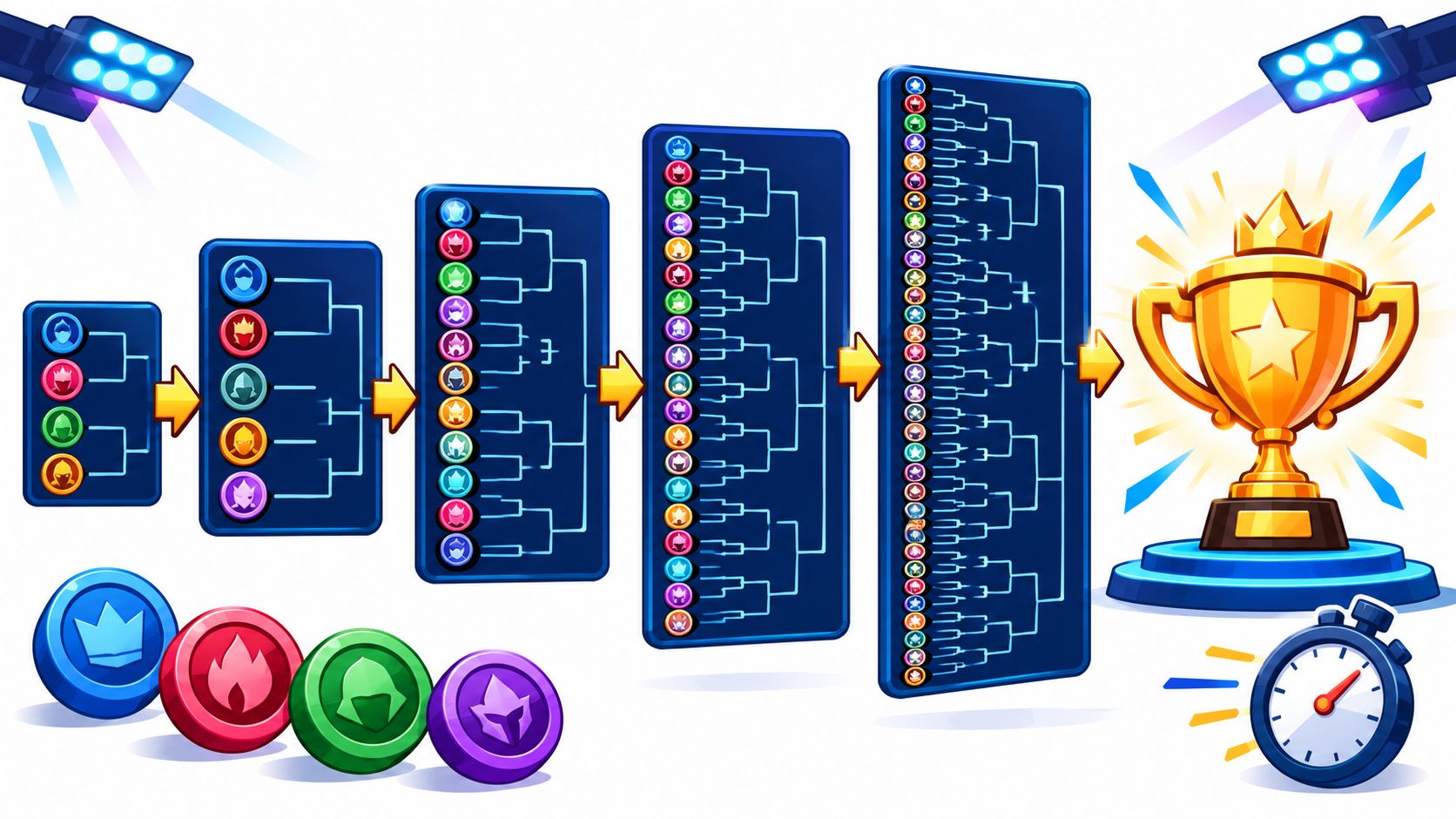
You've got a game picked, players are signing up, and the event date is already on the poster. Then the registrations land at an awkward total, and you realize the bracket you chose needs more matches than your schedule can handle. That's how a community tournament turns into a long wait between rounds, a rushed final, or a lobby full of people who've logged off.
Tournament bracket sizes are a scheduling decision disguised as math. Choose the field size before you lock in the event window. It tells you how many elimination rounds the tournament needs and how much match traffic your staff, players, and broadcast have to manage. Get that decision right, and the rest of the event becomes easier to plan.
Table of Contents
- Why Bracket Size Is the First Decision You Make
- The Powers of Two Rule and Why It Matters
- Match and Round Counts for Every Standard Size
- How Bracket Size Changes Seeding and Upset Risk
- What the NCAA Bracket Expansion Teaches Esports Organizers
- Single Elimination vs Double Elimination vs Swiss vs Round Robin
- Choosing the Right Bracket Size for Your Event
Why Bracket Size Is the First Decision You Make
An organizer might pick a Sunday afternoon, open registration to a large field, and only then ask whether the matches can fit. That order is backwards. In a single-elimination event, every match produces a winner and eliminates someone, so a larger field means more matches and at least one additional round whenever the field doubles.
Round count is only part of the workload. Think about whether your matches run one after another or concurrently, how many lobbies you can reliably manage, how long players need between games, and how much time you've set aside for check-ins and delays. A broadcast schedule adds another constraint: if every match is meant to be watched, your event timeline can't be based on the assumption that all games will finish at once.
Work backward from the time you have
Start with the event window, then estimate the match length based on the game and format you're running. Next, decide how many matches can happen at the same time without sacrificing result checks or creating a support headache. Only then choose the largest field your setup can finish comfortably.
Organizer's rule: Don't advertise a field size until you can explain how the last round fits into the schedule.
That's especially important for a large Apex Legends or Fortnite event where match setup and coordination may not look like a quick head-to-head game. A bracket can be mathematically tidy and still be a bad fit for the event. If your available time is tight, a smaller field with a clean finish beats a bigger field that leaves the finals scrambling for attention.
The Powers of Two Rule and Why It Matters
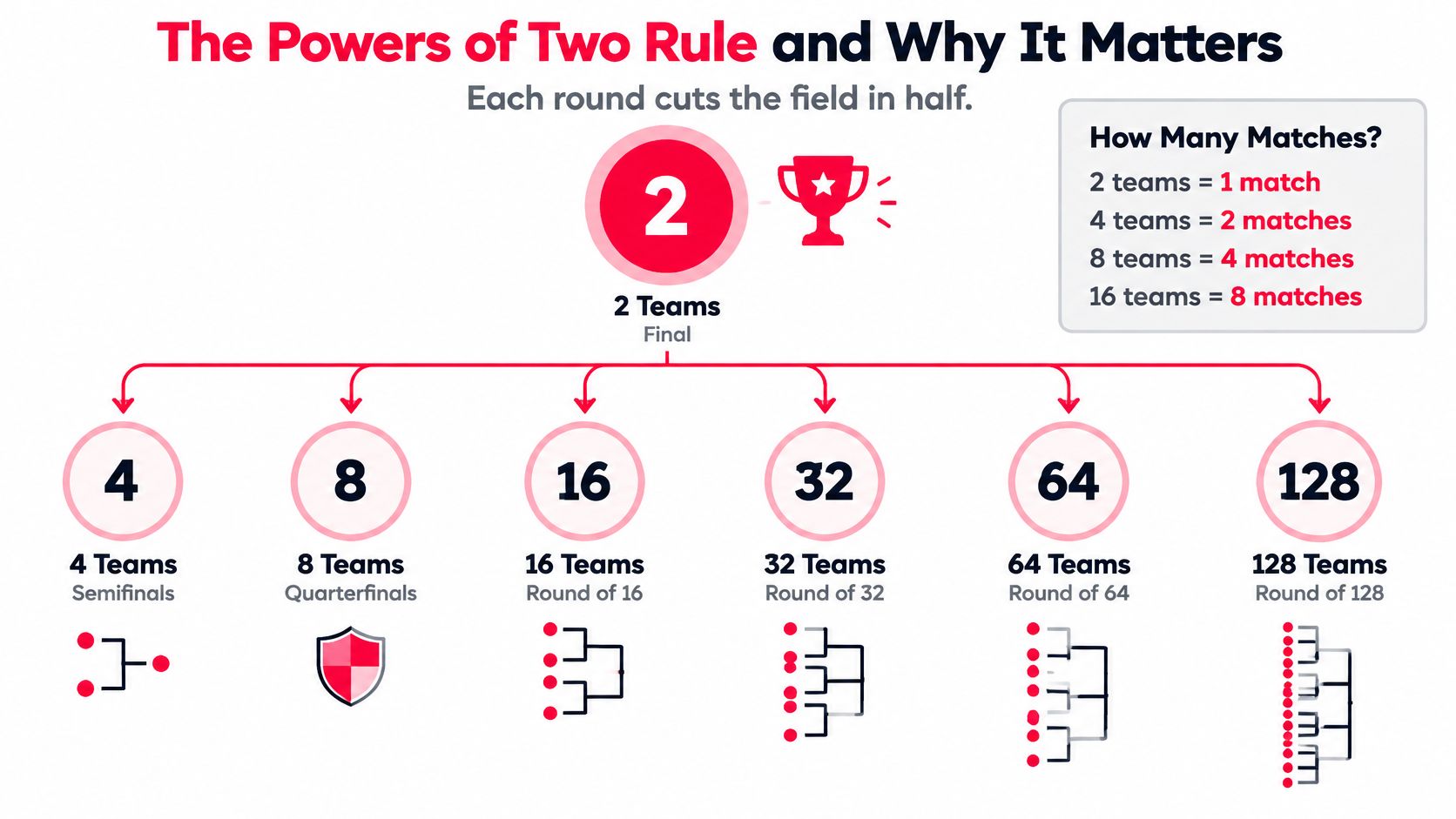
Single-elimination brackets are easiest to build when the number of entrants is a power of two: 2, 4, 8, 16, 32, 64, and so on. Each round cuts the remaining field in half. That's the mental model: start at the full field and keep halving until one competitor remains.
Registration rarely behaves that neatly. If you have an uneven number of entrants, you can use byes or play-in matches to reach a clean main bracket. A bye advances a player or team without a match. A play-in is a real match that reduces the field before the main bracket begins. They solve the same basic problem in different ways, but they don't feel the same to participants: a bye is an advantage built into the draw, while a play-in asks some entrants to compete before others join.
Choose the route that fits your event
First, estimate how many entries you'll confirm, not just how many people click "register." Then identify the next clean bracket size above that total. Finally, decide whether byes or preliminary matches are the fairest and clearest way to bridge the gap.
For example, a 53-team field can't be divided into equal first-round pairings, so some teams must advance without playing. You can also register above the size of the main bracket and run play-ins, as long as you explain who plays and how the main draw is formed before the event begins.
The practical mistake is treating a bye as a harmless visual detail. It changes who gets a match, who waits, and how players understand the draw. Publish the rules clearly, seed before generating the bracket, and make sure every participant knows whether they've received a bye or have a play-in to play.
Match and Round Counts for Every Standard Size
In any single-elimination field of n entries, the total matches equal n minus 1, because every match eliminates exactly one competitor. Rounds follow the repeated halving of the field. What catches newer organizers off guard is the growth curve: every step up in size adds a full round and roughly doubles the matches you have to run.
| Entries | Elimination rounds | Total matches |
|---|---|---|
| 4 | 2 | 3 |
| 8 | 3 | 7 |
| 16 | 4 | 15 |
| 32 | 5 | 31 |
| 64 | 6 | 63 |
| 128 | 7 | 127 |
Each row on that table is a scheduling decision. A match count only becomes hours once you factor in game length, lobby setup, result reporting, disputes, breaks, and how many matches can run at the same time. Skip that math and your time estimate is a guess.
Read the bracket as a production schedule
A 64-entry bracket has a predictable progression: 32 first-round matches, 16 second-round matches, 8 quarterfinals, 4 semifinals, 2 finals-stage matches, and 1 championship match. That structure helps with seeding, online tournament tools, live leaderboards, and broadcast planning because organizers can see the field narrow round by round.
Small does not always mean fast.
I have seen 8-team events outlast 32-team events because one ran matches sequentially while the other had stations to spare. Concurrent play demands lobbies, staff, and reporting rules that keep results flowing to the bracket. Choose the size based on the match flow you can support, because a clean chart means nothing if you cannot staff the lobbies behind it.
How Bracket Size Changes Seeding and Upset Risk
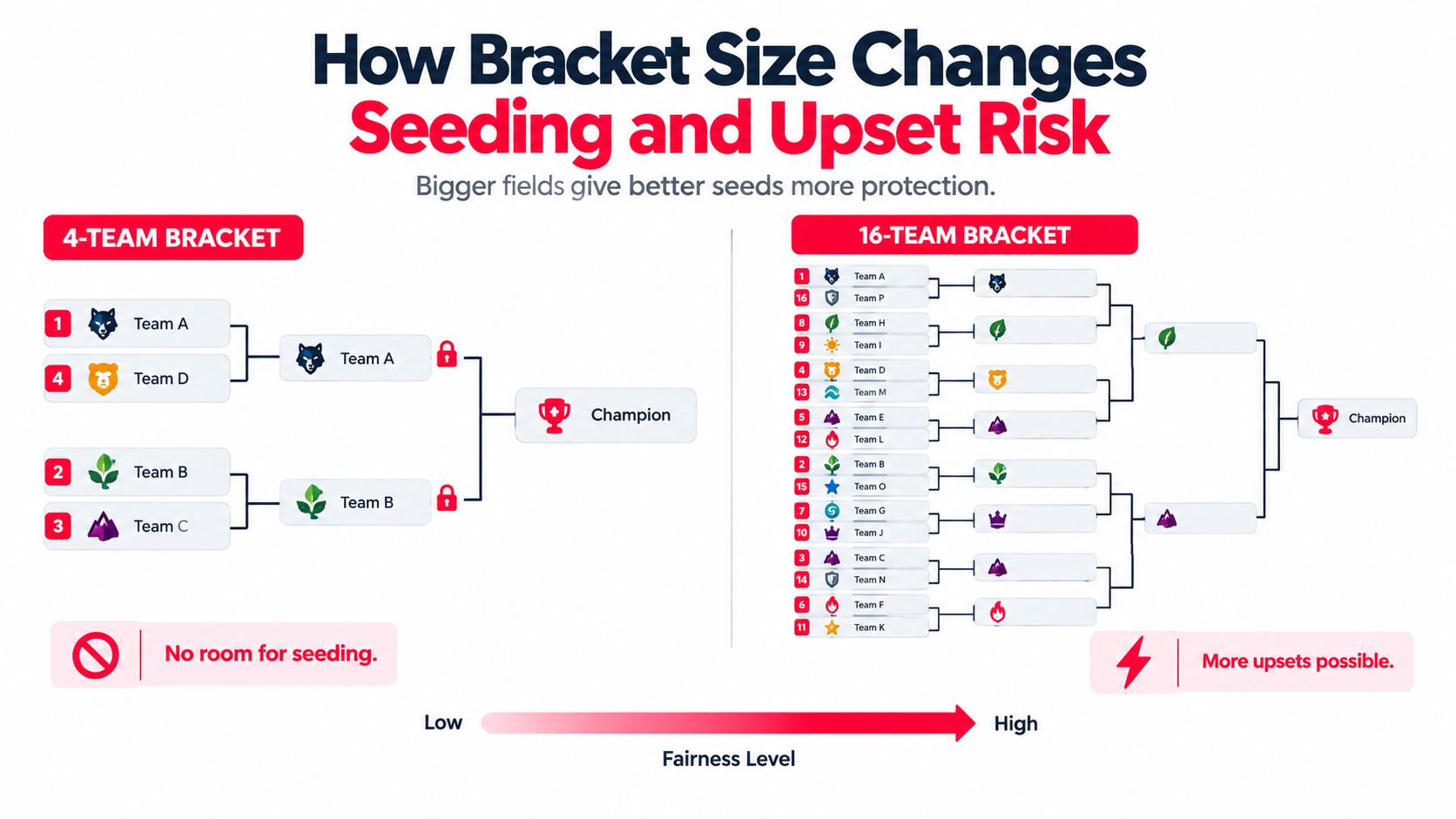
A small bracket offers fewer paths for seeds to separate. In a four-team draw, the semifinal matchups are effectively locked once the teams are placed. There's little room to protect the strongest entries from meeting early, and a single upset can change the story of the whole event before the final.
A larger draw gives organizers more room to distribute seeds across the bracket. A sixteen-team field can create a clearer path for higher seeds, while still leaving space for upsets and strong runs from lower seeds. The trade-off is that a bigger bracket takes more matches to complete and asks players to stay engaged through a longer competition.
Make the seeding rules visible
Seed from criteria you can explain and apply consistently, such as verified results or known competitive performance. Don't wait until players ask why a matchup looks lopsided. State the seeding approach before the draw, and use a bracket format that makes the path legible to both competitors and viewers. This tournament bracket example can help organizers think through how matchups and progression appear on the page.
A larger field doesn't prevent an upset. It gives the bracket more room to place seeds and gives the tournament a longer competitive arc. For a community event, a balanced field is often more satisfying than a crowded one with unclear seeding and an exhausting schedule. If you can't explain why teams landed where they did, the problem isn't just bracket size. It's trust in the draw.
What the NCAA Bracket Expansion Teaches Esports Organizers
An event with 53 teams does not fit a 64-team knockout draw cleanly. Play-ins can bridge that gap, but they add matches, scheduling pressure, and fatigue before the main bracket even starts. The NCAA's expansion offers a useful model: its men's tournament began with 8 teams in 1939, grew to 16 in 1951 and 32 in 1975, then reached a 64-team bracket in 1985. The First Four, added in 2011, brought the field to 68 while preserving the 64-team main draw, as described in the NCAA's tournament history.
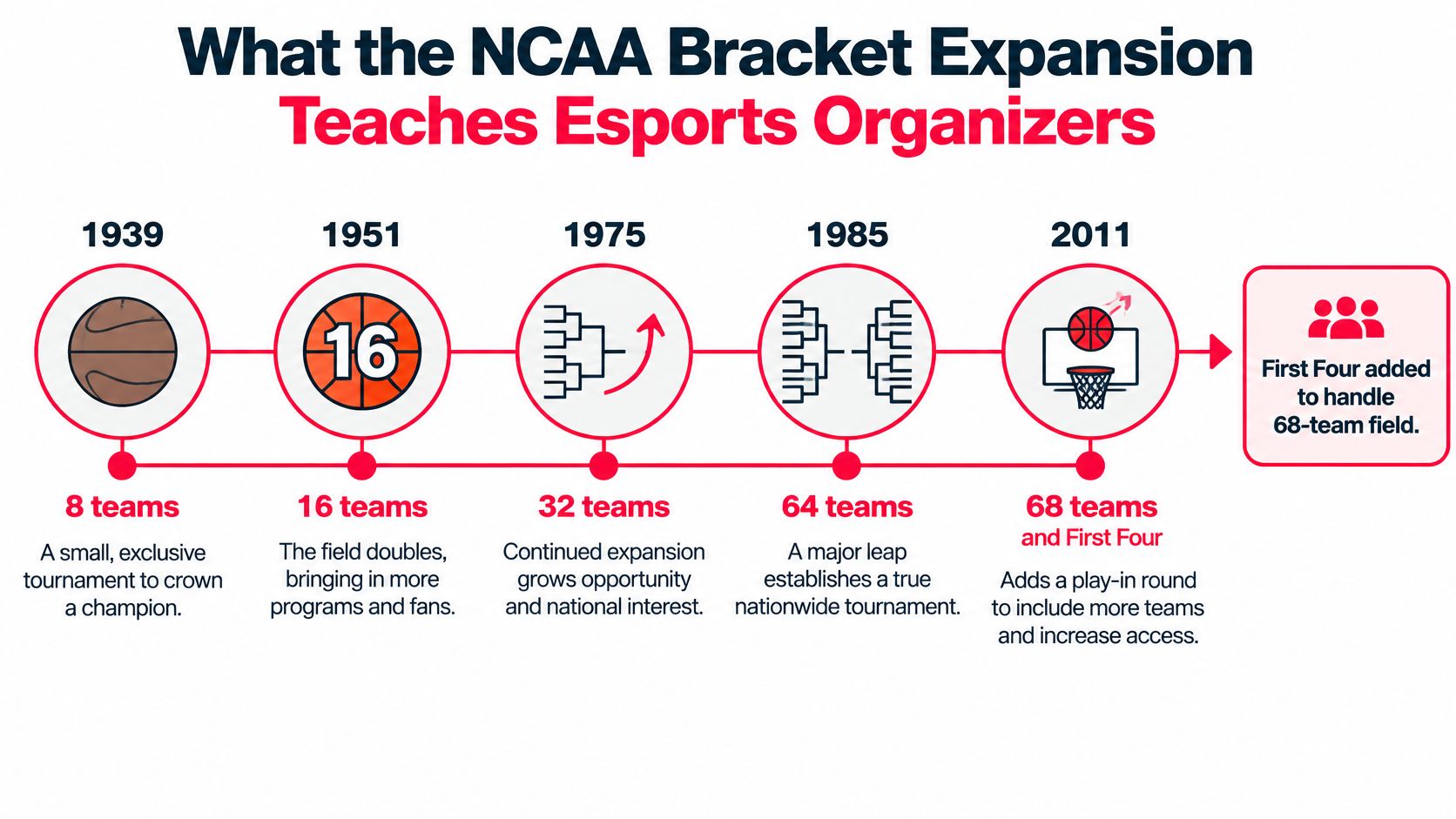
For esports, the takeaway is practical: use qualification rounds to absorb uneven signups, then start the main event with a bracket that advances cleanly. Those play-ins still cost match slots and player energy. Set the cutoff and advancement rules before registration opens, and make clear which entrants must qualify.
For an Apex Legends weekly or a Valorant community cup, tie play-in matches to confirmed attendance and publish when the main draw starts. Avoid promising every entrant a direct place in the main bracket if some teams will need to qualify. A larger field can fit the schedule only if you budget time for the extra round.
Here's the tournament timeline in motion:
Single Elimination vs Double Elimination vs Swiss vs Round Robin
Field size doesn't tell the whole workload story. Format changes how many chances players get and how many matches the organizer has to run. Single elimination is the cleanest route to a champion, but a loss ends a team's tournament. Double elimination gives teams a second path after a loss, which creates a fuller competition and more scheduling pressure. Read this guide to double-elimination brackets before choosing that format.
Swiss pairs competitors based on results across successive rounds rather than removing every losing team immediately. Round robin gives entrants a broader set of matchups, but it can become a heavy commitment as the field grows. Neither is automatically better. The right choice depends on whether your priority is a quick finish, more play for each entrant, or a fuller record of performance.
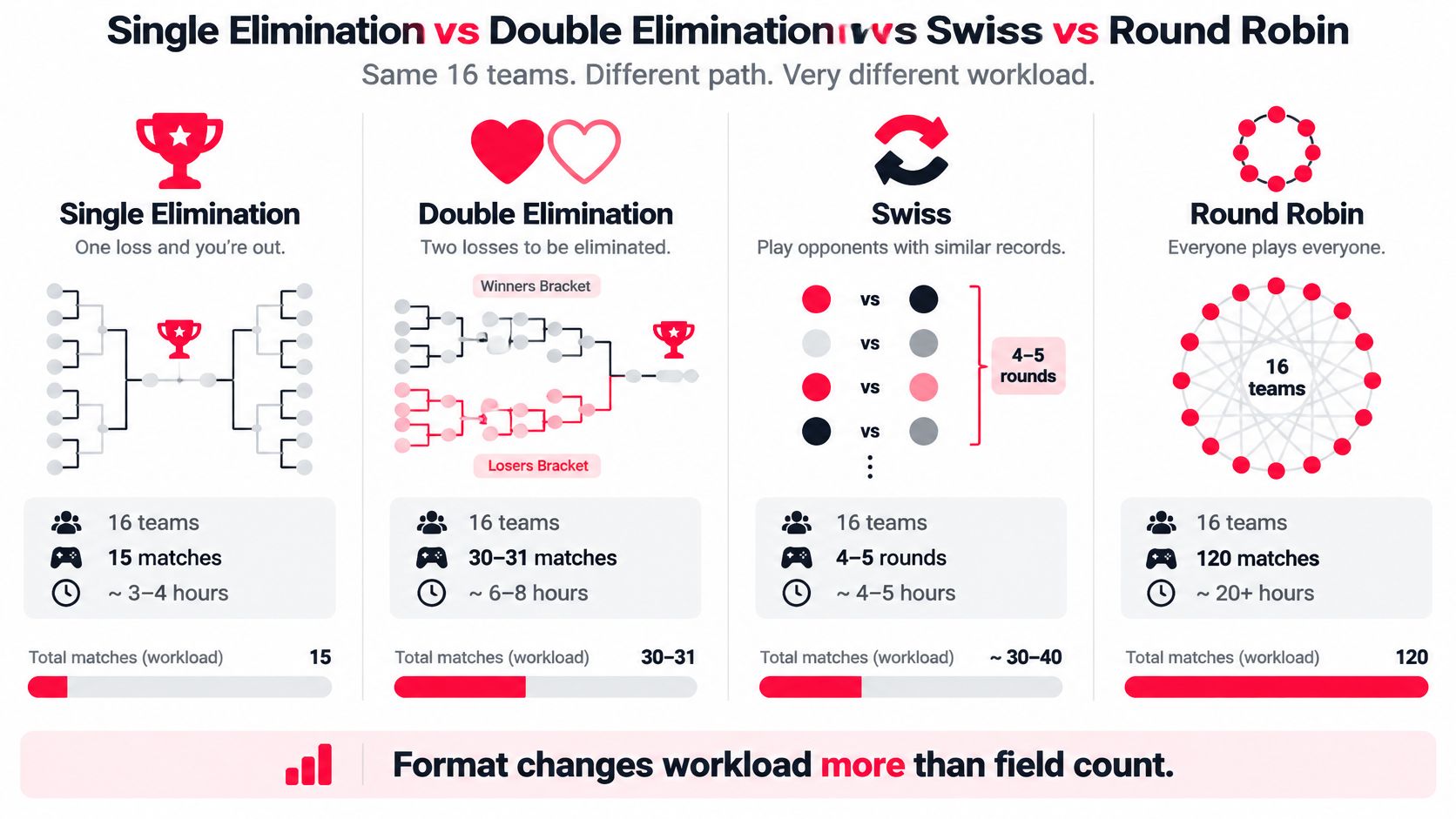
Choose format for the player experience
| Format | What works | What can go wrong |
|---|---|---|
| Single elimination | Simple progression and a clear finish | One loss ends a team's run |
| Double elimination | A loss doesn't immediately end the event | More matches need to fit the schedule |
| Swiss | Players can keep competing as results shape pairings | Pairing and standings need careful tracking |
| Round robin | Everyone gets a broad set of matchups | The schedule can grow unwieldy |
For organizers comparing different competition structures, the Pickleballer league directory offers a useful view of how leagues can organize recurring play beyond a one-off knockout event. The same practical question applies to esports: are you optimizing for a fast bracket, more matches for participants, or a format that rewards performance across multiple rounds? Decide that first, then choose a field size your staff and schedule can sustain.
Choosing the Right Bracket Size for Your Event
Make the call from three inputs: confirmed signups, available hours, and realistic match flow. Don't set the size from registration interest alone. A field that looks exciting on a signup page can become a bad event if your lobby capacity, staff coverage, or match windows can't support it.
Use this quick check before opening registration:
- Start with the time window. Decide when the final should begin and how much room you need for setup, delays, and results.
- Estimate match capacity. Work out how many games can run at once without losing control of lobbies, scores, or player communication.
- Set a registration cap. Choose the largest field that fits those limits, and decide in advance how you'll handle withdrawals or an uneven final count.
- Choose the format. Don't bolt on double elimination or Swiss after you've already committed to a single-elimination schedule.
Keep the rules and tools simple
If the event is short, a smaller single-elimination field is easier to finish cleanly. If you have more time and enough staff to manage match flow, you can consider a larger bracket or a format that lets teams continue after a loss. For advice on planning youth events, including registration considerations, see youth tournament registration and scouting tips.
When you need help managing registration, seeding, check-ins, results, and live progression, an esports tournament app can keep those moving parts in one workflow. Gamerplug supports brackets for Apex Legends, Valorant, Fortnite, and League of Legends across single elimination, double elimination, Swiss, and round robin formats. Check that any platform you choose supports the specific format and player flow you've promised.
Before posting the event, write down the field cap, format, advancement rules, and how players will receive updates. If that plan doesn't fit the time you have, reduce the field or change the format. Don't make participants absorb the cost of an organizer's optimistic math.
Build a bracket around the event you can run, not the signup number you hope to reach. Gamerplug supports tournament registration, check-ins, bracket formats, tracked results, and live leaderboards for supported games. Visit Gamerplug to set up your event and keep players informed as matches progress.