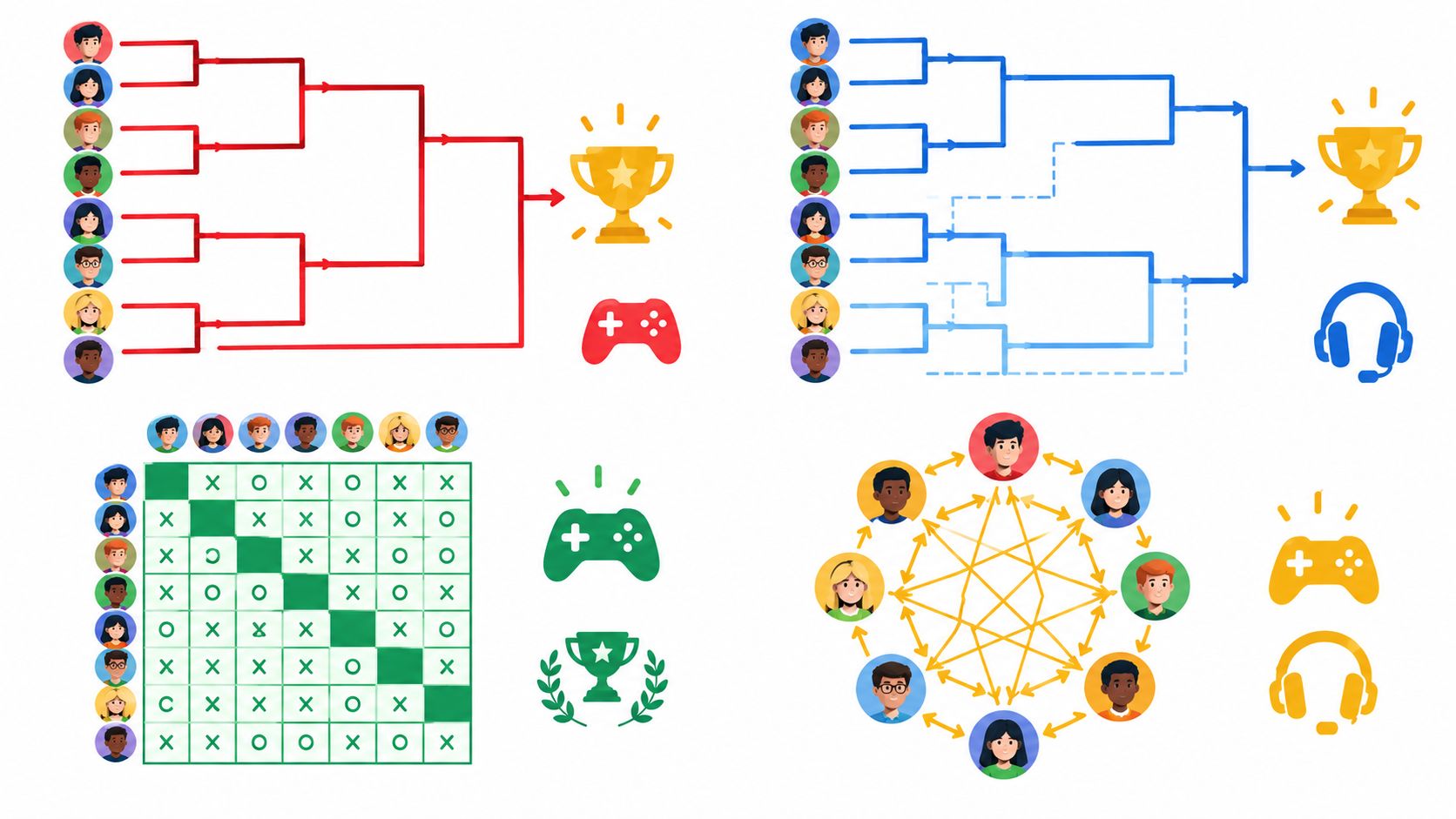
There's no single fairest bracket for every event. For a 16-team field, choose based on whether you value a fast finish, second chances, complete rankings, or meaningful matches without round-robin volume.
You've opened registration, players are asking when matches start, and the schedule already looks tighter than expected. Some competitors want a serious test of skill. Others just want a clean community event that finishes on time. Your bracket decides whether those expectations line up.
A tournament bracket isn't merely a visual map of matchups. It determines who gets eliminated, how often players compete, how much luck affects the result, and how difficult the event is to operate. A strong bracket example should therefore answer more than “Who plays next?” It should answer, “Why is this format right for this field and this schedule?”
Table of Contents
- Choosing the Right Tournament Structure for Your Event
- Understanding the Four Core Bracket Formats
- Evaluating Fairness Versus Tournament Speed
- Visualizing How a 16-Team Field Changes by Format
- Navigating Real-World Challenges Like Byes and Waivers
- Final Checklist for Selecting Your Tournament Bracket
Choosing the Right Tournament Structure for Your Event
Start with the constraints, not the software. Before you drag the first team into a bracket, write down the field size, the available match window, the expected match length, and how important accurate final standings are to your community.
A short Apex or Valorant community event may need a structure that moves quickly. A League of Legends event with teams traveling to play may justify more matches because participants expect the result to reflect sustained performance. Fortnite introduces another consideration, since your competition may use heats, lobbies, or points rather than a simple head-to-head path.
Four questions to answer first
How many participants are ready to play?
Registration totals can change after check-in. Treat confirmed players and teams as the field, not the number of sign-ups.How much time can each participant commit?
A format that looks fair on paper can become frustrating if players wait between matches or remain online far longer than expected.Does one bad result tell you enough?
Single elimination accepts high variance. If a strong team loses early, the bracket doesn't give it another route back.Do you need a winner or a reliable ranking of the whole field?
Those are different goals. A knockout event produces a clear champion quickly. A standings-focused event needs more opportunities for competitors to separate themselves.
Organizer's rule: Choose the format that matches the promise you make to players. If you advertise a quick knockout, don't run a schedule that quietly requires everyone to stay for a long series of matches.
A useful esports tournament app can help with registration, check-in, match reporting, and live standings, but software won't repair a poor format choice. Decide the competition logic first, then configure the tool around it.
The simplest decision is often the most useful. Pick single elimination when speed and spectacle matter most. Pick double elimination when an early mistake shouldn't end a competitor's day. Pick round robin when the field is small and complete comparison matters. Pick Swiss when you want participants to keep playing while facing opponents with similar records.
Understanding the Four Core Bracket Formats
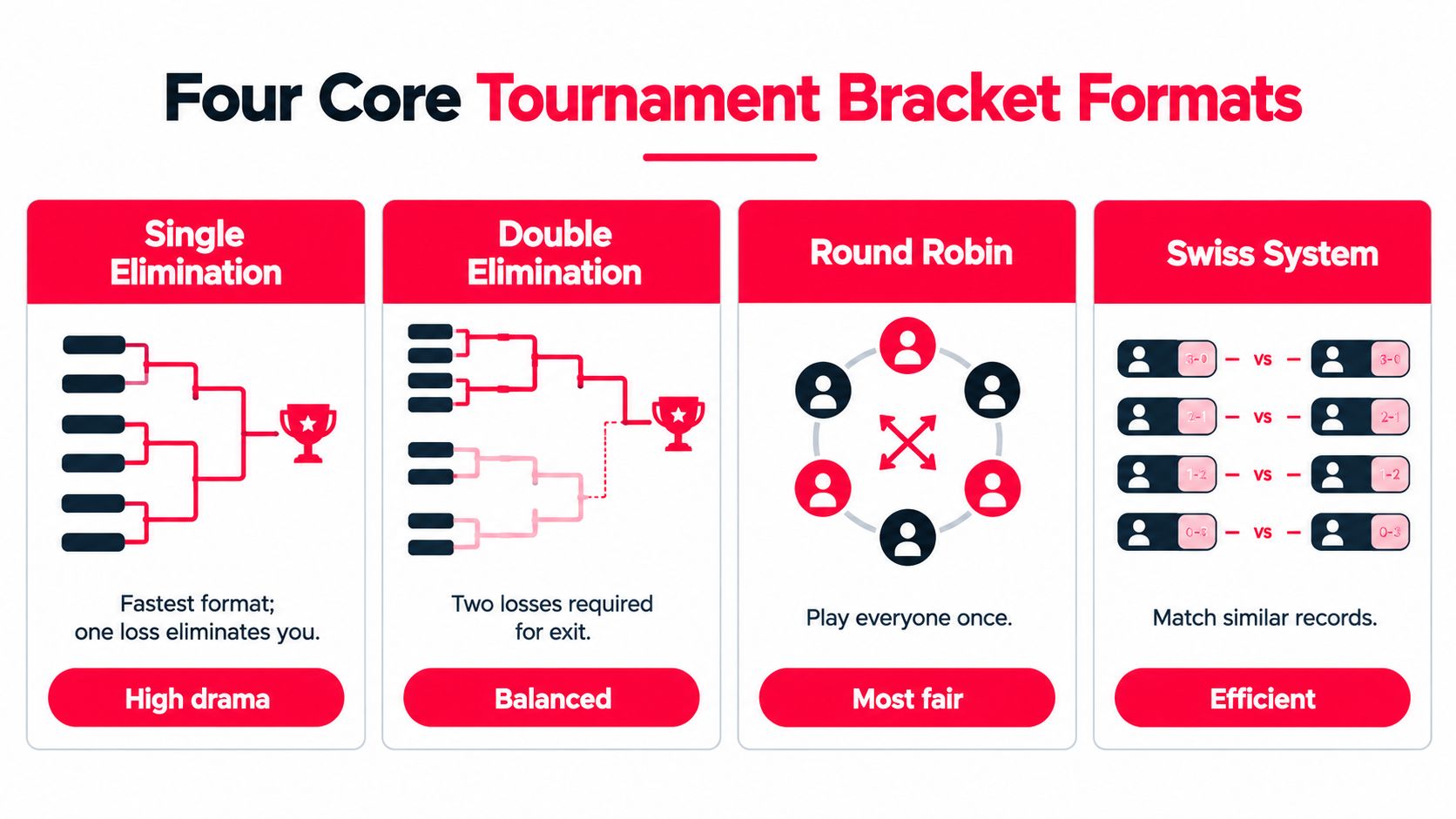
A Valorant team that loses its opening match faces a very different event from a Pokémon competitor who can recover through several rounds. The bracket format sets that difference before the first match begins. Single elimination favors speed, double elimination provides recovery, round robin maximizes direct comparison, and Swiss balances useful standings with a manageable schedule.
Single and double elimination
Single elimination is the clearest structure for players and spectators. A loss ends the run, while each winner moves along a visible path to the final. That makes the format easy to stream, staff, and explain. It also creates high variance. A disconnect, poor matchup, or unlucky opening can remove a capable team before it has shown its full level.
Double elimination gives each competitor a second life. After a first loss, a player or team enters the losers' bracket, where another defeat ends the tournament. This suits games such as Super Smash Bros. or fighting game events, where an early mistake does not have to define the entire day. The added route requires precise bracket management, including losers' bracket timing, grand-final rules, and possible resets.
Round robin and Swiss
Round robin schedules every participant against every other participant. It supplies the clearest head-to-head comparison, much like giving each classmate the same set of tests before assigning final places. That makes it a strong choice for a small field with enough schedule capacity. As the field grows, match volume makes the event harder to run and keeps players committed for longer.
Swiss uses a fixed number of rounds and usually pairs competitors with similar records. Participants remain active after an early loss, while later matches provide more relevant comparisons than random pairings. For a larger community, Swiss can produce useful standings without asking everyone to face the entire field.
Research comparing tournament designs found that Swiss generally ranks a full field more accurately than knockout formats, with its advantage increasing as competitors play more matches (tournament design research). That finding does not make Swiss the universal answer. Choose it when ranking quality matters more than a simple winner-takes-all story. Choose single elimination for a short, dramatic event, double elimination when recovery matters, and round robin when complete comparison is practical.
Organizers can review how to set up tournament brackets for practical construction guidance. A separate explanation of how tournament brackets work can help first-time participants understand advancement, losses, and standings before registration opens.
Evaluating Fairness Versus Tournament Speed
A single poor drop can end an Apex player's event. A close opening map can eliminate a Valorant team, and one misread League draft can send a strong squad home. The result is clear, fast, and easy to follow, but one match may not reveal the strongest competitor. That is the central format choice: do you need a decisive winner quickly, or a ranking built from repeated performances?
Fairness depends on the promise you make to participants. Some expect a second chance after an unlucky loss. Others want to face every opponent. Organizers may value a schedule that finishes on time and rules that spectators can understand. A bracket can satisfy one definition of fairness while falling short on another.
Single elimination prioritizes speed and tension. Each match has immediate consequences, the field shrinks quickly, and the route to the final is obvious. Its weakness is variance. A poor performance has the same effect as a repeated pattern of losses, even when the two results say different things about skill.
Round robin provides the fullest direct comparison because every participant meets every other participant. That produces more information for standings, though players must remain available for a longer schedule and administrators must record many more results. If the event runs beyond the community's attention span, the extra fairness can reduce participation and momentum.
Swiss occupies the middle ground. Competitors play a fixed number of rounds, and pairings generally bring players with similar records together. This creates useful comparisons without requiring the complete schedule of round robin. As discussed earlier, the comparative research found that Swiss tends to rank the field more accurately than knockout formats when competitors play more matches (the comparative tournament study).

Match the format to the promise
Use the event's main promise as the deciding test:
- Speed first: Choose single elimination for a short community event with a clear winner.
- Recovery matters: Choose double elimination when a meaningful second chance matters.
- Complete comparison matters: Choose round robin for a small field with enough available match time.
- Standings matter at scale: Choose Swiss when participants need repeated games and similar-record pairings without facing everyone.
Call a format fair only after defining fairness. Consistent rules may make a fast bracket fair for a one-day event. Swiss or round robin may give a more reliable measure of skill across repeated play.
Visualizing How a 16-Team Field Changes by Format
A 16-team field is useful for comparing structures because it can be arranged cleanly for a standard knockout bracket. The same entrants can experience very different events depending on the format you select.
In single elimination, the field contracts round by round until one team remains. The bracket is compact, easy to publish, and simple for spectators to understand. The winner must keep advancing, while an early loser leaves the event after one result.
In double elimination, the initial path splits after a loss. Teams in the winners' bracket protect their undefeated route, while teams in the losers' bracket fight to remain alive. This creates more complicated scheduling because an organizer must coordinate two active paths and explain whether the grand final includes a reset under the event rules.
Swiss doesn't look like a traditional branching tree. Instead, you publish pairings for each round, record the results, and create the next set of matchups from current records. Teams with similar results generally meet, so the competition becomes more informative as the event progresses without forcing every team into a complete round-robin schedule.
Round robin is the least bracket-shaped option. Every team receives a matchup against every other team, and the standings come from the complete result set. That makes it a strong choice for a small group, but a demanding one for a full field.
Match volume and time requirements by format
| Format | Total Matches | Max Rounds | Guaranteed Matches per Team |
|---|---|---|---|
| Single elimination | Depends on the final field and any byes | Depends on the bracket path | One match unless the team advances |
| Double elimination | Depends on losses, bracket rules, and any final reset | Depends on winners' and losers' paths | More than single elimination when the team loses and continues |
| Round robin | Every participant faces every other participant | Depends on how pairings are scheduled | Every participant faces the full field |
| Swiss | Depends on the fixed round plan | The organizer sets the round count | The organizer guarantees the published rounds |
The table exposes an important planning mistake. Organizers often compare formats by appearance instead of by participant commitment. A single-elimination diagram looks clean because it hides the matches that never happen. A Swiss schedule looks less familiar, but it can provide a more consistent play experience for teams that would otherwise be removed immediately.
Before publishing a 16-team bracket example, write down the expected route, the rules for ties, the match format, and the minimum participation each team receives. Players can accept a short event or a demanding event. They get frustrated when the rules reveal the actual workload only after registration.
Navigating Real-World Challenges Like Byes and Waivers
The perfect bracket rarely survives contact with check-in. A team withdraws, a player misses the start time, a substitute changes the roster, or a console and PC setup creates a platform problem. Your bracket needs rules for those situations before they happen.
An uneven field doesn't mean you should force participants into an arbitrary structure. Round robin can accommodate flexible participation more naturally, while knockout formats commonly use byes to reach a workable opening layout. The important part is deciding who receives a bye and publishing that rule before players see the draw.
Write the uncomfortable rules early
Use a short competition policy that answers practical questions:
- Check-in deadline: State when players must confirm that they're ready. Don't leave active slots open indefinitely.
- Late withdrawal: Define whether a replacement can enter, whether the next opponent advances, or whether the event redraws.
- Bye allocation: Use a visible rule based on seeding, random draw, or another announced method. Never award a favorable path privately.
- No-show forfeits: Set a reporting process and a reasonable response window so one missing team doesn't freeze the schedule.
- Rematches: Explain what happens after a server issue, disconnect, or disputed result. Require evidence and name the decision-maker.
- Duplicate matchups: In Swiss, document how the system handles a pairing that already occurred.
- Tie-breakers: Publish the order before the first round. Participants shouldn't learn the deciding rule after standings are locked.
Seeding deserves special care. Research indicates that seeding can improve knockout and group formats, but its effect is limited when organizers can't estimate true player skill accurately (research on seeding and tournament formats). Verified ranks, recent performance, and transparent tie-break rules are more defensible than placing a friend or familiar username at the top.
Team games add another layer
An individual bracket can replace one participant. A team bracket may need to account for roster locks, substitutes, captain responsibility, voice communication, and platform compatibility. A Valorant team that loses its only available substitute isn't facing the same administrative problem as an individual Fortnite player who disconnects.
Ask captains to confirm the active roster before the first match. Record the in-game names, platforms, contact method, and required communication setup. If cross-platform play is allowed, verify that every matchup can launch before assigning a default loss.
The fairest bracket is not the one with the prettiest diagram. It's the one whose edge cases are visible, consistent, and enforceable.
Final Checklist for Selecting Your Tournament Bracket
Make the final decision by matching the event's purpose to its limits. Don't start with a favorite format because it worked for another game. Start with what participants need to experience and what your staff can reliably administer.
Use this decision path
Choose single elimination when the event has a short operating window, the audience enjoys immediate stakes, and the main objective is to crown a winner efficiently. Use clear seeding and explain that one loss ends a run.
Choose double elimination when players need a second chance and you can manage two active bracket paths. Publish the losers' bracket flow, match order, and grand-final rule before registration closes.
Choose round robin when the group is small enough for every participant to face every other participant and you have enough schedule flexibility to record the full standings. This is a strong option for a league-style community where participation matters as much as the final match.
Choose Swiss when the field is larger, participants should keep playing, and you want standings that reflect repeated results without the full burden of round robin. Set the number of rounds, pairing rules, tie-breakers, and handling for repeat opponents before the first pairing.
Run the pre-launch check
- Field: How many players or teams are confirmed after check-in?
- Time: Can every scheduled match fit the available window?
- Fairness: Does the format fit your definition of a fair result?
- Participation: What does a team receive after its first loss?
- Rules: Are byes, withdrawals, no-shows, rematches, and tie-breakers documented?
- Seeding: Can you justify placements with verified information?
- Game fit: Does the structure suit Apex, Valorant, Fortnite, or League of Legends?
- Communication: Can players see pairings, report results, and find the next opponent?
- Staffing: Who resolves disputes and updates the standings?
A clean preparation routine for competitors also helps. Encourage captains to confirm availability, check their setup, and review the rules with this tournament-ready preparation guide.
Your final bracket should make three things obvious: who plays, what happens after a win or loss, and how the event decides its standings. If players can answer those questions before the first match, you've already removed much of the confusion that ruins community tournaments.
GamerPlug lets organizers create brackets for Apex Legends, Valorant, Fortnite, and League of Legends using single elimination, double elimination, Swiss, or round robin formats, with registration, check-in, results, and live leaderboards tracked in the app. Visit Gamerplug to set up an event structure that fits your field, schedule, and competitive goals.