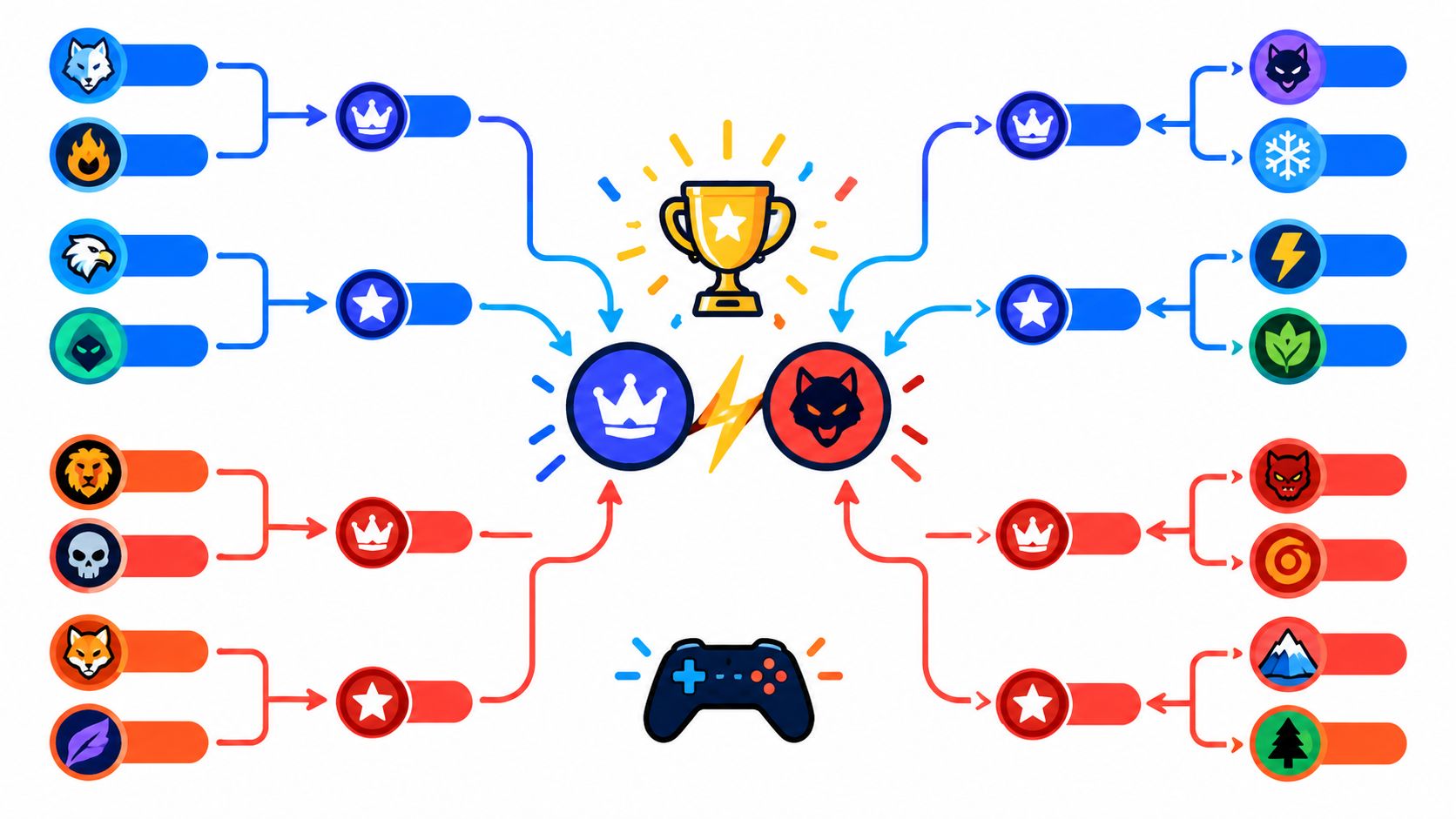
An 8-team double elimination bracket produces 14 or 15 total matches, depending on the grand final rule, while single elimination needs only 7. A double elimination bracket is a tournament format where teams must lose twice before they're eliminated, giving a squad that drops one match a real route back to the title.
You know the moment. Your squad finally reaches bracket play, scrapes through an opening series, then loses one ugly game because a headset cuts out, a hot drop goes sideways, or the other team reads the final zone better. In a single elimination event, that one result ends the run. In double elimination, it sends you to the lower bracket, where every next match becomes a do-or-die comeback.
That difference affects more than the graphic on a tournament page. It changes how many matches teams play, how organizers schedule the day, how casters build a story, and how believable the final standings feel. It also creates the kind of shared tournament memories that communities keep talking about later, much like the way it pools shared memories can preserve moments beyond the event itself.
Table of Contents
- Why the Bracket Format You Pick Actually Matters
- How Winners and Losers Brackets Actually Work
- Grand Finals and the Bracket Reset Rule
- Double Elimination vs Single Elimination, Swiss, and Round Robin
- Scheduling, Match Load, and What Hosts Are Really Signing Up For
- How Popular Esports Use Double Elimination in Practice
- Common Misconceptions About Double Elimination
- Quick Checklist for Hosting Your First Double Elimination Bracket
Why the Bracket Format You Pick Actually Matters
A bracket format decides whether one bad map is a footnote or the end of your event. Your Valorant team might lose a pistol-heavy opener, your Fortnite duo might get caught rotating, or your Apex squad might miss one late-game fight. Single elimination treats that result as final. Double elimination treats it as a setback.
That second life changes player behavior. The winners bracket rewards teams that stay composed and keep stacking wins. The losers bracket gives a strong team room to adjust its landing spot, swap a strategy, or recover from a rough first match. The pressure doesn't disappear, though. Once a team drops down, another loss removes it from the tournament.
The promise behind the format
The plain-English promise is simple: one loss won't end your tournament. That feels fairer for community events where teams may have practiced for days, traveled to a venue, or waited through a long registration queue for a short competitive window.
It also changes the emotional weight of second place. A team that survives the lower bracket has fought through elimination matches and arrives at the final with a different path from the undefeated finalist. The format recognizes both achievements instead of pretending every finalist took the same route.
Practical rule: Choose double elimination when you want players to have a recovery path, but still want every match after the first loss to matter immediately.
The tradeoff is time. More chances mean more matches, more admin work, and more decisions about when teams can take a break. The rest of the bracket mechanics exist to manage that tradeoff without losing the tension that makes tournament play fun.
How Winners and Losers Brackets Actually Work
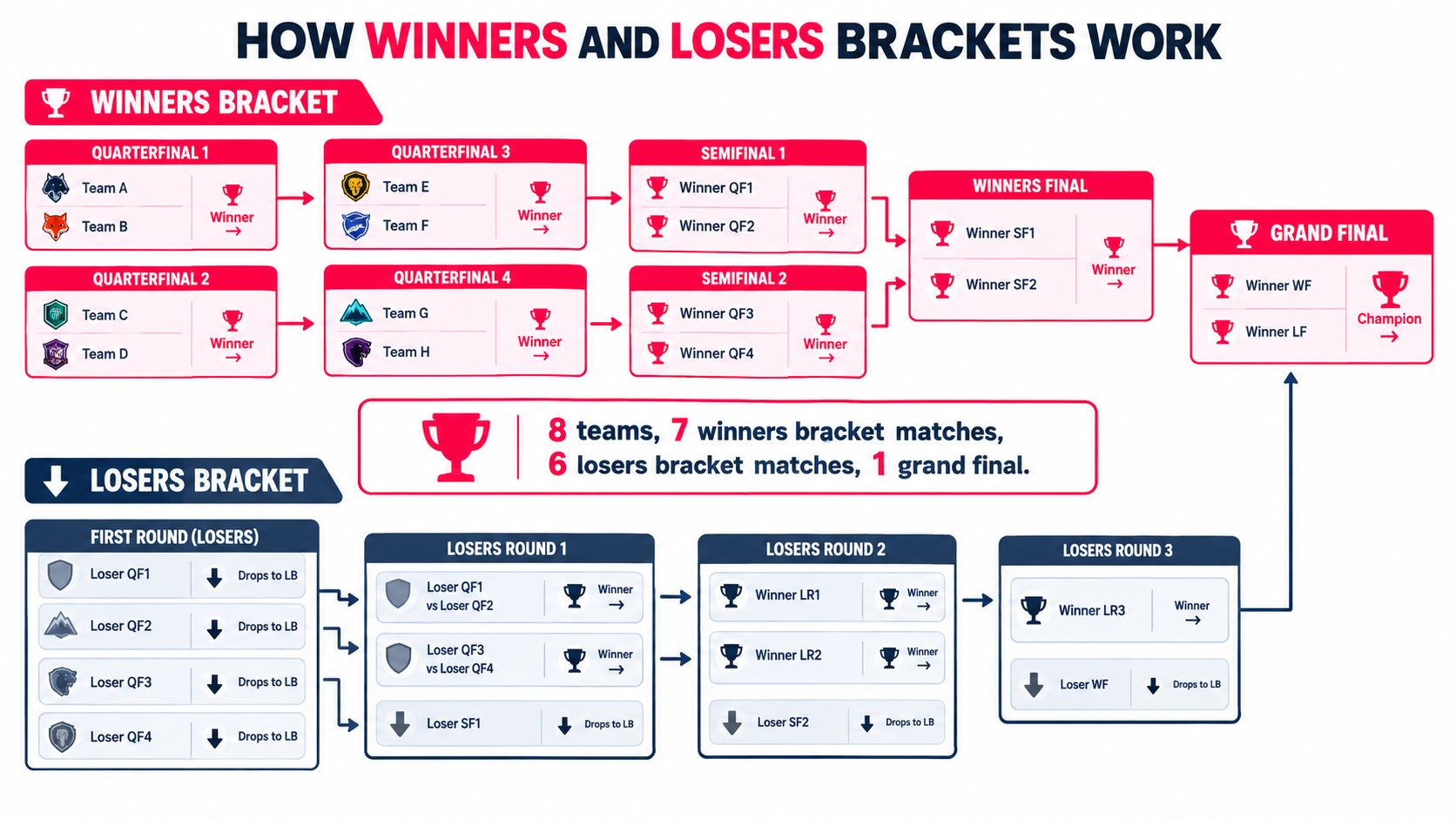
Start with eight teams. Every team enters the winners bracket, which is the main path through the event. Win there and you advance. Lose there and you drop into the losers bracket, where your next loss eliminates you.
The winners side looks familiar. Four opening matches produce four winners, those winners meet in two semifinal matches, and the remaining teams meet in a winners final. The team that keeps winning reaches the grand final without a loss.
The losers side is the redemption lane. Teams that lose in the winners bracket enter at different points, then face teams that survived earlier lower-bracket matches. This timing matters because a team can't be placed into its next match until the relevant winners-bracket result is known.
A simple match flow
Think of the sequence like this:
- WB Round 1: Eight teams play four matches. Winners stay on top, losers fall down.
- WB Semifinals: Four winners play two matches. The winners continue, while the losers enter the next available lower-bracket slot.
- LB rounds: Teams with one loss play elimination matches against other lower-bracket survivors or newly dropped winners-bracket teams.
- WB Final: The last undefeated path produces the winners-bracket finalist.
- LB Final: One team survives the lower bracket and earns the other grand-final spot.
For the standard eight-team structure, the winners bracket contains 7 matches, while the losers bracket contains 6 matches before the grand final, as shown in the GamerPlug guide to how tournament brackets work.
| Round | Bracket | Teams In | Teams Out |
|---|---|---|---|
| Round 1 | Winners | 8 | 4 |
| Semifinals | Winners | 4 | 2 |
| Early lower rounds | Losers | 4 | 2 |
| Winners final | Winners | 2 | 1 |
| Later lower rounds | Losers | 4 | 3 |
| Losers final | Losers | 2 | 1 |
| Grand final | Final | 2 | 1 |
The key idea is easier than the terminology: win and stay on the top side, lose once and move to the bottom side, lose again and go home.
Grand Finals and the Bracket Reset Rule
The grand final is where many first-time viewers get confused. One finalist arrives from the winners bracket without a loss. The other arrives from the losers bracket with one loss already recorded. That difference creates the one-loss advantage.
Under a standard reset rule, the undefeated finalist only needs to win the grand final once. If the lower-bracket finalist wins that match, both teams now have one loss. The bracket then resets, and they play one more match for the championship.
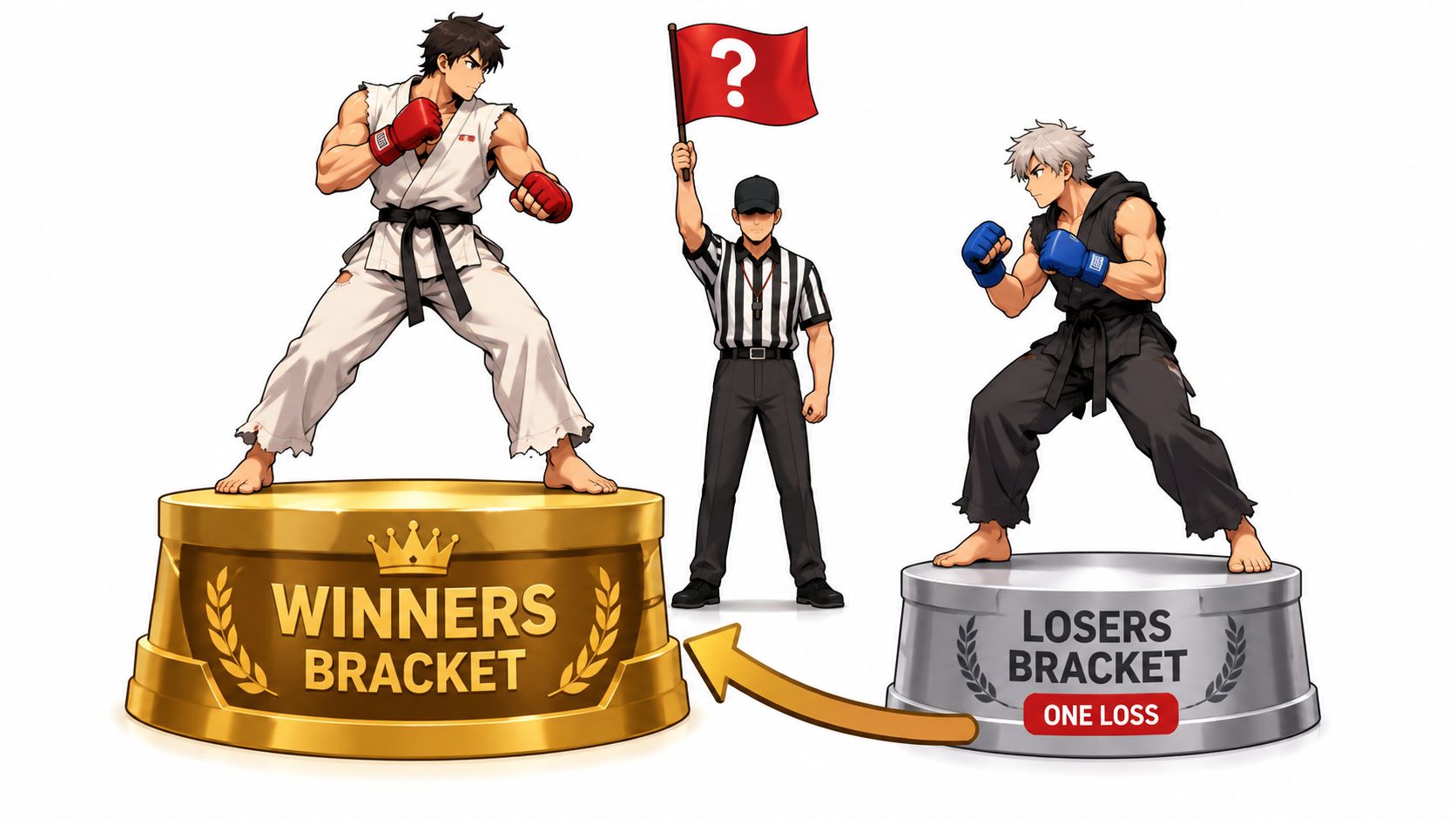
That reset isn't a bonus rematch. It's the rule that preserves the format's central logic. If the winners-bracket finalist lost once and immediately became champion's opponent without another chance, the undefeated team would effectively be eliminated after its first loss. The reset gives both finalists the same two-loss boundary.
Two final formats organizers use
Standard reset: The lower-bracket team must win once to tie the loss count, then win again to take the title. This creates the most faithful version of double elimination, but it can extend the broadcast and venue schedule.
No reset: The grand final is treated as the only deciding match. Whoever wins that match is champion, even if the winners-bracket finalist loses for the first time. Some smaller events choose this version when the schedule can't absorb another series.
Publish the rule before registration closes. A team that expects a reset will prepare differently from one that knows the final is winner-takes-all. Put the decision in the rules document, bracket description, and check-in message so nobody learns it after the last map.
For a visual explanation of how the final can play out, this double elimination bracket walkthrough can help players see why the second match only happens after the lower-bracket finalist wins the first one.
Double Elimination vs Single Elimination, Swiss, and Round Robin
No format is automatically right. The choice depends on whether you value speed, recovery chances, consistent match volume, or complete scheduling symmetry.
Single elimination is the cleanest option. Lose once and you're out, so the bracket moves quickly and produces a strong knockout-event atmosphere. It's a good fit for a large open event, a short stream window, or a tournament where the main goal is a sharp, high-pressure show.
Double elimination sits between ruthless knockout play and a longer league structure. It protects teams from one early stumble while keeping every lower-bracket match relevant. For a community major, that balance often feels right, especially when players expect more than one opportunity to compete.
Swiss rewards teams that keep producing results across a sequence of rounds. It works well when you want to compare a broad field without immediately sending every early loser home. The bracket is less intuitive for casual viewers because opponents are paired according to results rather than a fixed upper and lower path.
Round robin gives participants a shared schedule against the rest of the field. That makes it useful for small invitationals or league-style play, but it demands substantial coordination and can create long event days.
| Format | Matches for 8 Teams | Runtime Feel | Best Fit |
|---|---|---|---|
| Single elimination | 7 | Fast and sharp | Large, hype-driven events |
| Double elimination | 14 or 15 | Longer with comeback drama | Community majors |
| Swiss | Varies by event rules | Structured and steady | League stages and broad fields |
| Round robin | Varies by schedule | Long and consistent | Small invitationals |
The figures for the two bracket formats come from the verified eight-team comparison, where this tournament bracket example can help organizers compare layouts before publishing rules.
Choose based on your real production capacity. Ask how many matches you can cast, how long teams can stay online or at the venue, and whether you want to allow a bad-day comeback. If your answer favors speed, use single elimination. If players need a safety net, double elimination earns the extra coordination.
Scheduling, Match Load, and What Hosts Are Really Signing Up For
A double elimination bracket can look compact on a screen while creating a much larger workload behind the scenes. For an eight-team field, the format produces 14 or 15 total matches, depending on whether the grand final resets, compared with 7 matches in single elimination for the same field size. That makes the double-elimination schedule roughly twice as demanding before you account for pauses, technical checks, and remakes.
The lower bracket creates dependencies. An admin may need to wait for a winners-bracket match before confirming the next lower-bracket pairing, while a caster needs to decide whether to follow the upper side or a sudden elimination match. Running matches in parallel helps, but only if you have enough referees, voice channels, observers, and result tracking.
Build the day around match blocks
A practical schedule might look like this:
- Opening block: Run the winners-bracket opening matches while admins confirm rosters and server settings.
- Middle block: Alternate winners-bracket progress with lower-bracket matches as teams become available.
- Late block: Protect time for the winners final, losers final, and grand final.
- Contingency block: Reserve room for pauses, disputes, remakes, and a possible reset.
Don't plan a tight four-hour event because the bracket graphic has only a few visible layers. Match length varies by game, and a long Valorant series creates different pressure from a quick fighting-game set or a short Fortnite bracket round.
Host's note: Schedule the reset as a real possibility. If it doesn't happen, you've gained breathing room. If it does happen, you won't have to cut the ceremony or rush the final.
Your staffing plan should include an admin who tracks bracket dependencies, referees who can monitor parallel matches, and a caster setup that doesn't leave the lower bracket invisible. Teams that survive deep into the losers bracket may also need a short reset period before another elimination match, so place breaks where the bracket naturally allows them. This guide for online tournament organizers can help you think through those operational details before sign-ups open.
How Popular Esports Use Double Elimination in Practice
The format makes more sense when you attach it to games players already know. An Apex Legends squad can lose an early open-bracket match, adjust its drop plan, and fight through the lower side instead of watching the rest of the event from the lobby. The comeback path creates a story that a straight knockout bracket can't offer.
Valorant community tournaments often benefit from the same structure. A team may lose an opening series while still learning an opponent's tendencies, then face elimination matches where map preparation and adaptation matter more than a single cold start. The winners bracket remains valuable because teams that stay undefeated avoid the longer recovery route.
Fortnite cups use the format for a similar reason. Players can survive an awkward first result and continue competing, while the later lower-bracket matches become high-pressure tests of consistency. League of Legends community events also gain a useful balance: a roster isn't erased by one draft mistake, but every subsequent loss carries immediate consequences.
What players feel on each side
On the winners side, the objective is control. Teams want to protect an undefeated run and preserve the advantage that comes with reaching the final without a loss.
On the losers side, the objective is adaptation. Teams have less room for experimentation, but they may have clearer information about their own weaknesses and the opponents still standing.
That contrast is why the format works well for grassroots esports. It gives the bracket a competitive backbone without making the entire event depend on one early series. Organizers can publish the bracket, let players follow their route, and keep the story moving as teams rise or fall.

For organizers who want bracket creation, registration, and live tournament tracking in the same gaming community app, GamerPlug includes Double Elimination alongside Single Elimination, Swiss, and Round Robin formats.
Common Misconceptions About Double Elimination
Myth one: every team plays the same number of matches. They don't. A team that wins every winners-bracket match takes a shorter route, while a team that drops early and survives the lower bracket may play through several additional elimination rounds.
That imbalance is intentional. The top side rewards early consistency, and the lower side offers recovery at the cost of more pressure and more matches. A lower-bracket run is a comeback route, not an equal-length alternate route.
Myth two: double elimination always produces the unquestionably correct second-place team. It produces more information than a single loss, but standings still depend on paths and timing. A team can lose once to the eventual champion and finish below a team that suffered multiple losses elsewhere in the lower bracket.
The format improves competitive context without making every ranking perfect. Matchups, game variance, fatigue, and the grand-final rule still shape the result.
Myth three: double elimination is too complicated for small events. The structure takes more explanation, but a clear bracket, written rules, and an admin who records results can make it manageable. Small community playdays can use it when participants value a second chance more than a rapid finish.
The useful reframing: “Complex” often means the event has more recovery paths, not that players can't understand it.
Explain the two-loss rule before the first match, label the winners and losers sides clearly, and tell finalists whether a reset exists. Once players see where their next match goes, the format becomes much easier to follow.
Quick Checklist for Hosting Your First Double Elimination Bracket
Use this as the message you pin in your tournament Discord before registration begins.
- Set tiebreakers early: Decide how you resolve equal records, disputed results, late check-ins, and unfinished matches before creating the bracket.
- Choose the grand-final rule: State whether a lower-bracket win triggers a reset or whether the first grand-final match decides the title.
- Publish the route: Show teams that a winners-bracket loss sends them to the losers bracket, while a second loss eliminates them.
- Protect the schedule: Run available winners and losers matches in parallel, but don't place a team into a match before its previous result is confirmed.
- Assign responsibilities: Give one person bracket control, another result verification, and clear ownership of match lobbies or voice channels.
- Plan for breaks: Teams that survive a long lower-bracket run may need time to reset before another elimination match.
- Prepare the broadcast: Tell casters which matches matter for advancement and keep the lower bracket visible instead of treating it as background noise.
- Confirm standings and prizes: Check final placements and prize splits in your tournament dashboard before day one, then repeat the check after the championship result.
A good rules post should answer the questions players ask in chat: “Do I get another match after a loss?” “Where do I go next?” “Can the final reset?” and “What happens if two teams finish tied?” Clear answers prevent most bracket-day arguments.
Double elimination is more work than single elimination, but it gives community players what they usually want from a serious event: a real chance to recover, a meaningful path to the final, and matches that stay important after one bad result.
GamerPlug lets you create and host gaming tournaments with Double Elimination, Single Elimination, Swiss, and Round Robin brackets, alongside registration and live leaderboard tools. Visit Gamerplug to set up your next bracket and give your players a clear route from opening match to grand final.