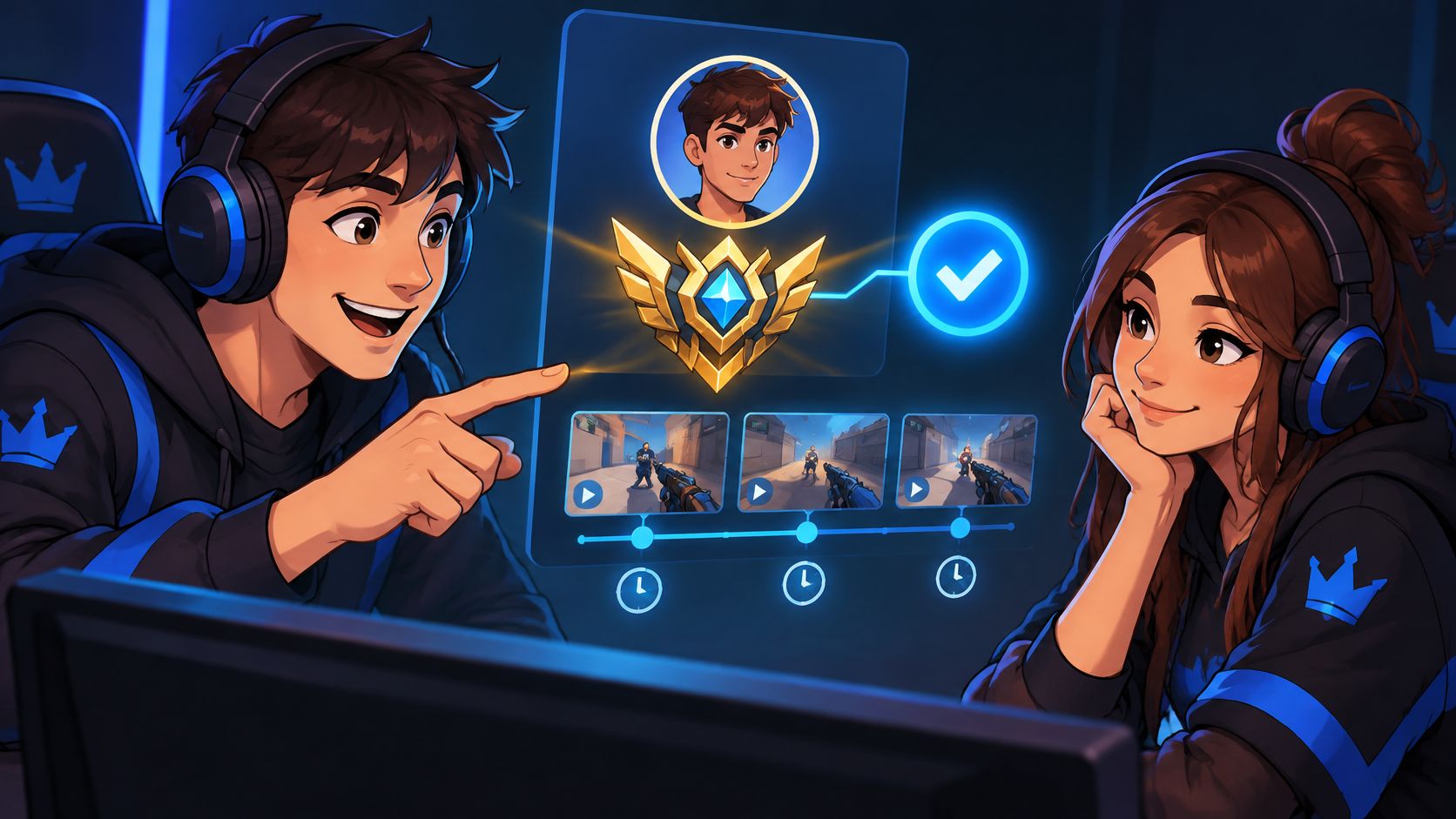
“Only invite verified players” sounds like sensible ranked advice. It isn't enough. A badge can confirm a narrow fact about an account while telling you nothing about whether its owner will hold an angle, respect a support pick, or stay calm after a failed push. Good verification of ratings starts with evidence, then leaves room for a separate decision about teammate fit.
Table of Contents
- Why a High Rank Still Needs a Check
- Rating Signals and What Each One Proves
- Validity and Reliability of a Rank
- How to Verify a Rank Before You Queue
- When a Verified Badge Still Misleads
- Reading Real Profiles Before You Invite
- Choose Teammates With Proof and Fit
Why a High Rank Still Needs a Check
Someone joins your lobby as Diamond, loses the opening fight, and immediately gets accused of buying the account. The support blames matchmaking. The new teammate blames the call. Before the next engagement, your squad is arguing about a number instead of playing.
That opening loss doesn't prove the rank was fake. A legitimate player can miss shots, misunderstand a call, or struggle on an unfamiliar role. The problem started earlier, when everyone treated the displayed tier as proof of everything they wanted from a teammate.
Verification of ratings means connecting a displayed rank or skill claim to an independent source, a time, and a specific claim. A username and a polished badge aren't enough.
Start with the claim, not the accusation
In ranked FPS and MOBA play, a poor check can cost the session and leave the party tilted. It can also hide different problems behind the same number: an old rank, a shared account, or progression that doesn't reflect the person currently playing.
Ask:
- What was verified? The account, its owner, its competitive tier, or something else?
- When was it verified? Before the latest matches, or before a reset?
- Which claim does it cover? Current tier in this mode, not general excellence across every role.
Lobby rule: A verified rank is a narrow competitive fact, not a character reference.
Keep communication, schedule, role comfort, and temperament outside that conclusion. You can respect someone's rank and still decide they're wrong for your party.
Before sending an invite, use the signal table as a quick scouting tool. Find the claim you need confirmed, then check whether the available evidence answers it.
Rating Signals and What Each One Proves
| Signal | Confirms | Does not prove | Useful freshness |
|---|---|---|---|
| Self-typed rank | The player's own claim | Current skill or account ownership | Treat as unverified |
| Linked game ID | The player can point to an account | That the displayed rank is current | Recheck before the session |
| Official API rank sync | The publisher's rank for that ID | Role skill, comms, or no boosting | Refresh before inviting and check the timestamp |
| Recent match history | Mode, role, and recent results | Consistent teamwork | Latest completed matches in the intended mode |
| Gameplay clip | How someone moves and decides on screen | That the clip is their account | A recent session with identifiable account context |
| Identity badge | A person passed the stated identity check | Competitive ability | Check that verification remains active |
| Peer endorsement | Someone else's opinion | Independent skill | Recent, specific, and not reciprocal |
| Win rate alone | Outcomes over a sample | Current rank or personal impact | Same patch and role |
Use this comparison before sending an invite. The important question isn't which profile has the most signals. It's which signal supports the claim you care about.
Move from claims toward independent evidence
A self-typed rank is a starting point for a conversation. A linked game ID makes the claim inspectable, but merely pointing to an account doesn't establish control of it. Look for an authenticated connection or an in-game check that connects the player to that ID.
An official API sync provides a stronger reference for rank because it reports the publisher's record for the linked account. It still doesn't tell you who made every decision during the climb, whether the player can fill your open role, or how they respond to a bad round.
Match history adds context. Look at the relevant mode, the roles played, and whether recent results support the profile's description. A win rate without that context can distract you from the actual question: can this player contribute in the slot you're filling?
Use identity and social signals carefully
Clips let you inspect movement, positioning, and decision-making instead of accepting a bio's description. But a highlight can be old, selectively edited, or disconnected from the linked account. Read it alongside identifiable gameplay context rather than treating clean mechanics as ownership proof.
Identity checks answer a different question. For a broader explanation of checking whether online profiles belong to the people presenting them, Digital Footprint Check's user search guide for daters offers a separate, non-gaming context. Don't turn identity checking into intrusive teammate screening, and never request passwords or private documents.
Peer praise belongs near the bottom of your evidence stack. A specific account of helpful shotcalling is useful context, but friendly endorsements aren't an independent competitive record.
A 2024 statistical study of Airbnb ratings identified reciprocal reviewing among indicators associated with potentially organized reviews, without proving individual reviews fraudulent. For lobby scouting, the practical caution is to avoid treating friends praising each other as independent confirmation.
Accept a claim only when a signal supports it. Leave mic preference and availability for the separate conversation about fit.
Validity and Reliability of a Rank
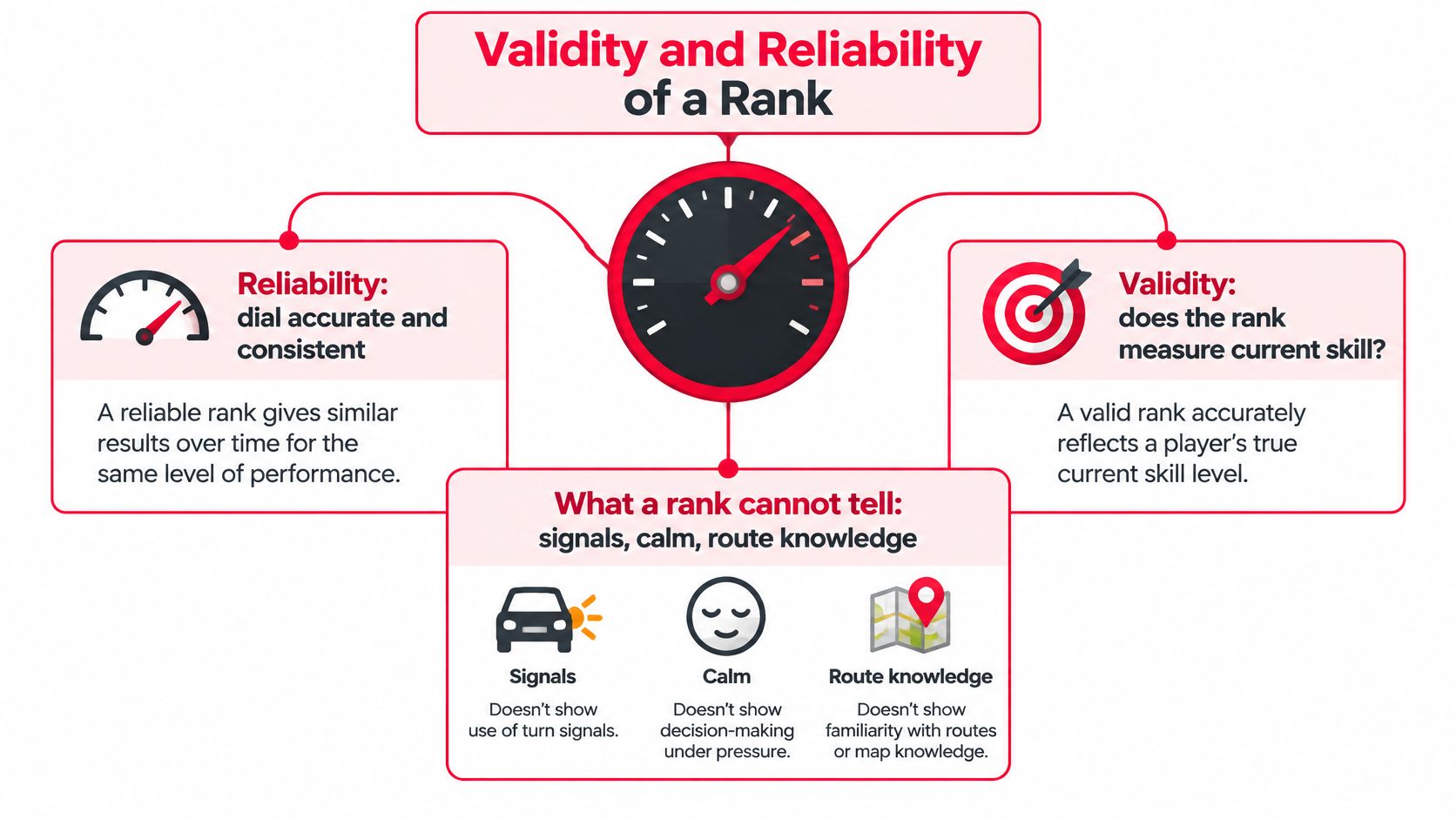
A speedometer can accurately show your speed without telling you whether you signal, keep your temper, or know the route. A competitive rank has a similar boundary. It can be a useful measurement without being a complete description of the player.
Validity asks whether the rating measures what you intend to assess. If you're recruiting for ranked support, an old tier earned in another mode isn't a strong answer to your current question.
Reliability asks whether comparable checks produce consistent results. Consistency isn't the same as correctness: a profile can repeatedly display the same outdated number.
Choose the right reference
Compare a displayed tier against an official game API or authenticated match record, not another field the player typed. The International Labour Organization's guidance on rating scales describes validation approaches including independent expert review, comparison with another valid rating system, and correlation with controlled outcomes.
In a lobby, related evidence should point in a compatible direction. The official tier, recent placements, and performance in the needed role should make sense together. A microphone preference or convenient schedule may improve compatibility, but neither validates competitive skill.
A 2024 study in the Journal of Electronic Gaming and Esports examined 292 players and found that a general mechanical-skill measure explained up to 21% of the variance in in-game ranks. That doesn't measure teammate quality, but it does caution against treating mechanics and rank as interchangeable.
Check consistency without hiding disagreement
For people building rating systems, agreement needs more care than reporting that most labels matched. Rating-scale measurement guidance recommends Cohen's kappa for categorical ratings and the intraclass correlation coefficient, or ICC, for continuous scores or appropriate multi-rater comparisons.
Kappa helps distinguish agreement beyond chance when comparing categorical labels. ICC evaluates agreement or consistency in numerical ratings, with the chosen form matched to the measurement design. Neither statistic repairs an unsuitable reference source.
Run those checks separately for each game. A reliable Apex connection doesn't validate a Valorant tier or a League rank.
An undated rating isn't ready to settle a disagreement about tonight's lobby.
Stale ratings can hurt in both directions. You might reject someone who has improved or accept someone whose current performance no longer supports the old display. If sources disagree, resolve the account, mode, and update time before treating the rating as verified for your session.
How to Verify a Rank Before You Queue
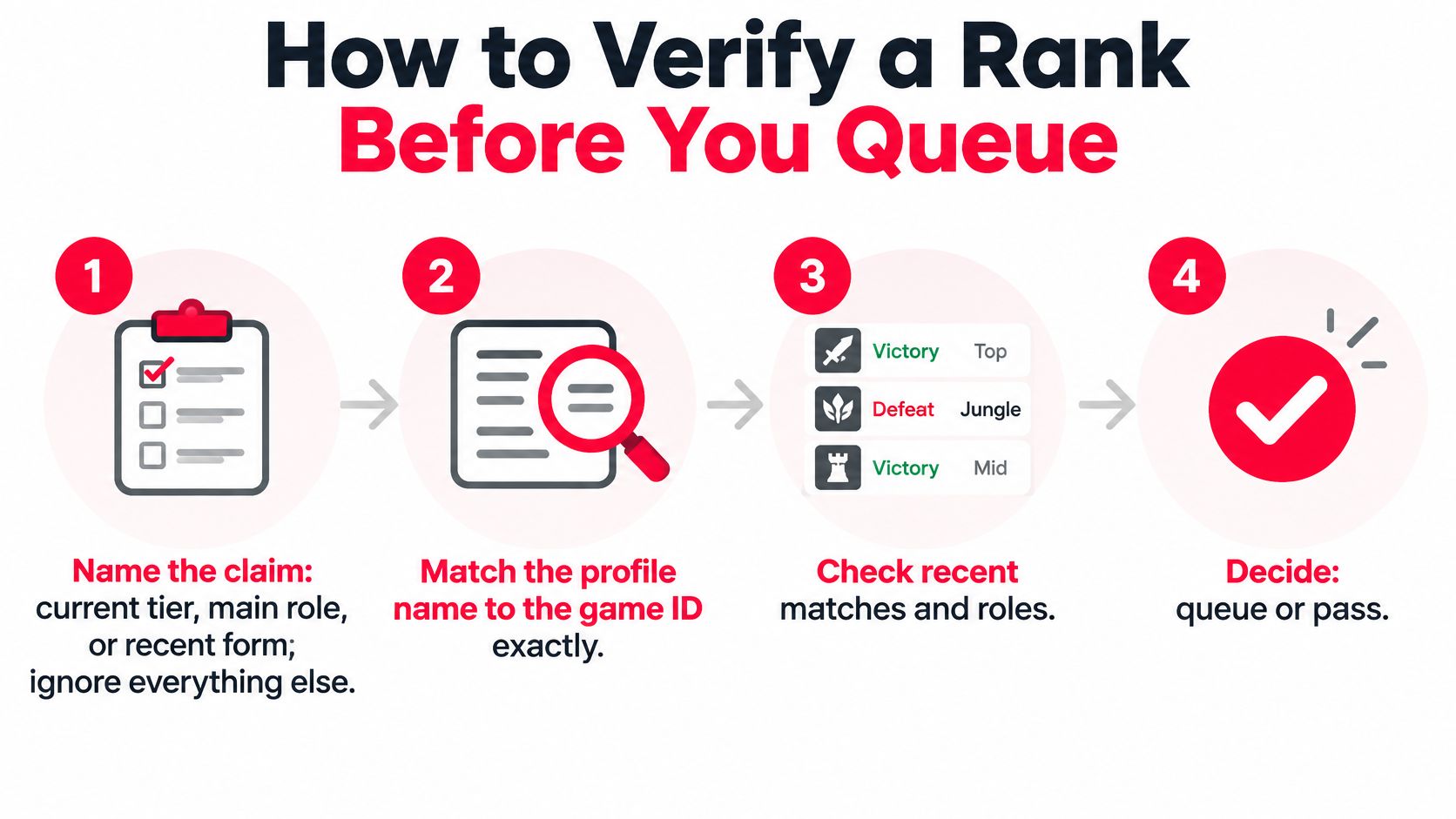
Run the check in a fixed order so an impressive clip doesn't distract you from a mismatched account. You don't need a detective board. You need a clear claim and a traceable record.
Establish the account and the current record
Name the claim you need. Write it mentally as a sentence: current ranked tier in this mode, recent support experience, or readiness for an aggressive entry role. Don't bundle those into a vague demand for a good player. Use clear rank requirements to distinguish an eligibility gate from a preference.
Match the profile to the official game ID. Check the Riot ID, Epic account name, or platform gamertag, including identifying details where the game uses them. Display names can differ legitimately, but the connection needs an explanation you can verify. If the account relationship remains unresolved, stop the rank-qualified invite.
Compare the badge with a live reference. Open the authenticated record or inspect the in-game profile. Check the relevant mode and season or act. If a screenshot and the live record disagree, don't choose whichever number looks better; pause until you know what each represents.
Find the refresh time. A current-looking interface isn't evidence of a current check. Look for the last successful update, and distinguish it from the time someone last opened the app. If you can't establish freshness, mark the displayed rank as potentially stale and verify it in-game before proceeding.
Inspect performance without inventing certainty
Scan recent matches in the intended mode. Look for role use, continuity, and results that match the claim. A sudden tier change without visible supporting matches deserves a question, not an instant cheating accusation. Private history or missing records can leave uncertainty without proving wrongdoing.
Watch a short gameplay clip. Pay attention to cover use, target selection, utility timing, and decisions after contact. A highlight kill is less informative for your needs than the sequence showing why the player took that fight.
Record fit separately. Ask about microphone use, the planned session window, and willingness to coordinate. Keep those answers outside the rank verdict so a failed schedule match doesn't become an accusation about skill.
Preserve uncertainty when signals disagree. If the official tier is confirmed but the role evidence is thin, record exactly that. Don't promote unknown communication or attitude into a positive rating just because the account check passed.
Pass rule: For a rank-gated invite, the account match, authoritative source, and freshness check must support the claim you named. If the claim concerns role ability, add relevant gameplay evidence before calling that claim confirmed.
When a Verified Badge Still Misleads
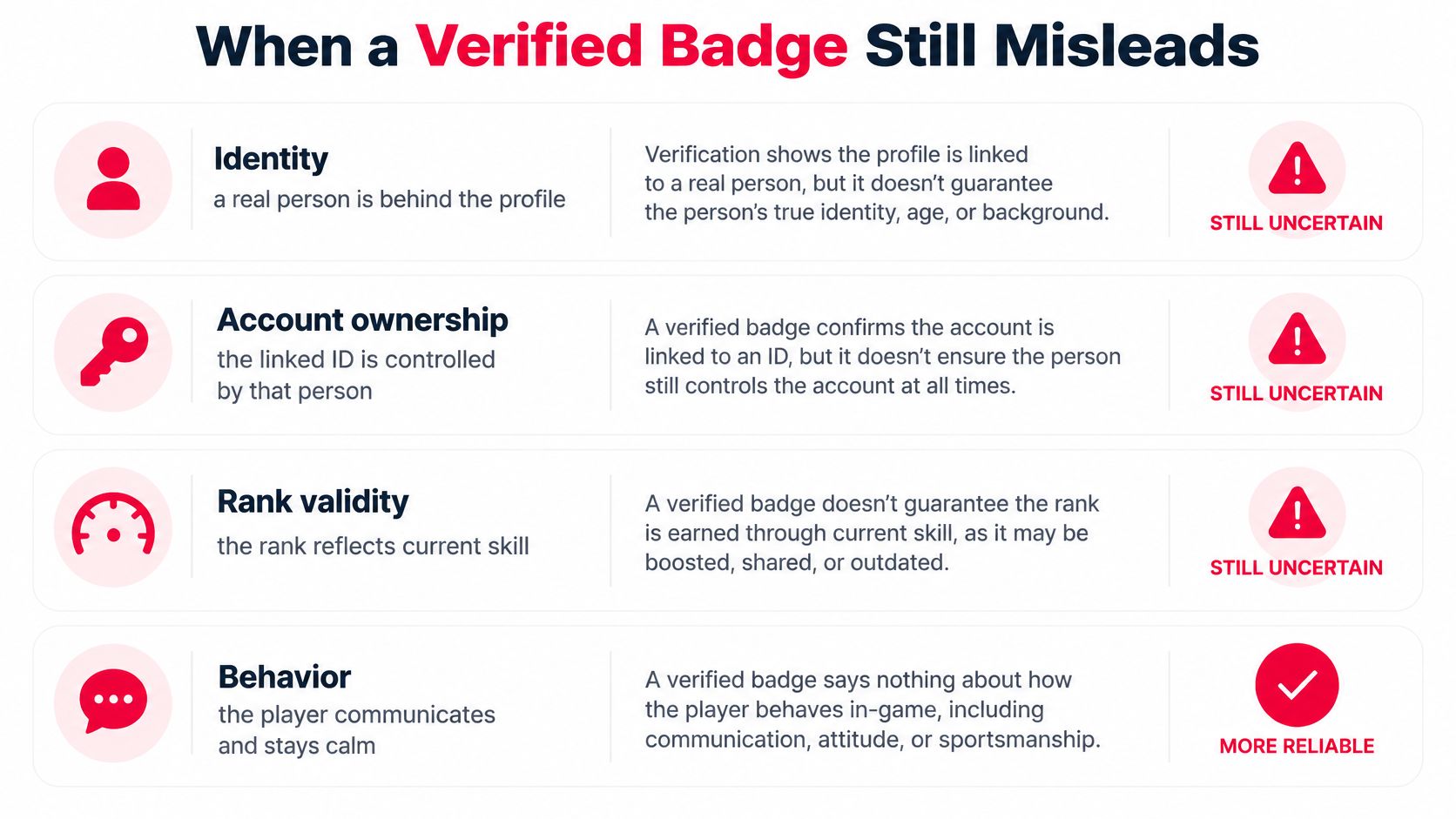
A checkmark can look broader than the check behind it. That's the central trap: readers may see a trusted person, a legitimate account, a current rank, and a cooperative teammate where the system verified only a single layer.
The Euroconsumers discussion of online reviews reports that 61% of consumers trust verified reviews as originating from purchasers. That finding concerns purchase reviews, not gaming profiles, but it illustrates why the meaning of verified needs to be explicit.
Separate the layers behind the checkmark
- Identity: A person passed an identity process. That doesn't establish competitive ability.
- Account control: The person demonstrated access to the linked account. That doesn't prove exclusive control throughout its history.
- Gameplay records: The displayed stats match the relevant source. That doesn't establish who earned every result.
- Behavior: The player communicates and cooperates in actual sessions. This requires its own evidence.
Boosted, shared, or compromised accounts can complicate the connection between a person and a competitive record. A smurf account raises a different question again: whether the displayed standing represents the experience of the person playing.
We monitor every profile to keep GamerPlug real and legit. That process doesn't turn a narrow verification result into a guarantee about every future interaction.
A useful label reads like an evidence statement: rank checked against the official source, with the mode and refresh time shown. A permanent checkmark without that context asks the reader to guess.
Avoid false confidence and unfair exclusion
Say a party leader selects the strongest-looking badges but never checks who will play support. The squad can meet its rank target and still enter the match with conflicting expectations. The badges didn't fail to pick a role-balanced team; the leader asked them to answer a question they never measured.
The reverse mistake is rejecting every unverified player. Someone may prefer not to link an account or may lack a supported connection.
Offer a bounded alternative:
- Live profile check: Confirm the claimed tier inside the game.
- Recent gameplay: Ask for account-identifiable footage relevant to the open role.
- Trial session: Agree on the role and expectations before playing together.
A trial match isn't formal rank verification, but it can answer practical compatibility questions. Verification should be a safety input, not an automatic decision to queue.
Reading Real Profiles Before You Invite
Consider these illustrative scouting situations. In each one, the decision changes when you name the exact claim instead of asking whether the whole profile looks convincing.
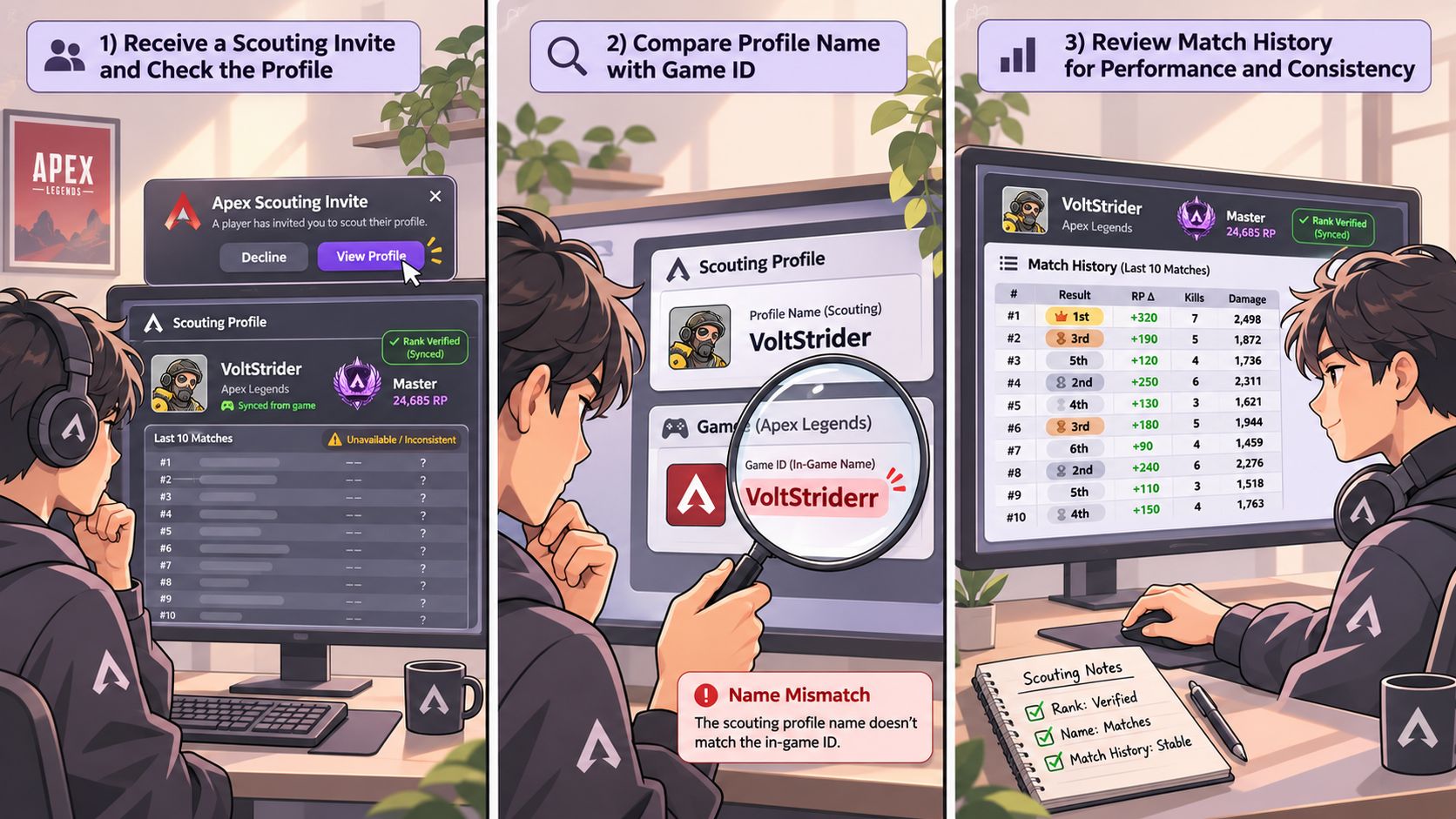
The Apex invite with the wrong approach
Say an Apex player's synced tier meets your lobby requirement. Their recent history shows another legend, while the available footage shows a cautious loot route and repeated disengagement. You're filling an aggressive space-taking role.
DBellGuns says ranks come straight from Apex, so no one can fake their way into a lobby. Treat that testimonial as confidence in the rank source, not proof that every linked player fits every composition.
The history doesn't establish inability to play aggressively. It doesn't support the claim you need.
Passed: Competitive eligibility. Not established: The required aggressive role. Decision: Ask for relevant footage or a trial game rather than assuming the tier answers both.
The friendly raid partner
A co-op applicant writes a thoughtful bio about patience and teamwork. It sounds promising, but the party needs someone who can position safely and communicate during a difficult encounter.
RealKraftyy says they can see how someone plays before dropping into a raid together. stankRat says a couple of clips tells them more than any profile bio. Both observations point toward inspecting behavior rather than rewarding polished self-description.
If the available clip is old or has no useful callout audio, keep your conclusion narrow. Don't infer poor communication from missing audio, but don't mark communication as demonstrated either.
Passed: The player expressed compatible intentions. Not established: Current encounter execution and callouts. Decision: Request relevant footage or arrange a low-pressure trial before committing the group.
The lower-ranked duo with useful evidence
Suppose a duo candidate sits a division below your preferred target, but their current role history and account-identifiable clip show the utility use your composition needs. Another applicant has a higher badge and no recent evidence for that role.
First check whether the lower tier meets the game's queue rules and your actual minimum. Preferences can be flexible; hard eligibility limits can't.
Passed: The lower-ranked player's current tier and relevant role evidence. Failed: Your preferred rank target, not necessarily the minimum. Decision: If eligible, invite the better-supported role fit instead of choosing the higher badge by default.
Choose Teammates With Proof and Fit
Use verification to confirm the competitive claim, then choose the person whose role, voice preferences, schedule, and approach suit the lobby. Those are separate gates. Passing the rank gate doesn't grant an exemption from the fit conversation.
Before accepting, ask:
- Role match: Will they play the open slot, or are they expecting someone else to switch?
- Voice match: Do their mic habits and communication preferences work for this squad?
- Session match: Can everyone share the planned play window without rushing or leaving early?
If an answer is no, choose someone else or agree on a trial with limited expectations. Forcing a mismatch because the badge looks strong usually means leaving an important question unanswered until the match starts.
Make the listing do some of the screening
When posting a looking-for-group request, state the mode, acceptable rank range, platform, mic rule, needed role, and open slots. Add whether you're practicing, pushing rank, or playing a relaxed session. Applicants shouldn't have to guess which version of the squad they're joining.
Our squad requirements on GamerPlug are checked against players' real stats. League ranks are pulled from Riot using the player's Riot ID, and users never enter a password; Apex and Fortnite ranks refresh every five minutes.
Those checks support eligibility decisions. You still need to decide what makes a good teammate for the particular group you're assembling.
Before you accept: Could you explain why this player fits without mentioning their badge?
If your answer includes a needed role, compatible communication, and a shared play window, you're making a teammate decision rather than a badge decision. If all you can name is the tier, ask another question before inviting.
The objective isn't to eliminate every uncertainty. It's to know which facts you've confirmed, which judgments remain provisional, and what you're willing to test in a real session. Verify the claim, confirm the fit, then pick the teammate you'd want beside you in the next fight.
Gamerplug offers synced ranks, gameplay-based profiles, and squad listings to help you find gaming teammates with evidence behind their claims. Review the rank source, watch how a player handles the role you need, and post your squad's expectations before sending your next invite.