On July 1, 1971, the chess world got its first official rating list. Bobby Fischer sat on top at 2,760, the only player above 2,700, with reigning world champion Boris Spassky second at 2,690, as FIDE's history of the Elo rating system records.
That list changed how competitive games answer a simple question: who is better? Elo's model doesn't vote on reputation or self-description. It estimates expected performance from the rating gap, so a player 200 points above an opponent is expected to score roughly 75% of the points across their games. Beat the expectation and the number rises. Miss it and the number falls.
Every rank requirement you've ever read inherits that idea and then muddles it. A badge is a prediction about a matchup, and predictions need inputs: which game, which season, which queue, and how recently anyone checked. Treat a rank requirement as a set of checks that can each fail, and you'll build better squads than any badge filter alone.
Table of Contents
- Rank Requirements at a Glance Across Games
- Why Visible Rank Drifts From Real Skill
- Eligibility Checks Before You Queue
- When Rank Misleads as a Teammate Signal
- Who Rank Gates Shut Out and Why It Matters
- Decide Whether to Post, Join or Invite
Rank Requirements at a Glance Across Games
A Diamond is not the same object in two different games. In Apex it decides who you're allowed to invite. In League it's a label painted over a hidden rating the lobby uses. In Call of Duty it's a stop on a ladder many players can't even reach until they've won enough ordinary matches. Same word, three different jobs.
| Game | Entry or unlock rule | Progression unit | Party or queue limit |
|---|---|---|---|
| Apex Legends | Ranked tiers, four divisions per tier | Ranked Points (RP) | Squad must fit the game's rank gap; matchmaking uses the highest-ranked member |
| Fortnite Ranked (2025) | 8 ranks in the FNCS 2025 Ranked mode | 18 divisions, per Epic's rules | Squad size set by the mode; the 2025 rules publish no tier-gap cap |
| League of Legends | Visible tiers and divisions, with a separate hidden MMR | Division progress tied to MMR | Solo-only queue once hidden MMR reaches Master; tighter limits below that |
| Call of Duty: Black Ops 6 | Ranked Play unlocks after 50 total Multiplayer match wins | Skill Rating won and lost after each match | Party rules tighten at the top ranks; the lobby follows the highest rank |
| Valorant | Competitive unlocks after a fixed set of unrated games plus placements | Rank Rating (RR) inside each division | Rank gap cap that narrows near the top of the ladder |
Reading the table takes thirty seconds. Reading the columns takes a minute and saves a wasted invite.
The entry rule answers whether a player can touch ranked at all. Call of Duty's gate is the bluntest of the group: Ranked Play in Black Ops 6 becomes available after 50 total Multiplayer match wins, according to Activision's ranked play briefing. Fifty wins says nothing about aim. It says the account has a history.
The progression unit answers how a player moves once they're inside. Apex moves players on RP, with four divisions inside every tier, so the ladder is a set of buckets rather than one smooth number. Fortnite's 2025 mode splits 8 ranks into 18 divisions under Epic's FNCS 2025 rules, the finest grain in this table and the hardest to verify at a glance, since two players sharing a rank name can sit several divisions apart.
The party limit answers who they can legally bring. This column causes the most failed lobbies, because players check the applicant and forget to check the rest of the squad.
League is where the party column gets strange. The visible tier is one thing; the matchmaking rating behind it is another, and the queue rules follow the rating rather than the badge. Once a player's hidden MMR sits at Master level, the game pushes them toward solo queue no matter what their profile shows.
Valorant runs a similar shape. Rank Rating moves you within a division, and the gap you're allowed to party across tightens as you climb, so a range that's perfectly legal at Gold can be impossible higher up. Skim the Valorant ranks in order breakdown before you write a range into a listing.
Do this before you invite anyone: find your game's row and check the party rule, not just the applicant's badge.
One side note for the clip-instead-of-bio crowd: if you cut a montage and want the voice track separated from the music, this comparison of free vocal remover tools covers what works.
Why Visible Rank Drifts From Real Skill
A visible rank is the sign above a shop door. The matchmaking rating is the stock behind the counter. Most days they agree, and the sign is a fair summary of what's inside. The days they don't agree are the days you drive across town for something the shop doesn't have.
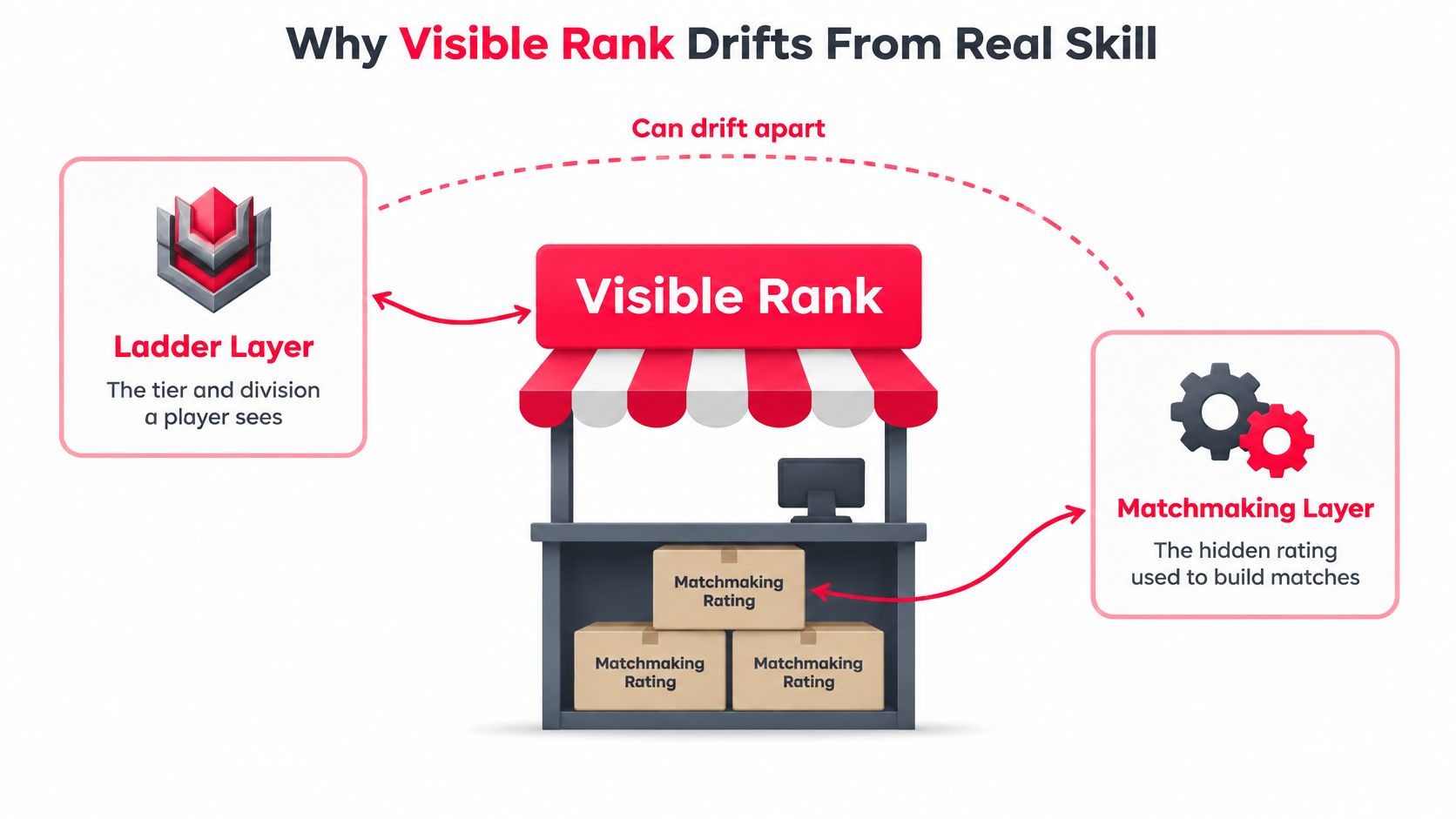
Apex makes the split explicit. Ranked matchmaking runs on the player's current Ranked Points, tiers are cut into four divisions, and each division costs progressively more RP to clear, per EA's Apex Legends ranked help page. The revealing part is the reset: the displayed tier gets reassigned using the player's ranked matchmaking rating, which means the visible snapshot can trail the system's own estimate of skill. The shop relabels the shelves while the stock is still in transit.
The ladder layer and the matchmaking layer
The ladder layer is what a player screenshots: tier, division, and the progress bar. It's built for motivation. It gives you a target that moves in visible steps and a reason to play one more game.
The matchmaking layer is what the lobby builder reads. It updates on its own schedule and doesn't care what's displayed. When the two disagree, the hidden number wins every time and your filter loses.
Three stages that change what a requirement means
Placement. A new or returning account has no settled rank. Whatever badge shows up during this stretch is provisional, and treating it as a settled fact is the single most common error in teammate filtering.
Climbing. Points move after every match, so a rank checked on Monday is a historical document by Friday. Fast risers break filters for a boring reason: the badge hasn't caught up yet. If you're not sure what a smurf account looks like from the outside, it's often indistinguishable from an improving player during the climb.
Reset. Seasonal resets reassign the displayed tier from the hidden rating, so a player can come back to a badge that looks worse than their actual level, or better. Either way, what they showed you last season is not what you're queueing with now.
The rule this article runs on: a rank requirement means something only when it names the game, the season, the queue type, the placement or post-reset state, and the date the rank was checked.
Miss any of those five and you're guessing with extra steps. A rank is a snapshot, not a live measurement, and a requirement that treats it as live will keep producing lobbies that don't work.
Eligibility Checks Before You Queue
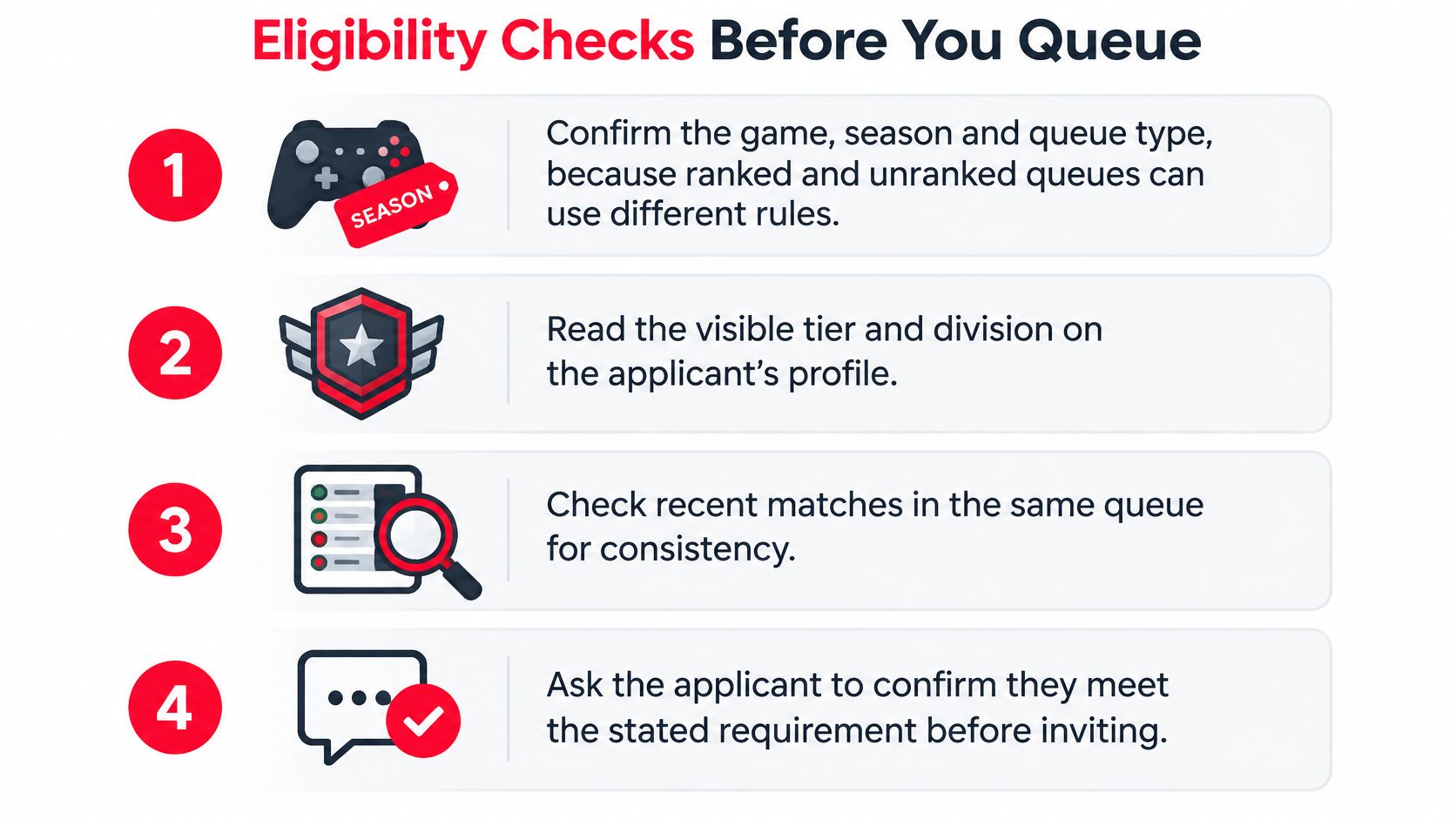
A posted requirement and a party that can legally queue are two different things, and six checks stand between them. Run all six on every applicant, the poster included. Skip one and the group can fail after everyone has committed to a session.
Confirm the game, season and queue type. Ranked and unranked run separate ladders, and a rank earned in one playlist says nothing about another. Filtering on "current rank" without recording which queue produced it is the standard failure here.
Read the tier and division, then date it. A badge from before the last reset describes a player who may no longer exist. A screenshot with no timestamp is a claim, not evidence.
Check placement status. A player mid-placements has a provisional badge, so sort them into a provisional bucket instead of treating the displayed tier as settled or rejecting them on sight.
Validate the whole party as a unit. Apex caps the rank spread inside a premade squad and sets the lobby off the highest-ranked member, so every applicant has to pass against every existing member. Measuring each newcomer against the post owner's badge alone misses the pairing that breaks the lobby.
Check the hidden-skill limits on League. Riot keeps tiers and divisions separate from MMR, and restrictions bite when MMR runs ahead of the badge: there are additional limitations from Emerald through Diamond II when a player's MMR corresponds to Master, while Master-and-above MMR is subject to solo-only restrictions, per Riot's ranked tiers and queues support page. Two players whose badges sit within your range can still be blocked from duoing.
Refresh next to session start. Rating moves after every match and resets reassign tiers, so a lunchtime check is stale by the evening. Verify once at invite time and once at queue time.
Some of this checking can be delegated to the platform. On GamerPlug, Apex and Fortnite ranks refresh every five minutes and League ranks come straight from Riot through the player's Riot ID, with no password involved, which turns checks 2 and 6 into a live feed instead of a screenshot audit. Posters set the game mode, rank range, platform and mic requirement when listing a squad, so checks 1 and 4 become a filter applicants answer before anyone trades messages.
When a check fails, the lazy option is rejection. The useful options are a broader range, a solo queue, or a later session, because most failures are timing and pairing problems rather than bad players.
The state worth waiting for looks like this: same game and queue across the group, every rank dated within the last day, placement players flagged, and the full party passing the game's own spread rules.
When Rank Misleads as a Teammate Signal
A badge is not a skill measurement. It's a compressed, delayed summary of results in a team game, and team results blur individual contribution by design.
TrueSkill-style systems need far more evidence in team formats before the estimate settles: about 46 games for two teams of four and 91 for two teams of eight, as Game News Line's breakdown of Elo, Glicko and TrueSkill explains. Not because the maths is slow, but because each match is a noisy signal about any one player. The same analysis notes that a study of team battle-royale rating systems found new-player participation distorts evaluation accuracy, with accuracy improving as the share of new players falls below 60%.
So the label is doing less work than it appears to. Two players at the same tier can differ enormously in role, consistency, communication, and whether they earned the rank solo or with a five-stack carrying them.
A strict rank match buys you confidence. It doesn't buy you compatibility.
What to require beyond the badge
- Verified current rank. The starting point, not the finish line, and only useful when it's dated.
- Recent match volume. Someone with twenty games this week is a different teammate from someone with twenty games since March.
- Role or champion pool. Two Diamonds who both play the same role badly fit worse than a Diamond and a Platinum whose roles interlock.
- Platform and input. Cross-play lobbies mix controller and mouse, and comfort matters more than people admit.
- Mic habits and pace. A quiet player in a comms-heavy squad is a mismatch no rank filter will catch.
- A clip or two. Thirty seconds of gameplay tells you more about positioning and decision-making than any tier badge.
The contrarian version is worth saying plainly: a lower-ranked player with the right role, a working mic and a compatible pace will often produce better results than a higher-ranked stranger who plays the same position and never speaks. Rank is the first filter, not a guarantee.
Who Rank Gates Shut Out and Why It Matters
Ask who the gate keeps out, not just who it lets in. Rank gates get described as neutral filters, but recent work on mixed-ability matchmaking treats them as a structural problem: matches that are consistently too hard can trigger a feedback loop that shrinks the player base, and small queue populations force some mismatched games regardless, as this study on handicapping for online competitive games sets out.
The churn numbers behind that loop are steep. One League of Legends study cited in the same paper reports that 61% of novices disappeared within 30 days, while another analysis reported inconsistent-tier matchmaking in 43% of examined "ELO hell" cases.
Three groups a badge handles badly
Returning players. Someone back after six months has a stale rank and a real skill level that may have moved in either direction. The badge describes the last time they played, not the player arriving tonight.
New players. They're still being measured, so their rank is the least reliable number on their profile. A strict gate turns that uncertainty into exclusion.
Fast improvers. Their rank lags their actual play by design. A narrow band rejects exactly the people most likely to outperform it.
Seasonal resets cut both ways. They lower the barrier to re-entry and pull people back into the ladder, but they also temporarily mix veterans, returners and newcomers in a pool where visible rank predicts less than usual. Cross-platform and multi-title communities make it worse, because placement rules and seasonal calendars don't line up between titles.
Try a dynamic range instead: start wide, require a handful of recent games in the same queue, then narrow based on how the sessions actually go.
That's a requirement built to update, rather than a badge check frozen at the moment of posting. It keeps the gate doing its job, filtering for a workable match, without turning rank into a wall that keeps out the people still finding their level.
Decide Whether to Post, Join or Invite
Before you post a listing, accept an invite, or send one, three questions decide it.
- Does the requirement name the game, season and queue type the party will use? If it doesn't, you're not comparing the same thing.
- Has every member's rank been checked recently, with placement and post-reset status noted? One dated check beats five screenshots.
- Does the whole party pass the game's own rules, not just the poster? Apex's rank-spread cap and League's MMR-based queue limits both fail squads that looked fine on paper.
Any "no" is a fixable gap. Close it before the invite goes out, not after the lobby refuses to launch.
Returning players get the same treatment in reverse: set a broad starting range, play a few sessions, then tighten it based on what happened. If you want a structured way to write that range down, this guide to looking for group posts covers the fields worth filling in.
That's where GamerPlug fits rather than replaces the work. When you post a squad you choose the game mode, rank range, platform and whether a mic is needed, and requirements are checked against players' real stats instead of a screenshot. League ranks sync from Riot through your Riot ID, with no password ever entered. A listing organizes the check. The match still depends on how each player plays.
Set the requirement in the terms the game uses, check the whole party against it, and send the invite once everyone passes. That's the whole method, and it works in every title in the table above.
GamerPlug is designed for the space between a badge and a teammate: post the mode, rank range, platform, and mic preference you want, and every applicant's requirement gets checked against their verified stats before they join. Ranks for Apex, Fortnite, and League sync directly from official game data, so the range you set matches the ladder you're queueing on tonight, not last season. Head to Gamerplug and find a squad that fits on more than one number.