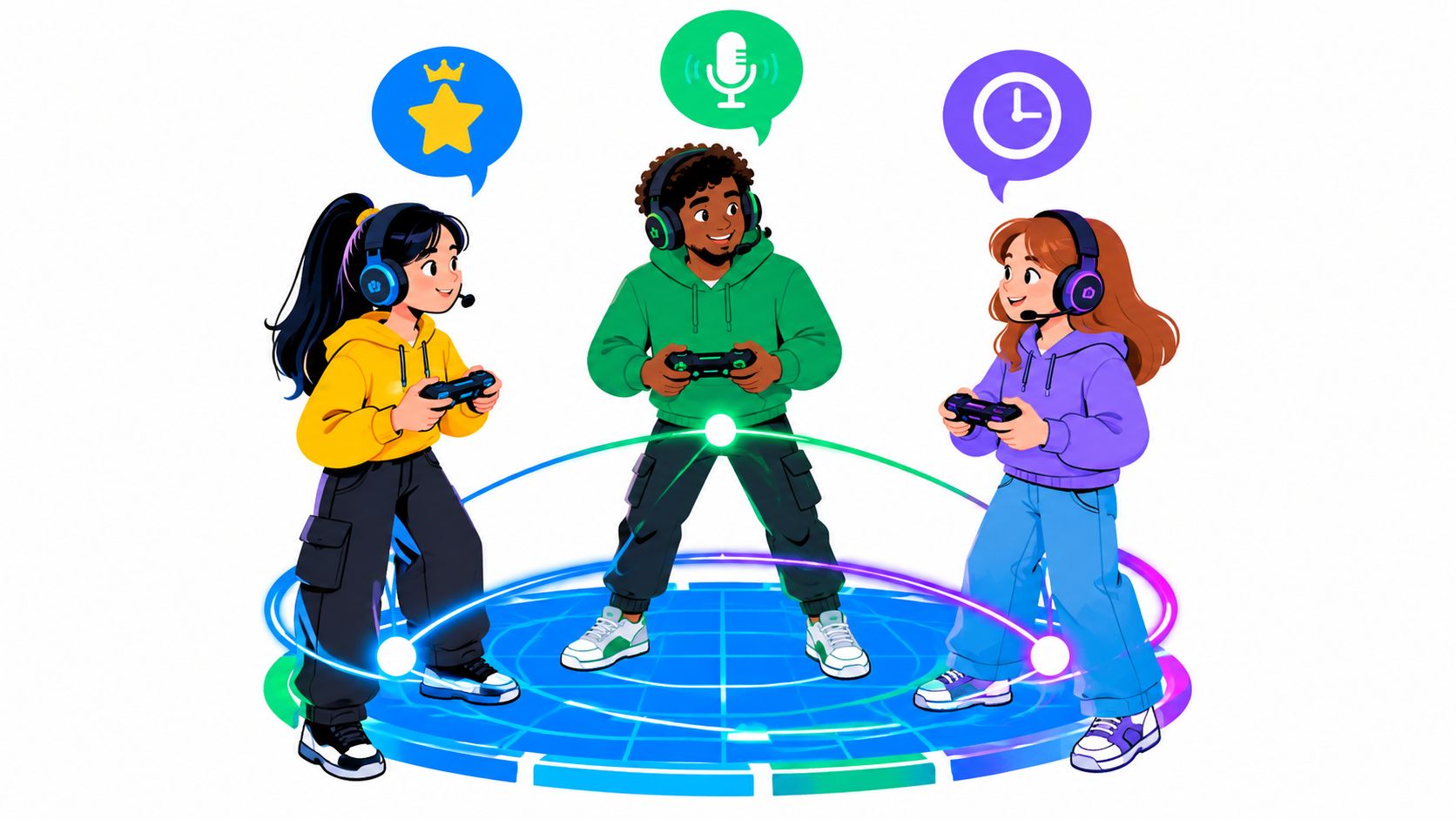
LFG most commonly means Looking For Group. In gaming, players use it to find teammates for things like raids, ranked queues, and co-op missions, while the second meaning, Let's Fing Go*, depends on context and usually shows up as hype rather than a teammate request.
If you searched “what is LFG,” there's a good chance you're not really asking for a dictionary answer. You're probably sitting in solo queue, staring at a lobby, or trying to put together a squad without ending up with random teammates who want totally different things.
That's where people get tripped up. They learn the acronym, but they still don't know how to use it well. They know what to type. They don't know how to find players who match their rank, comms style, role, or schedule.
So let's treat LFG the way players experience it. Not just as slang, but as a teammate-finding workflow. If you understand that part, you'll stop posting vague “LFG” messages into the void and start building groups that are much more likely to click.
Table of Contents
- Introduction to What LFG Means for Gamers
- What LFG Actually Means in Gaming Today
- Why LFG Exists and How Groups Form in Online Games
- Key Filters That Make an LFG Post Work
- Where to Find and Post LFGs That Actually Fill
- LFG Etiquette That Gets You Invited Back
Introduction to What LFG Means for Gamers
You queue up for ranked and tell yourself this will be the clean one. Then your team loads in. One player has no mic, one wants to hot drop, and you were hoping for a slow, coordinated game. Same mode, same lobby, completely different expectations.
That mismatch is the reason LFG matters.
In plain English, LFG means Looking For Group. It's a signal that says, “I need teammates for a specific activity.” That might be a raid, a dungeon run, a duo partner, a scrim team, or just a few solid people for tonight's games.
Why new players often misunderstand it
A lot of new players assume LFG is only MMO slang, or that it refers to one app or one platform feature. That's not how most gamers use it. It's broader than that. You'll see it across FPS games, MOBAs, MMOs, survival games, and console communities whenever someone needs a party with a shared goal.
The other point of confusion is that LFG can also mean excitement. You'll see someone post “LFG!” after a clutch win, a rank-up, or a trailer drop. Same letters, very different job.
Simple rule: If the player is trying to form a team, LFG means Looking For Group. If they're celebrating, it usually means Let's F***ing Go.
The real reason this matters
Knowing the meaning is useful. Knowing the workflow is what saves you time.
A weak LFG post gives you more randoms. A clear one helps you find players who fit the job. That's the difference between “need 2” and “need 2, ranked, mic on, crossplay okay, playing for two hours.”
If you've ever thought, “Why does finding teammates still feel harder than the match itself?” you're asking the right question.
What LFG Actually Means in Gaming Today
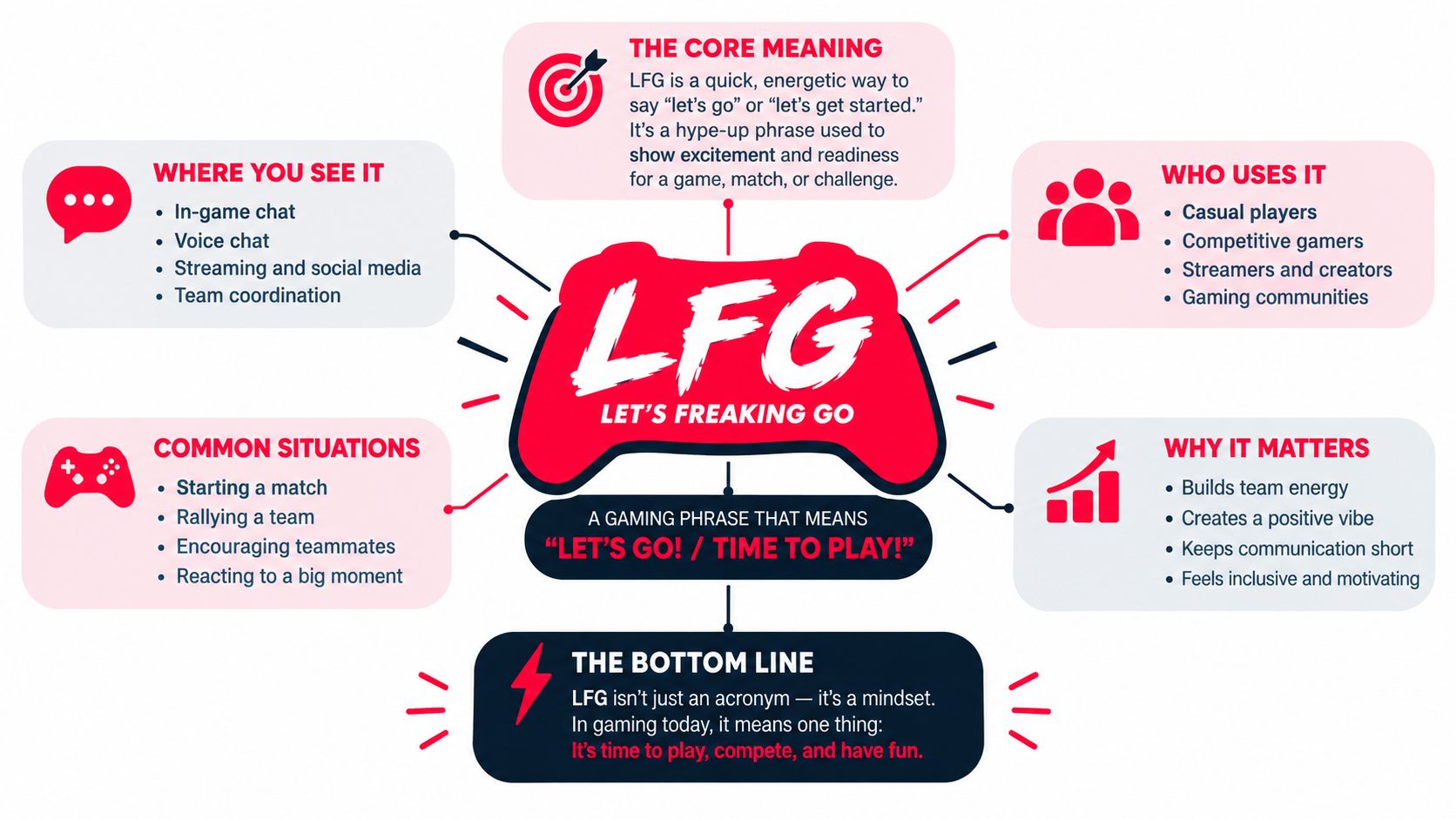
LFG means Looking For Group in gaming. It's a coordination signal players use when they want teammates for a specific multiplayer activity such as a raid, ranked queue, or co-op mission, and context matters because in hype chat it can also mean Let's Freaking Go, as explained in Ledger's gaming glossary entry on LFG.
Think of it like a pickup game call
The easiest way to understand LFG is to compare it to pickup basketball.
If someone at the court says, “Need two for half-court,” they're not making a speech. They're sending a fast signal with just enough info for the right people to join. In games, LFG works the same way. You're telling others what activity you want to run and what kind of teammates you need.
A few simple examples:
- “LFG raid, need support and tank” means someone is assembling a group for a raid
- “LFG duo for ranked, mic required” means they want a partner with voice comms
- “LFG casual co-op tonight” means the goal is relaxed play, not sweaty climbing
How to tell which meaning is being used
Players get confused because both meanings are common online. The fix is to read the room.
If the phrase appears in a party finder, game chat, Discord LFG channel, or console club post, it almost always means teammate search. If it appears after a win, a patch reveal, or a tournament moment, it's probably hype.
Here's the practical shortcut:
- Lobby context usually means Looking For Group
- Celebration context usually means Let's Freaking Go
- No extra details often means you need one more clue from the channel or conversation
In gaming spaces, LFG is less about the letters and more about the situation around them.
Why the acronym stuck
LFG survived because it's fast. Multiplayer players needed a quick, low-friction way to form parties, and short chat commands fit perfectly. Over time, that shorthand spread beyond one genre and became part of the wider language of online play.
Key takeaway: In gaming, LFG usually means “I need teammates for a specific thing.” The rest of the message decides whether those teammates are a good fit.
Why LFG Exists and How Groups Form in Online Games
LFG didn't become common just because gamers like acronyms. It stuck because team games create a real coordination problem.
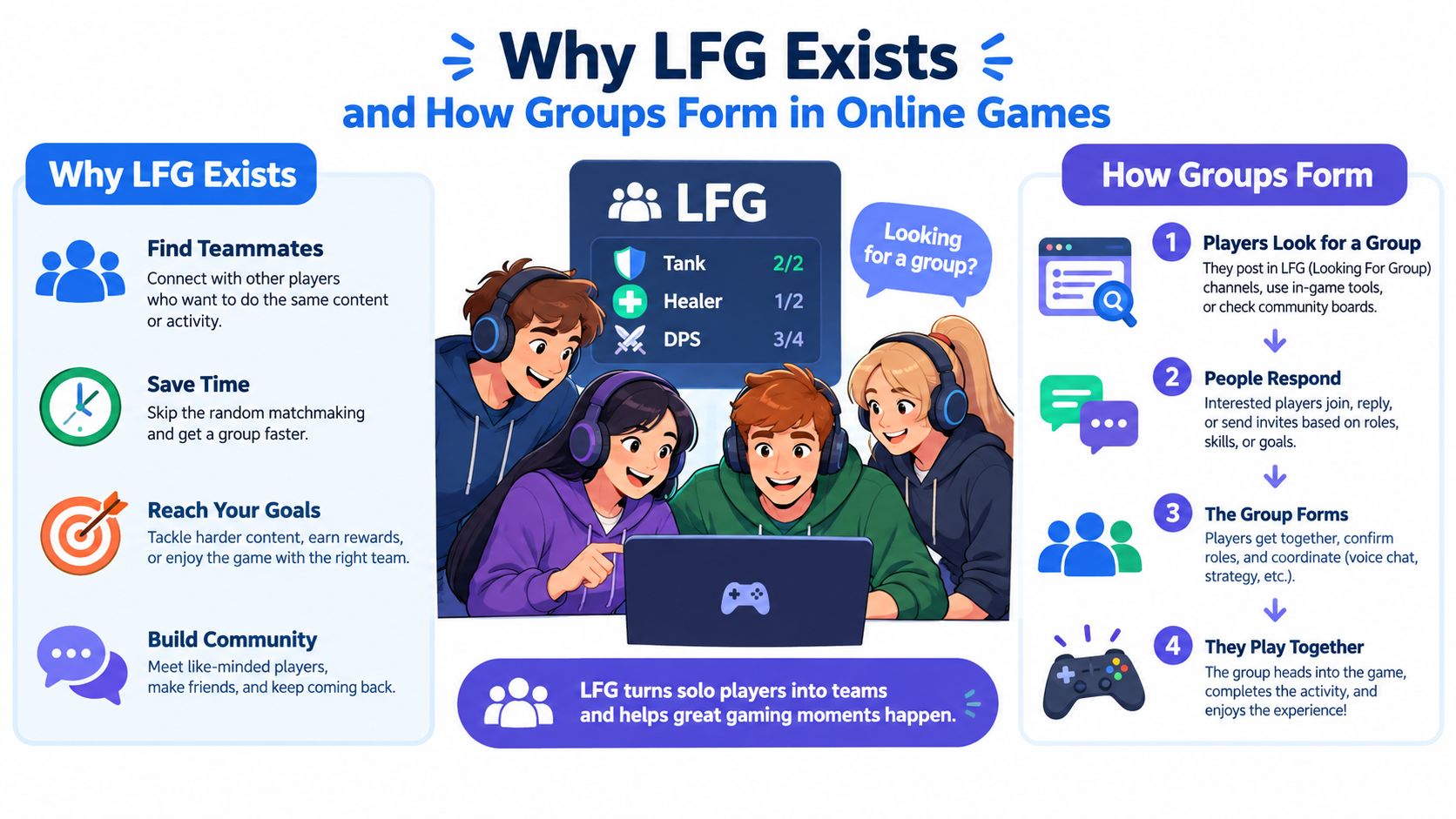
Long before modern party finders, players in early online games used chat to assemble groups for activities that were hard or impossible to do alone. One overview of the term's history ties LFG closely to early multiplayer culture, including MMORPGs like EverQuest, which launched in 1999, and World of Warcraft, which followed in 2004, while a separate glossary notes the earliest recorded internet-slang definition dates to 2002. That combination supports the idea that LFG was already established by the early 2000s and then spread across genres, as described in G2A's history of LFG in gaming.
Online teams form around shared objectives
A raid group isn't a friend group first. It's a goal group first.
That matters because online multiplayer teams often form around a job. Clear a dungeon. Win ranked games. Hold sites. Farm loot. Research on multiplayer group dynamics found that these are task-oriented temporary groups built around shared focuses like combat or objectives, driven by cooperative and competitive goals rather than random social pairing. That's a big reason LFG works so well in games where role fit, shared intent, and quick formation matter, especially in MMORPGs and MOBAs, as discussed in this research on peer presence and social group dynamics in multiplayer games.
Why random matchmaking often feels bad
Random matchmaking solves one problem. It gets bodies into a lobby.
It doesn't always solve the harder problems:
- Shared intent: Are you all trying to win, learn, farm, or mess around?
- Role fit: Does the team cover needed roles or playstyles?
- Communication: Can the group coordinate when things get chaotic?
- Commitment: Is everyone staying for one match, one hour, or a whole raid run?
That's why “just queueing” and “finding a good group” are not the same thing.
LFG is a social tool, not just a slang term
A lot of explainers stop at the acronym. Players care about the result.
LFG exists because many multiplayer games need temporary teams with enough alignment to function. Once you look at it that way, the challenge becomes obvious. The problem isn't learning what LFG stands for. The problem is building a post that attracts the right squad instead of whoever happens to answer first.
Key Filters That Make an LFG Post Work
Old-school LFG often looked like lobby spam. Short, loud, and vague. That still happens, but it doesn't solve the underlying pain point, which is finding teammates who fit.
Xbox's LFG rollout described the model as a “want-ad” system with filters like game, mode, number of players, behavior rules, and requirements such as level or gear. That's a useful reminder that LFG was never only about posting a phrase. It was about matching the right people for the job, as shown in Xbox's announcement for Clubs and Looking for Group.
Why filters beat vague posts
“LFG ranked” is better than nothing. It's still incomplete.
Good filters reduce specific mismatches before they happen. They don't make people nicer or more skilled overnight, but they do help you avoid obvious bad fits.
Here's a compact way to think about it:
| Filter | Prevents This Problem | Example Value |
|---|---|---|
| Rank range | Big skill gaps and smurf suspicion | Gold to Platinum |
| Role or legend | Overlapping picks and bad team comp | Support main |
| Mic requirement | Silent comms in team modes | Mic required |
| Platform | Invite and compatibility issues | PC only |
| Crossplay | Queue confusion across systems | Crossplay on |
| Mode | Different goals in the same game | Ranked trios |
| Open slots | Last-minute party confusion | Need 2 |
| Schedule | Players leaving early or not showing | Playing 8 to 10 PM |
The filters that matter most in practice
Some filters are optional. Some save the whole session.
- Rank range: This is the fastest way to signal expected pace and lobby difficulty.
- Mic preference: Not every mode needs voice, but many team games are smoother when that expectation is clear.
- Role or character: This matters most in games where comp and comfort picks shape the match.
- Schedule: Underrated and huge. A cracked teammate who leaves after one game is still a mismatch.
- Platform and crossplay: This avoids the annoying “wait, can we even queue together?” moment.
For players who want a more profile-based approach to teammate matching, this guide to an esports team finder workflow is useful context for how modern tools move beyond simple posting.
Practical rule: Every line in your LFG post should remove one likely mismatch.
A weak post versus a strong one
Weak post: “LFG ranked”
Strong post: “LFG ranked duos, Gold-Plat, mic on, chill but trying to win, PC, playing for two hours”
Same acronym. Totally different result.
The stronger version doesn't sound fancy. It sounds usable. That's the goal.
Where to Find and Post LFGs That Actually Fill
A good LFG workflow starts with location. Posting the right message in the wrong place still wastes time.
Players usually look in a few common spots. In-game party finders, console LFG tools, Discord servers, subreddit threads, and dedicated teammate-finding apps all serve the same basic purpose. The difference is structure. Some are just fast chat streams. Others let you filter people before you queue.
The main places players use
Each option has a different feel.
- In-game LFG tools: Fast and close to the action. Good when you want teammates right now.
- Console community features: Useful for players who stay inside the Xbox or console ecosystem.
- Discord servers: Strong for active game communities, but posts can disappear quickly in busy channels.
- Reddit and forum threads: Better for slower recruiting, recurring groups, or longer-form posts.
- Dedicated apps: Better when you want profiles, filters, and a cleaner way to compare potential teammates
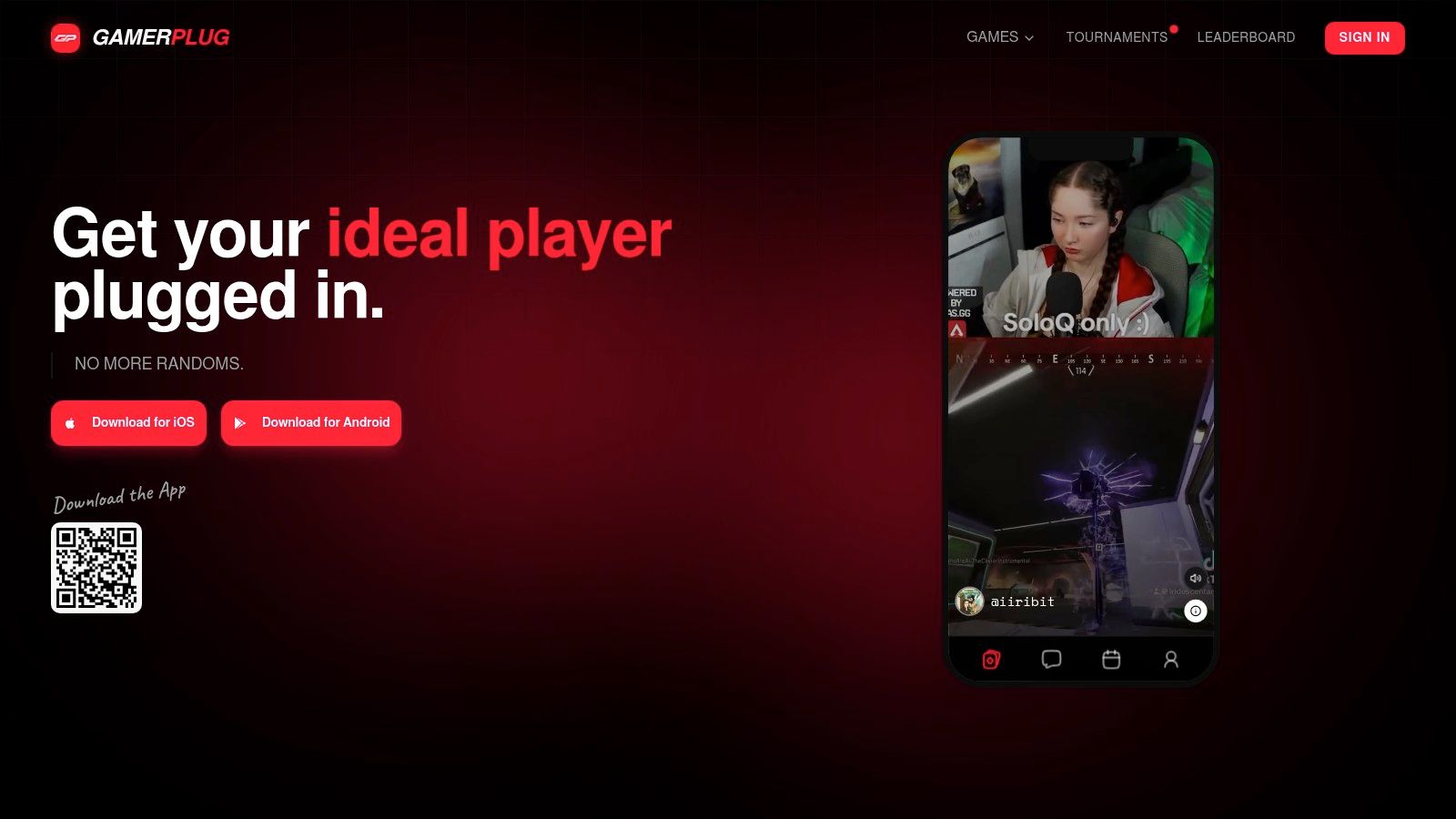
One example is GamerPlug, which offers clip-based profiles, verified ranks for supported titles, and squad posts with filters such as mode, rank range, platform, mic requirement, and open slots. If you play Fortnite specifically, this walkthrough on a Fortnite squad finder shows how game-specific LFG can be more precise than generic chat posts.
How to write a post that gets useful replies
Don't overthink it. Just answer the questions a good teammate would ask before joining.
Use this simple format:
Game and mode
Say exactly what you're playingSkill context
Add rank, experience level, or intent like casual, learning, or sweaty rankedComms expectation
Mic required, mic preferred, or no mic neededPlatform and crossplay
Say whether you're on PC, PlayStation, Xbox, or Switch, and whether crossplay is okayTiming
Mention when you're playing and for how longOpen spots
Say whether you need one duo partner, two teammates, or a full stack
A clean example:
Need 2 for ranked trios tonight, Gold-Plat range, mic on, crossplay okay, starting now, playing for a couple hours.
How to judge someone else's post fast
Before you join, check three things first:
- Clarity: Do they say what they want?
- Compatibility: Do rank, platform, and comms line up with yours?
- Tone: Do they sound tilted, demanding, or reasonable?
That quick scan saves a lot of miserable queues.
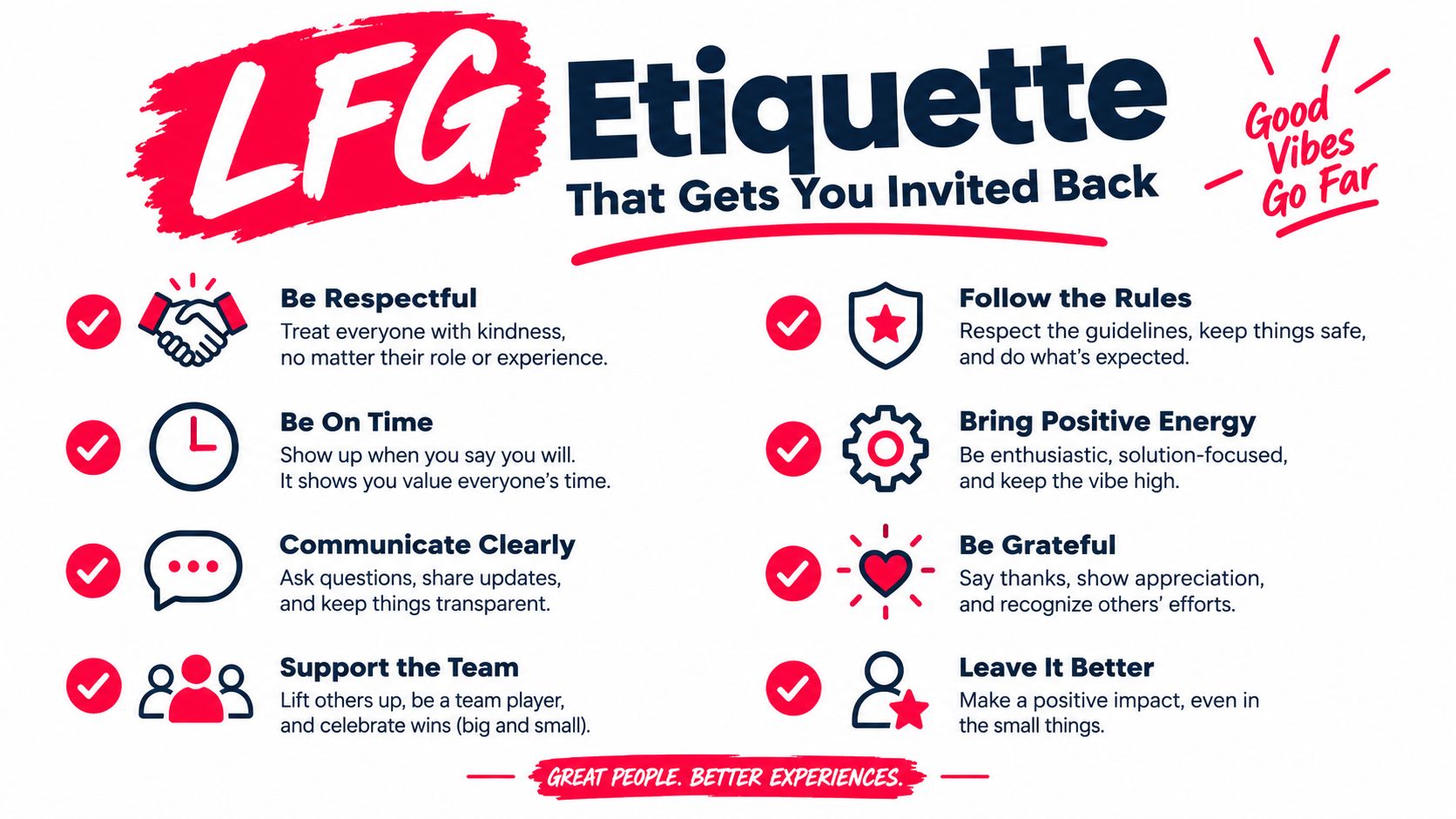
LFG Etiquette That Gets You Invited Back
Finding a group is only half the job. Keeping a good group is where the value shows up.
A lot of players can fill a party once. Fewer players become the person others want to queue with again. That part comes down to basic LFG etiquette.
The habits that make you easy to group with
Start with honesty. If you say you're a certain rank, role, or playstyle, be accurate. Nobody likes discovering mid-queue that “flex player” means “insta-locks one character and ignores calls.”
Then handle the small things well:
- Be clear in your post: State mode, rank, mic, platform, and timing
- Show up when you said you would: Reliability matters more than flashy stats
- Respect comms expectations: If the post says mic required, don't join silent
- Say something before leaving: A quick heads-up is better than disappearing
- Keep tilt under control: Frustration happens. Dumping it on strangers kills the vibe fast
Why etiquette matters more than people think
Players remember how a session felt.
They remember whether you were late. Whether you raged after one loss. Whether you communicated like a teammate or treated the group like disposable randoms. Good etiquette builds trust, and trust turns one-off LFG sessions into regular squads.
For players who want stronger community habits around this, this article on toxic-free gaming and positive communities connects the same idea to broader multiplayer behavior.
Good LFG etiquette says, “I respect your time, your queue, and the goal we joined for.”
A short checklist to remember
Before you post or join, ask yourself:
- Am I clear about what I want
- Am I honest about what I bring
- Am I ready to communicate
- Am I reliable enough that people would invite me again
If the answer is yes, you're already ahead of a lot of LFG traffic.
If you're done with vague lobby spam and want a cleaner way to find gaming teammates, Gamerplug is built around the LFG workflow. You can compare profiles, check supported rank verification, set filters like mode, mic, platform, and open slots, and look for squadmates who fit how you play.