
Valorant's ranks run in order from Iron 1 at the bottom to Radiant at the top: nine named ranks, three tiers each from Iron through Immortal, and Radiant as the single top tier with no numbered divisions. That's 25 ladder positions in total, and the pair players mis-sort most often sits near the middle, where Ascendant 3 is a lower rank than Immortal 1 despite carrying the bigger number.
The counterintuitive part is that a rank label was never one value. It's a rank family (Ascendant), a tier (3), a platform and a region, and the family always decides the order before the tier gets a vote. Read it the other way and Immortal 1 looks like the junior rank because 1 is smaller than 3, which is exactly backwards.
So treat rank as structured matchmaking data rather than a badge. The sections below build it in order: the full list, how tiers stack, how Rank Rating moves you between them, what a label really says about a player, and how to turn all of it into a rank range you can post to a squad.
Table of Contents
- Full Valorant Rank Order From Iron to Radiant
- How Tiers Stack and How to Sort Them
- How Rank Points Decide Promotion and Demotion
- What a Rank Tells You About Player Skill
- How Platform and Placement Change Your Rank
- How the Rank Ladder Changed Over Time
- Confirm Your Rank and Placement Status
- Set a Squad Rank Range and Post
Full Valorant Rank Order From Iron to Radiant
Read the ladder from top to bottom to see each rank family in sequence. The Valorant ranks reference lists them from lowest to highest: Iron, Bronze, Silver, Gold, Platinum, Diamond, Ascendant, Immortal, Radiant. Iron through Immortal each have three tiers.
That makes 24 numbered tiers, followed by Radiant. Ascendant sits between Diamond and Immortal, so older guides that skip it show an outdated order.
| Position | Rank | Rank Group | Notes |
|---|---|---|---|
| 1 | Iron 1 | Iron | Lowest rank on the ladder |
| 2 | Iron 2 | Iron | Standard tier |
| 3 | Iron 3 | Iron | Standard tier |
| 4 | Bronze 1 | Bronze | Standard tier |
| 5 | Bronze 2 | Bronze | Standard tier |
| 6 | Bronze 3 | Bronze | Standard tier |
| 7 | Silver 1 | Silver | Standard tier |
| 8 | Silver 2 | Silver | Standard tier |
| 9 | Silver 3 | Silver | Standard tier |
| 10 | Gold 1 | Gold | First Gold tier |
| 11 | Gold 2 | Gold | Standard tier |
| 12 | Gold 3 | Gold | Standard tier |
| 13 | Platinum 1 | Platinum | Standard tier |
| 14 | Platinum 2 | Platinum | Standard tier |
| 15 | Platinum 3 | Platinum | Standard tier |
| 16 | Diamond 1 | Diamond | Standard tier |
| 17 | Diamond 2 | Diamond | Standard tier |
| 18 | Diamond 3 | Diamond | Standard tier |
| 19 | Ascendant 1 | Ascendant | First tier between Diamond and Immortal |
| 20 | Ascendant 2 | Ascendant | Standard tier |
| 21 | Ascendant 3 | Ascendant | Highest Ascendant tier |
| 22 | Immortal 1 | Immortal | First Immortal tier |
| 23 | Immortal 2 | Immortal | Standard tier |
| 24 | Immortal 3 | Immortal | Highest numbered tier |
| 25 | Radiant | Radiant | Top rank, with no numbered tiers |
Use the position column to compare ranks across families. A larger tier number does not automatically mean a higher rank: Ascendant 3 is below Immortal 1 because the rank family comes first in the ordering. For a quick progression check, find your current row and look at the one immediately after it.
How Tiers Stack and How to Sort Them
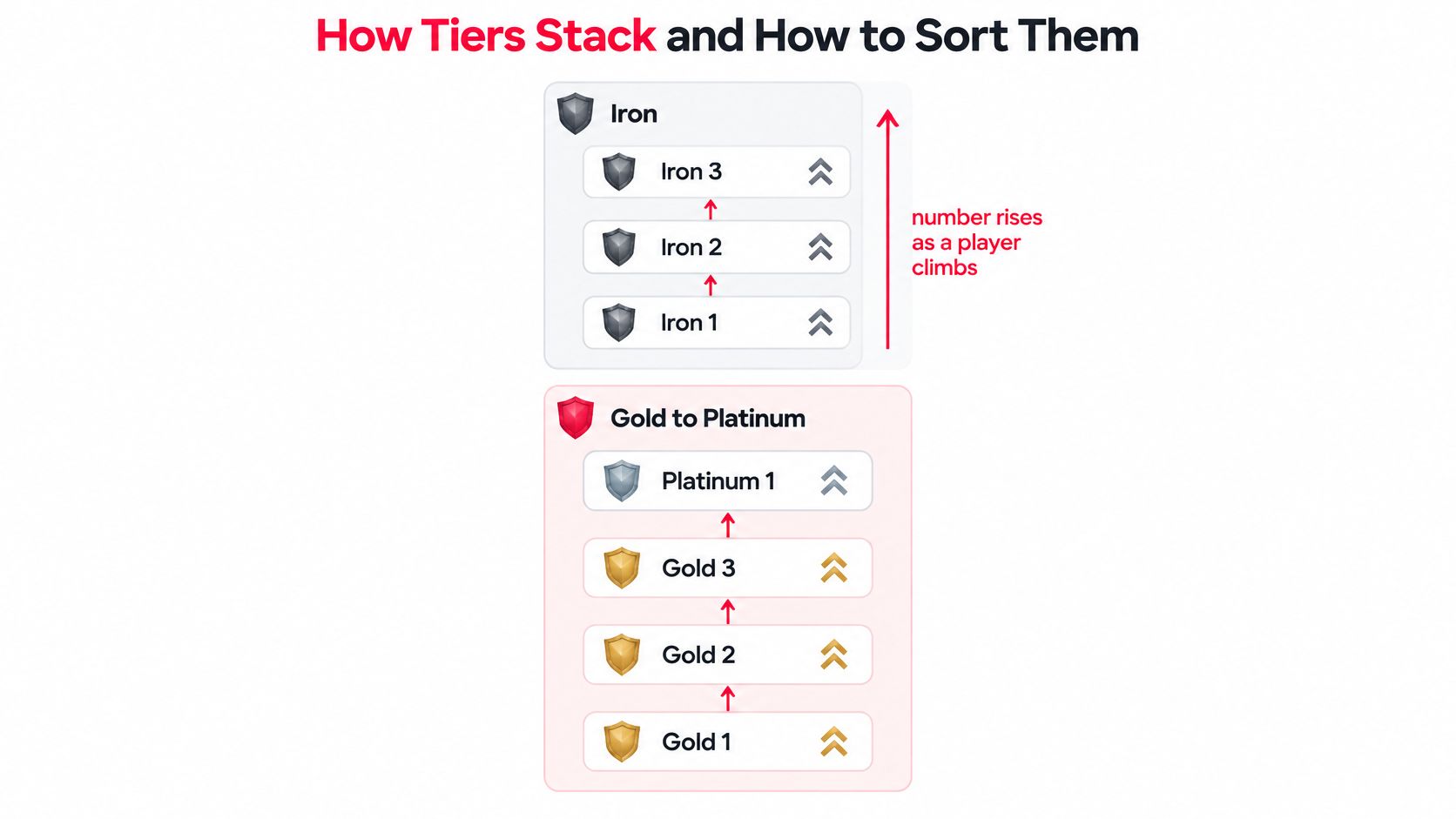
Start with the simplest case. Iron 1, Iron 2 and Iron 3 are the same rank three times over, and the number climbs as the player climbs. Someone in Iron 1 who earns enough to promote lands in Iron 2, not Bronze. The family stays put until tier 3 is cleared.
Gold works the same way at one remove. A player moves Gold 1, then Gold 2, then Gold 3, and only after that does the badge change family to Platinum 1. Two promotions and three tiers sit between "I'm Gold" and "I'm Platinum," which is why rank conversations that skip the tier are so imprecise.
The four blocks worth knowing
Group the 25 positions and the ladder stops feeling like a long hallway.
- Low ranks (Iron to Silver, positions 1 to 9): the learning block. Crosshair placement and utility basics decide most games here.
- Middle ranks (Gold to Diamond, positions 10 to 18): the widest block in the game, and where most players spend most of their time.
- The Ascendant bridge (positions 19 to 21): the step between Diamond-level play and the elite tiers, and the block older guides leave out entirely.
- The top block (Immortal and Radiant, positions 22 to 25): Immortal is the last numbered family. Radiant isn't a tier at all but a leaderboard position.
The sorting mistake is structural, not a matter of paying closer attention. Any system that reads a rank as one string will eventually place Immortal 1 below Ascendant 3, because text and numerals sort differently from rank families.
Practical rule: store three fields, never one. Rank family, tier number, and a derived sort value running from Iron 1 = 1 up to Immortal 3 = 24, with Radiant at 25.
That derived value settles arguments in a single glance. A squad asking for Gold 2 to Platinum 3 is asking for positions 11 to 15, five tiers in total. A player filtering for the same range on a list that only stores the family name would get everyone from Gold 1 to Platinum 3, which is seven positions.
Radiant needs its own handling in any filter, since there's no tier number to compare. The quick test before you trust any comparison: Diamond 2 means family Diamond, tier 2, and both fields have to be present for two players to be ranked against each other.
How Rank Points Decide Promotion and Demotion
Below Immortal, progression is a straight counter. Riot's Rank Rating support article sets the pattern: after placement a player generally begins at 50 RR in the assigned rank, needs 100 RR to promote, and receives a minimum 10 RR buffer on entering the next rank or tier. That buffer is why a fresh promotion never drops you instantly.
Demotion has a floor and a delay. A player at 0 RR can be demoted after another loss, and the lowest starting RR after a demotion is 70. Riot also doesn't hand out fixed amounts per match, so the same win can move two players by different amounts depending on the lobby and their hidden rating.
Where the 100 RR step stops
Immortal and Radiant abandon the counter entirely. Promotion there is governed by regional RR thresholds that keep accumulating rather than resetting at 100, and Radiant adds a second condition on top of the number: a place on the regional leaderboard.
| Rank Band | Promotion Rule | Notes |
|---|---|---|
| Iron to Ascendant | 100 RR to promote, with a 10 RR minimum buffer into the next rank or tier | Placement starts at 50 RR |
| Immortal 1 | Region-set RR threshold, no fixed 100 RR step | Thresholds vary by region |
| Immortal 2 | 90 RR | Commonly documented threshold |
| Immortal 3 | 150 RR | Commonly documented threshold |
| Radiant | 200 RR plus a top 500 position in the region | Leaderboard placement required |
The rows are ordered on purpose, and the last three are the ones people quote out of context. Those thresholds are published per region and Riot tunes them, so a screenshot of "90 RR for Immortal 2" from one region isn't a universal target.
Check two fields, not one: before treating two Immortal players as equal, compare their RR and their region. A 100 RR Immortal 1 in one region and a 100 RR Immortal 1 in another may not sit at the same point on the ladder.
This is also why rank ranges in squad listings work better as bands than as single values. A range from Diamond 1 to Ascendant 3 spans positions 16 to 21 and captures the full transition zone, while a flat "Ascendant only" requirement excludes every Diamond 3 player one good session away from qualifying.
What a Rank Tells You About Player Skill
A rank shows where a player sits in the ladder, not everything they bring to a match. The rank distribution data on vstats puts Gold at 22.12% of ranked players, Immortal at 1.77%, and Radiant at 0.03%.
| Rank | Share of ranked players | What the figure shows |
|---|---|---|
| Gold | 22.12% | The largest group in the dataset |
| Immortal | 1.77% | A smaller share of the player base |
| Radiant | 0.03% | A very small share of the player base |
These are population shares, not direct ratings of skill. Two Gold players can differ in aim, game sense, communication, and consistency. A higher rank narrows the group a player belongs to, but it still cannot show how they communicate or fit a team.
What to check beside the rank
- Recent ranked games: Someone active this week may be playing at a different level from someone whose last competitive match was months ago.
- Role fit: A Gold 3 controller who calls rotations may suit your squad better than an Ascendant 1 duelist who stays silent. Rank reflects ladder results, not every team habit.
- Communication: A short chat or voice exchange can give you a better sense of how someone handles coordination and tilt. For agent choices by role, the Valorant tier list offers another point of comparison.
Rule of thumb: Read a rank as one signal. Pair it with recent activity, communication, and role fit before deciding whether someone suits your team.
Rank, region, platform, and recent activity describe different parts of a player's competitive context. The badge alone answers only where the ladder placed them.
How Platform and Placement Change Your Rank
A Valorant rank only makes sense alongside the ladder that produced it. PC and console ranks are separate, according to the Valorant rank reference. A player can therefore have different ranks on each platform, and matching rank labels do not necessarily reflect the same competitive history.
Placement adds another layer. New players complete five placement matches to receive an initial rank. That rank is an estimate based on early results, not a settled measure of performance. Two players with the same badge may have very different amounts of ranked experience.
Three checks before you trust a label
- Platform: Check whether the rank is from PC or console. The label alone does not identify the ladder.
- Placement status: A newly placed player has less ranked history behind their badge than someone with results across multiple matches.
- Recent activity: A rank from a while ago may not reflect how the player performs now.
For example, a console player placed at Platinum 1 and a PC player who has held Platinum 1 across two seasons share a label, but not the same evidence behind it. One rank comes from an initial set of placement matches; the other reflects results over a longer period.
For a cross-platform squad, check the guide to Valorant cross-platform play before comparing ranks. Include the platform in your listing, such as “Platinum 1, console,” so teammates know which ladder the rank belongs to.
How the Rank Ladder Changed Over Time
Valorant's rank ladder has changed, so a rank label needs a date to make sense. Riot's Episode 2 competitive notes describe eight ranks: Iron, Bronze, Silver, Gold, Platinum, Diamond, Immortal, and VALORANT. Every rank except VALORANT had three tiers. The notes also describe the top rank as Radiant, the name used after VALORANT was renamed. Riot's Episode 2 competitive notes give the rank structure and name change context.
Ascendant was added later, changing the rungs between Diamond and Immortal. Episode 2 also set out a range of RR changes: wins could award 10 to 50 RR, losses could remove 0 to 30 RR, and draws could award up to 20 RR depending on performance. Those figures describe that update, not a permanent rule for every patch.
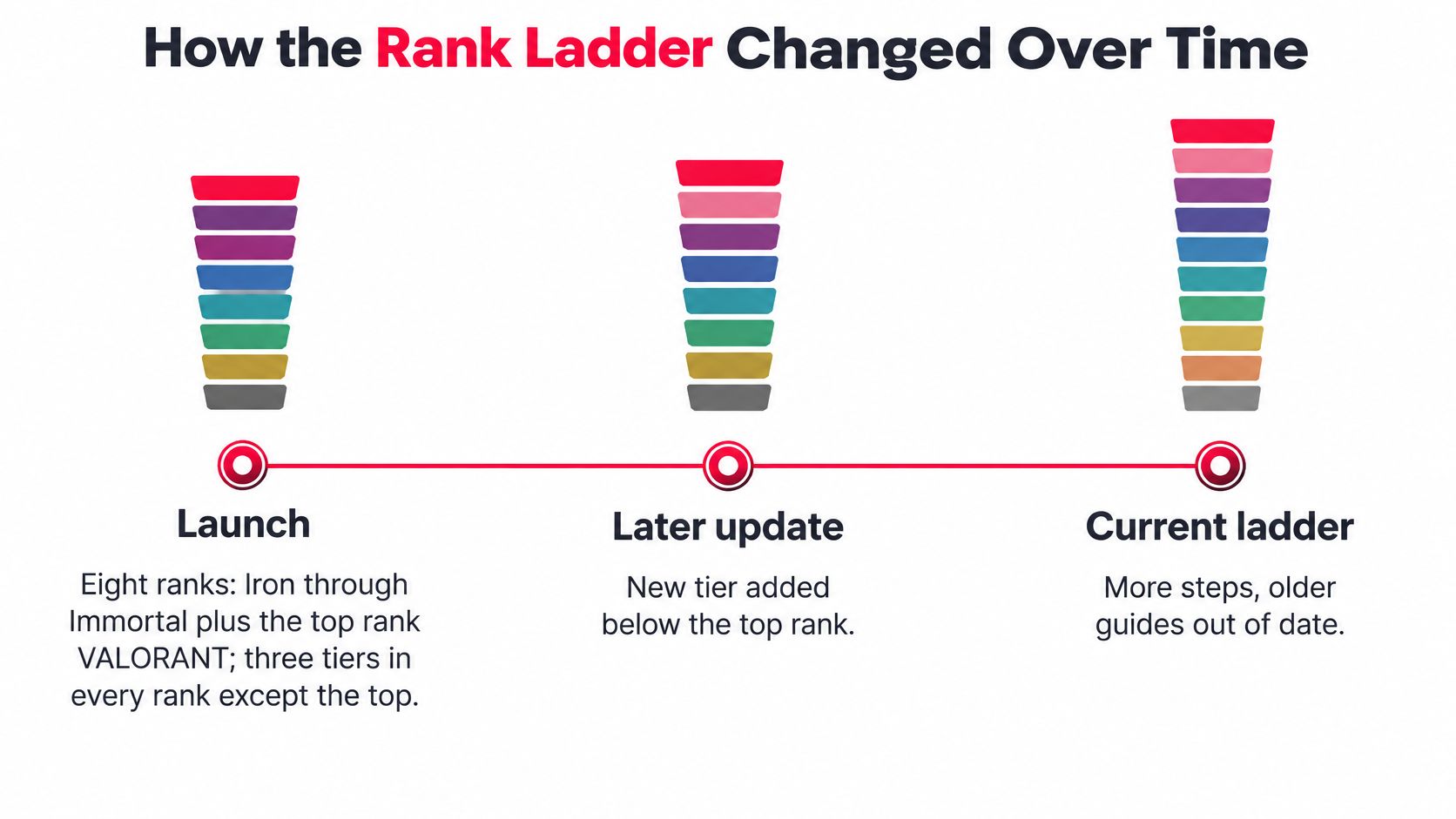
A Diamond label from before Ascendant was added belongs to a different ladder layout than today's Diamond. The rank family is the same, but the tiers above it have changed. Likewise, a quoted RR gain or loss needs its patch context: RR is a tuning value, not a fixed exchange rate.
Date the rank before comparing it. A profile, video, or guide can use a familiar label while referring to an older ladder. Match the rank family and tier to the version of the system in effect at the time.
Confirm Your Rank and Placement Status
Before you queue or post a squad, write down what your label consists of. Four facts cover it.
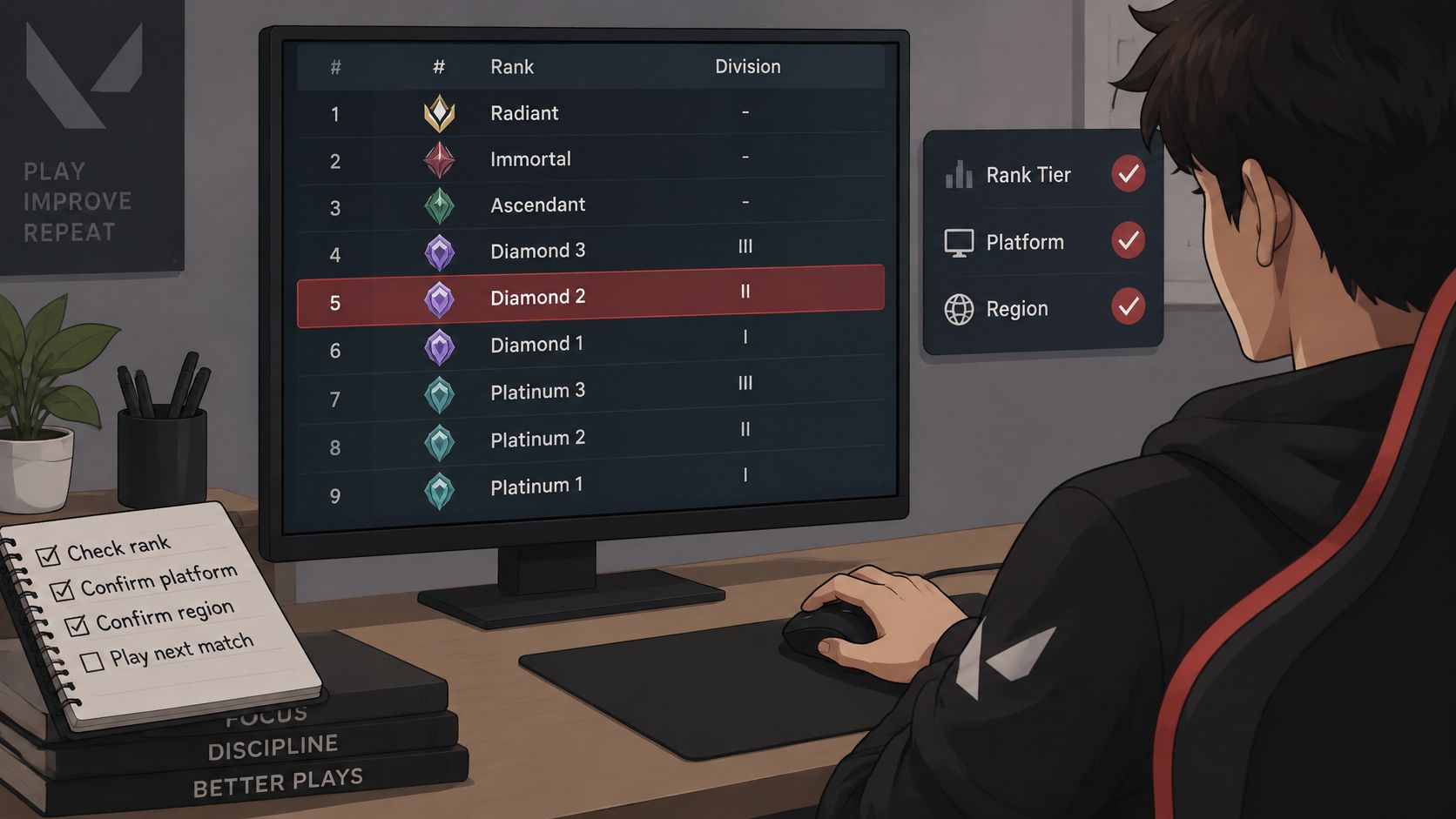
- Find your ladder position: note the family and tier together, such as Diamond 2, which is position 17 in the table above.
- Record the platform: PC or console, because the same label on two platforms describes two different competitive records.
- Confirm your placements are done: five matches at the start of a season, and a fresh result is a starting rank rather than a settled measure.
- Note your region and the date you last played ranked: region matters most at Immortal and Radiant, and recency matters everywhere.
A rank read from a profile is only as current as the last ranked game behind it.
Those four fields then turn into the range you'll use when you go looking for teammates, which is the last step.
Set a Squad Rank Range and Post
A range built from ladder positions beats a single rank word every time. Diamond 1 to Ascendant 3 covers positions 16 to 21, so it catches every Diamond 3 player who is one good session from the bridge as well as the Ascendant players already there.
Never compare the text labels instead. Immortal 1 sits at position 22 and above Ascendant 3 at 21, so a listing that says "Ascendant 3 and up" and one that says "Immortal 1 only" describe two adjacent, non-overlapping slices of the same ladder. Writing both as positions removes the ambiguity in one move.
Pair the tier with the platform so a console Diamond 2 and a PC Diamond 2 aren't read as the same competitive history. Same words, different ladders.
Radiant is the exception to the whole range system. It has no tier number, so a Radiant range should say it's a leaderboard position within a stated region rather than a numbered tier, and it should come with a date. Two Radiant players in different regions may not be comparable at all.
Then add the practical requirements: the number of open slots, whether a mic is needed, and the mode you're queuing. On GamerPlug, when you post a squad listing, you choose the game mode, rank range, platform and mic requirement, and those requirements get checked against players' real stats before anyone joins, so "Diamond 1 to Ascendant 3, PC, mic required" means what it says.
That's the difference between a rank as decoration and a rank as a filter. Once family, tier, platform and region sit in separate fields, the ladder stops being a list to memorise and becomes something you can match against.
Valorant's rank ladder only gets useful when the data behind it is sorted properly, and that's the part GamerPlug is built for: verified ranks, play style and platform on every profile, so you can post "Diamond 1 to Ascendant 3, PC, mic required" and find players who fit that range instead of a queue full of strangers. Post a squad with your rank range, platform and mic preference, or swipe through the Discover feed and find teammates who match your schedule as well as your tier. Head to Gamerplug and turn your ladder position into an actual party.