
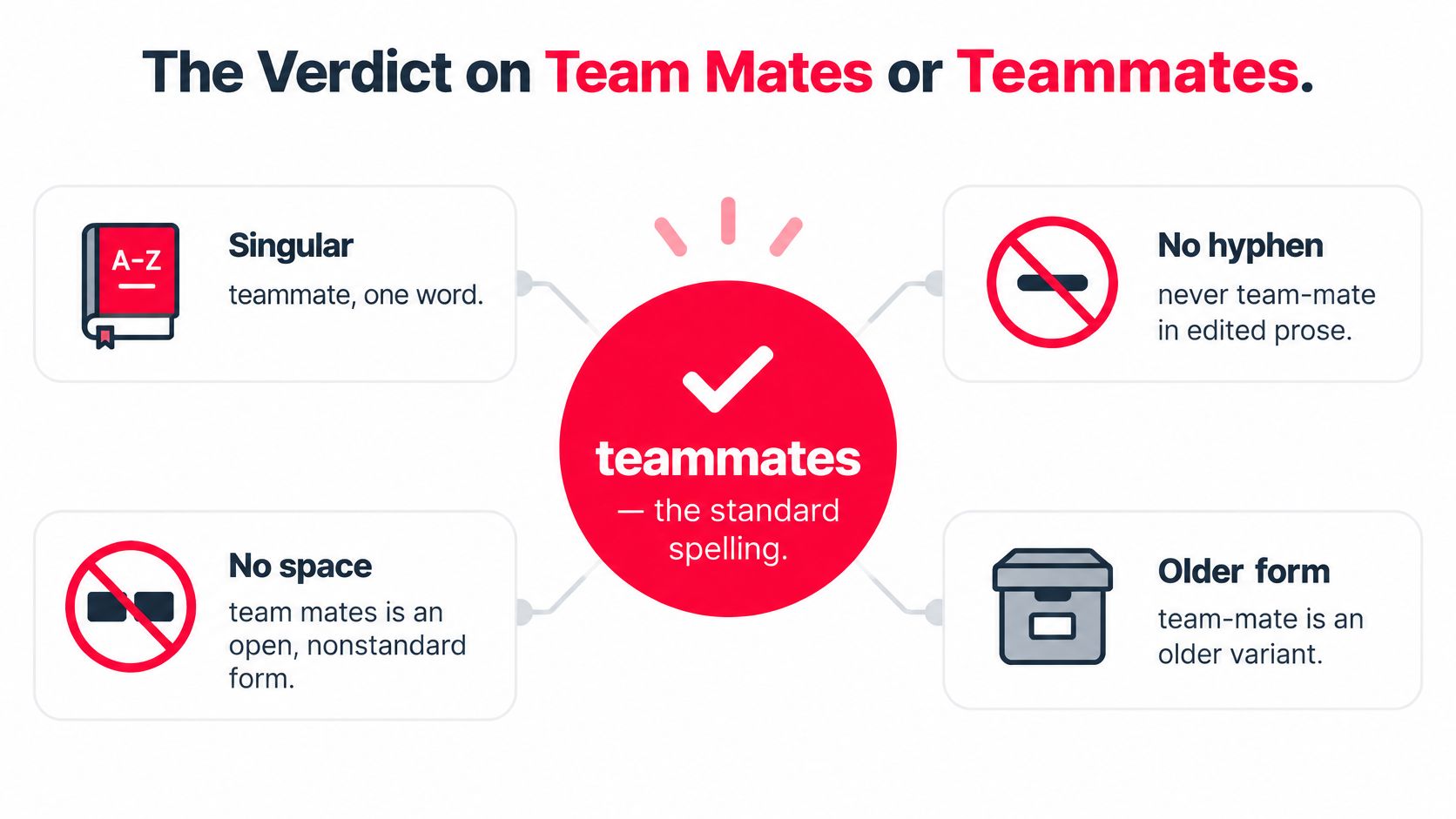
Teammates, one word and unhyphenated, is the standard spelling in modern edited English; team mates is the form to retire. The singular is teammate.
The surprising part is that choosing the right spelling is simpler than choosing the right people. A large-scale study of squad gameplay found that coordination had a statistically significant, curvilinear relationship with performance: more collaboration wasn't automatically better for every team. Spelling has a cleaner default, with only a few exceptions worth preserving.
Whether you're editing a match recap, writing a player bio, or posting a ranked squad request, you can make this decision without turning casual copy into formal prose.
Table of Contents
- The Verdict on Team Mates or Teammates
- Every Spelling Variant Compared
- What Dictionaries and Style Guides List
- When the Space or Hyphen Still Shows Up
- Plurals Possessives and Modifiers
- Teammates in Real Sentences and Your Draft
The Verdict on Team Mates or Teammates
Teammates is the standard plural. Teammate is the singular. Neither needs an internal space or hyphen in ordinary new copy.
Treat team mates as a spelling to correct when you're preparing an article, profile, newsletter, or game interface for publication. Readers will understand it, but understanding a form doesn't make it the best editorial choice. You want the spelling that lets readers continue without noticing the word itself.
Why the closed form makes sense
A closed compound combines its parts into a single written word. Teammate belongs alongside classmate, roommate, and workmate: each names a recognizable relationship, rather than presenting separate words for readers to assemble.
That analogy is useful, but it isn't a universal spelling formula. English also keeps expressions such as team captain open. Learn the established spelling of the particular word rather than closing every phrase that begins with team.
The search question team mates or teammates reflects a genuine source of hesitation. A reader may encounter spaced wording in a forum, a hyphen in British copy, and the closed form in a player profile. Those encounters don't give all the spellings equal standing in a new draft.
Quick checks before you publish
- Check the headword. Look up the singular teammate, not just the plural your sentence happens to need.
- Check your house style. Follow an explicit publication rule if one exists, especially a British rule retaining the hyphen.
- Check the meaning. If you mean another member of someone's team, you need the compound noun.
There are legitimate reasons to preserve a different appearance: quoted older wording, a line-break mark, or a written style requirement. Don't apply those exceptions to every occurrence. Use the comparison below to distinguish the default from a form you're deliberately retaining.
Every Spelling Variant Compared
The easiest way to choose is to match the form to the document you're editing. For a fresh sports report, game listing, or personal bio, the closed singular or plural is the useful choice. The other rows help you recognize wording that may need correction or preservation.
Team mates, teammates, and the hyphen
| Form | Status | Where it still appears | Model sentence |
|---|---|---|---|
| teammates | Standard plural | Edited US and modern UK prose, sports, games | She trusted her teammates. |
| teammate | Standard singular | Dictionaries, bios, AP-style sports copy | He is my teammate. |
| team mates | Nonstandard open plural | Casual posts, older unedited pages | She trusted her team mates. |
| team mate | Nonstandard open singular | Informal chat and forum threads | He is my team mate. |
| team-mate / team-mates | Traditional hyphenated variant | Older British print and British styles retaining the hyphen | She trusted her team-mates. |
The open and hyphenated forms remain understandable. This is a spelling and style distinction, not a change in the person's role. The sentences in the last rows illustrate the variants; they aren't recommendations for new copy.
Match the context, then copy the pattern
For a club website, use a sentence such as She thanked her teammates after the match. For a short individual bio, use Support player and reliable teammate. The number of people determines the ending, while the document's tone determines everything around the word.
A game interface might need only Invite teammate. A recap might need Their teammates stayed behind to applaud. You don't need a different spelling because one is a button and the other is a complete sentence.
The hyphenated row needs a more deliberate decision. If you're maintaining a publication whose written style requires team-mate, retain that spelling consistently. Don't switch halfway through because another contributor submitted the closed form.
Editing principle: Recognize a variant without adopting it. A form can be intelligible, historically familiar, and still be the wrong choice for your draft.
Don't let spell-check make the decision
Microsoft Word, Google Docs, and phone keyboards are useful for finding possible errors, but their suggestions depend on language settings, dictionaries, and saved vocabulary. A program may accept separate words because team and mates are individually valid.
Equally, a checker's acceptance of a hyphen doesn't establish your publication's preferred spelling. Set the document's language, choose your house form, and review suggestions against that decision. A green light from software isn't a style ruling.
What Dictionaries and Style Guides List
A dictionary and a house style answer different questions. A dictionary records a word and may recognize variants; a house style tells contributors which acceptable form to use in a particular publication. Confusing those jobs can turn a straightforward spelling decision into an unnecessary argument.
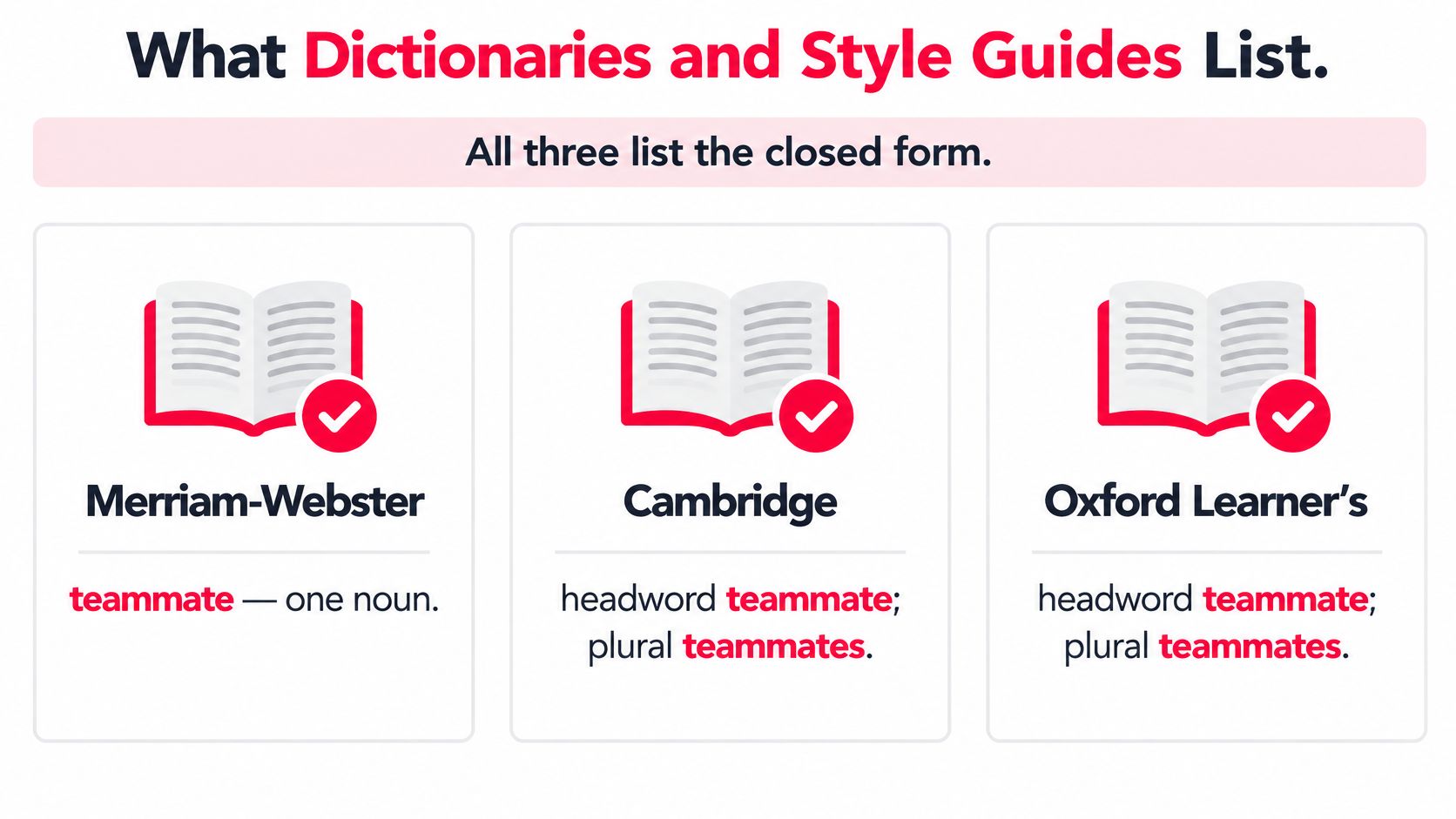
For this noun, the practical reference pattern is the closed headword teammate. Look under that singular form, then apply ordinary plural and possessive endings as your sentence requires.
Read the reference for the right purpose
The distinction below matters particularly for style manuals. A spelling that fits an AP-style article or Chicago-edited manuscript doesn't necessarily come from a dedicated entry discussing that exact word.
Dictionary and style-guide rulings
| Reference | Preferred form | Hyphen | What to copy |
|---|---|---|---|
| Merriam-Webster | teammate | No in the headword | One word in US edited prose |
| Cambridge | teammate | No in the headword | Closed singular and teammates plural |
| Oxford learner's | teammate | No in the headword | Closed headword |
| Collins | teammate | Team-mate recognized as a British variant | Closed form unless house style selects the British hyphen |
| AP Style | teammate in ordinary sports copy | No in the default spelling | Closed noun; don't assume a separate special rule |
| Chicago | teammate as an established compound | No once established | Same practical pattern as classmate |
Use the dictionary entries to settle the base spelling. Use your publication's style sheet to settle consistency, capitalization conventions, and the treatment of quotations. Neither job requires you to invent a special sports-only grammar rule.
Understand the compound without overgeneralizing
English compounds can be open, hyphenated, or closed. Some become familiar enough to be written together, but that process isn't a rule you can apply mechanically to every pair of nouns.
Compare teammate with team meeting. The former names a person in a particular relationship; the latter names a meeting associated with a team. Likewise, team captain remains an open expression even though it describes a recognizable role.
If the person is a member of your side, write teammate. If you mean the group modifying a separate noun, check that expression on its own.
For an editorial team, a short written decision prevents repeated debate. You can browse editorial style guidelines from Zemith for help organizing a style sheet, then record your chosen singular, plural, and treatment of quotations.
Make that entry actionable: Use teammate and teammates in new prose; preserve original spelling in exact quotations. If a named British publication requires team-mate instead, record that exception explicitly. A contributor shouldn't have to infer a rule from whichever article they happened to read last.
When the Space or Hyphen Still Shows Up
Preserve the original spelling inside an exact quotation. If an older club history uses team-mates, modernizing it changes the quoted text. Your surrounding explanation can still use teammates.
The same care applies to official book titles, usernames, and reproduced patch notes. Those are identifiable pieces of wording, not opportunities to impose your preferred spelling. Correct your own prose; reproduce someone else's text accurately.
Separate a spelling hyphen from a line-break mark
A hyphen at the edge of a printed column may mark a word divided between lines rather than the publication's chosen spelling. When transcribing a scanned page, inspect the layout instead of copying every visible hyphen into continuous text.
For example, a scan may end a line after team- and begin the next with mate. Don't assume that proves the original writer chose a permanent hyphenated compound. Check other occurrences on the page or the publication's stated style.
British usage is another reason to avoid an absolute ban. Team-mate remains a recognized British variant, even though the closed form is a sound default for a new article aimed at a broad readership. A regional variant deserves a specific style decision, not a claim that British writers must always hyphenate.
Preserve deliberate wording, not accidental spacing
Wordplay can intentionally separate familiar parts. A heading pairing team mates with soul mates may invite readers to notice the parallel. That's a creative choice, not a model for the ordinary noun.
In a learner's draft, by contrast, the space may reflect knowledge of the separate words team and mate. Fix the compound without treating the writer's entire sentence as wrong. Their vocabulary choice can be appropriate even when the spacing needs attention.
Gaming shorthand deserves the same distinction. An abbreviation such as LFG has its own convention, explained in this guide to looking for group; it doesn't justify splitting teammate. Keep intentional shorthand while correcting the ordinary noun.
For search-focused copy, it's reasonable to mention the alternative spelling when discussing the question itself. Don't scatter the open form through unrelated paragraphs merely to repeat a search phrase.
Apply this final test:
- Quoting original wording? Preserve the spelling inside the quotation.
- Following a written house style? Use its required form throughout your own prose.
- Making deliberate wordplay? Keep the separation only where the joke needs it.
If none applies, close the word.
Plurals Possessives and Modifiers
Choosing teammate settles the base word, but it doesn't settle every ending. Plurality tells readers how many people you mean. Possession tells them whose action, equipment, or information you're describing. An apostrophe can't do both jobs indiscriminately.
Use these contrasts to identify the actual problem before changing the sentence.
| Purpose | Incorrect example | Correct example |
|---|---|---|
| Singular noun | My team mate is ready. | My teammate is ready. |
| Simple plural | My teammate's are ready. | My teammates are ready. |
| Singular possessive | My teammate callout helped. | My teammate's callout helped. |
| Plural possessive | My teammates callouts helped. | My teammates' callouts helped. |
| Noun modifier | We held a teammates meeting. | We held a teammate meeting. |
| Compound modifier | It's a teammate finding app. | It's a teammate-finding app. |
| Verb agreement | My teammates is ready. | My teammates are ready. |
Put the apostrophe where the meaning requires it
My teammate's rank refers to the rank of a single teammate. My teammates' ranks refers to ranks belonging to multiple teammates. If they share a rank, my teammates' rank can also be grammatical, but the surrounding sentence should make that shared status clear.
With names, attach possession to the names rather than adding an unnecessary teammate construction. Alex and Sam's squad describes their shared squad; Alex's and Sam's squads describes separate squads.
A guide to Call of Duty ranked play provides a useful context for sentences about ranks and squads. In your own listing, distinguish teammates needed from my teammate's rank: the first is plural, while the second is possessive.
Hyphenate the modifier, not the noun
In teammate-finding app, the hyphen connects teammate with finding so they work together before app. It doesn't split teammate internally. Similarly, teammate synergy needs no extra punctuation.
Although teammate meeting is grammatically possible, team meeting will usually be the more natural label for a meeting involving the group. A correct construction isn't always the clearest wording.
Keep teammates lowercase in ordinary mid-sentence prose. Capitalize it at the start of a sentence or according to a title's capitalization style. Also keep teammates are distinct from regional choices about the team is or the team are.
Run this self-check:
- Base word: teammate.
- Plural: teammates, without an apostrophe.
- Singular possession: teammate's.
- Plural possession: teammates'.
- Modifier: teammate-finding when it modifies a following noun.
- Agreement: teammate is; teammates are.
Teammates in Real Sentences and Your Draft
A useful correction changes the spelling without rewriting the speaker's personality. A sports reporter, a student, and a ranked player can all use teammates while keeping very different voices. You don't need to turn a quick squad request into a formal announcement.
Use the following as editing models, not quotations from actual matches or publications. Each demonstrates how the closed form fits a particular job.
Sports copy and short displays
Sports recap
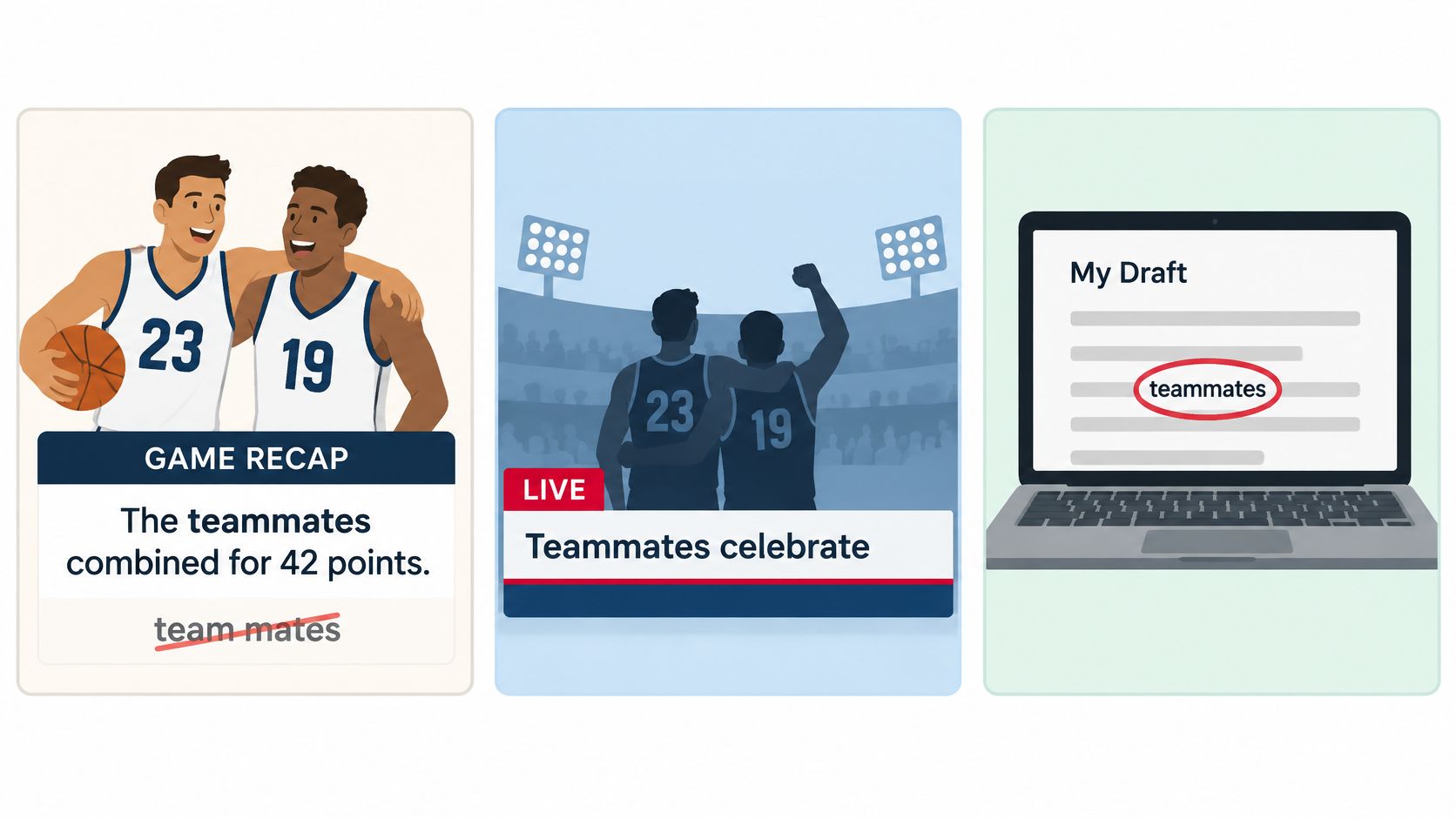
The teammates combined to create the winning chance.
The sentence emphasizes their shared contribution. Replacing a spaced compound with teammates doesn't require changing the action or adding an explanation.
Broadcast chyron
Teammates celebrate
A display line can omit sentence-ending punctuation if that's the broadcaster's style. The shorter format doesn't change the noun's spelling.
Workplace update
Loop in your teammates before the standup.
Keep in after loop for the intended meaning of including colleagues. Spelling cleanup is a good opportunity to notice a missing word, but don't rewrite the sentence beyond what clarity requires.
The same distinction works across sports and gaming examples:
Bios, squad chat, and untouched phrases
School or club bio
Looking for teammates who can scrimmage on weeknights.
Squad chat
Need teammates for ranked. Mic on, evenings.
Player introduction
Patient teammate, direct callouts, happy to practice.
These examples describe availability and expectations without making the voice stiff. Leave game titles, rank names, and intentional slang alone unless they contain a separate error.
Also leave these open expressions alone:
- Meeting notice: The team meeting starts after practice.
- Match recap: Our team captain called the timeout.
- Roster update: The team manager confirmed the lineup.
For an older quotation, preserve an authentic occurrence of team-mates inside the quoted passage, then use teammates in your modern explanation. Don't invent an archival sentence and present it as something a club printed.
Keep spelling separate from character
The spelling doesn't signal skill or loyalty. Teammates names the role; trust depends on how those people play and treat one another.
A profile can be perfectly edited and still tell you little about someone's patience or communication. Use behavioral descriptions alongside the noun, such as respects stopping times or gives concise callouts. The discussion of what makes a good teammate addresses that separate question of conduct.
LyviaXO says GamerPlug makes it easy to find people who match their vibe, not just their rank. That distinction is useful when writing a bio: say what working together should feel like, not merely which competitive label you hold.
Apply the cleanup to your own draft
Paste your sentence beneath the closest model and change only what needs changing. For broader practice, the proofreading habits for student writers from David T.C. Tutoring Services offer a useful companion to a targeted spelling pass.
Publish rule: use the closed compound in your own prose unless a named house style explicitly requires the British hyphen.
- Search the draft for team mate and team-mate. Include headings, captions, bios, and interface labels.
- Confirm that each hit names a person. Leave separate expressions such as team meeting and team captain untouched.
- Replace compound hits with teammate or teammates as grammar requires. Preserve exact quotations, official names, and any explicitly required house-style hyphen.
- If the spelling comparison belongs in your title or search heading, show both strings there once. Use teammates in the body wherever you're naming the people.
Gamerplug helps you find gaming teammates through profiles and squad listings that make your play style, schedule, and mic expectations clear. Visit Gamerplug, write a straightforward teammate bio, and look for players who fit how you want to play.