If your Overwatch badge tells the whole story, why can two players with the same rank feel so different in a match, and why does a reset suddenly make familiar teammates look unranked?
The answer is that visible rank, hidden matchmaking rating, and placement status are different signals. Your badge communicates where you stand on the public ladder. Matchmaking estimates who you should play against, while placements determine how your current results translate into a visible starting point.
Understanding the Overwatch ranks system means learning which signal answers which question. That makes the ladder easier to read, helps you interpret a frustrating session, and gives you better criteria for choosing teammates.
Table of Contents
- Every Overwatch Rank Tier and Division at a Glance
- How the Ladder Changed From SR to Tiers
- Why Visible Rank Is Not Your Matchmaking Rating
- Placements and the 2026 Reset Explained
- Wide Groups and Playing With Friends Across Ranks
- How to Climb One Division at a Time
- Pick Teammates by Rank Range Before You Queue
Every Overwatch Rank Tier and Division at a Glance
| Tier | Divisions | Approx. SR per Division |
|---|---|---|
| Bronze | 5 (lowest) to 1 (highest) | ~100 SR |
| Silver | 5 (lowest) to 1 (highest) | ~100 SR |
| Gold | 5 (lowest) to 1 (highest) | ~100 SR |
| Platinum | 5 (lowest) to 1 (highest) | ~100 SR |
| Diamond | 5 (lowest) to 1 (highest) | ~100 SR |
| Master | 5 (lowest) to 1 (highest) | ~100 SR |
| Grandmaster | 5 (lowest) to 1 (highest) | ~100 SR |
| Champion | None (single tier) | No standard division conversion |
The approximate division sizes above follow Blizzard's Competitive structure explanation, which describes standard tiers as five divisions, each representing approximately 100 SR. Treat that as a way to understand the ladder's granularity, not as a promise that the game exposes an exact SR conversion for every badge.
Blizzard's ranked redesign announcement introduced Champion above Grandmaster in Season 9, beginning in February 2024, describing it as the game's most prestigious rank. The table therefore runs from the lowest tier at the top to the highest at the bottom.
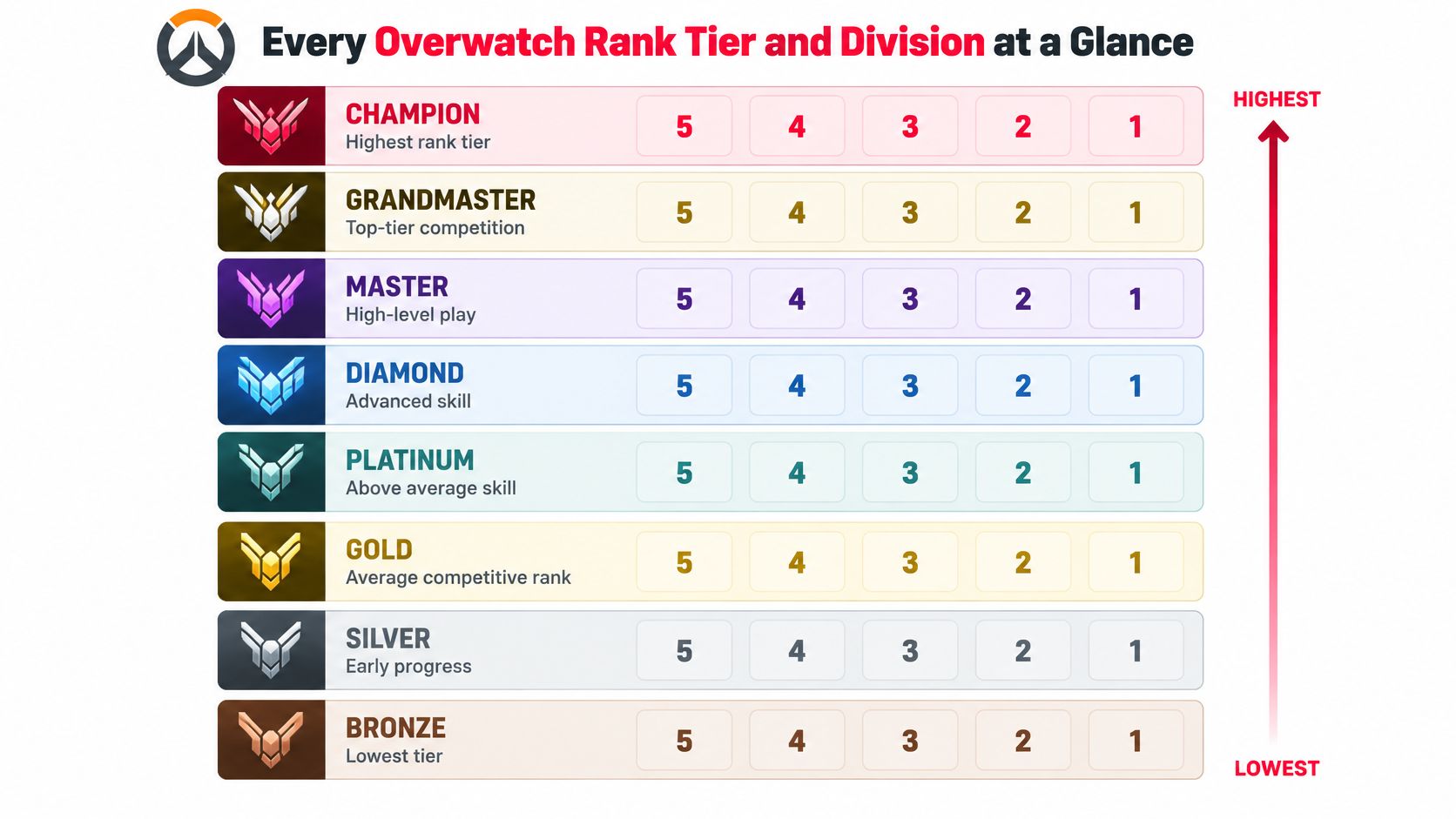
Use the visual ladder to keep the tier order and division direction straight.
Read the tier before the division
Start with the name: Bronze, Silver, Gold, Platinum, Diamond, Master, Grandmaster, or Champion. Then read the division, where applicable. A smaller division number means a higher position within that tier.
For example, consider a player displaying Diamond 3. That badge sits above Diamond 4 and below Diamond 2. The number isn't a count of wins, a season identifier, or a rating out of ten.
A tier change can make this feel backward at first. Moving upward from the strongest division in a tier takes you into the lowest division of the next tier. You've climbed even though the division number becomes larger again.
The badge is useful because players can communicate a recruiting range without discussing an invisible numerical estimate. But don't read more into it than it contains: it isn't a complete description of someone's hero pool, communication, or consistency.
Check the context around your badge
When you open your Competitive profile, make these checks in order:
- Find your tier. Locate its position relative to the surrounding tiers rather than judging the icon alone.
- Confirm your current division. Use the current season's entry, not a career peak or an old screenshot.
- Check placement status. Make sure you're looking at a completed rank for the role or queue you intend to play.
That last detail matters when you invite someone. A familiar badge from a previous season and an unfinished current placement record don't answer the same question. You want the entry that describes the queue you're about to enter.
How the Ladder Changed From SR to Tiers
Say a friend sends you an old screenshot with a large SR number and asks what it means today. Before comparing it with your current badge, establish when that screenshot was taken. Overwatch has changed both its public rating display and how often players receive rank feedback.
Blizzard's Competitive history and redesign explanation describes the move in Season 2, launched in September 2016, from the original 1–100 scale to 1–5000 SR, followed by the 2022 shift to tier divisions and updates after seven wins or 20 losses.
| Era | Scale Shown | Tiers | Feedback After Matches |
|---|---|---|---|
| Season 2, September 2016 | 1–5000 SR | Seven tiers, no divisions | Visible SR era, with inactivity decay above 3000 SR |
| 2022 Competitive redesign | Tiers and divisions, raw SR not shown | Seven tiers, five divisions each | Update after seven wins or 20 losses |
| Later Competitive update | Tiers and divisions | Eight tiers including Champion | Movement shown after every match |
The table describes different versions of Competitive, not rules that all operate together. In particular, the inactivity system belongs to the older SR era; it's not an instruction for maintaining a current badge.
What an old SR screenshot leaves out
Under the historical decay rule, players above 3000 SR needed to complete at least one Competitive match every seven days or lose 50 SR for each 24-hour period of inactivity, with decay unable to take them below 3000 SR. Those conditions are part of Blizzard's historical explanation, not a current maintenance checklist.
That means an old screenshot could reflect more than the player's most recent match result. Activity rules also influenced what the public number showed. Comparing that number directly with a current profile without acknowledging the era creates false precision.
Practical rule: Check the season and interface before applying advice from an old ranked guide.
Feedback changed as much as the badge
The early Overwatch 2 update cycle required patience because players completed a batch of results before seeing a Competitive update. Later updates show rank movement after each match, with modifiers explaining factors affecting the result.
For a returning player, this difference can change how ranked feels. More immediate feedback makes each result visible, but it doesn't make every result a meaningful verdict on your improvement.
Read older forum discussions with that distinction in mind. Someone complaining about delayed updates may be describing an interface you no longer use. Someone discussing raw SR may be talking about a public scale that your current profile doesn't display.
Why Visible Rank Is Not Your Matchmaking Rating
Visible rank answers where your public progression stands. Hidden MMR answers how matchmaking estimates your skill. They're related, but they aren't interchangeable.
Blizzard's matchmaking explanation describes MMR as a numerical estimate of skill and states that Competitive matches use MMR, not visible rank or Skill Division. It also explains that MMR changes after wins and losses and can be adjusted when someone returns after a long absence.
This is why a lobby can look confusing when you inspect only profile badges. You're looking at the public labels, not the actual values the matchmaker used.
Same badge, different context
Consider two hypothetical teammates who both display Diamond 3. One has played regularly on their preferred role. The other has recently returned and is still establishing their current form.
Their matching labels don't prove that the game assigns them identical matchmaking estimates. Nor do they prove that both players currently approach fights with the same awareness, confidence, or hero familiarity.
A player climbing rapidly creates another possible mismatch. Their displayed progression may not yet communicate their underlying matchmaking strength neatly. Calling that player incorrectly ranked based on a single match goes beyond what you can establish from the badge.
The distinction also limits what you can infer from an unexpectedly difficult opponent. You can describe how they played, but you can't calculate their hidden MMR from their public profile.
What the badge can and can't tell you
- Useful communication range: It gives prospective teammates a shared label for discussing the level of play they're seeking.
- Broad progression context: It helps distinguish a current recruiting target from a much lower or higher public tier.
- Not recent form: It doesn't show whether someone is returning, distracted, struggling with a hero, or playing particularly well.
- Not universal role strength: Don't assume a player's confidence on their preferred role transfers to every other role.
- Not an MMR readout: You can't reverse-engineer the hidden matchmaking value from the icon alone.
A compatible badge is a useful starting filter, not a complete teammate assessment.
For teammate discovery, record verified rank, role, recent Competitive activity, and the season or update timestamp together. Each field answers a different practical question: where they're listed, what they play, whether they're active, and whether the information is fresh.
You don't need access to hidden MMR to make a sensible invitation. You need enough current context to avoid treating an old or incomplete badge as the whole player.
Placements and the 2026 Reset Explained
A rank reset doesn't automatically make the player pool stronger or weaker. It changes how players establish their visible positions, which can make the ladder look unsettled even when the overall distribution hasn't changed.
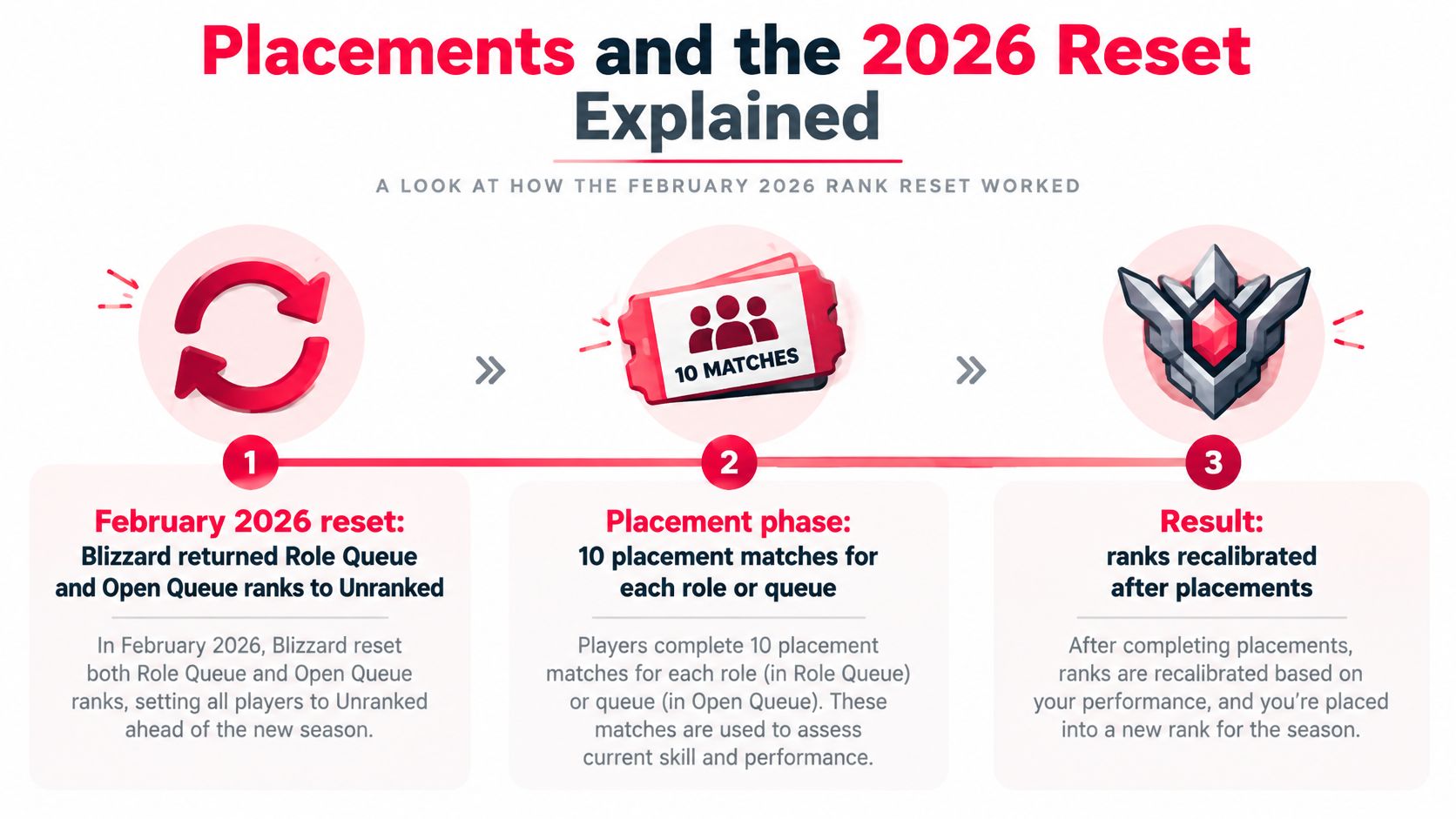
Blizzard's February 2026 patch notes returned Role Queue and Open Queue ranks to Unranked, required 10 placement matches for each role or queue, and explicitly stated that the underlying rank distribution was unchanged.
That last statement is the important correction to blanket claims about resets. An unfinished or surprising badge doesn't establish that the entire population has become better, worse, or easier to climb through.
The reset timeline separates the public status change from the matches used to establish a rank.
Follow the calibration sequence
- The reset removes the current visible rank. Unranked describes placement status, not an absence of skill or experience.
- The player completes placements for the relevant role or queue. Finishing one track doesn't mean every other track is ready.
- The visible result establishes a starting position. Keep evaluating current play rather than treating that first result as an immutable judgment.
- Ordinary Competitive feedback continues afterward. Read the update and its explanatory modifiers instead of assuming every change has the same cause.
Returning players can find this especially disorienting. They remember the rank they used to hold, while teammates see an incomplete or newly calibrated entry. Neither should substitute memory or first impressions for recent matches.
For a companion discussion of the ranked experience, use the video below.
Recruit differently during placements
During calibration, ask which role someone has played recently and what kind of session they want. A duo trying to rebuild coordination needs a different conversation from a group expecting polished, familiar strategies immediately.
Look for recent role-specific clips, clear communication habits, and relevant match history. A clip showing positioning and decision-making is more useful for this purpose than an isolated highlight with no context.
Don't reject someone solely because their first post-reset badge looks unusual. Equally, don't assume an impressive previous peak guarantees that they're ready to perform at that level today. Give the current evidence room to develop.
Wide Groups and Playing With Friends Across Ranks
Playing ranked with a friend isn't only a question of whether the game lets you queue together. You also need to understand how a large skill gap changes the experience and how progression is handled.
The Xbox Wire explanation of Overwatch's fair-play systems describes Wide Groups as including Diamond-or-lower players more than five Skill Divisions apart, Master players more than three divisions apart, or any group containing a Grandmaster or Champion player.
As a worked example, Gold 2 to Platinum 1 crosses six division boundaries, so that pairing is wide under the Diamond-or-lower rule. Gold 2 to Platinum 4 crosses three boundaries, so those two players alone wouldn't trigger that threshold.
Choose the experience you actually want
| Queue choice | Main benefit | Trade-off to consider |
|---|---|---|
| Solo queue | You can focus on your own decisions and schedule | You start without established teammate communication |
| Narrow-rank group | You can build routines with players at a comparable public level | Similar rank still doesn't guarantee compatible goals |
| Wide Group | Friends with substantial rank differences can play together | Different expectations and progression need discussion |
Solo queue makes sense when your immediate aim is to review your own play without coordinating a regular party. You still need to communicate and adapt, but you're not negotiating a session around a friend's learning pace.
A narrow-rank group is useful when you want repeatable practice. Teammates can agree on engagements, hero combinations, and review habits without deliberately introducing a large public skill gap.
A Wide Group prioritizes access to friends. That can be the right choice, provided everyone understands that playing together and climbing identically aren't the same promise.
Discuss progression before queueing
Blizzard's progression modifier is intended to prevent lower-ranked players from being unfairly boosted by higher-ranked teammates. Don't expect every party member to receive matching progress just because you shared the same result.
The lower-ranked friend shouldn't feel responsible for proving they belong, and the higher-ranked friend shouldn't treat every disagreement as a coaching opportunity. Agree whether the session is social, practice-focused, or a serious climb before entering the queue.
Platform compatibility is a separate check from rank eligibility. Review cross-platform compatibility before organizing the party rather than assuming a shared game title guarantees the same ranked options.
Recruit for rank range, role, communication style, and goals together. The highest-ranked available player isn't automatically the best fit for the group you're trying to build.
How to Climb One Division at a Time
A useful climb plan gives you something to do after a difficult match besides queueing again in frustration. Choose a repeatable role, a specific review question, and a stopping condition before the session starts.
Keep the process small enough that you'll repeat it. You're trying to improve decisions you can control, not manufacture a winning streak on demand.
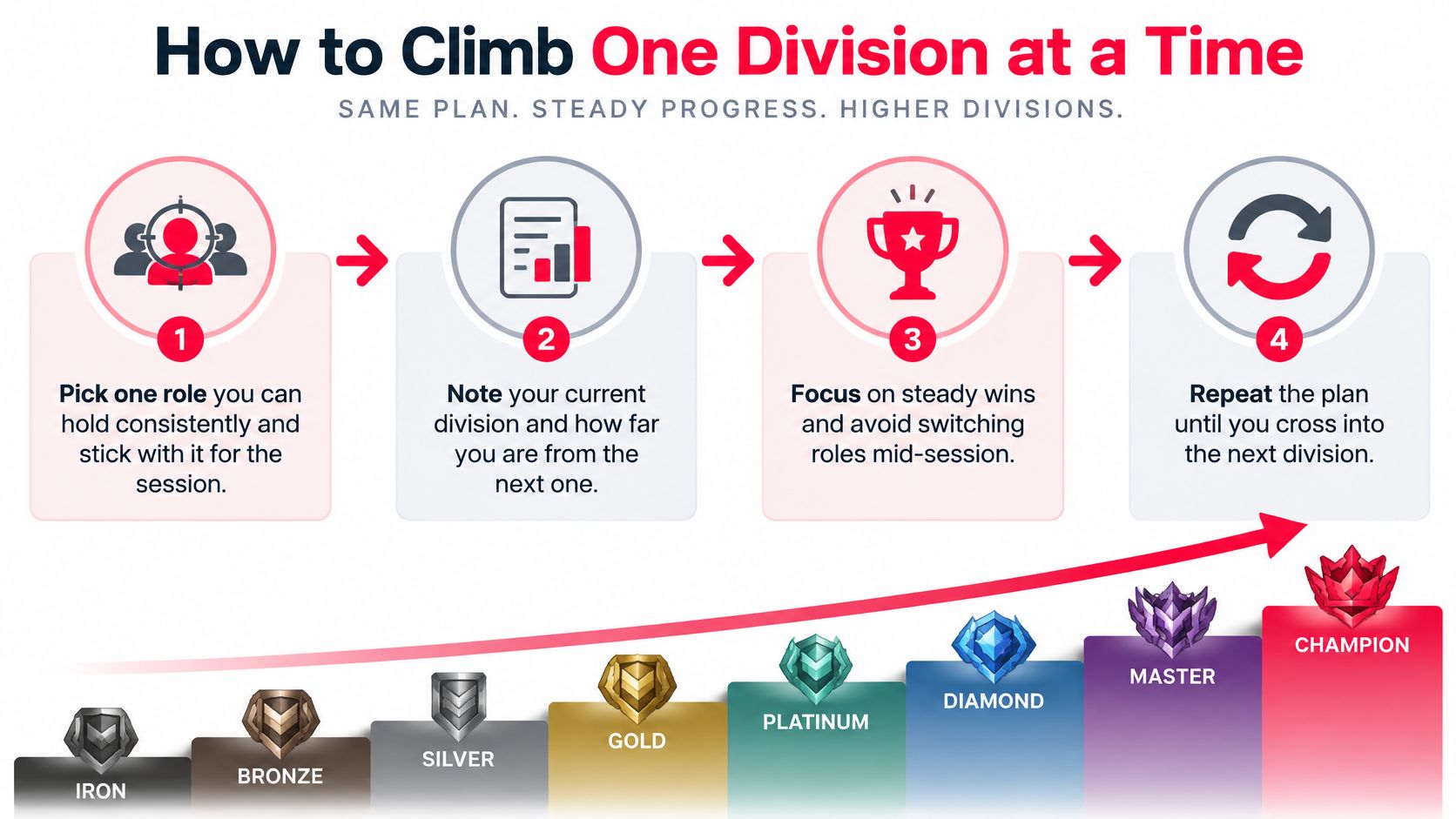
Use this flow as a reminder to keep the session focused.
Build a repeatable session
Pick a role you can hold consistently. Stay with it for the session so you can compare similar decisions across matches. Hero swaps can still be sensible responses to the map or enemy composition.
Record your starting division and displayed progress. Use the information the client provides instead of inventing an exact hidden rating. Your immediate target is the next boundary, not a distant peak that makes ordinary progress feel insignificant.
Review the Competitive Update, then review your play. Modifiers explain rank movement, but they aren't a diagnosis of your positioning or cooldown usage. Use a replay to identify a decision you could change, such as entering a lost fight or spending a defensive ability too early.
Stop when frustration changes your decisions. Warning signs include chasing staggered enemies, arguing instead of communicating, and queueing only to recover a loss. Take a break rather than treating another match as an obligation.
Compare sessions across the week. Track the role, starting and ending position, and the habit you practiced. That gives you a more useful record than remembering only the most painful defeat.
Avoid changes that hide the lesson
- Changing everything after a loss: Swapping your role, hero pool, sensitivity, and approach together makes it hard to identify what helped.
- Judging progress by a bad session: Review the actual mistakes before deciding that your practice isn't working.
- Reading modifiers as personal feedback: Separate the explanation for rank movement from the gameplay decision you want to improve.
For example, suppose a Platinum player holds a consistent role and reviews unnecessary deaths across several sessions. Their notes can reveal whether they're surviving engagements more reliably, even when individual match outcomes vary.
A player who changes role whenever they lose has a harder comparison to make. They may be practicing different responsibilities without giving any particular habit enough attention.
Use these ranked gameplay improvement tips to support that review routine. A healthy climb means more repeatable decisions and a steadier trend across sessions, not an exciting streak followed by an exhausted recovery attempt.
Pick Teammates by Rank Range Before You Queue
Choose a compatible range before you choose a name. That keeps recruitment focused on the session you want instead of the most impressive badge you happen to find.
A good invitation answers practical questions before anyone loads into a match. You should know which mode you're playing, who fills each role, and whether everyone expects calm practice or an intensive climb.
Use a pre-queue checklist
- Confirm the current badge: Ask for the relevant season, tier, and division rather than accepting a career peak as the recruiting standard.
- Check placement completion: Establish whether the intended role or queue has a completed current rank.
- Choose a nearby range: Keeping recruitment close to your own tier is a practical starting habit, not an official grouping rule.
- State your role and mic status: Don't leave the group to discover a missing role or mismatched communication expectations after queueing.
- Review recent play: Look for decisions, teamwork, and a representative role, not just an impressive elimination sequence.
The point isn't to interrogate prospective teammates. It's to prevent avoidable mismatches that neither player enjoys.
Write a squad post people can assess
Use the same concrete fields in your post: game mode, rank range, platform, mic requirement, and open slots. Add a short sentence about your goal, such as practicing coordinated engagements or playing a focused ranked session without blame.
For example, a support player could describe the role they're filling, the nearby rank range they want, and whether voice callouts are expected. That tells a prospective teammate far more than asking for good players.
When posting a squad on Gamerplug, we let you choose the game mode, rank range, platform, and whether a mic is needed. Keep those settings aligned with the invitation rather than advertising one kind of session and expecting another.
If you're unfamiliar with the terminology, this looking-for-group guide explains how LFG fits teammate discovery. Use the listing to start a conversation, then confirm the details that matter for your party.
Post or join a squad this week with a range suited to your current tier. After a short run of matches, assess communication, role fit, and whether you'd willingly queue together again.
Gamerplug helps you find gaming teammates and organize squads around your mode, rank range, platform, and mic preferences. Build a listing around your current Competitive role and the session you want, then invite players whose goals fit yours.