3.6 billion people were expected to play games in 2025, and the strongest way to find reliable teammates isn't a single online gaming platform. It's a workflow that combines social features, verified ranks, and LFG tools around the games and devices you use.
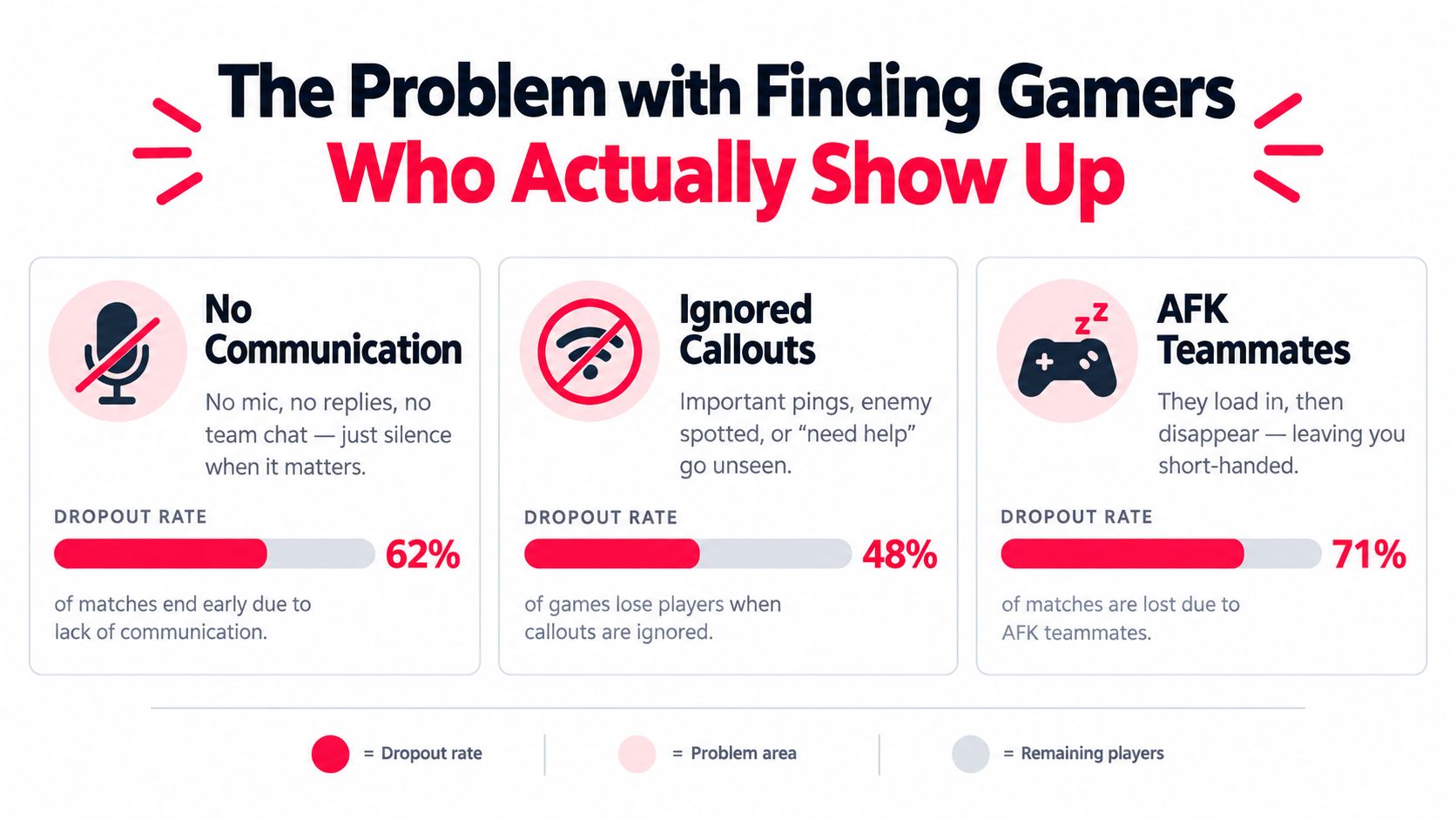
You know the session. You queue for ranked Apex Legends, hoping to build a serious squad, and get paired with players who never use a microphone, ignore callouts, or treat a coordinated match like a solo warm-up. One teammate disappears between rounds. Another has a completely different idea of “playing seriously.” By the time the match ends, you're back where you started, searching for gamers who'll show up.
That frustration sits inside a huge ecosystem. Newzoo estimated that 3.6 billion people would play games in 2025, representing 61.5% of the world's online population, with projected games revenue of $188.8 billion for that year. Mobile was expected to reach approximately 3.0 billion players, compared with 936 million PC players and 645 million console players. The figures overlap because many people play across devices, but they show why teammate discovery now needs to work across PC, console, and mobile communities. Newzoo's 2025 Global Games Market Report provides the market context.
A modern online gaming platform is more than a lobby with a chat box. It can combine a player profile, rank signals, game and platform filters, communication tools, reputation features, and looking-for-group posts. The important shift is that trust and social fit belong beside skill rank, not after it.
Table of Contents
- The Problem with Finding Gamers Who Actually Show Up
- Core Features That Define Modern Gaming Platforms
- Social Platforms Versus Competitive Platforms
- How Cross-Platform Play Changes Team Building
- Building an Effective LFG Workflow
- Avoiding Toxic Players and Mismatched Expectations
- From Random Matches to Consistent Squads
The Problem with Finding Gamers Who Actually Show Up
You post an LFG request for Valorant teammates. The first reply says “I'm down,” but gives no rank, schedule, or communication preference. The second player has the right rank but starts blaming everyone after the first lost round. A third joins voice chat, says nothing, and vanishes before the next game.
None of these players is necessarily bad at the game. They're poor matches for the session you wanted. Rank can tell you something about ability, but it can't tell you whether someone communicates clearly, respects the team, or has time to finish the session.
Why ordinary matchmaking falls short
Built-in matchmaking usually optimizes for getting players into a game. It doesn't always explain why those players belong together as a squad. A ranked system may group people within a broad skill range, while leaving out practical details such as preferred role, microphone use, session length, region, or attitude toward mistakes.
That creates a familiar mismatch:
- Mechanical fit: Players may have similar ranks but different levels of consistency.
- Communication fit: One teammate may want constant callouts, while another prefers silent play.
- Schedule fit: A player looking for a regular evening squad won't benefit much from someone available only occasionally.
- Social fit: A technically strong player can still damage team chemistry through insults, baiting, or refusal to cooperate.
Community design matters here. A useful resource such as PostSyncer on community growth tactics can help explain why clear participation norms and repeat interaction matter. In gaming, those principles become practical filters for finding people who contribute to a stable group rather than appearing once and disappearing.
The market is bigger than a niche
Online gaming has become a major commercial segment. Grand View Research valued the global online gaming market at $144.6 billion in 2025 and projected $280.3 billion by 2033, with an 8.1% compound annual growth rate from 2026 through 2033. Asia-Pacific represented 38.6% of global revenue in 2025, showing that a globally minded gaming service can't treat one Western market as the whole audience. Grand View Research's online gaming market analysis offers that market estimate.
The practical lesson is simple. Finding a teammate isn't only a matter of searching harder. You need enough information to decide whether a player fits your game, rank, role, region, schedule, communication style, and safety boundaries before you commit to a full session.
Core Features That Define Modern Gaming Platforms
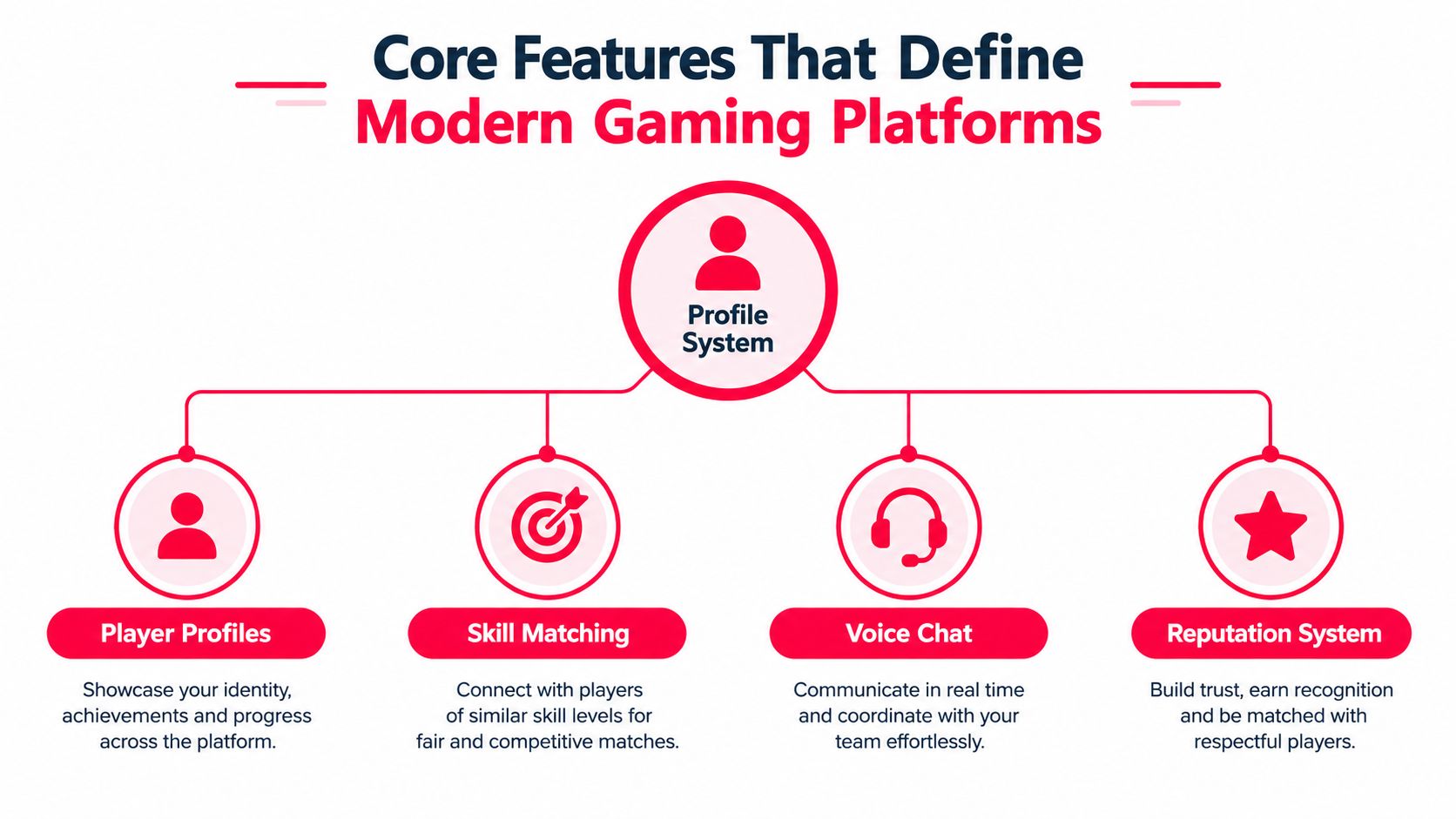
A quality online gaming platform starts with a profile that answers useful questions before anyone joins a party. A username and avatar establish identity, but they don't show whether a player has the right role, rank, temperament, or availability for your squad.
The strongest systems connect several features into one discovery loop. You describe what you need, review evidence from potential teammates, communicate in a controlled space, and build a record of positive interactions.
Profiles that give context
A useful profile can include gameplay clips, verified ranks, preferred roles, mic usage, team-play preferences, platform, and schedule. Each field reduces uncertainty. A clip can show whether someone communicates under pressure. A schedule can prevent a promising duo from failing because the players are never online together.
Verification also needs careful handling. A displayed rank is more useful when it connects to an official game account or another credible signal, rather than relying only on a typed claim. Still, verification doesn't prove that two people will have good chemistry. It confirms one part of the match, not the whole relationship.
Matching beyond a single rank
Microsoft Research's TrueSkill framework models ability as an estimate with uncertainty and updates it after matches. It was designed for multiplayer and team-based games, where individual ability must be inferred from team outcomes. For an LFG service, that suggests storing more than visible rank. A useful candidate score can consider skill estimate, confidence, recent activity, role, game mode, region, and preferred schedule. The research on role-based matchmaking and TrueSkill explains why uncertainty matters.
Practical rule: Treat rank as the starting filter, not the final verdict.
Communication tools then turn discovery into coordination. Group chat, direct messages, tournament threads, mentions, and reactions let players clarify expectations before entering a match. Voice chat can help a team act quickly, but it should never be the only trust signal. Players need reporting, blocking, and moderation options when communication becomes abusive.
For a deeper look at how competitive communities organize around structured play, explore competitive gaming platforms. The key design principle remains consistent: profiles create context, matching narrows the field, communication tests chemistry, and reputation protects the community.
Social Platforms Versus Competitive Platforms
Social-first and competitive-first platforms can both help you find gaming teammates, but they solve different problems. Choosing the wrong type can leave you with a friendly community that doesn't match your ranked goals, or a highly filtered player pool that feels cold and difficult to join.
A social-first platform emphasizes connection before optimization. You might browse players by shared interests, join a persistent club, discuss games, exchange clips, or find a casual Fortnite group. The platform helps you build a wider gaming circle, and the relationship can continue even when nobody is chasing a leaderboard.
A competitive-first platform starts with the match objective. Rank, role, mode, region, schedule, and communication requirements shape discovery. Social features still matter, but they support a specific outcome, such as finding a Valorant controller player for a ranked session or assembling a League of Legends duo with compatible availability.
| Feature | Social-First Platforms | Competitive-First Platforms |
|---|---|---|
| Main purpose | Build connections and communities | Form effective teams for coordinated play |
| Discovery | Interests, games, clubs, and personality | Rank, role, mode, platform, region, and schedule |
| Profile emphasis | Identity, clips, interests, and community activity | Verified skill, availability, role fit, and performance context |
| Communication | Persistent community chat and casual conversation | Direct coordination for parties, matches, and tournaments |
| Best fit | Casual groups, new friendships, and broad game discovery | Ranked queues, organized squads, and amateur competition |
| Main risk | Friendly contacts may not share your commitment | Efficient matching may overlook social comfort and safety |
Match the tool to the session
Suppose you want relaxed Fortnite games after work. A social-first space may be ideal because personality and low-pressure interaction matter more than exact rank. If you're preparing for a serious Apex Legends ranked climb, a competitive-first workflow gives you better control over role, skill range, region, and schedule.
Many platforms blend both models. That blend can work well, but only if you know which objective comes first for the current session. Start by asking, “Am I trying to meet people, or am I trying to complete a specific team?”
A good teammate search doesn't maximize the number of replies. It improves the quality of the next session.
The safest approach combines both layers. Use competitive filters to narrow the pool, then use clips, messages, and a short trial match to assess social fit. A player who meets your rank requirement but makes everyone uncomfortable isn't a successful match. Compatibility includes whether people can communicate, disagree, and reset after a bad round without turning the party hostile.
How Cross-Platform Play Changes Team Building
Cross-platform play expands the pool of potential teammates, but it also adds information that an LFG post must make visible. A PC player, a PlayStation player, and an Xbox player may all be eligible for the same match, yet still differ in input method, voice setup, performance expectations, or access to a particular ranked queue.
For games with broad cross-play support, a larger pool can make it easier to find a teammate who matches your role and schedule. Fortnite and Apex Legends are familiar examples of games where squads can span devices. In other titles, matchmaking rules may limit which platforms can join a party, so a clear platform filter prevents an invitation that can't work.
Show compatibility before the invite
A useful profile should answer four practical questions:
- Device: Is the player on PC, PlayStation, Xbox, Nintendo Switch, or mobile?
- Input: Does the player use mouse and keyboard, controller, or touch controls?
- Party access: Can the account join the requested cross-play or ranked queue?
- Communication: Will the player use in-game voice, a platform chat, or text?
These details don't decide whether someone is a good person to play with. They prevent avoidable friction. You shouldn't discover after adding a player that the game mode or platform rules keep them out of the party.
Cross-platform discovery also increases the importance of region and network quality. Matchmaking research treats geography and latency as operational constraints alongside skill. A controlled FPS study tested latency from 0 to 100 milliseconds and reported that each additional 100 milliseconds of latency was associated with an approximately 25% decline in measured performance and quality of experience, although the effect varied by condition and task. Separate cloud-gaming measurement work identified roughly 80 milliseconds as a point where latency begins to appreciably affect user experience. The latency and jitter study supports showing connection quality as part of team compatibility.
A platform can turn that technical issue into a simple player-facing signal. Match within compatible server regions, show a connection indicator where possible, and warn users when a proposed squad spans locations likely to produce delay. Good team building isn't only about who can play together. It's about who can play together under workable conditions.
The following video can help newer players visualize how connected gaming communities bring different devices into one social environment.
Building an Effective LFG Workflow
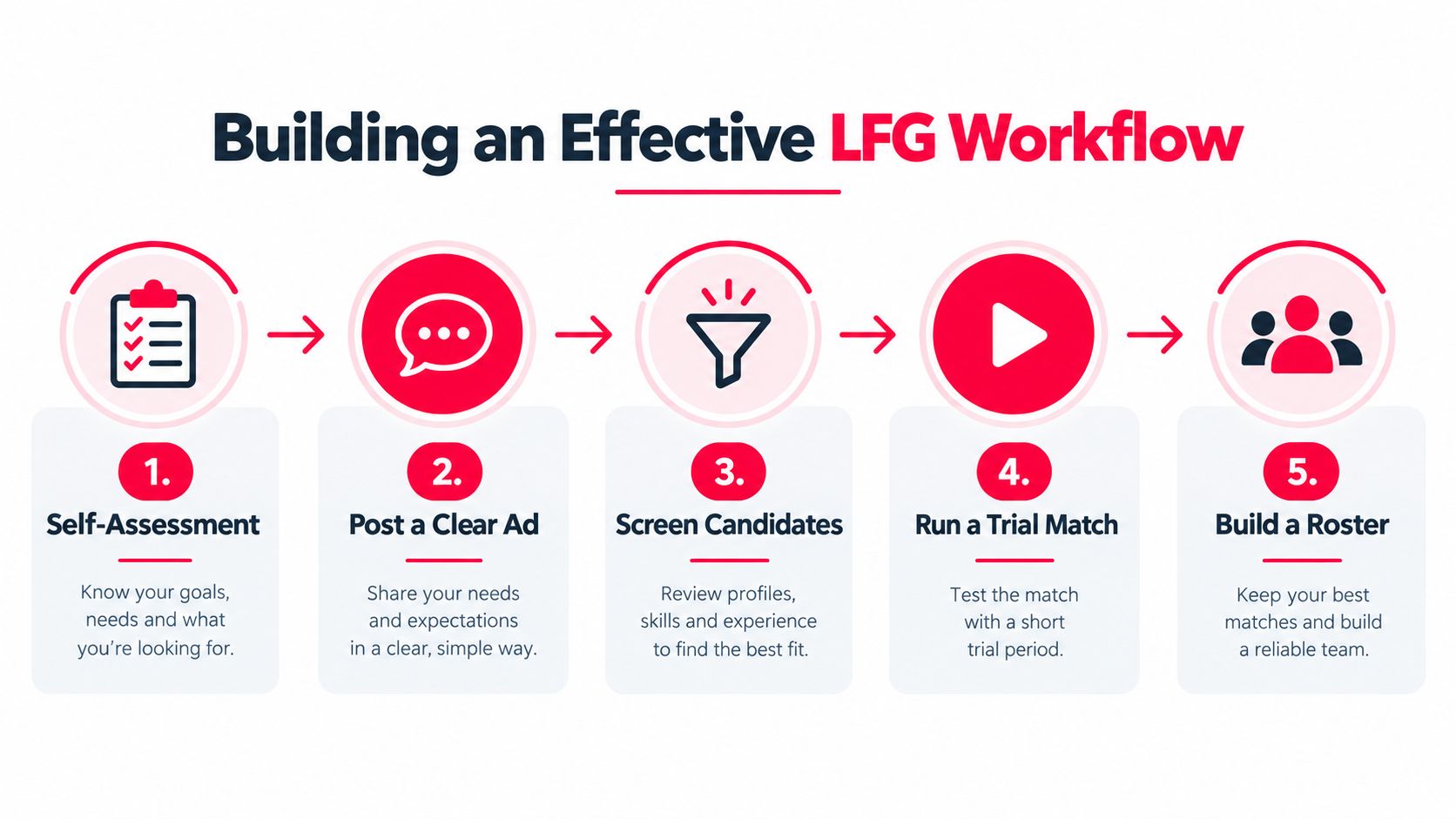
An effective LFG process starts before you open the player feed. If you don't know what you offer and what you need, every reply will feel equally promising, and you'll waste time testing players who were never a fit.
Start with a useful self-assessment
Write down your game, mode, rank range, role, platform, region, normal schedule, and communication preference. Add the behavior you want to bring to the squad. “I play ranked Apex and want teammates who communicate” is a start, but “I play ranked Apex on weekday evenings, use a microphone, prefer structured callouts, and want to review mistakes without blame” gives people something concrete to respond to.
Your post should also state what you don't need. If you're happy with text chat, say so. If you need a microphone for coordinated play, make that visible. Clear expectations reduce mismatched replies and give respectful players a reason to trust your listing.
Turn the post into a filter
A strong LFG post answers the questions a teammate would otherwise need to ask privately:
- Game and mode: Name the title, queue, and objective.
- Skill range: State the rank or experience range you can support.
- Team structure: Mention the role or position you need.
- Availability: Give the session window you can honor.
- Communication: Explain whether voice chat is required.
- Culture: State whether the group is competitive, relaxed, educational, or mixed.
- Next step: Ask interested players to share the detail you need to screen them.
A detailed post isn't elitist. It's respectful. It saves another player from joining a session that doesn't suit them, and it makes your own search more efficient. For terminology and practical examples, use this guide to what LFG means.
Screen, test, and retain
Review profiles for verified information, recent activity, clips, and signs of compatible behavior. Then run a short trial session instead of promising a long-term roster immediately. Watch how the player handles a missed shot, a disagreement about strategy, and a teammate who makes a mistake.
Screen for recovery: The best squadmates aren't flawless. They communicate after a bad round and reset quickly.
If the trial works, follow up while the session is fresh. Agree on the next play time, preferred channel, and whether the group needs a shared server. A small community may only need a simple group chat, while a larger roster can benefit from a more structured setup. This guide to running Discord at scale is useful when a casual group grows into a community with roles, channels, and moderation needs.
Avoiding Toxic Players and Mismatched Expectations
A high rank doesn't excuse harmful behavior. Players often treat toxicity as an unfortunate side effect of competitive games, then focus every screening question on skill. That reverses the priority. A teammate who damages communication can make a mechanically strong roster less effective and less enjoyable.
A 2026 Secure Communities Forum study found that 75% of respondents had encountered hate speech, harassment, or toxic behavior in the previous six months. The study identified voice chat as the leading surface for harmful behavior for 45.7% of respondents, while 29.8% of people who filed a report said they received no response. The sample was small, with 70 respondents, and geographically concentrated, so it shouldn't be generalized to all gamers. It still highlights why a teammate-finding service needs clear safety tools and useful guidance. The Secure Communities Forum research is referenced through the tournament and esports research page.
Set boundaries before the queue
Put expectations in the LFG post, not after the first conflict. Say whether harassment, slurs, personal attacks, rage quitting, or unsolicited contact outside the game will end the session. You don't need a long legal document. One direct paragraph can tell potential teammates what kind of squad they're joining.
Check for early warning signs:
- Blame as a habit: They insult previous teammates before discussing the match.
- Boundary testing: They push for private information or off-platform contact immediately.
- Communication control: They talk over everyone, reject every callout, or punish disagreement.
- Unreliable participation: They confirm repeatedly but disappear without notice.
- Escalation: They turn a small error into threats, targeted abuse, or sustained harassment.
A trial match gives you a safe exit. You can leave after one session without creating the social pressure that comes with removing someone from an established roster. Keep personal details private, use platform messaging when possible, and block or report behavior that crosses your stated boundaries.
Treat reporting as part of the product
Reporting only helps when players understand what it does and when platforms communicate the outcome. If a service offers reporting, blocking, moderation, and verification, those features should be easy to find before a problem occurs.
The same principle applies to positive behavior. Respond on time, say when your schedule changes, and don't make new teammates guess whether the next session is still happening. For more practical community guidance, see toxic-free gaming and positive communities.
Safety isn't a soft extra around matchmaking. It affects whether players can communicate, return, and build a squad they trust.
From Random Matches to Consistent Squads
The transition from random matches to a regular roster usually happens through small, repeatable habits. A player posts a specific request, checks the replies against clear criteria, runs a trial, and follows up with the people who made the session better.
Consider a hypothetical Apex Legends player who wants a dependable ranked group. Instead of posting a broad request, they describe their platform, role preference, available session window, microphone requirement, and desired commitment. They review profiles for verified rank and recent clips, invite a small group to a trial session, and pay attention to how each person communicates after a lost fight.
One player has excellent aim but blames the support player. Another has a lower visible rank but listens, shares information, and stays calm when the plan fails. The second player becomes the better long-term choice because a squad needs repeatable decision-making, not isolated highlights.
Build a roster through follow-up
After a good session, send a specific message. Mention what worked, suggest the next time to play, and confirm the role or mode you want to repeat. Keep notes on availability and preferred communication so the next invitation feels intentional rather than random.
As the group stabilizes, structured competition can create a reason to keep showing up. Tournament brackets, check-ins, tracked results, and shared goals give a temporary party a common history. Community leaders who later want to connect audience activity with creator opportunities can explore guidance on how to turn community ties into sponsorships.
Roster habit: Reward reliability with another invitation. Don't wait for a perfect match before building consistency.
The strongest squad manager isn't always the highest-ranked player. They make expectations visible, protect the group culture, communicate schedule changes, and choose teammates who improve the session for everyone. That is the difference between using an online gaming platform as a random contact list and using it as a teammate discovery and retention system.
GamerPlug offers gameplay-clip profiles, verified ranks, player discovery, squad listings, chat, and tournament tools for players across PC, PS5, Xbox, and Nintendo Switch. If you're ready to stop gambling on randoms and start screening for skill, schedule, communication, and fit, visit Gamerplug and create a squad workflow that matches the way you play.