
Your registration list looks healthy, but check-in tells a different story. A captain is still finding a substitute, another team hasn't answered, and someone wants to know why their opening opponent got an easier draw.
That's the core work behind learning how to make tournament brackets. You need a format that fits the evening, a defensible seed list, and a clear point when attendance stops changing the draw. Build around the teams that are truly ready to play, not the names that filled out a form.
Table of Contents
- Choosing Single Elimination, Swiss or Round Robin
- Byes and Match Counts for Common Field Sizes
- How to Seed Teams Fairly Before the First Match
- Handling Check-Ins, No-Shows and Redraws
- Build, Schedule and Publish the Bracket
- Bracket Tools Compared and What Each One Handles
Choosing Single Elimination, Swiss or Round Robin
Format fit by field size and time
These are illustrative planning fields, not participation requirements. Match totals are calculated from each format's rules.
| Format | Best for | How a team leaves | Matches for 8 teams |
|---|---|---|---|
| Single elimination | A short evening with a hypothetical field of 8 to 32 teams | One loss | 7 |
| Double elimination | A hypothetical field of 6 to 16 teams, with one-loss forgiveness | Two losses | 14, plus a possible grand final reset |
| Swiss | A hypothetical field of 16+ teams wanting several games each | Never eliminated, ranked by record | 12 in an illustrative 3-round schedule |
| Round robin | A hypothetical group of 4 to 8 teams | Never eliminated, ranked by wins | 28 |
Single elimination is the easiest format to finish under a hard deadline. You advance winners, close out losers, and don't need to maintain standings across the whole field. The trade-off is blunt: a capable team can have a bad opening game and spend the rest of the evening watching.
Double elimination gives that team another route. It also creates more scheduling dependencies, because players moving through the losers bracket may need to play while others wait. Don't choose it just because the bracket looks more substantial.
Decide what you're promising players
Swiss suits an event where participation matters as much as finding a winner. You set the round count in advance, pair teams by record as play progresses, and publish tiebreakers before registration closes. More rounds separate the standings more clearly, but nobody should discover halfway through that the advertised finish time has moved.
Round robin gives every team the same set of opponents. That makes the schedule easy to understand, but the workload expands quickly because every additional entrant needs a match against everyone already entered.
For either standings-based format, specify how ties are broken. Match wins might come first, followed by head-to-head where applicable, then an opponent-strength or game-differential measure appropriate to your rules. Don't invent that order when the final standings produce an inconvenient tie.
Practical rule: Promise a format your staff can finish, not the format you'd enjoy running with unlimited time.
Also check whether your game fits head-to-head elimination. Valorant and League of Legends map naturally to team-versus-team matches. An Apex Legends or Fortnite battle royale event may need lobby standings instead; decide what counts as winning a pairing before drawing anything.
Count your available hours, lobby capacity, and staff coverage first. Then choose the format that fits inside them.
Byes and Match Counts for Common Field Sizes
For a conventional elimination bracket, use the smallest power-of-two bracket that can hold the field. Empty opening-round positions become byes, while the number of played matches follows from how many teams must be eliminated.
Bracket slots, byes and match counts by team count
The following hypothetical fields show the arithmetic: slots minus teams gives byes, and teams minus the eventual champion gives single-elimination matches.
| Teams | Bracket slots | Byes | Single elimination matches |
|---|---|---|---|
| 4 | 4 | 0 | 3 |
| 6 | 8 | 2 | 5 |
| 8 | 8 | 0 | 7 |
| 10 | 16 | 6 | 9 |
| 12 | 16 | 4 | 11 |
| 14 | 16 | 2 | 13 |
| 16 | 16 | 0 | 15 |
Those match counts assume the field completes the event. A forfeit can advance a team without a played match, so don't confuse bracket results with games that really happened.
Put byes where your seeding policy says
Say you're running a hypothetical 10-team Apex Legends event using a defined head-to-head challenge format. A 16-slot draw leaves 6 byes, which would go to the highest seeds under a seeded-bye policy.
Use a standard seeded template rather than dropping empty spaces wherever the diagram looks balanced. Spread the strongest seeds through separate bracket paths so they can meet late, and ensure an opening match feeds into the intended waiting opponent. Don't place empty slots against each other.
A bye is an advancement, not a match win earned in play. Keep that distinction clear if your event also tracks performance statistics or awards based on games won.
A team with a bye still needs a reporting time. Don't tell its captain to watch the bracket indefinitely.
Publish both the expected call time and the channel where staff will announce changes. Waiting teams should know whether they must remain in the lobby or can step away until called.
Round robin needs different arithmetic because every pair must play. For hypothetical fields of 6 and 10 teams, calculating teams multiplied by opponents and dividing by two produces 15 and 45 matches respectively. That's a scheduling decision, not just a different-looking diagram.
Use the tournament bracket sizes guide when checking your layout. Write down the field size, required slots, and bye allocation before entering names.
How to Seed Teams Fairly Before the First Match
Seeding arguments usually start when organizers use a reasonable measure inconsistently. A published rule won't make every captain happy, but it gives staff something firmer than personal opinion.
Make the ranking reproducible
Pick one seeding source and announce it. Use verified in-game rank, the previous event's results, or a published rating method. State when you'll capture that information so a last-minute rank change doesn't trigger another argument.
Sort teams from highest to lowest seed using that method. If you're aggregating player ranks into a team rating, explain which roster members count and how substitutes affect the calculation.
Break ties with an announced rule. Head-to-head results can work when the teams have comparable event history; otherwise, a visible random draw is more defensible than an organizer's private preference. Record the outcome so another staff member can reproduce the list.
Place seeds so the strongest teams meet late. In a hypothetical 8-slot bracket, the complete opening pairings are 1 versus 8, 4 versus 5, 2 versus 7, and 3 versus 6, with those pairings arranged into separate halves.
Allocate byes through the seeded template. In a hypothetical 16-slot draw with vacancies, give available byes to the highest eligible seeds under your published policy. Don't move a favored team into an easier path after seeing the opponents.
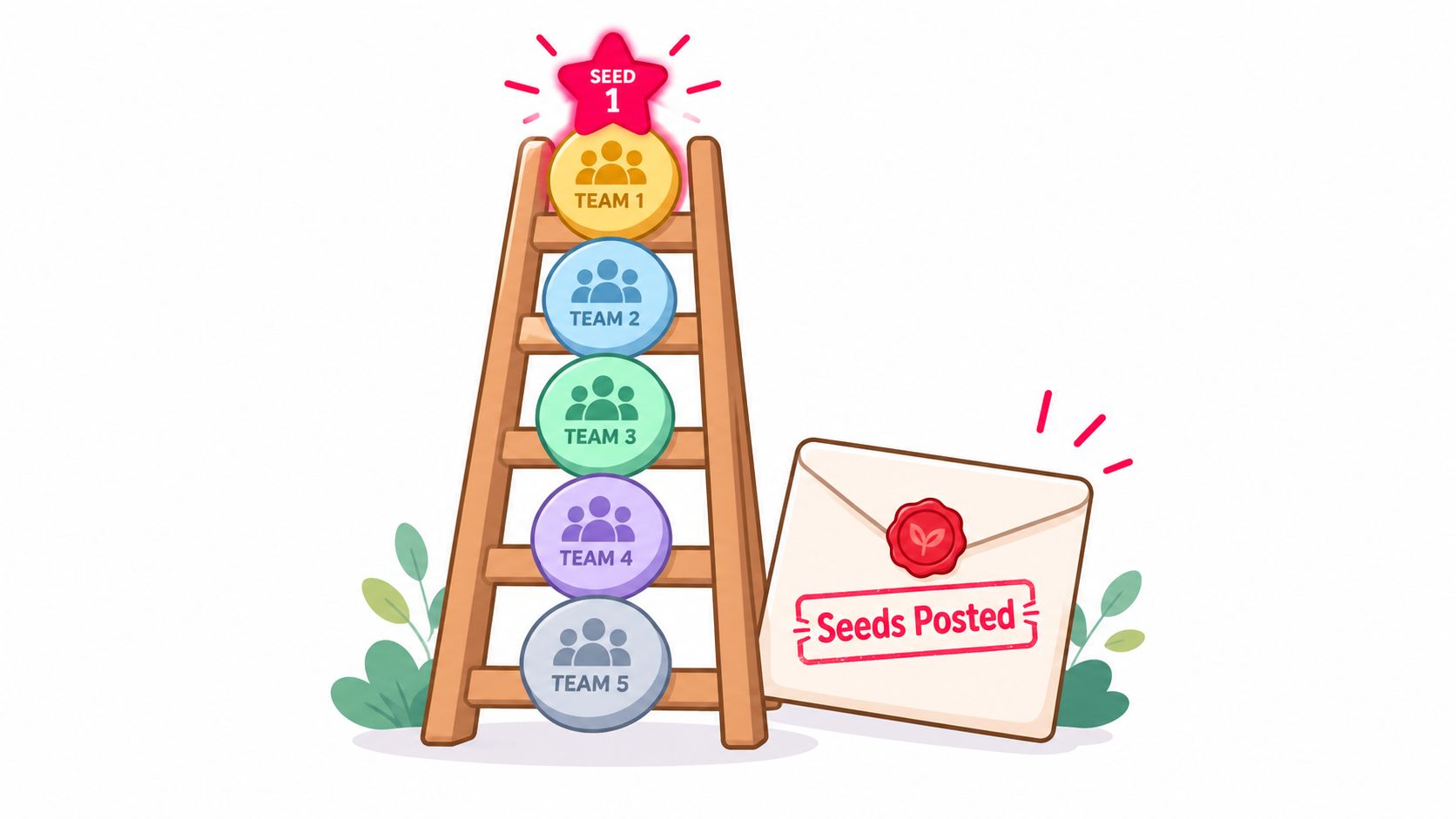
Publish the seed list with its ranking source and a correction deadline. Accept evidence of a mistaken roster or rank, but don't treat disagreement with the policy as evidence that the calculation is wrong.
A visible seed list helps captains distinguish their ranking from their eventual bracket position.
Handle incomplete information consistently
Teams without a verifiable rating need a declared route into the field. You can place them in an unranked pool with random ordering, or use placement play if your schedule supports it. Don't assign them a strong seed without evidence just because somebody recognizes a player's username.
Mixed-platform teams need a shared measure that means the same thing across the eligible field. If ranks aren't comparable, admit that limitation and use an alternative instead of presenting unlike ladders as equivalent.
Swiss uses the initial ranking to establish opening pairings, then results drive subsequent opponents. Round-robin seeding mainly affects scheduling and group allocation, so spend more effort preventing rest disadvantages than polishing a ladder that won't change who plays whom.
Handling Check-Ins, No-Shows and Redraws
Most bracket tutorials assume the registered field will turn up. Online organizers have to deal with missing captains, incomplete rosters, late substitutions, and players who disappear after confirming.
The Score7 tournament bracket guide describes check-in commonly opening 30–60 minutes before the start, with players who miss check-in potentially removed from the bracket. Treat that window as an attendance-verification stage, not another registration reminder.
Redrawing the bracket after attendance changes
These hypothetical attendance scenarios show how the verified field changes the draw before publication.
| Registered | Present | Bracket slots | Byes | Action |
|---|---|---|---|---|
| 6 | 6 | 8 | 2 | Run the bracket as drawn |
| 6 | 5 | 8 | 3 | Backfill from the waitlist or give the bye to the top seed |
| 10 | 8 | 8 | 0 | Redraw as an 8-team bracket |
| 14 | 13 | 16 | 3 | Backfill, or redraw the top seeds with three byes |
The extra bye in a reduced field belongs within the overall seed order. If the top seed already has a bye, allocate the available byes across the highest eligible seeds rather than giving that team another empty advancement.
Backfilling also changes the calculation. Add the replacement to the present field, confirm its roster, and then produce the final draw. Don't leave the old bye count in place after filling the vacancy.
Separate changes before and after publication
Before publication, you can rebuild from the checked-in seed list without invalidating a match anyone has played. After publication, a global redraw can change opponents, preparation, and rest time for teams that did nothing wrong.
Use a short operational checklist:
- Lock eligible rosters. Record the active lineup and approved substitutes at check-in. A substitute should meet the same eligibility rules as the original player.
- Use a published forfeit clock. Define when it starts, where staff issue the call, and what counts as ready. A captain saying they're coming isn't the same as a complete team joining.
- Close check-in before redrawing. Keep a draft private while attendance is unsettled, then publish a clearly identified final version.
- Preserve unaffected placements. After publication, use an approved replacement in the vacant position rather than moving unrelated teams around. Don't introduce a replacement after results exist unless your rules explicitly permit it.
- Record forfeits consistently. Use the platform's forfeit result and the same prescribed score treatment. Avoid entering invented gameplay statistics.
- Log the decision. Save the match ID, reason, staff member, and captain notification so another admin can explain what happened.
Draw from the present field. After play begins, resolve withdrawals through the published rules, not a fresh bracket.
A late arrival doesn't automatically reclaim its registration slot. If check-in has closed and the final draw is published, admitting that team requires a rule you announced beforehand, not a favor negotiated in chat.
Build, Schedule and Publish the Bracket
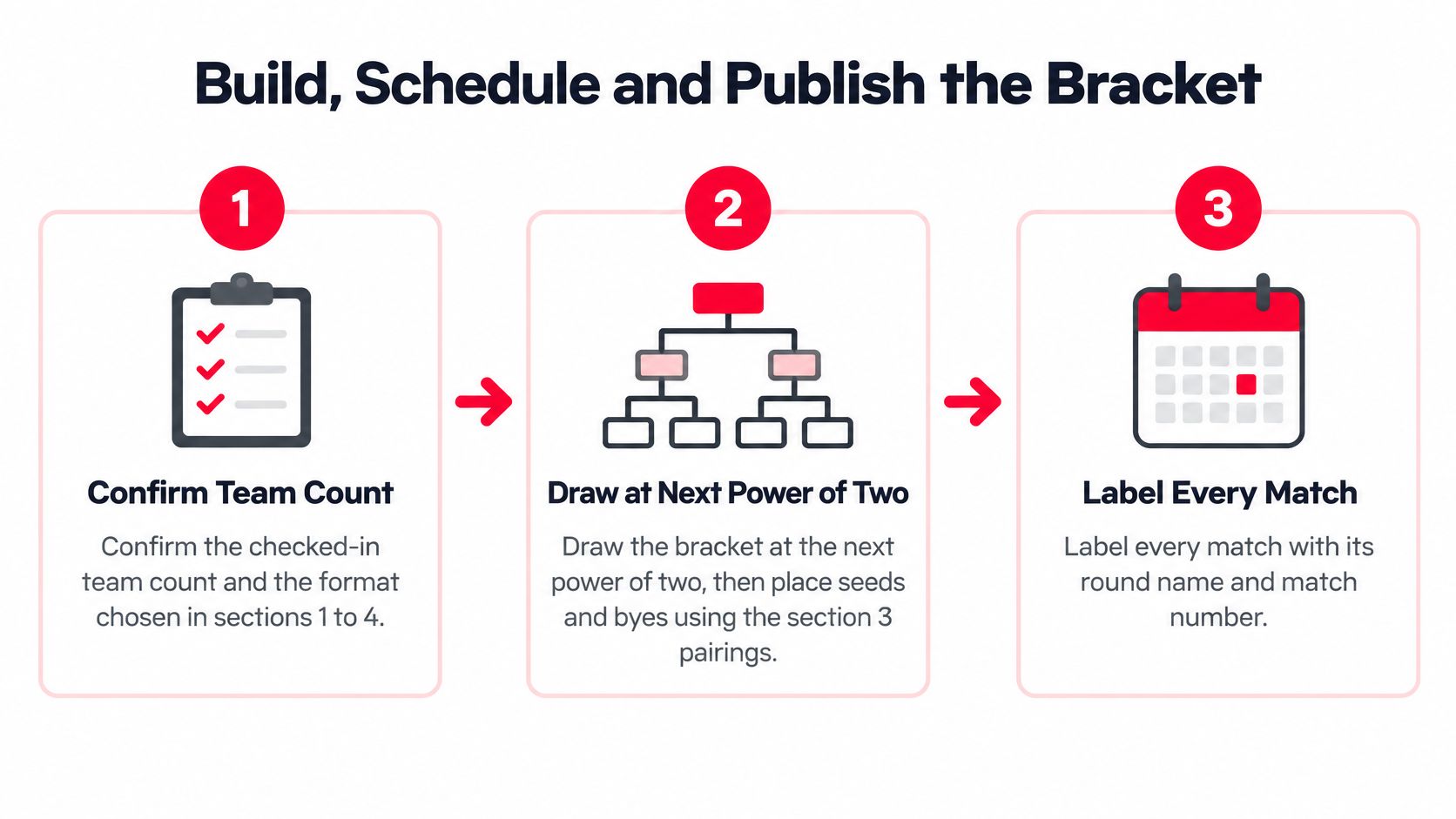
Keep the operational sequence visible while you build. It's easier to catch a wrong roster or misplaced seed before captains start preparing for their opponents.
Turn the draw into runnable matches
Confirm the checked-in field and format. Save the attendance list alongside the eligible roster for each team. Mark who has authority to answer staff calls so you aren't waiting for agreement from an entire squad.
Build the elimination layout from the confirmed field, then enter the approved seed order and bye positions. For Swiss or round robin, create the appropriate pairing or schedule structure instead of forcing teams into knockout slots.
Give every match a stable ID. For example, W1-3 can mean winners bracket, opening round, third match; L2-1 can identify a losers-bracket match. Keep those IDs unchanged when display names or start times change.
For double elimination, check every loser destination before publishing. Under a reset-final ruleset, the losers-bracket finalist must first beat the undefeated finalist to force the deciding reset; if you use another grand-final arrangement, announce it explicitly.
Configure standings formats separately. Swiss pairings should follow compatible records while avoiding rematches where possible, with a declared policy for odd fields and unavoidable exceptions. Round robin needs a complete opponent schedule, reporting procedure, and tiebreak order before play starts.
Set match windows using the game, series length, lobby procedure, and dispute allowance. Don't give Valorant and Apex Legends identical windows merely because both events use an elimination diagram; include map selection, overtime exposure, server setup, and result confirmation where relevant.
Schedule by dependencies and lobby capacity. In a hypothetical 8-team single-elimination event with 30-minute match windows, running all 7 matches sequentially consumes 3.5 hours, while parallel opening matches reduce the critical path to 1.5 hours before extra buffers. For hypothetical double-elimination or Swiss schedules, calculate their actual dependency chains rather than assuming the same reduction: losers-bracket paths, available admins, and shared broadcasts can prevent full concurrency.
Publish one authoritative bracket page with reporting times, timezone, match rules, and the staff contact channel. Leave a deliberate preparation interval before play, and send round reminders through the channel captains agreed to monitor.
Protect the start time
A schedule needs an owner, not just timestamps. Assign someone to call matches, someone to confirm results, and a clear escalation route for disputes; in a small event, the same person may cover those jobs, but captains still need to know whom to contact.
For organizers collecting eligibility checks or rules acknowledgments through forms, Form Timer's guide to scheduling timed Google Forms assessments offers a useful reference for setting controlled completion windows. Keep that form deadline distinct from the requirement to be present and ready for a match.
You can enter the event details through the tournament creation page, but review the generated schedule before sharing it. Confirm that waiting teams, advancing teams, and staff all see the same reporting instructions.
Use the walkthrough as a visual companion while checking the draw against your event rules.
Bracket Tools Compared and What Each One Handles
Choose software by the operations you need to perform: supported formats, manual seed control, attendance edits, forfeit recording, live results, and usable views on phones and laptops. A clean bracket graphic doesn't prove the tool can absorb a missing team without breaking later matches.
Bracket tool options for amateur events
The field sizes below are typical fits, not software limits.
| Option | Formats | Check-in and forfeits | Best for |
|---|---|---|---|
| Paper or spreadsheet | Any, drawn by hand | Manual | In-person events of 4 to 8 teams |
| Free online bracket generator | Mostly single elimination | Often manual or absent | Quick draws with no roster tracking |
| GamerPlug tournaments | Single, Double, Swiss, Round Robin | Tournament registration and live leaderboards; confirm roster and forfeit handling before committing | Online Apex, Valorant, League and Fortnite events |
Test the awkward actions first
Paper and Google Sheets work when staff can keep everyone informed directly. Their weakness shows up after the draw: maintaining a shared current version while captains ask questions and results arrive together.
A browser generator produces a presentable draw quickly. Try replacing an entrant, correcting a result, and recording a withdrawal before choosing it. If your bracket is built from the checked-in field rather than the registration list, the tool also needs to swap a confirmed team for a standby without a full redraw. Run that test before you announce the bracket.
The tournament interface should let captains find their event information without relying on a staff member to paste updates.
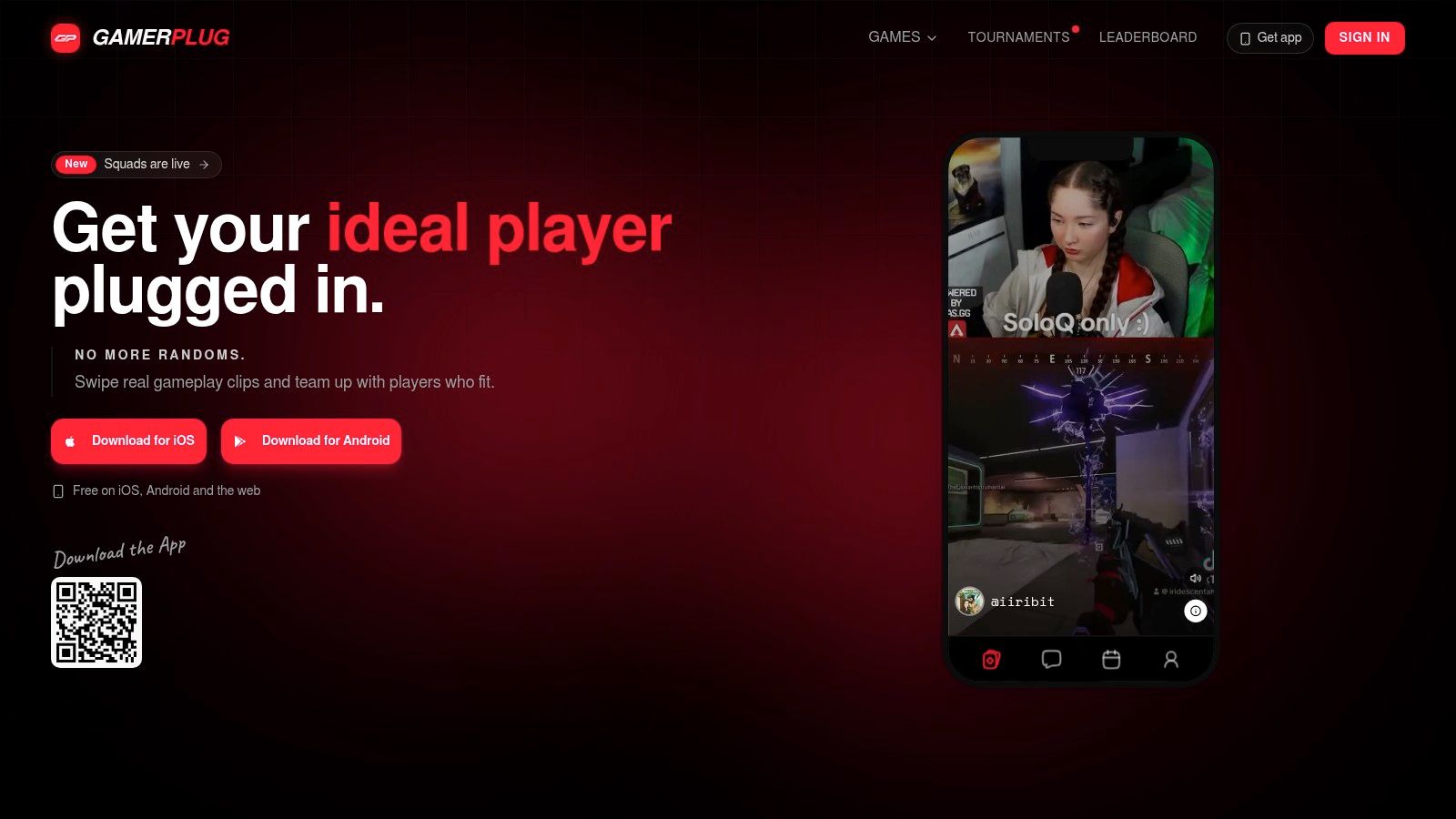
For an app-based event, confirm current game support, roster controls, supported formats, and pricing before committing. Registration tracking and roster locks are separate controls, and a live leaderboard won't show you how an admin corrects a disputed result.
- Run a rehearsal. Enter dummy teams, advance a result, reverse it, and check what captains see.
- Keep an external copy. Save the seed list, roster snapshot, match IDs, and completed results outside the tournament tool.
- Check mobile access. Captains should be able to read opponents, deadlines, and staff instructions from the device they'll use on match day.
The tournament bracket app guide can help frame that comparison. Choose the setup that handles your attendance changes and platform mix without giving staff more manual work than they can manage.
GamerPlug offers tournament hosting alongside teammate discovery and squad-building tools, so organizers can assemble the field and manage competitive play in the same app. Visit GamerPlug to check the options for your game, then prepare your check-in rules and seed list before publishing the draw.