
You queue solo, get matched with a random duo who rotates when you call it, win two games, and type "gg, add me." They accept. Then nothing happens. You're both online four nights that week and neither of you sends the invite, because "add me" isn't a plan.
That's the default outcome, and it's why most advice about how to make gamer friends fails. Adding people isn't the hard part. I treat every promising teammate as a three-session trial that starts with a safety screen before any invite goes out, and ends with a booked time slot or a clean drop. Friendship is what's left after a stranger proves they're safe, reliable and playing the same game you are, in the same way, at the same hours.
Table of Contents
- Where Compatible Gamer Friends Actually Show Up
- Safety Checks Before You Trust a New Teammate
- A Five-Step Method to Turn Matches Into Friends
- How to Test a Teammate Across Three Sessions
- Keeping a Squad Together Past the First Month
- Post Your First Squad Listing This Week
Where Compatible Gamer Friends Actually Show Up
Good teammate leads usually come from rooms with repeated contact. In 2024, 72% of surveyed U.S. adolescents reported multiplayer gaming with friends or family during a typical week, while 66% reported playing multiplayer games with strangers, according to Digital Wellness Lab's survey of more than 1,400 adolescents. The pool is already there. The work is filtering it before you spend three sessions on someone who plays at the wrong time, talks over the team, or disappears after one win.
| Where to Look | Best For | Filter to Set First | Realistic First Test |
|---|---|---|---|
| Same-game Discord server | Players with a shared schedule and voice habits | Game, region and mic rule | Scrim or custom within one week |
| Public voice lobbies in casual modes | Relaxed players who mix skill levels | Mode and voice requirement | One session, then a follow-up invite |
| Ranked solo queue regulars | Players who want competitive pace | Rank band and role | Two or three sessions before queueing as a duo |
| Local LAN, campus or cafe gaming club | In-person friendships | Location and fixed weekly time | Two or three weekly sessions at the same time, then a follow-up invite |
| LFG squad-finder apps | Players who want filtered matches | Game, platform, rank range and mic requirement | First accepted invite, then the three-session trial |
Why the filter matters more than the channel
A Discord server with thousands of members and no region tag will hand you people who play at 3am your time. A ranked lobby will hand you someone at your exact skill level who never speaks. Neither channel is useless. Each one just needs a filter for the thing you need: game, mode, rank band, platform, mic rule, and hours you can repeat.
Start tight. Pick the game and mode you want to run, the rank range you can play in without resenting it, and the nights you can realistically show up. Mic preference comes next. Role, platform and tolerance for ranked pressure can narrow the pool after those basics are aligned. A broad pool with clear filters beats a huge pool where everyone looks compatible until the first queue.
The in-person row deserves attention if you want something local. Campus clubs and cafe LAN nights work because the fixed weekly slot does retention work for you. Recurring attendance in one specific room beats scattered one-off events, and the same logic behind finding like-minded people in Chicago applies here. Show up at the same time three weeks running before you decide the group is not for you. That gives you a rhythm, and rhythm makes the second invite easier.
If you would rather browse than lurk, a gaming social network built around profiles and play style lets you read someone's habits before you speak to them. GamerPlug is a free social platform for gamers where users find a squad and build a community. Profiles open on gameplay, users can swipe through real clips, and a "Request to match" option gives you a direct way to start from fit instead of a random hello.
Pick one channel where rank, schedule and communication style overlap. Treat the first invite as a test, not a commitment.
Safety Checks Before You Trust a New Teammate
"Be more social" is bad advice for a large share of players. In a 2025 U.S. survey of 2,000 gamers, 77.75% said they had experienced harassment while gaming online, and many responded by muting voice chat, avoiding matchmaking or playing only with existing friends, according to Besedo's online gaming safety analysis. If that's your situation, the barrier isn't a shortage of people. It's that you have no reliable way to tell a respectful stranger from an abusive one before you've already queued with them.
So screen first, invite second.
What to check before you add anyone
- Gameplay history over claims. Look at the profile's clips, match history or synced rank. Someone saying "Diamond, carry you" should have something visible that backs it.
- Consistency between stats and story. A player claiming a high rank on a fresh account with no history isn't automatically a liar, but they haven't earned a duo slot yet.
- Your own disclosure budget. No full name, school, workplace, city or daily routine in early chat. Gamertag only until trust exists.
- Where the conversation lives. Public voice or squad chat first, direct messages only after several sessions, and only while the topic stays on the game. A structured looking-for-group thread keeps that early contact in a space other people can see.
| Warning sign | Response | Stop now? |
|---|---|---|
| Repeated harassment | Mute, report in-app and leave the group calmly | Yes |
| Pressure to move to another app | Decline and stay in game chat | Yes |
| Requests for personal information | Refuse and end the conversation | Yes |
| Hostility after you set a boundary | Leave the group and do not argue in public chat | Yes |
| Competitive trash talk | Mute if it bothers you and judge over several sessions | No |
Trash talk aimed at the game ("that push was awful") is ordinary competitive noise. Harassment aims at you as a person, repeats after you've asked it to stop, or follows you into DMs. The distinction isn't volume, it's target and persistence.
Exit rule: mute, report, leave. In that order, without a farewell message. You don't owe a toxic group an explanation, and arguing in public chat only gives them an audience.
These checks matter most for women, younger players, LGBTQ+ players and anyone coming back after a bad experience. Screening isn't paranoia, it's the step that makes being social survivable.
A Five-Step Method to Turn Matches Into Friends
Filters decide who you meet. Everything after that decides whether they come back. Run these five in order and you'll stop relying on luck.
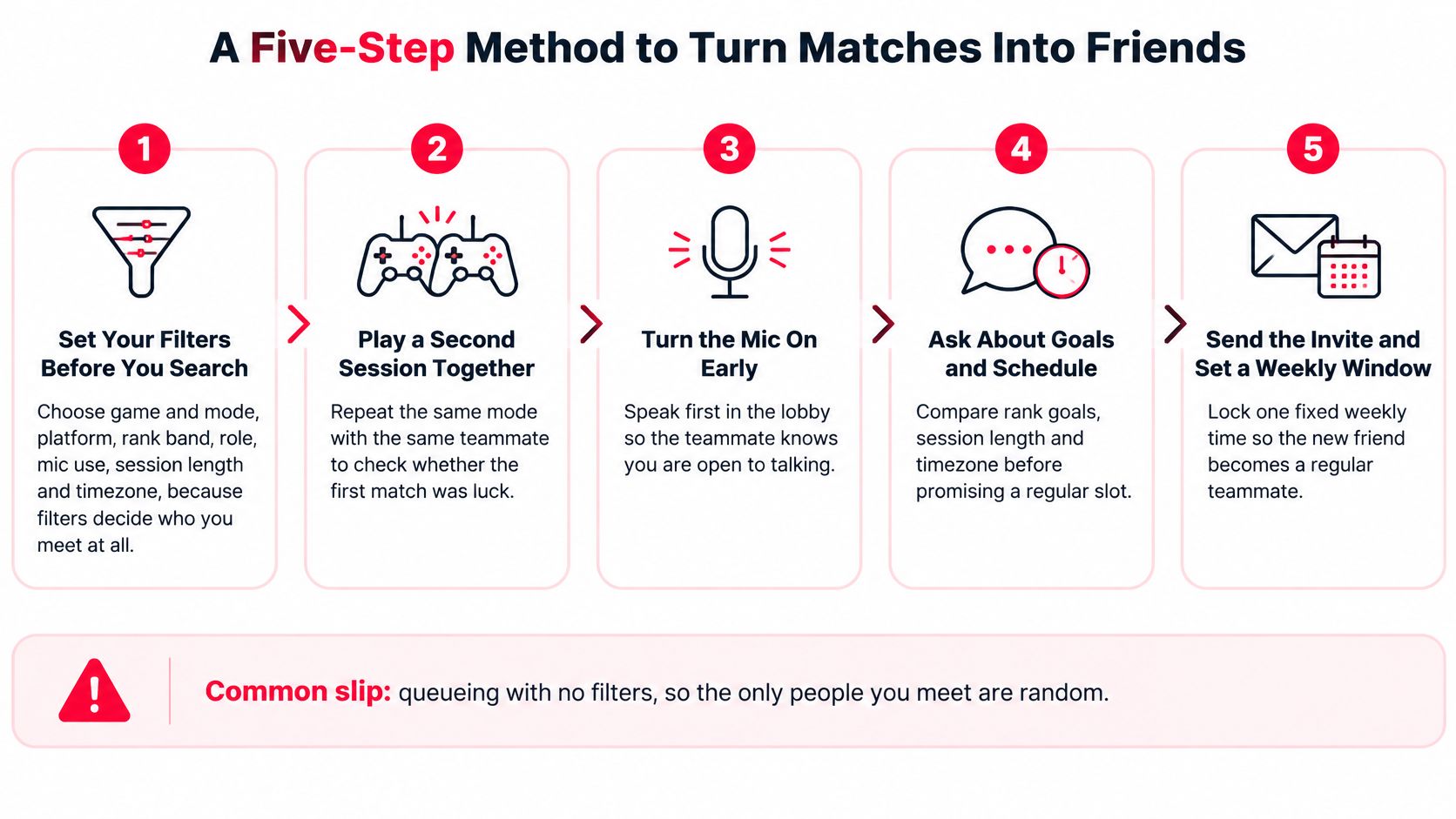
Set your filters before you search. Write down game and mode, platform, rank band, preferred role, mic use, session length and timezone. Seven lines in a notes app is enough. Filters decide who you meet at all, so this step does more work than any message you'll send later. The common slip is queueing with no filters and accepting whoever answers, then wondering why nobody's schedule matches yours.
Name one concrete objective before you queue. "Coordinated rotations on the second circle" or "clean mid-round callouts, no backseat driving." Both players now know what success looks like, so a loss doesn't read as a failed trial. "Just win" is the vague version, and it makes every defeat feel like evidence against the partnership.
Use short callouts, and turn the mic on when you're comfortable. Voice converts an anonymous name into a recognizable teammate, and it's how you learn whether someone jokes, rages or goes silent under pressure. Keep callouts to information: position, cooldown, intent. The slip here is the long emotional post-mortem delivered while the round is still live. Text-only is a legitimate choice too, just say so up front so nobody reads silence as hostility.
Invite the same person back with a specific message. "You covered the flank well on that last hold, want to run it again tomorrow around 9?" Naming real behavior tells them you noticed something they did, not just that you won. A blank friend request after one victory is the opposite signal, and it's how people collect fifty contacts they never speak to.
Book the next window before you log off. A time on the calendar is the strongest sign a match is turning into a routine. Say the day and hour out loud, get a yes, and put it in the squad chat. "Maybe later" is how good sessions die.
The invite should name what worked and when you're playing next. If it doesn't do both, it isn't an invite, it's a compliment.
Notice what's missing from that list: rank chasing, highlight clips and win rate. Those tell you who's good. They don't tell you who shows up.
How to Test a Teammate Across Three Sessions
One great match is a weak signal. Short-term performance hides tilt control, flaky availability and goals that conflict with yours. In a 2018 study of 234 players, interdependence, meaning situations where teammates rely on one another, was one of the strongest predictors of in-game social capital, while cooperation alone was a weaker predictor, according to the ACM paper on player relationships. You learn that from repeated rounds under pressure, not from a single win.
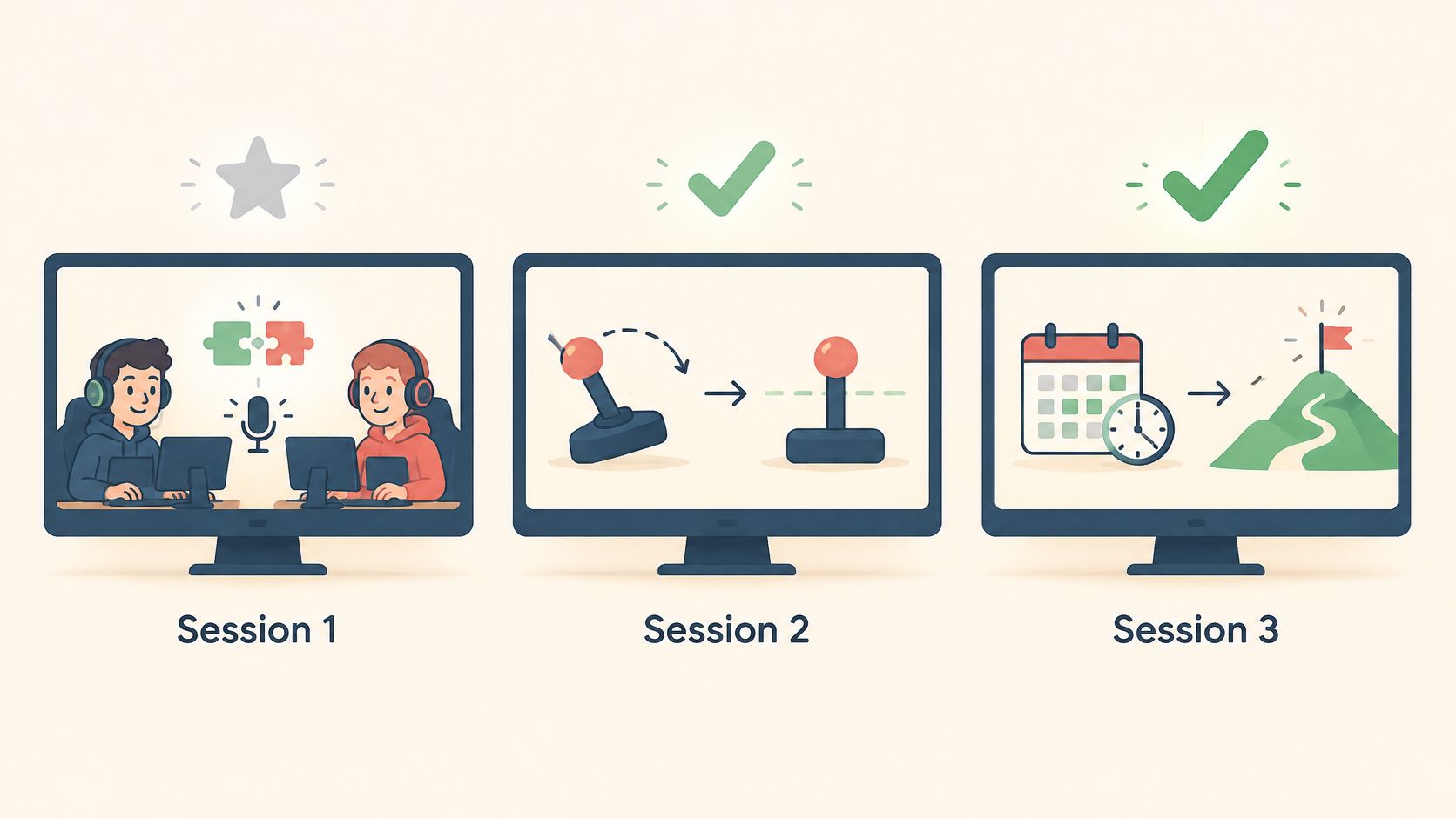
Session 1 checks basic compatibility
Play the mode you intend to keep playing. Watch three things: does their role fit yours, do they respond to callouts or talk over them, and does the rank gap feel fair to both of you? Keep going if you both talk through a mistake calmly and re-queue without being asked.
Session 2 checks reliability after a loss
Losing is the test. Did they arrive on time, stay calm when the scoreboard turned ugly, and take a piece of feedback without treating it as an attack? Keep going if they're still punctual and respectful on a bad night, because that's the version of them you'll be playing with most weeks.
After this session, ask one diagnostic question: "Do you want ranked pushes, casual games or tournaments?" If your answer is a ladder climb and theirs is Friday-night chaos with friends, the friendship probably won't survive however well you play together. Better to learn that now than after a month of resentment.
Session 3 checks mutual interest
Does either of you propose the next match without prompting? That's the whole test. One-sided scheduling is the most common reason a promising duo dies, and it shows up by the third session.
Keep the player only if they're punctual, non-toxic, communicative after errors, and contributing to team decisions rather than just executing yours.
Write one line after each session: what worked, what slipped, whether they proposed the next game. Three lines per person is enough. It turns a keep-or-drop call into something you can read instead of something you try to remember while they're carrying you through a good match.
Keeping a Squad Together Past the First Month
Squads rarely dissolve because people stop liking each other. They dissolve because someone's shift changed, one player climbed two divisions, and nobody ever agreed on what the sessions were for. Fix those three and the group holds.
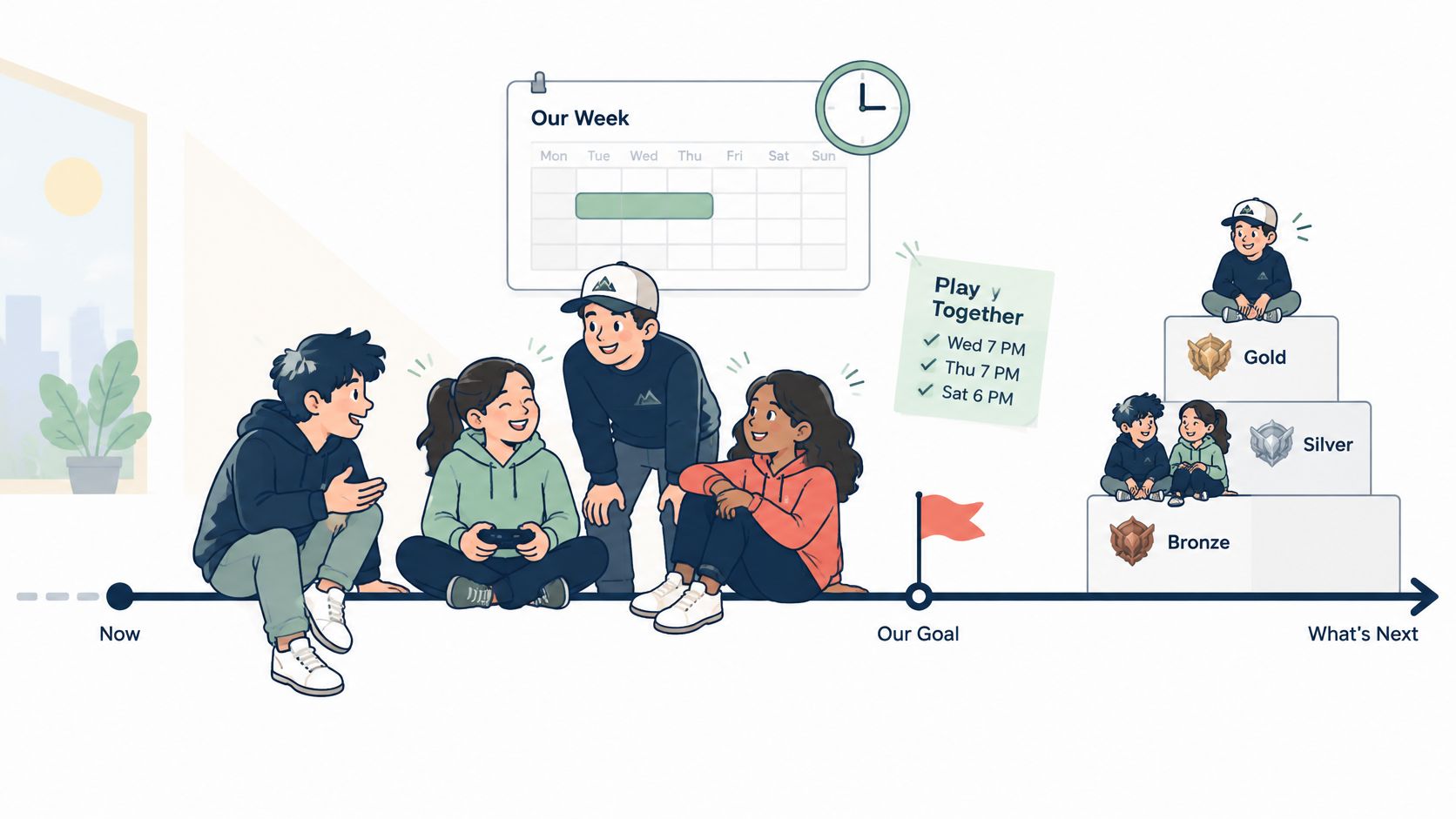
The routine is worth protecting because it becomes its own reason to log in. In 2025, 24% of surveyed players said they would buy or download a game if their friends were playing it too, according to Ampere Analysis' survey of 34,428 players across 22 markets reported by Video Games Chronicle. Your squad will pull you into new titles. Keep it alive and the game library follows.
Rules that hold a group together, in the order they usually break:
- One fixed weekly window. Same day, same hour, agreed out loud. Flexible scheduling sounds friendly and produces zero sessions.
- A three-line check-in after each match. One thing that worked, one thing to fix, one time for next session. Keep it in a persistent squad group chat so nobody has to reconstruct the plan from memory.
- Rank gaps get a different mode. When one player is far above the other, run casual games or a coaching-style session. Forcing ranked with a wide gap punishes both players and breeds quiet blame.
- Label the session type. Casual and competitive players coexist fine once you agree which nights are ladder pushes and which are relaxed games. Unlabeled sessions are where expectations collide.
- Name the shared platform. If you're on different devices, pick one crossplay lobby or one shared platform for the weekly slot and write it in the check-in, so nobody spends the first ten minutes on setup.
- Rotate the awkward time zone slot. Choose an overlap window, then swap who takes the late night each month. One person always absorbing the inconvenience eventually stops showing up.
- Agree the miss policy in advance. A quick message within a day when you can't make it, and a stated number of misses before the group reshuffles. Deciding this while everyone's happy prevents the awkward version later.
Protect the routine before you add new people. A stable four beats a rotating eight.
Post Your First Squad Listing This Week
Write one looking-for-group post today. Skip the vague "anyone want to play?" and post a listing that names the game and mode, rank range, platform, mic requirement and how many slots are open. Specific posts outperform vague ones because they let the right players self-select before anyone types a word, and they filter out the people you'd otherwise spend three awkward sessions dropping.
A workable version reads: "Apex Legends, ranked trios, Gold to Plat, PC, mic required, two slots, Tue and Thu 9 to 11pm ET." Every field there is a filter someone can check against their own situation in five seconds.
The time window deserves as much care as the rank range. A listing that fits your real schedule attracts players who can show up week after week, and availability is the filter most listings leave out. Two slots with honest hours beat four slots with wishful ones.
If you want somewhere to publish it, we built GamerPlug for exactly this. When you post a squad you choose the game mode, rank range, platform and whether a mic is needed, and every profile opens on gameplay so you can swipe through real clips before you invite anyone. That means a rank claim gets tested against something you can watch instead of something you have to take on faith. GamerPlug is currently in development, so you can join its waitlist to be told when it launches.
Once the group exists, the work shifts from recruiting to retention, and the mechanics are the same ones any recurring club runs on. This piece on how to keep members engaged is a useful companion read, particularly on giving people a reason to return that isn't just the activity itself.
Your sequence for this week: pick one channel, post one clear listing, run one three-session trial with the red-flag checks in mind, and book the next session before you log off. Four actions, one week, and you'll know more about your future squad than a month of solo queue will tell you.
GamerPlug is a free teammate-finding app where profiles open on real gameplay clips and squad listings filter by mode, rank range, platform and mic requirement, so you can screen a player before you ever queue with them. If you're tired of collecting friend requests that go nowhere, post your first squad listing and run the three-session trial on someone who matches your schedule. Find your next regulars at Gamerplug.