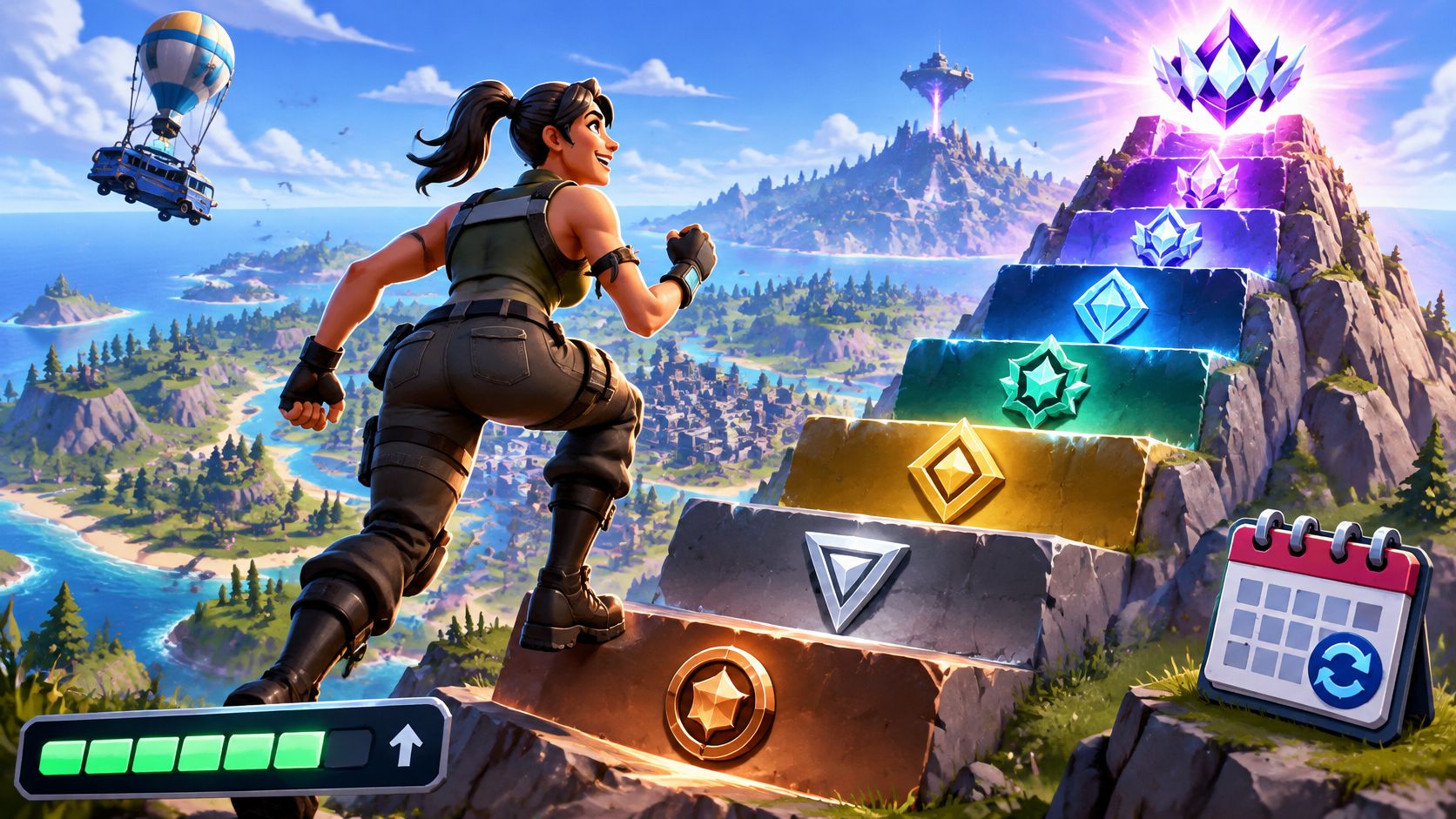
You've just queued Ranked with a friend and the lobby feels wrong. You land, rotate once, and every player you meet builds faster, edits cleaner, and hits shots you'd expect several ranks above you. Your badge says one thing. The match says another. That's where most players start asking How Does Fortnite Ranked Work, and the honest answer is that your visible rank is only part of the story.
Table of Contents
- What Fortnite Ranked Is and Why Your Rank Matters
- The Eight Tiers and 18 Divisions Explained
- How Rank Progress Moves After Every Match
- Placements, Season Resets, and Separate Ladders
- How Matchmaking Treats Mixed-Rank Squads
- Comparing Ways to Find Teammates Near Your Level
- Climbing the Ladder and Your Next Step
What Fortnite Ranked Is and Why Your Rank Matters
You're in Gold. Your friend invites you to duos. Within two fights, you're boxed, edited on, and sent back to the lobby wondering if you misclicked into a tournament. You probably didn't. You ran into the gap between a visible rank and the matchmaking happening behind it.
Fortnite Ranked is a competitive ladder layered on top of normal Fortnite. It was introduced in May 2023 with update 24.40, replacing the former Arena system across Battle Royale and Zero Build. You still loot, rotate, fight, and chase the win, but every result now moves you toward a defined competitive position.
Think of your rank as a short message to other players. Diamond III tells a potential teammate more than your account level does, because it places you inside a ladder they can compare with their own. That shorthand matters when you're building a duo, filling a squad, or browsing players through the Fortnite page on GamerPlug.
The Three Ideas That Explain Most Confusion
- The ladder: You'll climb through eight ranks and 18 total divisions, so small steps matter before you reach the top tiers.
- The progress bar: Your placement and eliminations move your progress after matches, but not every elimination carries the same value.
- The matchmaking: Your badge doesn't fully control who lands in your lobby, especially when your party contains players at different levels.
Your rank describes where you sit on the ladder. It doesn't perfectly predict how hard your next lobby will feel.
That's why two players with similar badges can have very different nights. One queues solo into lobbies near their current level. Another queues with a stronger friend and spends every endgame fighting for space against players they'd never normally meet yet. Both are playing Ranked, but they're not experiencing the same Ranked.
Your rank also changes with the season and the mode. A current, verified rank is useful because it's a time-specific competitive snapshot, not a permanent label. Old screenshots and ranks from another queue can mislead teammates before the first match even starts.
Start with the badge, then ask three follow-up questions. Which mode is it from, when was it earned, and who else is in the party? Those answers turn a pretty icon into information you can use for your next queue.
The Eight Tiers and 18 Divisions Explained
Picture the ladder as a building. Bronze is the ground floor, Unreal is the roof, and every promotion moves you closer to players who make fewer free mistakes. The climb feels gradual early on because most floors contain smaller landings.
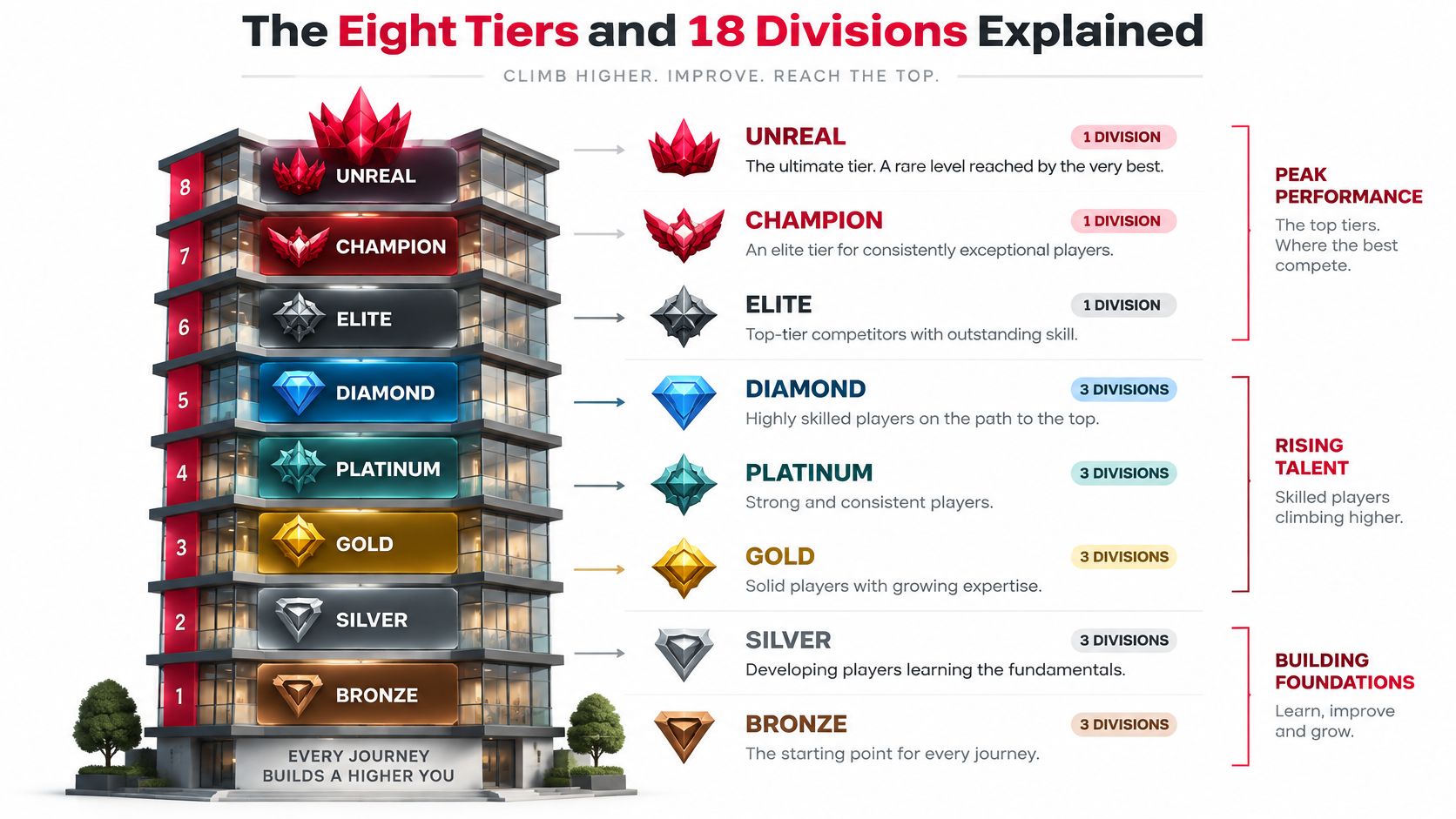
The full structure contains Bronze, Silver, Gold, Platinum, Diamond, Elite, Champion, and Unreal. From Bronze through Diamond, each rank has three divisions, written as I, II, and III. Elite, Champion, and Unreal don't use those subdivided steps.
How the Floors Stack Up
- Bronze I to III: You're learning Ranked pacing and finding where you belong.
- Silver I to III: You're starting to survive longer and choose fights with more intent.
- Gold I to III: You're past the opening floors and into the middle of the building.
- Platinum I to III: Mistakes get punished faster, and consistent placement becomes harder to fake.
- Diamond I to III: You're near the top section, where one division can signal a meaningful competitive gap.
- Elite and Champion: You're in single-tier territory, with no smaller division label to soften the comparison.
- Unreal: You're no longer just chasing the next badge.
That structure gives you 18 total divisions. Five ranks multiplied by three divisions makes fifteen steps through Diamond, then Elite, Champion, and Unreal add the final three. The design gives newer and mid-ladder players frequent checkpoints, while the top becomes a sharper test of whether you belong among the strongest players in the queue.
Unreal works differently because it places you on a global Unreal leaderboard. You're not only displaying a local badge for matchmaking. You're entering a worldwide ranking competition, which makes the label far more specific than saying someone is high level.
Why Diamond III Says More Than Account Level
A generic Fortnite level mainly reflects time and activity. Diamond III identifies your position within a defined competitive ladder. Before queueing, a teammate can immediately understand that you're one step below Elite, not merely someone who's played a lot of matches.
That label still needs its mode attached. The ladder is tracked separately for different queues, so Diamond in one mode shouldn't be presented as proof of the same standing in another. Read the tier, the division, and the mode together. Anything less gives your squad an incomplete picture.
How Rank Progress Moves After Every Match
You don't move through Ranked with a public points total you can calculate to the last digit. Progress appears as an in-game percentage bar, and that bar rises or falls after matches based on your placement and eliminations, according to Epic's performance evaluation rules for Ranked progression.
That sounds simple until two matches confuse you. In the first, you land hot, grab an early elimination, and get knocked before the lobby has thinned out. In the second, you rotate carefully, survive into the closing circles, and win one late fight. The second match can move your bar more, even if the elimination count looks similar.
Why Timing Changes an Elimination's Value
Eliminations later in the match carry greater value than equivalent early eliminations. Eliminating a higher-ranked opponent also matters more than eliminating a lower-ranked opponent. Ranked is rewarding you for beating people when the lobby is stronger, space is tighter, and survival itself is harder.
It's like scoring in the final round instead of during warmups. The action looks similar, but the context is tougher. You've already survived rotations, third parties, shrinking zones, and better remaining players before that late fight happens.
Practical rule: Don't treat your first fight and your final fight as equal. Ranked doesn't.
Rank Progress Factors and What They Mean
| Progress Factor | How It Affects Your Bar | Practical Takeaway |
|---|---|---|
| Strong placement | Supports upward progress because you survived deeper into the match | Rotate with enough time to avoid panic fights at the zone edge |
| Low placement | Can limit or reverse progress, especially without meaningful late results | Don't land purely for chaos if your goal is climbing |
| Early elimination | Counts, but carries less weight than a later elimination | Take a clean early fight, but don't chase the whole area afterward |
| Late elimination | Carries greater value because it happens against the surviving field | Stay ready to fight once you've secured endgame position |
| Higher-ranked opponent eliminated | Carries greater value than defeating a lower-ranked opponent | Don't avoid every strong player, but choose angles you can actually win |
| Survival plus endgame fighting | Combines the match signals Ranked rewards most clearly | Play for late game first, then convert good position into eliminations |
You can't optimize what you only glance at. After each match, check whether the bar moved and connect the result to what happened. Did you die early after forcing a fight, or did you reach endgame and lose one close box fight?
Over a session, those patterns teach you faster than staring at an elimination total. Placement gets you to the valuable part of the match. Endgame eliminations prove you can compete once you're there.
Placements, Season Resets, and Separate Ladders
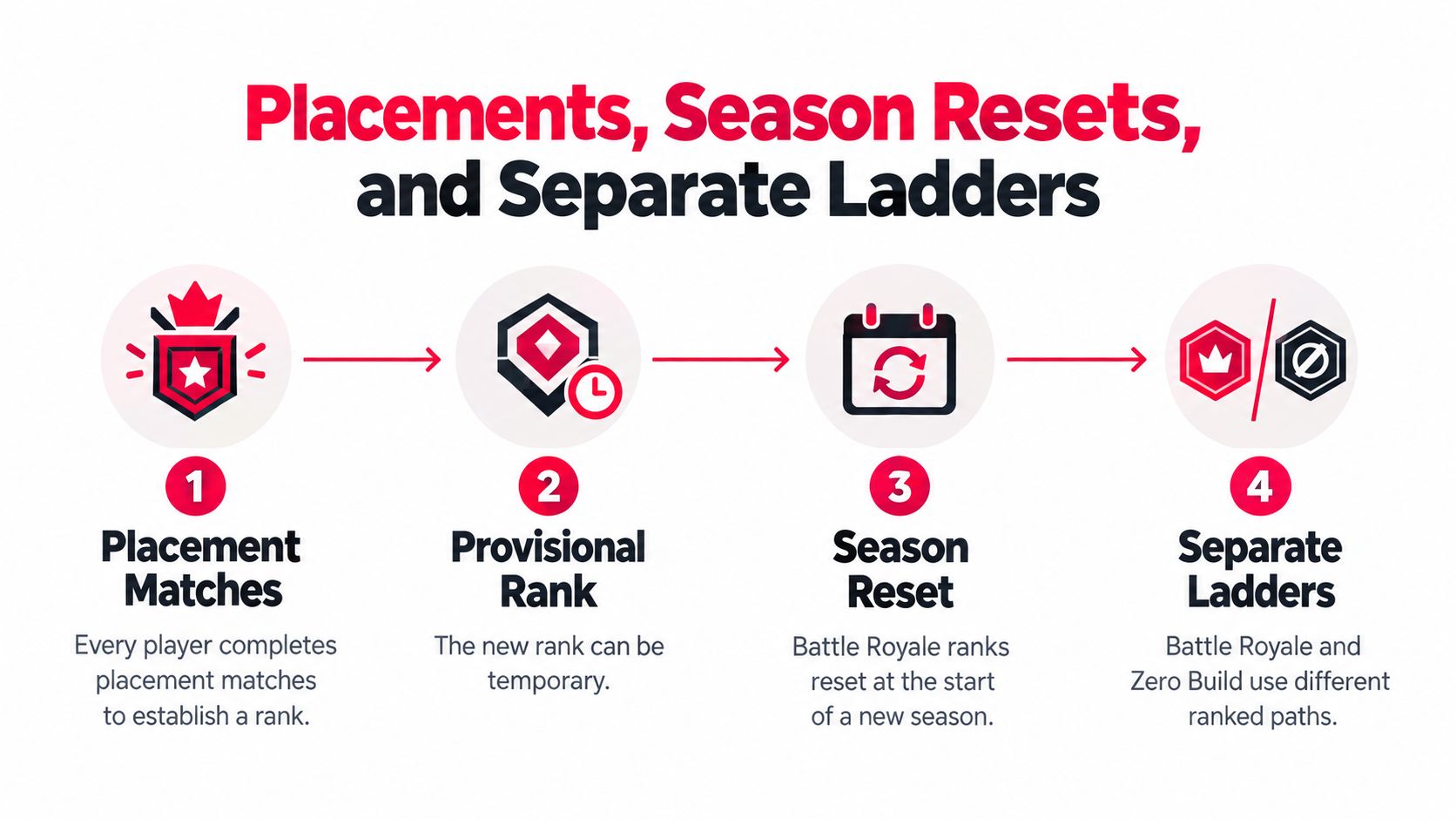
Your first Ranked session in a season doesn't start with a fully settled badge. You complete initial placement matches to establish a rank, and Epic notes that Battle Royale ranks reset at the end of a season, requiring placement again.
What Happens During Placements
Placements are the system taking an early measurement. You're giving it fresh match results so it can place you somewhere sensible for the new competitive cycle. That first badge is useful, but you should read it as provisional rather than final proof of your level.
A good or rough opening session can leave you slightly above or below where you'll settle. Give the ladder more matches before you judge yourself, and give teammates the same grace early in a season. One fresh badge doesn't tell the whole story yet.
Why the Reset Changes Teammate Comparisons
At the season boundary, the visible ladder starts again. That means a newly reset player and a player with an established current-season division aren't perfectly comparable on badge alone. Recent results and verified past performance give you better context during that messy opening stretch.
Players ask a fair question here. Why did the rank drop if the opponents still feel strong? The public badge and the competitive field around you don't reset in exactly the same visible way, so early-season lobbies can feel harder than the fresh labels suggest.
An early-season rank is a starting estimate. Don't recruit from it as if it were a settled final grade.
Rank also affects competitive access. Epic identifies Gold-or-higher players as eligible for certain cash-prize tournaments, while lower-ranked players can enter events such as Ranked Cups within their applicable skill group. If your squad has tournament goals, everyone's current standing matters before you register.
One Player Can Have More Than One Ladder
Battle Royale and Zero Build are tracked separately. Strong building, editing, and piece control don't automatically prove the same level in a mode built around positioning and gunplay without builds. The reverse is also true.
Always attach the mode to the badge. Ask whether placements are finished, whether the rank is from this season, and which queue produced it. Those details prevent the classic mistake of recruiting a strong player for the wrong version of Fortnite.
How Matchmaking Treats Mixed-Rank Squads
Most players assume Ranked just finds everyone with the same badge and throws them into a lobby. That assumption breaks the moment ranks inside one party spread out. Epic's support documentation says Fortnite matchmaking prioritizes similar skill rather than your current displayed rank.
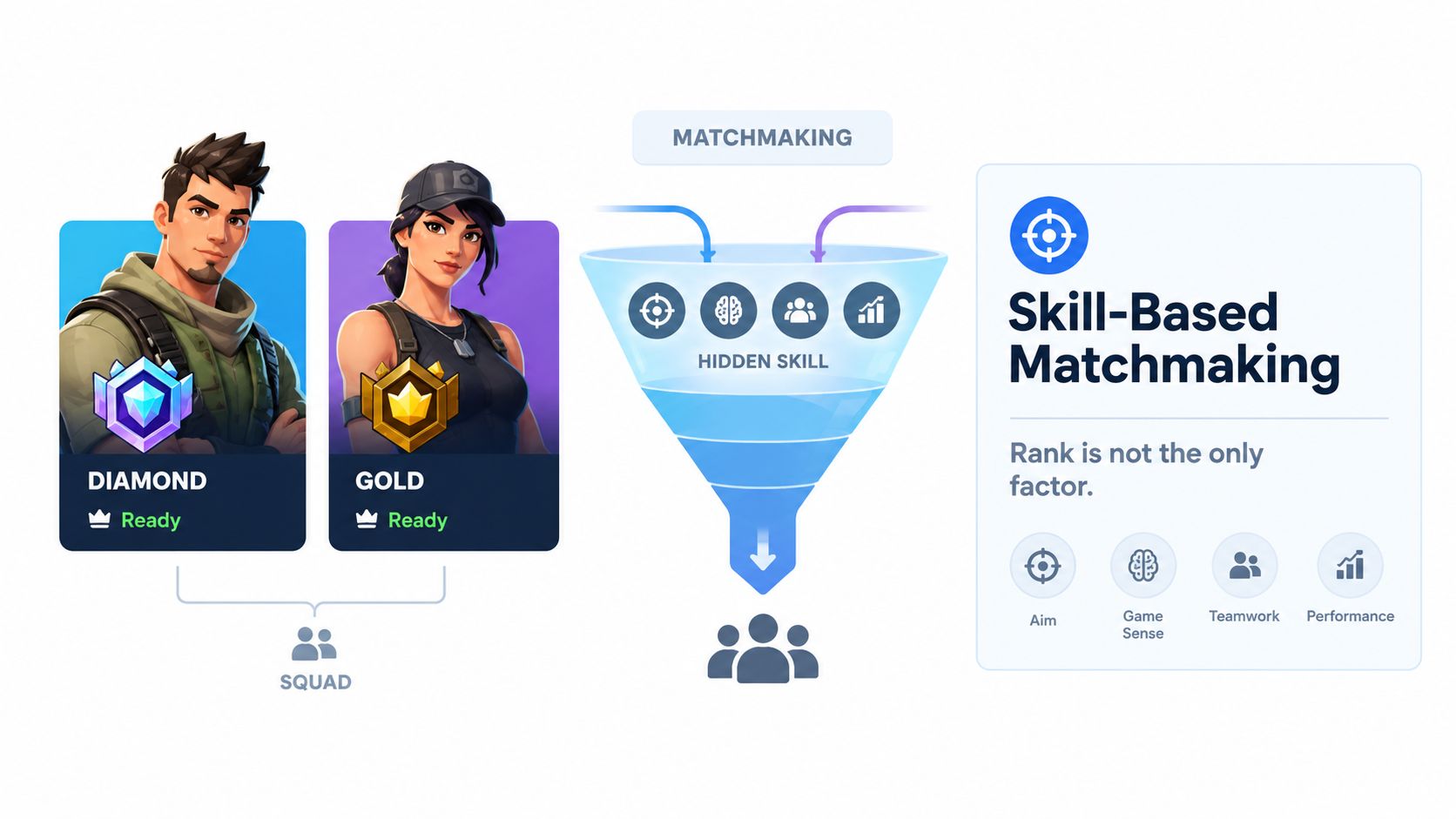
Team matchmaking has also historically used the highest-ranked member of the party as the reference point. That one detail explains a lot of painful duo nights. Your lobby isn't necessarily built around the lowest player, and it shouldn't be expected to rest neatly in the middle.
The Gold and Unreal Duo Problem
Put a Gold player with an Unreal player. The Gold player might expect something like a Platinum-feeling lobby, as if matchmaking averages two badges into one friendly number. It doesn't work that cleanly.
The Unreal teammate can pull the party toward much stronger opposition. The Gold player then faces faster edits, better rotations, and endgame pressure they're not ready for, while the Unreal player may feel the responsibility to win every fight for both people. Nobody gets the match they imagined.
- Queue difficulty jumps: The lower-ranked player meets opponents selected with the stronger party member in mind.
- Roles get distorted: The stronger player becomes a rescue plan instead of a teammate playing their normal game.
- Progress feels confusing: Strong personal moments may still end in early exits because the overall lobby is above one player's level.
- Wait times can feel inconsistent: Matchmaking is solving for skill similarity, not just collecting identical badges.
What to Check Before You Queue
Look at the whole party, not only your own profile. Compare current ranks, modes, and recent play before you ready up. A close skill range gives you a lobby everyone can read and a better chance to learn from each loss.
That doesn't mean you can't play with stronger friends. Just go in with honest expectations. You're choosing harder lobbies and faster lessons, not an easy ride upward.
Before you ready up: Ask whose skill level the lobby is most likely to respect. In a mixed party, it usually isn't the lowest badge.
Treat visible rank as a weak predictor of lobby difficulty by itself. Party composition can move your actual experience far away from the badge on your own screen.
Comparing Ways to Find Teammates Near Your Level
Finding any teammate is easy. Finding one whose mode, rank, schedule, and communication style fit yours is the hard part. The method you use determines how much you can check before that first risky queue.
Three Common Routes
- Random fill: It's instant, but you learn almost nothing beforehand. You can't reliably verify current rank, preferred mode, mic use, or whether the player wants placement play or constant fights.
- Friends only: Communication is comfortable and trust is already there. Skill gaps can still wreck the plan, especially if one friend's stronger level pulls everyone into tougher lobbies.
- A dedicated LFG app: You can compare players before inviting them. The value comes from filters and verified information, not from a longer list of usernames.
Random fill asks you to gamble match after match. Friends solve the social side but not always the competitive side. A squad finder gives you a middle path, where you can screen for fit without waiting for your regular duo to come online.
That's the practical role of GamerPlug for Fortnite players. It's a free app on iOS, Android, and the web, and its profiles are built around gameplay clips of up to 90 seconds plus verified ranks that sync automatically from official game APIs. A clip shows how someone fights and rotates, while verification reduces the guesswork around the badge they claim.
Its Discover feed filters by game, platform, and verification status across PC, PlayStation, Xbox, and Switch. Squads posts can list mode, rank range, platform, mic requirement, and open slots, so your listing says whether you need a Zero Build Platinum teammate or a Battle Royale Diamond player before anyone joins.
Filter by the Exact Queue
Mode-specific filtering matters because a seasonal badge reset changes the public signal without fully resetting the competitive ecosystem around you. As the guidance behind mode-specific Fortnite squad finder filters makes clear, a finder should distinguish Battle Royale from Zero Build, record whether current-season placements are complete, and avoid comparing an unplaced account directly with an established division.
Use the Fortnite squad finder approach as your checklist. Verify the rank, watch the clip, confirm the mode, and ask about placements if the season has just reset. Five minutes of screening can save an evening of mismatched lobbies.
Climbing the Ladder and Your Next Step
Climbing is less mysterious once you build habits around what moves the bar. You don't need to play scared. You need to survive long enough for your fights to matter, then take those fights from positions you can defend.
Habits That Fit the System
- Play for endgame first: Land where you can loot and rotate without gambling the whole match on your first fight.
- Convert position into pressure: Once you're established late, look for clean eliminations instead of hiding until the zone forces a bad move.
- Pick one main ladder: Focus a block of sessions on Battle Royale or Zero Build so your progress reflects repeated play in the same queue.
- Review the bar after every session: Note which matches moved it, then connect those results to placement, fight timing, and party composition.
- Queue near your level: Choose teammates whose verified ranks and recent play are close enough that your lobbies stay readable.
Scattered sessions make your results harder to interpret. If you alternate modes, party sizes, and wildly different teammates every match, you won't know whether the problem was your rotation, your aim, or a lobby built around someone much stronger.
Keep one variable steady while you work on another. Run several matches with the same duo in the same mode, then review the pattern. These practical tips to improve your ranked gameplay work best when you apply them to a stable queue instead of changing everything at once.
Climbing is a feedback loop. Play, check the bar, identify the match moment that changed it, adjust one habit, and queue again.
Your next step is simple. Build a verified Fortnite profile with your current rank and a short clip that shows your real play style. Then post a squad listing with your mode, rank range, platform, mic preference, and open slots so the right teammates can find the exact ladder you're climbing.
Stop guessing whether a new teammate's Fortnite badge is current, mode-specific, or close enough for your next Ranked queue. Visit Gamerplug to build a clip-based profile with a verified rank, filter players by game and platform, and post a squad listing with your mode, rank range, and open slots.