Another ranked game ends the same way. Your random teammate won't comm, locks the role you needed, ignores the rotate, then blames everyone after the loss. You know you'd climb more consistently with one reliable partner, but every attempt to find a duo turns into the same loop: post “need duo,” accept the first invite, play two games, and never queue together again.
The fix isn't finding more players. It's filtering for the right one. A durable duo needs compatible rank, role, communication, schedule, goals, and temperament. This guide gives you a practical system to find a duo partner, screen candidates before queueing, run a real trial session, and decide whether someone belongs in your regular ranked rotation.
Table of Contents
- The Solo Queue Reality Most Guides Skip
- Build Your Compatibility Filter Stack
- Read Clips and Stats Like a Recruiter
- Writing an LFG Post That Actually Fills
- Screening for Communication and Trust Before You Queue
- The Trial Session Protocol
- Your Recurring Duo Playbook and Common Questions
The Solo Queue Reality Most Guides Skip
Solo queue creates problems that mechanical skill can't solve. You can win your lane, top the damage chart, or make the correct rotation, then lose because a teammate refuses to communicate during the only fight that matters. In the next match, someone trolls the role assignment. After that, you face a coordinated three-stack while your side has four players with different plans.
That cycle produces tilt because every game feels like a fresh negotiation. You're not only playing the opponent. You're trying to discover whether your teammates use voice chat, understand the mode, respect pings, and stay in the lobby after one bad round.
The demand for reliable teammates isn't unusual. The Entertainment Software Association's 2025 U.S. industry study found that 89% of players ages 8–90 had played with other people, online or offline, and 55% played with others every week. Among adult players, 78% agreed that games can introduce people to new friends, while 49% said gaming helped them stay connected with friends or family. Finding someone compatible is a normal multiplayer problem, not evidence that you're bad at making friends.
Why “Join a Discord” rarely solves it
Discord can put you in front of players quickly, but speed isn't compatibility. A busy LFG channel rewards the person who posts at the right moment, not necessarily someone who shares your schedule, role expectations, or approach to losing.
A typical post also leaves out the information that decides whether a duo survives. “Need ranked teammates” says nothing about platform, region, mic intensity, session length, or whether you want focused climbing or relaxed games. You get replies, but most are unusable.
Practical rule: Treat a duo partner like a recurring teammate, not a random invite with a microphone.
Players who care about streaming, overlays, or consistent team presentation already understand that reliable results come from repeatable systems. The same thinking appears in design operations with FLYP LTD, where workflows matter more than improvising every time. Your duo search needs its own operating system: define the filters, inspect proof, test communication, then commit.
A good duo is a relationship built through repeated decisions. Start with a shortlist, not a queue. That change alone removes much of the randomness from the search.
Build Your Compatibility Filter Stack
Don't send a message until you know what you're looking for. A useful filter stack starts broad enough to find candidates, then becomes strict enough to protect your time.
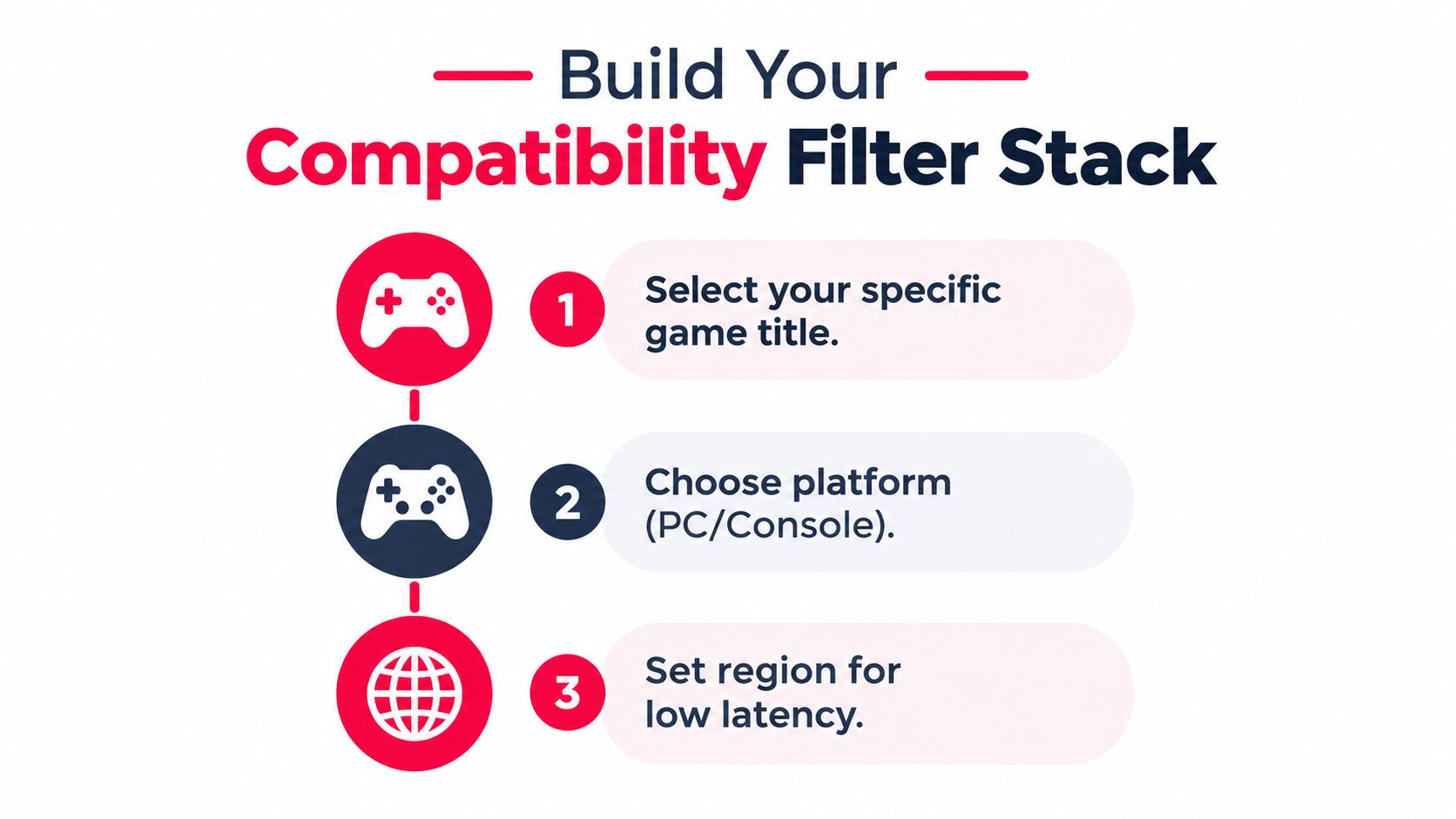
Start with the hard filters
Put these fields in your search profile or LFG post:
- Game and mode. Name the exact title and mode. “Apex” isn't enough if you want ranked instead of pubs. “Fortnite” isn't enough if Build and Zero Build require different habits.
- Platform and input. PC, PlayStation, Xbox, and Switch players may share a game, but hardware and input can affect expectations. Say whether you use mouse and keyboard or controller when that matters to the lobby.
- Region and server. Match within a practical region so latency doesn't decide every close fight. A great teammate on an incompatible server is still a poor ranked pairing.
- Rank band. Use a realistic range rather than demanding an identical badge. Rank provides context, but recent match evidence and role execution matter more than a title on a profile.
- Role complement. Don't recruit a copy of yourself by accident. Look for combinations such as entry and trade, initiator and follow-up, jungle and lane setup, or fragger and support.
- Mic preference. State whether you want full comms, concise callouts, push-to-talk, or mostly pings. “Has a mic” doesn't tell you how they use it.
- Schedule and session length. Give specific windows and expected duration. “Available often” is useless compared with “weekday evenings, two focused games.”
- Goal. Separate ranked climbing, tournament practice, casual wins, and social play. Players with different goals can still have fun, but they shouldn't assume they're building the same duo.
Use the GamerPlug esports team finder as one example of a tool category built around finding teammates rather than scrolling through unstructured chat.
Separate predictive filters from profile decoration
Some details help you predict a workable pairing. Others only look impressive.
| Filter | What it tells you |
|---|---|
| Recent match evidence | How the player currently makes decisions |
| Role complement | Whether both players solve different problems |
| Mic and callout style | Whether information will arrive clearly |
| Schedule overlap | Whether the partnership can continue |
| Rank band | Whether expectations and lobby access are broadly aligned |
| Cosmetic profile details | Almost nothing about teamwork |
Stacking filters doesn't mean demanding perfection. It means eliminating obvious mismatches before you spend a session testing them. Your candidate pool may shrink, but the remaining conversations become far more useful.
Read Clips and Stats Like a Recruiter
A short gameplay clip tells you more than a polished bio. A player can claim to be “chill,” “smart,” or “team-oriented.” A clip shows what happens when the fight gets messy.
Ask for a 60 to 90 second clip that includes a decision point, not only a highlight elimination. In Apex, watch how they position before a push and whether they share information about armor, angles, and exits. In Valorant, look for timing, utility coordination, and whether they give actionable information after dying. In League of Legends, check wave awareness, response to pressure, and whether they understand when a teammate can keep up.
The five-minute candidate check
Use this order:
- Watch the first decision. Does the player create an advantage, or do they force a fight because they're bored?
- Listen to the comms. Useful calls name the situation and the action, such as an enemy position, timing, or target. Constant noise isn't communication.
- Check the response to failure. A missed shot is normal. Blaming a teammate instead of adjusting is the clearest signal.
- Look for team awareness. Pings, trades, cover, resource sharing, and coordinated exits matter more than a single flashy play.
- Compare the clip with recent stats. Stats should confirm the role and habits you saw, not replace them.
Why K/D alone is a weak signal
A high kill ratio can come from taking low-value fights, abandoning teammates, or farming damage after the round is already lost. A support player may look ordinary in a scoreboard while creating the openings that let a duo win.
Check whether the player's recent results fit the role they advertise. A player who claims to be an entry should show timely pressure, not only late cleanup. A controller player should demonstrate space creation and information value. A League player should show decisions that help the lane or objective, not just personal farm.
A highlight proves that someone can make a play. A trial proves whether they can make the right play with you.
End the conversation early if the clip is full of blame, mocking, rage, or refusal to follow a plan. You're not recruiting a highlight reel. You're choosing the person who'll be in your voice channel when the match turns against you.
Writing an LFG Post That Actually Fills
Your LFG post should let a compatible player self-select in seconds. Put the useful details in the first lines, and offer enough about your own play style that the post doesn't read like a job listing for someone else.
A strong post includes the game, mode, platform, region, rank range, role, mic expectations, schedule, session length, and goal. Add one sentence about how you play. “I take first contact and want a calm trade partner” gives a candidate something concrete to evaluate.
LFG Post Anatomy
| Post Element | Weak Version | Strong Version |
|---|---|---|
| Game and mode | “Need duo” | “Apex ranked, looking for a focused climb” |
| Platform | Omitted | “PC, controller, cross-platform is fine” |
| Rank | “Good players only” | “Current rank in a nearby band, open to similar recent results” |
| Role | Omitted | “I entry and need a player who trades and anchors” |
| Mic | “Must talk” | “Concise callouts, no constant backseat coaching” |
| Schedule | “On later” | “Weekday evenings, short focused sessions” |
| Goal | Omitted | “Ranked improvement, not casual hot drops” |
Here's a copy-ready version:
Game and mode: [title and mode]
Platform and region: [platform, input, region]
Rank: [current rank or realistic band]
Looking for: [role and complementary role]
Mic: [full comms, concise calls, pings, or low chat]
Schedule: [specific days and local time]
Session: [short session, extended session, or flexible]
Play style: [one sentence about tempo and decision-making]
Goal: [tonight's games, recurring duo, ranked climb, or tournament prep]
Avoid “need duo,” rankless posts, platform omissions, and demands that never describe what you bring. If you want someone patient, say whether you're patient. If you want serious ranked games, don't invite people to a vague “chill session.”
For terminology and channel etiquette, the LFG guide from GamerPlug provides useful context. Post in a dedicated LFG app, a game-specific Discord, a subreddit, or a community forum, but adjust the message to the audience. Broad channels bring volume. Filtered spaces usually bring better matches.
Rank your options by purpose:
- Fastest for tonight: An active game-specific LFG channel.
- Best for repeated matching: A profile-based teammate finder with game, rank, style, and availability fields.
- Best for organized practice: Tournament and scrim communities after you have a partner.
- Best for local communities: Collegiate, regional, or creator-led groups with recurring sessions.
Screening for Communication and Trust Before You Queue
A microphone isn't proof of communication quality. Some players fill every second with noise. Others speak only after the fight is lost. Test the interaction before you attach your rank points to it.
Safety belongs in the same filter as role and schedule. A 2025 NYU multinational survey reported that 36% of participants experienced extreme or hate-based harassment while playing online multiplayer games during the previous year, including stalking, sexual harassment, violent threats, doxxing, or swatting. The same verified research notes that teammate toxicity can affect players more strongly than opponent toxicity. Read the NYU survey and its discussion of online multiplayer harassment before treating abusive behavior as ordinary lobby culture.
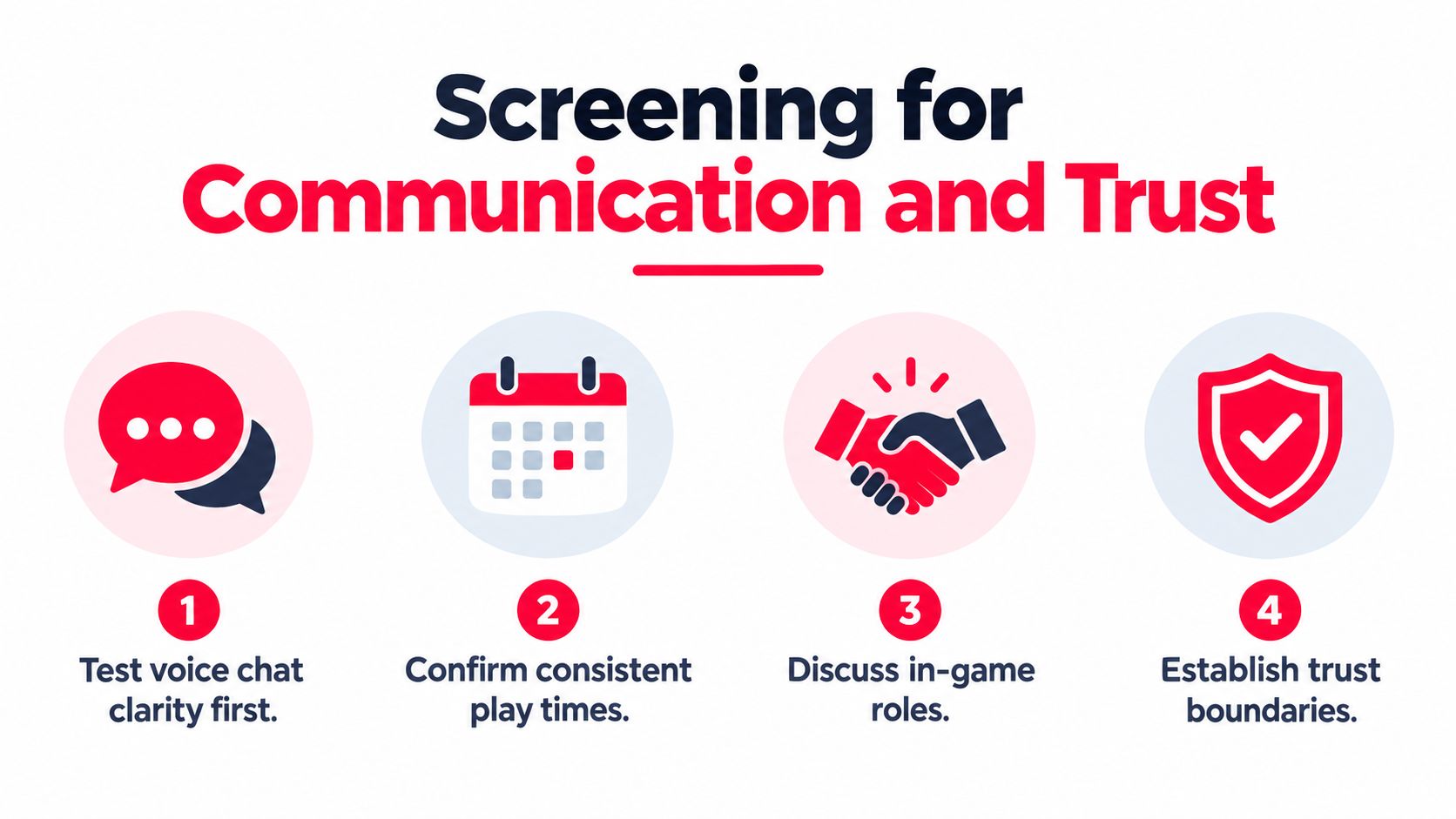
Run the pre-queue script
Ask these questions in chat or voice:
- “What kind of comms do you prefer?” Look for a clear answer about callouts, silence between fights, feedback, and backseating.
- “What happens when we lose several games?” The answer matters less than the tone. Accountability and adjustment are good signs. Stories about every teammate being stupid are not.
- “What role do you want to own?” A player who can explain their job is easier to coordinate with than someone who only says they'll “fill.”
- “What are you playing today?” Confirm whether they want ranked focus, casual games, practice, or social time.
- “What's an easy way to call a reset?” Agree that either player can end the session without an argument.
Set boundaries before the first queue. No slurs, harassment, account requests, unwanted personal questions, or pressure to move immediately into private channels. If someone mocks the boundary, the screening worked. Leave.
Players also need to discuss schedules openly. Research on matchmaking compatibility highlights timezone normalization, typical play hours, session length, and play frequency as meaningful signals, while distinguishing a single queue from a durable relationship. A player who can join tonight but never overlaps with your regular window may be useful for one session, not a permanent duo.
For more structured coordination, compare your expectations with the communication features described in GamerPlug's team chat guide. The tool matters less than the habit: concise calls, predictable timing, and a safe way to stop playing.
The Trial Session Protocol
Don't promote someone to permanent ranked partner after one good game. One match can hide bad habits, favorable matchmaking, or a shared hot streak.
Run a three to five game trial in a familiar, low-stakes mode. Tell the candidate that it's a compatibility test, not an audition for a professional roster. Keep the pressure low enough that you can observe decisions instead of watching both players perform.
Score the pairing after each game on five criteria:
- Information quality: Were calls timely, specific, and connected to the current game state?
- Mic clarity: Could both players hear and understand each other without constant repetition?
- Role execution: Did each player perform the agreed job without fighting for the same space?
- Tilt control: Did mistakes lead to adjustment, or blame and silence?
- Conflict recovery: Could the duo disagree, reset, and play the next round?
Research on squad-mode matches found a curvilinear relationship between behavioral interdependence and team performance, based on more than 140,000 matches involving over 500,000 players. The study is available through Scientific Reports. The practical lesson is simple: coordination helps, but forcing complex cooperation onto an inexperienced pairing can make the team worse.
After the first game, ask one direct question: “What should we change next game?” If the answer is specific and mutual, continue. If it becomes a prosecution of your mistakes, end the trial politely.
Promote the pairing only when the same positive behaviors repeat across the session. Move from trial to scheduled duo when communication is useful and both players want another session. Move from scheduled to permanent ranked partner when your schedules overlap, roles complement each other, and disagreements don't damage the next game.
Your Recurring Duo Playbook and Common Questions
Save this weekly routine:
- Sunday: Define game, mode, role, rank band, mic style, schedule, and goal.
- Monday: Publish a detailed LFG post.
- Tuesday: Screen candidates through clips, stats, and the pre-queue script.
- Thursday: Run one low-stakes trial.
- After the session: Promote, repeat, or move on without forcing it.
Need a duo for tonight? Relax the recurring-schedule requirement, but keep platform, region, mode, mic, and toxicity boundaries.
Want a permanent ranked partner? Require overlapping recurring windows and a trial across several games. A single successful evening isn't enough.
Only overlap once a week? Label the partnership clearly as a weekly duo. It can still work if both players commit to that window.
One player wants to climb while the other wants to chill? Don't queue ranked together until the goal changes. Different expectations create resentment faster than different skill levels.
Does cross-platform duoing work? It can, provided the game supports it and both players agree on input, communication, region, and performance expectations before the trial.
GamerPlug helps you find gaming teammates through shared games, platform, verified ranks, gameplay clips, play style, mic preferences, and availability, with LFG listings for specific modes and roles. Stop accepting random invites and build your shortlist at Gamerplug, then test the right candidate before you commit your next ranked session.