You queue into ranked with someone you met five minutes ago in a community lobby. Their rank badge looks solid, their mic works, and the first round feels promising. By the third match, you're both pushing opposite angles without calling it, their tone turns sharp after one lost clutch, and they vanish offline before the night even gets going.
A good rank doesn't guarantee a good partner. Most pairs fall apart because players treat finding a teammate like an impulse invite instead of a real duo setup. When you skip compatibility checks, ignore social comfort, and judge everything off a single lucky win, you end up back in solo queue by Friday.
Building a dependable partnership works better when you flip the usual order. Lock in your social boundaries before the first queue, align roles in one quick conversation, and test whether the pairing holds up across a five-game calibration block.
Table of Contents
- Find Partners Worth Shortlisting
- Check Compatibility Before You Queue
- Set Boundaries Before the First Session
- Set Roles and Win Conditions in One Session
- Calibrate Over Five Games, Not One
- Call Clearly and Review Every Match
- Start Your First Duo Session This Week
Find Partners Worth Shortlisting
Start with one game you both play at a comparable level. Rank tiers, pacing, and role preferences only mean something inside the same title, so trying to recruit a general gaming buddy for four different genres usually produces a weak fit in all of them. Once you pick the game, look where active players for that title already gather, including in-game party finders, official community Discord servers, and dedicated teammate-finding apps.
Write a Pre-Filtered Request
Post one short looking-for-group message that does the heavy lifting for you. State your current rank, preferred role, typical play windows, and microphone preference right up front so mismatched players scroll past instead of filling your inbox. If you play on PC with a controller or mix inputs across titles, mention that early too, and if you're still dialing in your own hardware before recruiting, you can browse the best PC gamepads from Atticus Goods to make sure your input setup feels consistent before you invite someone else into your lobby.
Message no more than three candidates per week so you aren't juggling five half-hearted trial runs at once. Ask every candidate the exact same four questions:
- Recent competitive form: Ask for their current rank alongside how their last 20 games went, not just their peak tier from two seasons ago.
- Role comfort: Find out which role they default to when a match gets sweaty and which secondary role they can flex into without tilting.
- Session length: Check whether they prefer quick two-match bursts or two-hour blocks so you don't lose your partner right as you warm up.
- Voice habits: Confirm whether they use open mic, push-to-talk, or pings only, and how much chatter they want between fights.
Keep a Clean Shortlist
Narrow your replies down to two or three candidates whose answers line up cleanly with your own routine. Treat every rank screenshot or stat line on a profile as an unverified claim until you see that person play in a warm-up match, because self-reported numbers drive most bad pairings.
Sourcing rule: Write each candidate's tag, the game, and the date of first contact in one shared note so you can track who replied and revisit solid backups without starting from scratch.
Check Compatibility Before You Queue
Multiplayer gaming isn't an occasional weekend hobby anymore. According to the Entertainment Software Association's 2025 U.S. industry study, 89% of players aged 8 to 90 have played video games online, 55% play with other people every week, and 49% of adult players say games have helped them stay connected to friends or family. Because playing with others is already a weekly habit, spending ten minutes checking partner fit saves hours of frustrating lobbies later.
Run a five-point checklist in text or voice chat before you ever click ready. Score every row as a match, discuss, or conflict, and log each result in the note you started during shortlisting.
| Criterion | What to Compare | Red Flag |
|---|---|---|
| Rank and recent form | Current rank and last 20 games | Gap of more than one division with no plan |
| Play style | Aggressive entry versus hold and anchor | Both players want to take every fight |
| Schedule | Typical play windows and session length | One player leaves after two games |
| Mic use and callouts | Mic on and short calls | Silence or constant background noise |
| Platform and input | Same platform or confirmed cross-play | Unplanned lag or controller mismatch |
Apply the Three-Conflict Rule
You rarely need five perfect matches to build a strong duo setup, especially if one gap is easy to negotiate. One discussable red flag is completely workable, such as a slight rank gap where the lower-ranked player runs support utility while learning faster rotations. If three of the five criteria land in conflict, thank the player politely and move to the next person on your shortlist before you burn an evening trying to force chemistry.
This check isn't about judging someone's personality. It's a practical filter that keeps two decent players from blaming each other for predictable friction. If you want sharper prompts to uncover playstyle mismatches quickly, reviewing smart pre-queue compatibility questions helps turn vague small talk into clear answers.
Catch Technical Friction Early
Platform and connection mismatches ruin more promising duos than mechanical mistakes. Confirm cross-play lobby settings ahead of time so console and PC players know which matchmaking pool they're entering and whether aim assist or input lobbies change the pace of fights. If one of you deals with sudden ping spikes whenever someone else streams video on the home network, reading router QoS settings explained from Nerds 2 You Edmonton gives you a straightforward way to prioritize game traffic before blaming the server.
Set Boundaries Before the First Session
Most players assume a new duo should jump straight into a private Discord server, swap socials, and chat like longtime friends on night one. In practice, a fresh partnership usually works better with less social access at first, not more. Cross-play makes it effortless to share a lobby across PC and console, yet technical access does nothing to protect your headspace if a stranger turns hostile after one bad round.
The numbers back up why caution pays off early. In Unity's survey of 1,167 U.S. multiplayer gamers cited in a 2025 ACM study on cross-platform gaming, 68% had experienced toxic behavior, 67% said they would be likely to stop playing a game when another player behaved toxically, and 77% agreed that protecting players from toxicity should be a developer priority. The same research highlights how teen gamers using Discord deliberately kept communication narrowly focused on gameplay to limit personal exposure while collaborating across platforms.
Build Trust in Stages
Treat social access as something a partner earns through steady, respectful sessions rather than a default perk of matching once. Follow five straightforward guardrails from day one:
- Start inside the game client. Use in-game voice or limited text chat for your opening sessions so neither player has to hand over external handles right away.
- Protect personal details. Never share personal accounts, email addresses, phone numbers, or login credentials, even if a teammate offers to help earn rewards or share a battle pass.
- Set recording and streaming rules early. Ask whether either player streams, clips matches, or records voice audio before the first lobby loads so nobody gets surprised by a public clip.
- Test moderation controls right away. Check where the mute, block, and reporting tools sit during your first two games so you aren't digging through menus mid-match if something goes sideways.
- Delay external voice servers. Move to a private Discord channel or party chat only after several sessions that felt relaxed, fair, and drama-free for both of you.
Setting boundaries before game one feels slightly formal for thirty seconds and saves you from awkward ghosting for the next three months.
Keep conversation anchored to gameplay early on, match mic energy so neither person feels forced to narrate their whole evening, and speak up the moment something rubs you the wrong way instead of vanishing. Coordinating expectations around aligning your weekly gaming schedule also keeps social pressure low, because both players know when the session ends without guessing.
Share a Three-Line Boundary Note
Before your first warm-up lobby, paste a quick three-line note into chat so both players agree on the ground rules in plain sight:
- Voice channel: We'll stick to in-game voice and gameplay callouts for our first few sessions.
- Personal info: Let's keep things strictly to gamer tags until we've played together regularly.
- Recording: Tell me before we queue if you're streaming or saving voice clips.
Set Roles and Win Conditions in One Session
Once boundaries are clear, spend ten minutes turning two solo habits into one coordinated plan. You don't need a thirty-page playbook to win more games, just six concrete agreements that remove hesitation when fights break out fast.
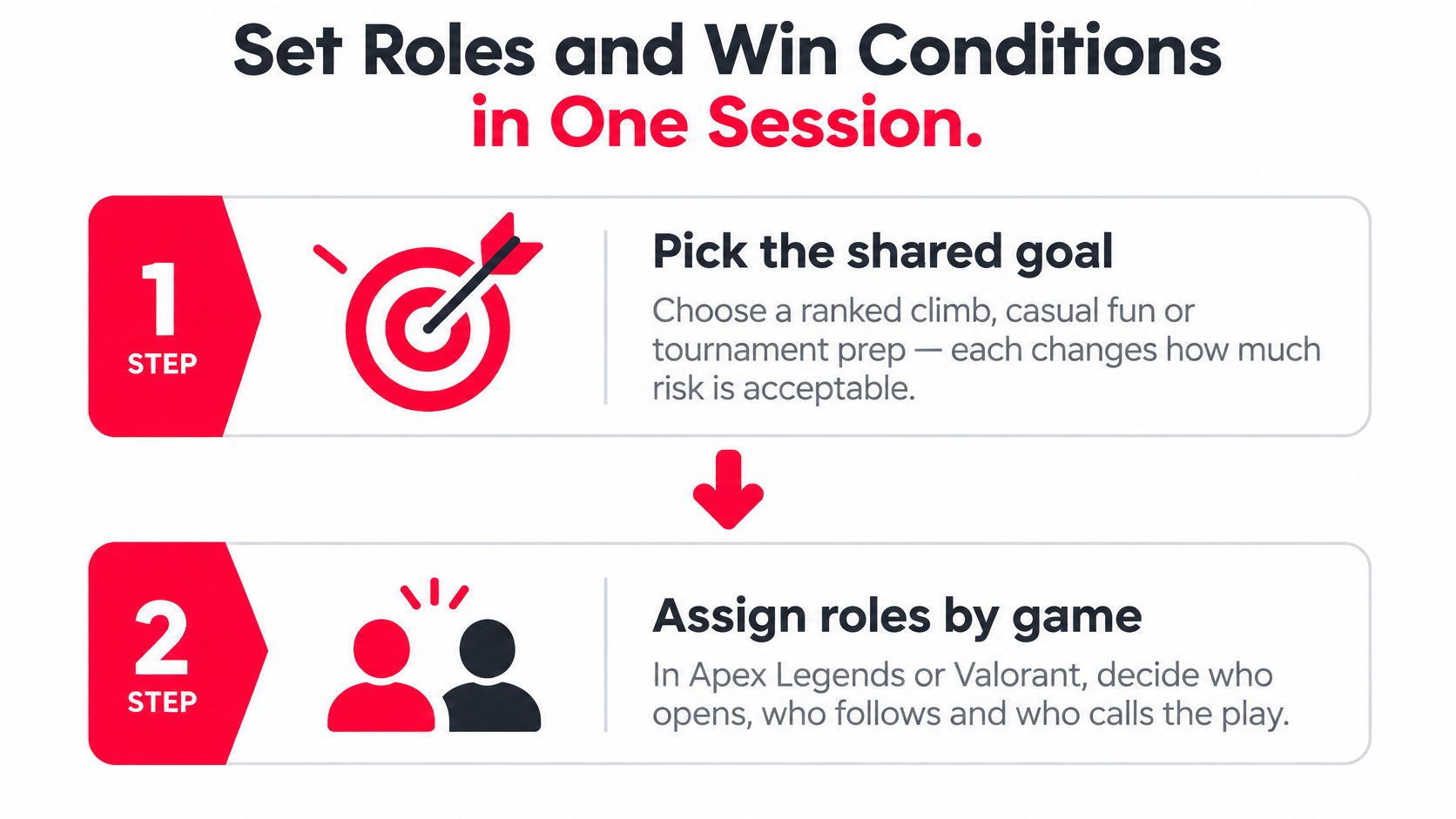
The graphic below highlights the first two foundational decisions that shape every other choice in your session.
Lock In Your Structure in Six Steps
Work through these six decisions together before queueing your first real match, adapting the examples to the title you play:
- Pick one shared goal. Decide whether tonight is a ranked climb, casual fun, or tournament prep. Each goal changes your risk tolerance, because a ranked grind rewards playing safe for placement or objective control while casual lobbies invite looser ego fights.
- Assign roles by game. Split responsibilities cleanly so you aren't stepping on each other's timing. In Apex Legends or Valorant, name who takes first contact, who anchors the trade or flank, and who calls rotations; in Fortnite, agree on who handles early box-fighting and builds versus who holds power weapons for the closing fight; in League of Legends, lock your lane or jungle pairing before queue pops so nobody gets forced onto an off-role.
- Choose a default plan plus one backup. Pick a standard landing spot, opening route, or early objective before the loading screen hits. Always attach a backup right beside it, such as rotating to a secondary POI in Apex Legends if three squads contest your main drop, so neither player freezes when Plan A gets crowded.
- Write your win condition in one sentence. Keep it crisp enough to remember under stress, such as agreeing to secure site control before taking extra duels or playing exclusively around early dragon timers. A one-sentence rule gives both players an instant tiebreaker whenever someone feels tempted to chase a stray kill.
Before finalizing your comms shorthand and reset rules, this quick breakdown walks through how simple duo habits tighten coordination under live match pressure.
- Build a five-to-eight phrase callout list. Agree on short, consistent shorthand for your most frequent plays, like swinging together, resetting health, or holding crossfires. Pre-agreed terms stop both players from inventing confusing phrases halfway through a clutch.
- Set a hard reset rule. Decide right now what happens the second one player gets knocked or your opening plan collapses. Defaulting to gathering information and playing for survival instead of rushing in for blind revenge saves far more rounds than hero plays.
Save All Six Agreements in One Place
Copy your six decisions into your shared duo note and glance at them for thirty seconds at the start of every session. That tiny ritual keeps both players aligned even if you haven't queued together since last weekend.
Calibrate Over Five Games, Not One
A single blowout win tricks players into thinking they've found their permanent teammate, while one ugly stomp makes good pairs quit ten minutes too early. Matchmaking variance, lucky loot, or an enemy smurf can swing any individual lobby beyond your control. Running a deliberate five-game calibration block strips away the noise and shows you how a partner behaves when plans bend.
Use games one and two to lock in your assigned roles and default opening plan without overreacting to the scoreboard. Games three through five are your stress test, designed to reveal whether both players still respect the agreed win condition when you fall behind on economy, tempo, or map control.
Why Coordination Outweighs Raw Rank
In 2024 League of Legends research analyzing more than 52,000 ranked matches, communication, vision control, movement, and positioning stood out among the strongest dimensions differentiating skill levels, with timely, purposeful pings standing out as a dependable coordination channel. A second esports study covered in that same analysis examined 6,444,502 match observations and found that cooperative familiarity averaged about 28.57 prior teammate interactions in its representative dyad, showing that repeated collaboration strengthens both explicit calls and unspoken timing.
To measure that growth during your five-game trial, track four ranked fundamentals: clear lane or jungle ownership, who calls early objective timing, agreed retreat thresholds, and whether each player turns vision or map intel into concrete action. Log five simple metrics right after each match so your review relies on patterns instead of mood.
| Metric | What to Track | Warning Sign |
|---|---|---|
| Objective setup | Towers, dragons or resets set up together | Objectives abandoned mid-setup |
| Conflicting calls | Deaths right after opposing instructions | More than one such death per game |
| Ping use | Pings given before fights and timed to the plan | Constant or contradictory pings |
| Win condition followed | Both players follow the agreed macro rule | One player chases kills against the plan |
| Conversion | Map control turned into objectives | Kill count rises while objectives are lost |
Four Pitfalls That Skew Calibration
Even disciplined duos misread their trial block when they fall into four familiar traps:
- Ignoring rank gaps in role selection: Letting a higher-ranked and lower-ranked player run mismatched carry roles without adjusting responsibilities creates constant tempo whiplash.
- Spamming contradictory pings: Flooding the minimap mid-skirmish drowns out real warnings and forces your partner to guess which mark matters.
- Starting fights alone: Engaging before your duo finishes rotating turns winnable 2v2 setups into staggered 1v2 trades.
- Grading purely on eliminations: Celebrating high kill counts while losing towers, dragons, Baron, or clean base resets hides the exact macro leaks costing you matches.
Make the Two-Branch Decision After Game Five
If communication stays clean while matches slip away, fix the macro rule; if communication keeps fracturing, end the pairing no matter how sharp the aim looks.
After your fifth game, sit down with the tracking table for five minutes and pick one of two clear branches. If your callouts stay calm, pings stay purposeful, and you're losing because your default opening is too greedy, keep the partner and adjust one macro rule for the next block. If you're still dying to conflicting calls, silent flanks, or ego chases after five games, thank them for the runs and move on to the next candidate on your shortlist.
Call Clearly and Review Every Match
Great mechanics collapse fast when voice chat turns into panicked noise. Under pressure, every callout needs to deliver high signal density instead of raw volume. In a study of 4,040 in-game statements across eight CS:GO matches, expert teams communicated more frequently, at a faster pace, and with more factual, action-oriented content than nonexpert teams, reinforcing how temporal and spatial precision anchors tactical play.
Use the Four-Part Call Format
Train yourself to pack who, where, when, and what action follows into one compressed line. A sharp call like "two on roof, 10 seconds, swing left" gives your partner every detail needed to line up a trade immediately. Compare that to yelling that someone is low or shouting that enemies are pushing without naming a target spot, which forces your teammate to look away from their crosshair just to decode what you meant.
Look at how a two-player team holding high ground relies on crisp timing and shared sightlines rather than guesswork.
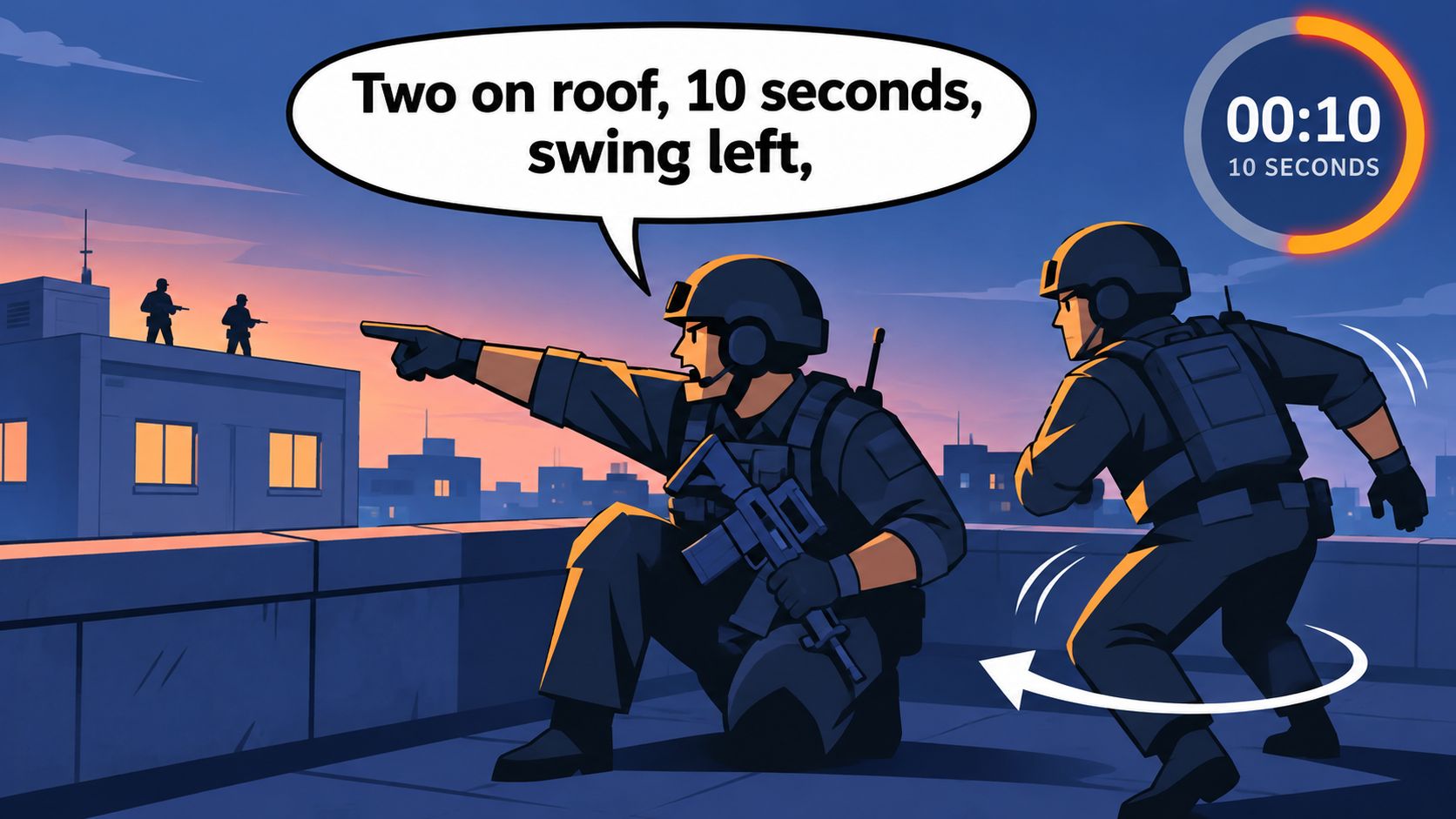
Keep your voice loop tight so neither player talks over footsteps or ability cues. One player delivers the call, the partner confirms with a single crisp word like copy or swinging, and both go right back to gathering information. Building those habits that define a dependable teammate stops comms from drifting into live commentary.
Watch out for three communication habits that break fights in Apex Legends, Valorant, Fortnite, and Call of Duty:
- Overlapping voices mid-duel: Two people calling separate targets at once guarantees neither player hears audio cues or finishes the trade.
- Location-free damage calls: Announcing enemy health without saying which corner, doorway, or elevation they hold creates blind peeks.
- Stubborn plan lock: Continuing an old rotation after an enemy pick or zone shift flips the game state turns a smart idea into a free loss.
Run a One-Rule Post-Match Review
Skip fifteen-minute blame sessions between lobbies. Right after each game ends, pick one failed rotation, missed trade, or unclear callout, agree on a single rule to fix it in the next match, and add that line to your shared duo note.
Paste this three-line template into your chat before the next queue so both players stay locked on the loop:
- Call: Who, where, when, and the next action in under four seconds.
- Confirm: One word back so the caller knows the play is live.
- Next-game rule: One specific adjustment taken from our biggest mistake last match.
Start Your First Duo Session This Week
You don't need luck or a giant friends list to escape random matchmaking. You just need a repeatable routine that filters out bad fits early and gives strong pairings enough structure to click.
Your Five-Step Launch Sequence
Follow this order over the next seven days to put the whole system into motion:
- Commit to one title where you know your current tier and preferred role.
- Shortlist two or three candidates by running your ten-minute compatibility check before anyone queues.
- Run one warm-up session with your shared roles note and three-line boundary note already posted, using that match to verify every claimed rank or playstyle.
- Play your five-game calibration block and record objective setups, conflicting calls, pings, win-condition discipline, and conversion after every game.
- Take one clear branch after game five by refining your macro rule with a strong communicator or rotating to your next candidate if comms broke down.
Final checkpoint: One intentional trial week beats fifty nights of rolling the dice on random fill teammates.
If you want one place built specifically to run this screening process without digging through messy forum threads, GamerPlug lets you compare play style, mic use, and schedule on player profiles before you ever load a lobby. Squad requirements on GamerPlug are checked against players' real stats, and profiles include a 'Request to match' option so you can move straight from shortlisting into a real warm-up session to verify how someone plays under pressure.
Pick your main game tonight, write your short pre-filtered request, and send your first partner invite before the weekend hits.
Ready to stop guessing with random fill teammates and test a real duo setup? We built Gamerplug so players on PC, console, and mobile can browse clip-backed profiles, check synced stats, and match by play style, mic preference, and schedule before queuing up. Create your free profile, shortlist players who fit your routine, and start your first five-game calibration block this week.