You queue into a ranked lobby expecting five players with one goal. Instead, the Jett instalocks, the smokes player gets pushed into a role they don't understand, and nobody calls a rotate until the fourth round. By then, two teammates are arguing, one has muted everyone, and your cleanest frag of the night still can't repair the team.
That frustration is why players eventually look beyond solo queue. A Discord ping or an “LF2M” post might fill the party, but a full roster needs more than matching ranks. It needs trust, role fit, reliable schedules, disciplined communication, and a shared standard for losing. That's what a competitive gaming community provides when it works properly.
Table of Contents
- The Randoms Problem and Why Communities Exist
- What a Competitive Gaming Community Actually Is
- The Four Roles That Keep a Scene Alive
- Finding Teammates Who Match Your Rank, Style, and Schedule
- How Communication and Role Fit Drive Real Wins
- Building a Squad That Doesn't Become a Toxicity Trap
- Hosting Tournaments and Growing the Community
- Quick Answers and Your First Steps Tonight
The Randoms Problem and Why Communities Exist
Solo queue is useful for sharpening individual mechanics, but it has a hard ceiling. Every match begins without shared context. You don't know whether the player hovering controller in Valorant understands default smoke timings, whether the Apex teammate will play edge or contest every hot drop, or whether your League of Legends jungler wants early fights or a scaling route.
The problem isn't always skill. It's the absence of memory.
A random teammate can make a brilliant entry one round and disappear the next. They don't know your preferred trade distance, your retake habits, or the call you use when you want to abandon a site. You also have no practical way to hold them accountable after the match. If the game goes badly, everyone returns to the matchmaking pool and the lesson disappears with the scoreboard.
Squad leader rule: If your team has to renegotiate its identity every match, it isn't building chemistry. It's restarting.
Discord can solve only part of that problem. A busy server may offer constant “looking for group” posts, but speed creates its own noise. Players often filter by rank and game, then discover that one person wants relaxed comms, another wants a tournament roster, and a third logs on at a completely different time. The group forms quickly and dissolves just as quickly.
A real community compounds match experience. The same Valorant players learn which site setups feel natural. An Apex trio develops a shared response to an early knock. A League Clash group recognises when a lost lane calls for a reset instead of a desperate fight. Those decisions become faster because players have rehearsed them together.
The scale of the wider scene explains why this matters. Estimates for 2025 place worldwide esports viewership at about 640.8 million people, including 318.1 million dedicated enthusiasts and 322.7 million casual viewers, according to Quantumrun's esports market overview. That audience includes professional broadcasts, grassroots events, community streams, ranked specialists, and creators. You don't need to join a major organization to benefit from the ecosystem. You need a smaller group with enough structure to turn repeated games into progress.
The useful question isn't “Where can I find five players tonight?” It's “Who will still communicate, review mistakes, and show up next week?” The answer starts with understanding what a community really is.
What a Competitive Gaming Community Actually Is
A competitive gaming community is a recurring network of players and contributors who share a game, region, expectations, and a way to improve together. Think of it as a five-stack roster with a memory. The group doesn't just queue. It runs ranked sessions, scrims, clip reviews, watch parties, coaching discussions, and tournaments under a recognisable set of standards.
That separates it from ordinary matchmaking. Random matchmaking is transaction-based. You play together, complete the match, and usually lose the relationship. A loose Discord server is more social, but it may lack a skill floor, an event calendar, or any process for dealing with unreliable and abusive members.
A functioning scene usually has four traits:
- A shared skill floor: Members understand the level of play, whether that means Apex Predator lobbies, Valorant ranked circuits, or a developing League Clash roster.
- Defined roles: Players know who entries, anchors, calls, supports, flexes, or handles late-round decisions.
- Regular events: The calendar includes ranked nights, scrims, tournaments, VOD reviews, or community watch sessions.
- Verification and accountability: Profiles, references, gameplay clips, rank checks, rules, and moderation help members know who they are joining.
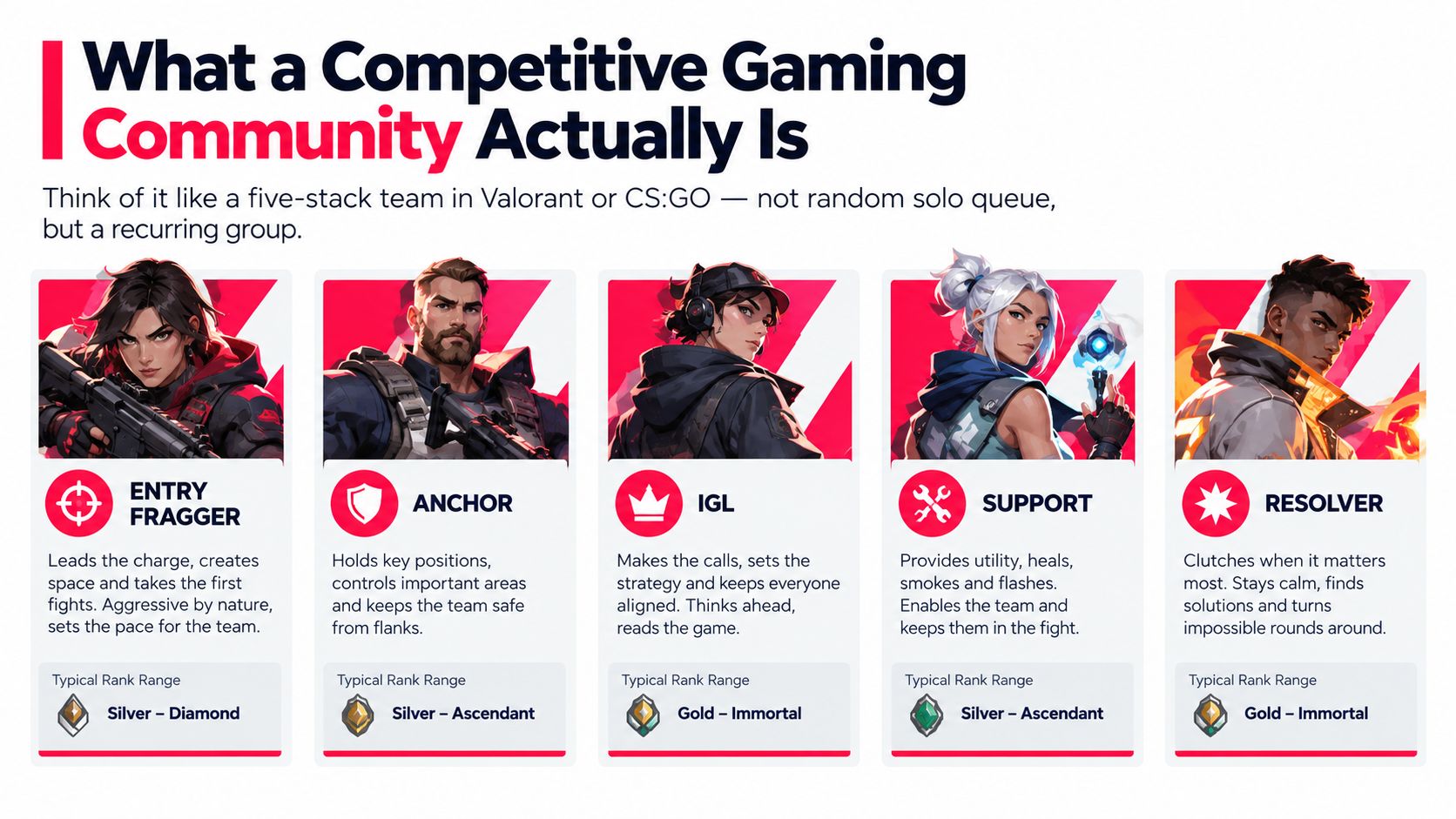
The structure doesn't need to be formal. A small Fortnite group can have a simple schedule and a shared chat. A university Overwatch team may use coaches, practices, and performance reviews. A creator-led Valorant server might combine ranked queues with community events. The common feature is repeated interaction with consequences. People remember who turns up, who adapts, who blames others, and who helps a new player improve.
Creators also need this kind of structure. A useful resource on community tips for streamers can help creators think beyond collecting followers and toward building recurring participation. The same principle applies to competitive players. A chat server becomes a scene when people know how to enter it, contribute to it, and earn trust inside it.
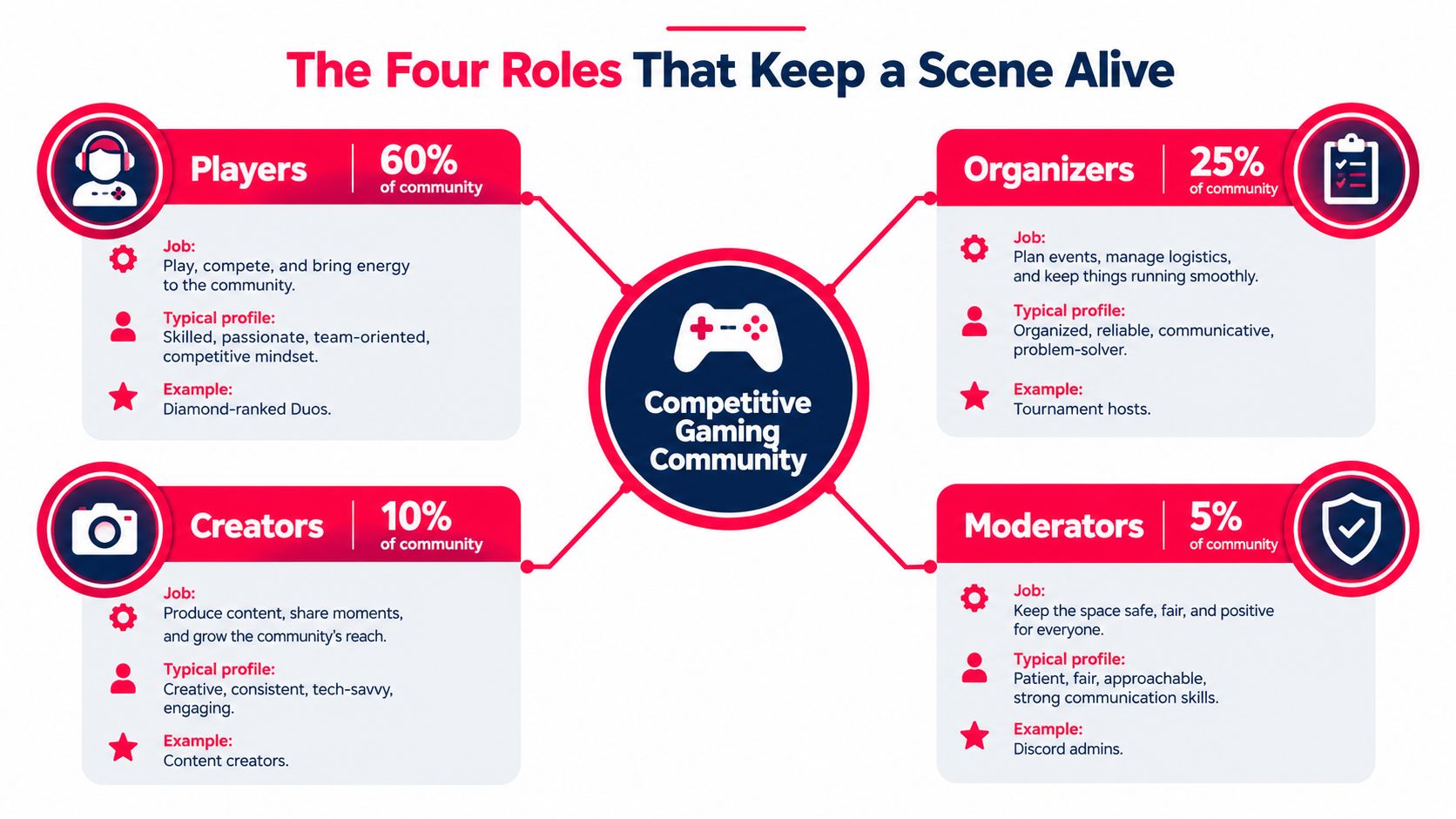
Four roles keep that loop moving: players, organizers, creators, and moderators.
The Four Roles That Keep a Scene Alive
Players are the visible core, but they aren't the whole structure. In an Apex community, players form trios, grind ranked, scrim, and discuss tournament matches. In Valorant, they develop agent pools and site protocols. In League of Legends, they build a stable Clash group instead of searching for a replacement every time a bracket opens.
Organizers turn interest into a calendar. They set check-in times, collect rosters, seed brackets, publish rules, resolve score disputes, and make sure a new member knows where to post. A good organizer doesn't need to be the highest-ranked player. They need to remove friction so skilled players can spend their attention on the game.
Creators give the scene a public memory. A Twitch VOD, a short montage, or an X thread can turn an amateur squad's close series into a story people want to follow. Without creators, a community may keep playing but struggle to attract new players, opponents, or volunteers. Content doesn't need to be polished broadcast production. A clear clip with context is often enough to show the group's style.
Moderators protect the conditions that make all three roles sustainable. They screen applicants, enforce the code of conduct, separate arguments from harassment, and remove repeat offenders before their behaviour becomes normal. Their work is less visible than a tournament win, but it determines whether members feel safe returning.
What happens when one role is missing
A player-only community can grind for months without improving its public profile or event discipline. An organizer-only server can schedule brackets that nobody wants to play. A creator-heavy group may generate attention without developing reliable rosters. A server without moderation eventually asks its most patient members to absorb the cost of everyone else's behaviour.
The strongest communities let people move between roles. A support player may help run check-ins. A streamer may publish VODs from a local bracket. A moderator may recruit a substitute after noticing a recurring scheduling gap. That cross-support is what makes a scene resilient rather than dependent on one administrator.
Your job as a new member isn't to perform all four roles. It's to recognise which role the community handles well and which one it leaves exposed. That tells you more than the member count or the number of channels.
Finding Teammates Who Match Your Rank, Style, and Schedule
A good teammate search begins with filters, not vibes. Start by writing down verified rank, playstyle, and availability. These filters answer three different questions: Can this player operate at the required level? How will they behave inside the round? Can they attend the sessions the team plans to run?
Your squad post should be short enough to scan:
Valorant: peak Immortal, current rank listed, controller or flex, structured comms, weekday evenings, looking for a stable ranked and scrim group.
Do the same for Apex, Fortnite, or League. Include your main role, preferred pace, platform, microphone expectations, and whether you're looking for relaxed ranked play or a tournament roster. A vague post attracts vague matches.
Verify the player behind the badge
Self-claimed rank is a starting point, not proof of fit. A short gameplay clip shows decision-making that a badge can't. In Apex, look at how a candidate rotates after a teammate is cracked. In Valorant, check whether their entry creates space for a trade or leads to a highlight attempt. In League, watch how they respond when a lane loses priority.
The clip doesn't need to show a perfect game. It should reveal whether the player communicates useful information, understands their role, and stays engaged after a mistake. Public match history, rank verification, and references from known community members add further context.
Dedicated services such as GamerMatch, ESEA, and FACEIT can reduce search time by combining game, rank, region, and availability filters. The broader principle is similar to how teams match intent to the right team. A match should reflect what both sides need, not merely who happens to be online.
Test compatibility before committing
Run a trial session before adding someone to a permanent roster. Three games are enough to expose obvious problems, provided you observe the right moments:
- Round loss: Do they give a useful adjustment, go silent, or start assigning blame?
- Role pressure: Do they follow the agreed plan when the match becomes uncomfortable?
- Schedule reality: Do they arrive when promised and communicate if plans change?
- Information quality: Are their calls short, specific, and actionable?
- Team response: Do they create space for others to speak?
Use an LFG post for discovery, but don't stop there. A practical explanation of what LFG means is useful for players who know they need teammates but haven't yet learned how structured group-finding works. The right teammate isn't just the person with the highest badge. It's the person whose rank, role, temperament, and calendar fit the work your squad is trying to do.
How Communication and Role Fit Drive Real Wins
The best team comms aren't the loudest. They're the fastest route from information to action.
A CS:GO study examined 4,040 in-game statements and 22,490 words across eight matches. Expert teams communicated more frequently and quickly, used more factual and action-related statements, and distributed speaking more evenly than nonexpert teams, as reported in the expert communication study indexed by PubMed. The useful lesson isn't to fill every second with voice chat. It's to make every call easier to process.
A call such as “two B, one low” gives location, count, and an immediate tactical fact. A long explanation about how the opponents have been playing all match forces teammates to extract the useful detail while the fight is already moving. Valorant, CS, Overwatch, Apex, and League all reward the same habit, even though the vocabulary differs.
A simple comms contract
Set the rules before the first serious session:
- Call the fact first: State the enemy location, cooldown, health state, or objective status.
- Use declarative language: Say what is happening and what action is needed.
- Protect IGL priority: During a fast execute or retake, the caller's instruction gets the first response.
- Avoid overlap: If someone is giving a live fight call, wait before adding a secondary observation.
- Review after the round: Save analysis for the pause or post-game discussion.
A university-affiliated Overwatch study found that a structured intervention increasing declarative calls produced better perceived response speed and overall team performance. The study involved 10 teams, and its practical implication is direct: teams can train cleaner communication instead of hoping it appears through more matches, as described in the Journal of Electronic Gaming and Esports study.
| Comms habit | Example | Impact on wins |
|---|---|---|
| Short factual call | “Enemy B main, one tagged” | Gives teammates information they can act on immediately |
| Action call | “Smoke door, play retake” | Connects utility and positioning to a clear plan |
| Balanced speaking | IGL calls the plan, teammates add confirmed updates | Reduces the chance that one voice hides critical information |
| Emotional commentary | “Why are we always losing this?” | Uses attention without changing the next decision |
| Post-round review | “We lacked a trade on entry” | Turns a lost round into a specific adjustment |
Role fit makes those calls meaningful. The duelist or entry player creates the opening. The controller places utility on contact. The sentinel or anchor protects the weak side. In a MOBA, the same principle appears through lane priority, jungle timing, engage windows, and objective setup.
Voice chat still matters, but it needs a container. Players who want to improve their setup can use a practical guide to voice chat for gaming, then agree on when to speak and when to listen. A team with average aim and clear roles can outperform a mechanically gifted group that talks over every decision.
Building a Squad That Doesn't Become a Toxicity Trap
Moderation alone can't prevent toxicity. A moderator can remove a slur after it appears, but they can't restore the focus lost during the round or undo the reason a good player stopped joining. The better intervention happens before the player enters the ranked party.
The risk is substantial for communities that rely on constant interaction. A multi-country gaming trust-and-safety survey found that 65% of gamers had quit or were likely to quit because of toxicity, while 73% were more likely to quit in high-interaction genres such as MOBAs and FPS games, according to the systematic review and trust-and-safety research. Those findings make toxicity a retention and performance problem, not merely a question of server etiquette.
Screen for behaviour before skill
Ask prospective members how they handle a lost round. Watch their clips for reactions, not only mechanics. Run a trial session and notice whether they respect role agreements, accept corrections, and communicate when frustrated.
A player who refuses every adjustment will damage a roster even if they top the scoreboard. A calm support player who keeps giving useful information after a failed execute may be more valuable over a season. Build the standard first, then fill the roster.
Put expectations in writing
A short code of conduct should define unacceptable behaviour, reporting steps, and consequences. It should cover harassment, threats, hate speech, targeted insults, griefing, and attempts to expose private information. It should also explain the ordinary standard: no personal attacks, no rage directed at teammates, and no punishment for asking a legitimate question.
Use a staged response where appropriate. A warning can correct a poor habit. A temporary removal can create space after a serious incident. Permanent removal protects the group when someone repeats the behaviour or threatens members.
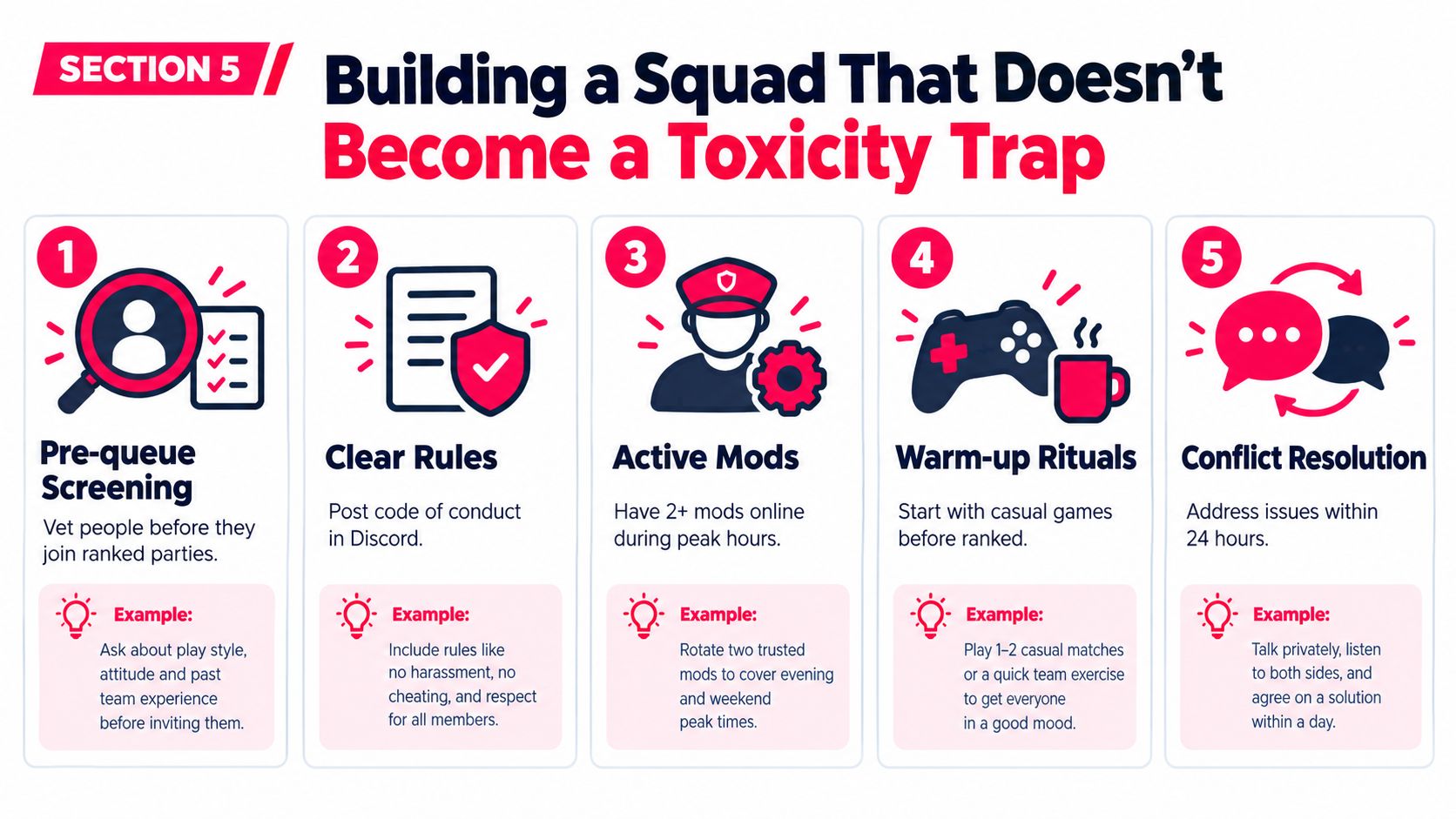
Warm-up sessions help too. Start with casual games or a low-stakes queue before a tournament block, so new players can learn voices, pacing, and expectations without risking a bracket result. When conflict appears, address it promptly and privately where possible. A community that treats “gg, go next” as a reset signal gives players permission to recover rather than perform anger.
Teams that want a practical framework for this culture can also review toxic-free gaming and positive communities. The goal isn't a squad that never disagrees. It's a squad where disagreement produces an adjustment instead of a target.
Hosting Tournaments and Growing the Community
A tournament changes a chat server into a place with stakes, even when the prize is modest. Start with a format your organizers can run cleanly. An eight-team single-elimination bracket is easier to explain and manage than an ambitious league that cannot post results on time.
Before you announce the event, set the operating rules:
- Check-in: Use one clear window and mark confirmed rosters.
- Seeding: Use rank, prior results, or a transparent random process.
- Match reporting: Give captains one template for scores and disputes.
- Communication: Create match rooms or threads so officials can reach teams quickly.
- Review: Store VODs, clips, and rulings in a channel members can revisit.
Bracket choice should match the experience you want to create. Single elimination moves fast, but one bad series sends a team home. Double elimination gives a strong roster room to recover. Swiss and GSL formats work well when the field gets larger and you want more meaningful matches. Round robin fits a group that values repeated practice over a short knockout.
A seasonal ladder keeps people coming back between headline events. Players have a reason to return, organizers have a recurring calendar, and creators have material to publish. A public leaderboard can show more than wins. It can track series participation, standout plays, sportsmanship recognition, or improvement notes if the community agrees on the criteria.
Creators make the event visible. Ask a caster to explain a close Valorant retake, clip an Apex endgame, or post a League objective setup with enough context for viewers to follow the decision. Those assets give new members a reason to join before they know anyone personally.
The growth loop is simple, host, record, clip, promote, retain. Organizers create the match. Players provide the competition. Creators preserve and distribute the story. Moderators keep the environment usable. Remove one part and the event may still finish, but it becomes harder to turn a one-time entrant into a regular member.
Community broadcasts already drive a large share of watch time across major esports titles. A local bracket does not need that scale. It needs the same basic insight: community members are not only spectators or players. They help carry the event, and they help other people find it.
Quick Answers and Your First Steps Tonight
Which game should you choose? Start with the game you already understand and enjoy. A community can't fix a title you don't want to play. FPS players can look for Valorant, Apex, Fortnite, or Overwatch groups. MOBA players can search for League of Legends duos, Clash rosters, or teams that share their preferred pace.
Should you use Discord, Reddit LFG, or an app? Discord is useful for established communities and ongoing conversation. Reddit LFG can expose you to new groups, but posts vary in detail and reliability. A dedicated teammate-finding service can be more useful when you need filters for rank, platform, role, clips, and schedule. Pick the channel that gives you enough information to judge fit before you queue.
Do you need a high rank or a large playtime history? Not necessarily. Communities differ, and many care more about reliability, communication, and a willingness to improve than a specific badge. Be honest about your current level and apply to groups whose expectations match it.
Are competitive communities free? Many are. Costs may appear for tournament entry, coaching, or optional services, so check the rules before joining.
Can a community help you climb? Yes, mainly by giving you consistent practice partners, clearer role expectations, and better comms. It won't replace mechanics or game knowledge, and no legitimate group should promise boosted results.
Start tonight:
- Clean up your public match history and select a clip that shows how you play.
- Write a short bio with your main game, rank, region, platform, role, microphone status, and schedule.
- Apply to two relevant communities.
- Post once in an LFG channel with a specific goal, such as ranked practice, scrims, or a tournament roster.
- Run a trial session and judge reactions to failure before committing.
Don't wait for the perfect roster. Publish the useful information, join the first serious trial, and make your next queue a test of fit rather than another roll of the dice.
Gamerplug helps players find teammates through profiles built around gameplay clips, verified ranks, playstyle, microphone use, platform, and schedule, with LFG listings and tournament tools for games including Apex Legends, Valorant, Fortnite, and League of Legends. Visit Gamerplug tonight, create a clear profile, and start building a squad that can communicate and show up.