
You've just hit the ranked gate, opened the playlist, and now the lobby is asking you to make a decision you didn't have to make in public matches: who are you queueing with? A familiar badge can look reassuring, but a Gold player with no mic, a different schedule, and a reckless drop style may be a worse partner than a lower-ranked player who communicates and plays for the same win condition.
The Apex Legends ranked system is easier to understand when you treat it as a set of checkpoints. Your tier shows where you currently sit, Ranked Points show how each match moved you, and the season rules determine how much that badge really says about your ability. The ladder matters, but teammate compatibility matters just as much.
Table of Contents
- Hitting Level 10 and Entering Ranked
- Every Rank and Division Explained
- How RP Is Earned Each Match
- Promotion, Demotion, and Safety Nets
- Why Your Rank Is Not as Fixed as It Looks
- Season Resets, Splits, and Where You Land
- Climbing Faster by Choosing the Right Squad
- Putting It All Together Before the Next Drop
Hitting Level 10 and Entering Ranked
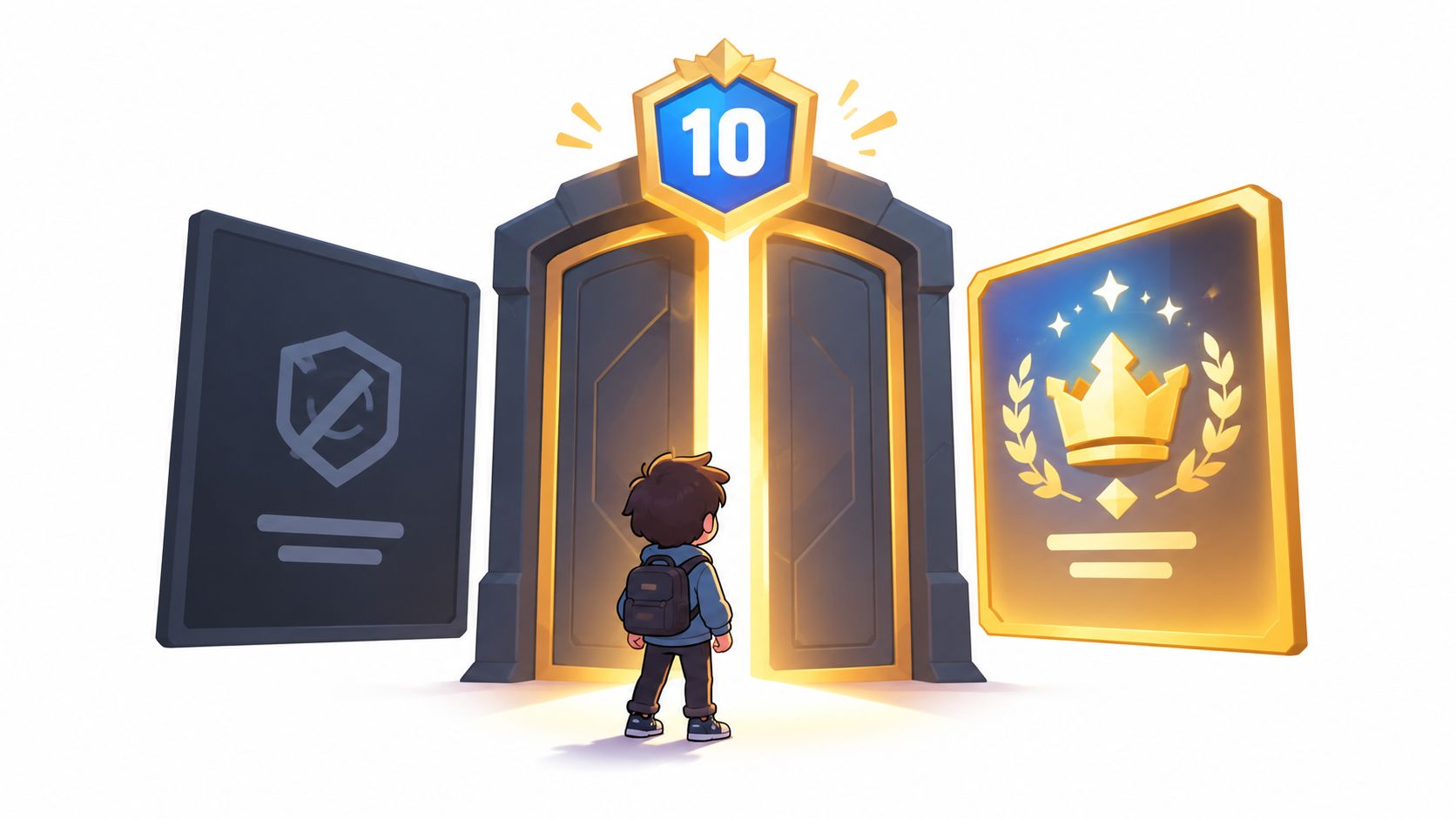
You reach level 10, queue into the lobby, and see a new choice waiting beside your usual matches. Until now, each game has helped you learn weapons, rotations, legends, and the map. Ranked adds a ladder, so the result of every match becomes part of a longer climb. Before you press Play, decide which teammates can support your true play style.
Treat ranked as a chain of checkpoints rather than one giant climb. You enter at the bottom of the available ladder, finish matches, receive an RP result, and measure that result against the next division or tier. The ladder works like a series of doors: each result tells you whether you are getting closer to the next one or slipping back.
What changes when ranked opens
Before the access gate, unranked matches give you room to practise. You can test an early fight, learn when to disengage, and find legends that fit your instincts without putting RP on the line. After ranked becomes available, the game records your results under the competitive rules active for the current season or split.
You will see a tier-based ladder, a season or split timer, and a ranked queue governed by that period's rules. Your RP position comes from completed matches, not from entering the lobby. A strong session can build rank, while a poor one can cost RP, as explained in EA's ranked explanation.
Use your first matches to answer four practical questions:
- Can you survive the opening rotation?
- Do you communicate before taking a fight?
- Can you stop looting when your squad needs to move?
- Do you understand when a kill is worth the risk?
Use the gate as a checkpoint
Do not treat the access gate as proof that you are ready to solo-carry every lobby. It gives you a better test of your habits, especially when choosing who to queue with.
Your first useful checkpoint is a repeatable routine. Look for players with compatible platforms, schedules, communication habits, and preferred pace. A rank badge shows someone's competitive tier, but it cannot show whether they hot-drop every match, stay silent, or leave the squad without warning.
A strong first ranked session leaves you with a clearer role. You may be an aggressive entry player who needs a calm anchor, or a support player who prefers late rotations and controlled fights. Finding teammates who match that role will help more than chasing a badge with random players.
Every Rank and Division Explained
The ladder is arranged from entry-level competition to the highest skill bracket. The modern order is Rookie, Bronze, Silver, Gold, Platinum, Diamond, Master, and Apex Predator, although the rules and thresholds attached to those labels can change between seasons, as EA notes in its current ranked guidance.
The normal tiers use divisions. Electronic Arts describes the structure as four divisions per tier, ordered from Division IV, the lowest point in a tier, through Division III and Division II to Division I, the highest. Master and Apex Predator are the exceptions. They use a single elite tier rather than four divisions.
| Tier | Divisions | Skill band |
|---|---|---|
| Rookie | Four divisions | Entry-level ranked competition |
| Bronze | Four divisions | Developing ranked fundamentals |
| Silver | Four divisions | More consistent combat and rotations |
| Gold | Four divisions | Established competitive baseline |
| Platinum | Four divisions | Stronger decision-making under pressure |
| Diamond | Four divisions | Elite lobbies with demanding execution |
| Master | Single tier | Highest broad competitive bracket |
| Apex Predator | Single leaderboard tier | Top-ranked players on the ladder |
How to read the divisions
The division is more useful than the badge alone. Gold IV and Gold I are both Gold, but they represent different points within that tier. Division IV means you've just entered the bracket, while Division I means you're close to the next major checkpoint.
Below Master, each tier is split into four divisions. You climb through the divisions in order, then move into the next tier after reaching its promotion requirement. The exact RP thresholds and costs can change, so don't memorize an old season's chart and assume it still applies.
Diamond is the practical dividing line for many players. Once you reach Diamond, stronger opponents punish loose rotations, isolated pushes, and late decisions more consistently. The game stops forgiving the same mistakes that might survive in Bronze, Silver, or Gold.
Master removes the division icons and presents a single elite pool. Apex Predator sits above that pool as a visible leaderboard position rather than a four-division tier. That makes the top of the ladder more fluid than a normal promotion track.
Badge rule: Use rank to estimate competitive experience, not to predict teammate chemistry.
For a broader view of how competitive players are ordered across games and rankings, rankings from EsportsOdds can provide useful context. For an actual Apex queue, though, you still need to check platform, schedule, mic use, and play style. A similar badge helps, but it doesn't guarantee a similar approach to fights.
How RP Is Earned Each Match
RP is the scoreboard that turns a match into progress or regression. The current system combines placement, eliminations, and performance-related factors, rather than treating survival or combat as the only valid path. EA also explains that higher placement increases the value of kills, which means an elimination late in a successful match can matter more than an early elimination in a doomed drop.
The three questions to ask after a match
Where did the squad finish? Placement is the foundation. Reaching the final teams gives your eliminations more value and protects the match from becoming a total loss after an early fight goes wrong.
How much did the squad contribute in combat? Eliminations add combat value, but kills aren't automatically a reason to force every fight. A squad that takes a bad early engagement may collect damage and one elimination, then lose the match before placement can improve the result.
What rules applied to your current rank? Ranked systems can attach different entry or loss conditions to different tiers. Those conditions are season-dependent, so the number shown in your lobby is the authority for that match. Don't use an old spreadsheet as a substitute for the live rules.
Aggression versus survival
Consider two simple match shapes without assigning invented values to them. In the first, your squad fights early, earns two eliminations, and finishes third. The placement gives those eliminations more weight, so the aggressive opening can become a strong RP result if the squad converts its advantage into a late finish.
In the second, your squad avoids every fight, reaches first place, and records no eliminations. The win supplies the strongest placement outcome, but the squad leaves combat value unused. That can still be a successful match, especially when the lobby is dangerous, but it isn't proof that hiding is always optimal.
The right question isn't “Should I rat or fight?” Ask, “Can this fight improve our route to a higher placement?” Take a clean engagement when your squad has position, resources, and an exit. Leave when the fight exposes you to a third party or blocks the next rotation.
Your teammates need to understand this shared logic. An entry fragger who pushes without a reset plan can turn a high-placement game into an early loss. A passive player who refuses every safe opportunity can leave the squad under-equipped for the final ring. RP rewards the squad that combines survival with useful combat.
Promotion, Demotion, and Safety Nets
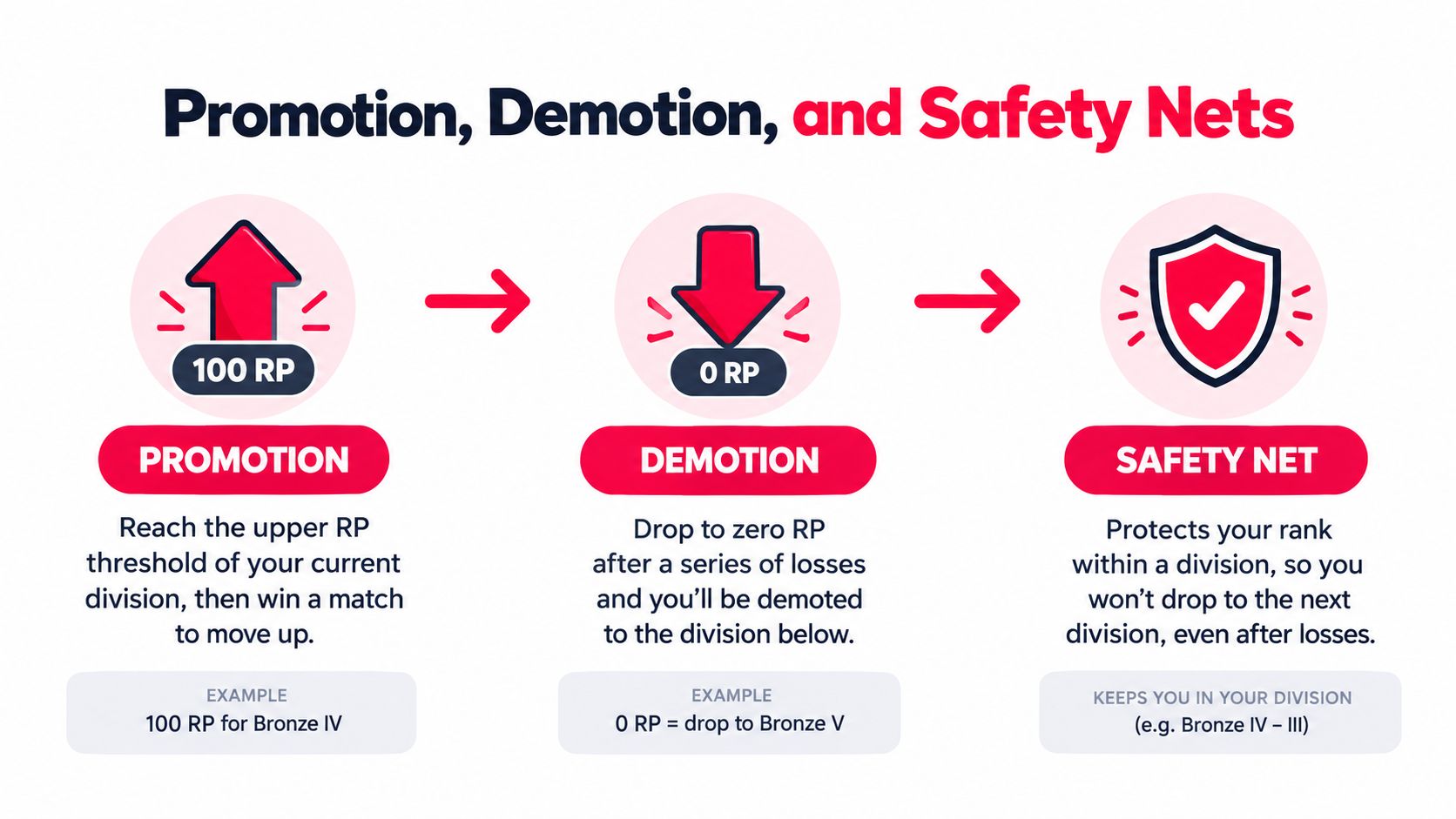
Promotion is the moment the ladder asks you to protect progress instead of merely chase it. You reach the upper RP requirement for your current division, move into the next checkpoint, and then need to play under the rules of that new position. The exact promotion behavior can vary by ruleset, so read the live in-game description before assuming a particular win condition applies.
Demotion works in the opposite direction. Repeated losses reduce RP, and reaching the lower boundary can send you back through the ladder. A new tier can feel secure because the badge has changed, but the protection around that promotion isn't a permanent shield.
What protection is really for
Tier protection, sometimes described as a free pass, exists to stop one immediate mistake from erasing a fresh promotion. It gives you room to play at the new tier, but it doesn't make the new rank permanent. Once that protection is used, another run of losses can push you back down.
This changes how you should play directly after promotion. Don't queue tilted, swap to a completely unfamiliar legend, or follow a teammate into fights you wouldn't take at your previous checkpoint. Your first job is to learn the lobby, not prove that the promotion was lucky.
Track a short run, not one result
One match can be noisy. A teammate disconnects, a landing spot goes wrong, or a third party arrives at the worst possible moment. Look at a short run of games instead and record three things:
- Early deaths: Note whether the squad is losing before it has a rotation plan.
- Fight quality: Separate clean advantages from desperate contests.
- Communication: Track whether calls happen before the push, not after the knock.
A short review can expose streak risk. If the squad keeps losing after the same type of opening fight, stop repeating it. If everyone is frustrated after a promotion, take a break before the safety net becomes the only thing keeping the badge alive.
Practical rule: A promotion is a checkpoint to stabilize, not an invitation to increase the risk every match.
Why Your Rank Is Not as Fixed as It Looks
A ranked badge is a snapshot produced by a particular ruleset, reset method, and player population. It isn't a permanent skill percentile. Apex's ranked history makes that clear because the same labels have represented very different player distributions across different periods.
Season 13's Ranked Reloaded update shifted emphasis away from kills toward placement and introduced tier demotion. In its first split, the reported distribution was 10.8% Bronze, 28.78% Silver, 44.45% Gold, 14.6% Platinum, 1.25% Diamond, and 0.1% Master or Predator. Those figures are documented in the historical ranked distribution report from Dot Esports.
The contrast with the prior season was substantial. More than 65% of players who had played over 10 hours in Season 12 reportedly finished in Platinum or Diamond, while the combined share fell to just over 15% after the first split of Season 13, according to the same report.
The second split changed the picture again
The second split partially reversed that distribution. Bronze represented 2.22%, Silver 15.22%, Gold 41.5%, Platinum 32.57%, Diamond 8.05%, and Master or Predator 0.45% in the reported snapshot.
| Snapshot | Master entry RP | Predator entry RP | Approx. Predator pool size |
|---|---|---|---|
| Season 13 first split | Ruleset-dependent, not a permanent value | Ruleset-dependent, not a permanent value | 0.1% Master or Predator combined |
| Season 13 second split | Ruleset-dependent, not a permanent value | Ruleset-dependent, not a permanent value | 0.45% Master or Predator combined |
| Later matchmaking reference | 16,000 or more RP treated as Master-tier for matchmaking | Not separately stated | Not separately stated |
The practical lesson is simple. A Gold badge earned under one split isn't automatically equivalent to a Gold badge earned under another. When you choose teammates, ask when the rank was earned, whether they understand the current rules, and whether their recent performance matches the label.
Network quality can also affect what a badge tells you in practice. Before judging a teammate's decision-making, check whether connection problems are affecting their fights, and use this guide on Apex Legends packet loss when diagnosing inconsistent matches.
Season Resets, Splits, and Where You Land
A new ranked season doesn't preserve your exact RP position forever. The system can move players through a soft reset, rebuilding the ladder while retaining some connection to previous progress. That reset is why a player who ended one period in a high tier may begin the next climb lower than expected.
The badge history still matters because it shows where you previously reached. Your current RP, however, is the number that governs the new run. Don't confuse a visible past achievement with the position from which your next match is being scored.
Soft resets create a new lobby problem
The first matches after a reset can feel strange. Players with very different historical skill levels may be working through the same lower section of the ladder. A lower badge doesn't necessarily mean the lobby contains only inexperienced players.
That makes the opening session a poor time for ego drops. Use the early games to measure the pace of the lobby, identify common rotation routes, and see whether your squad can win a controlled fight. Aggressive play can work, but only when the whole team understands the risk.
Splits change the context
A mid-season split refreshes the competitive environment and changes where players sit on the ladder. The exact timing and reset behavior can vary, so use the in-game season information rather than relying on an old schedule. Your visible split result provides useful history, but it doesn't guarantee the same match quality in the next period.
Planning matters more than grinding blindly. Mark the reset and split windows, then use your first group of matches to establish a stable routine:
- Queue with a consistent squad so you can judge your decisions rather than random teammate behavior.
- Review the first rotations and identify where the squad loses time.
- Protect good RP games instead of turning every lead into a forced fight.
- Reassess the roster if communication or schedules keep breaking the session.
Players who want to understand the upper end of the ladder can also review the highest rank in Apex. The useful takeaway isn't the title alone. It's recognizing that every season and split gives that title a different competitive context.
Climbing Faster by Choosing the Right Squad
Mechanical skill wins individual fights, but a compatible squad determines how often you reach those fights with a plan. Ranked scoring applies to the match result, so one teammate's reckless push can damage the whole team's RP position. One teammate's calm call can save the entire rotation.
Rank is still a useful filter. A Gold or Diamond badge provides a verified baseline for competitive tier, as EA's ranked system describes. But rank alone doesn't answer the questions that decide whether a squad works:
- Can everyone use a microphone?
- Do players want early fights or controlled rotations?
- Are their schedules compatible?
- Will the team follow one IGL call when the ring closes?
- Does everyone understand when to disengage?
Build the LFG filter before the queue
Start with rank range, but don't stop there. Look for players in a compatible major bracket and confirm how recently their rank was earned. A badge produced by a different season's rules may not predict current performance as well as a short conversation and a few clips.
Then check communication. A working mic isn't enough if nobody gives useful information. Agree on simple callouts before the match, such as who leads the rotation, who starts an entry, and when the team abandons a fight.
Style labels make the search faster. Describe yourself as an aggressive entry, IGL anchor, support flex, or another honest role. These labels aren't permanent classes, but they help prevent a common mismatch: one player wants to force every contest while another expects a slow endgame.
Use schedule and stop-loss rules
A compatible squad must be available at the same time. Filter by platform, region, and normal play hours instead of accepting a teammate who can only play when you're exhausted or facing unstable matchmaking conditions.
Set a stop-loss rule before the session. After two bad sessions, review the pattern or stop for the night. Don't keep queueing just to recover RP while tilted. Rotate the IGL role across sessions so one player doesn't carry every call, every mistake, and every emotional reaction.
A practical way to find Apex Legends teams is to treat teammate search like roster building. Check rank, clips, mic use, schedule, and style before you commit to a long grind. The right partner isn't the player with the highest badge. It's the player whose decisions give your own strengths room to work.
Putting It All Together Before the Next Drop
Treat the ladder as a system of inputs, not a single climb. Before you queue, check the live RP rules for your tier, identify the promotion requirement, and understand how close you are to the lower boundary. Know whether tier protection is available, but don't play as if it makes losses harmless.
Use the season calendar as part of your strategy. Mark the next reset or split, then plan an early run with a squad you can keep together. Early matches are for establishing a reliable pace, not for proving that every fight belongs to you.
Your pre-queue checklist should fit on one screen:
- Rank: Are the players in a compatible competitive bracket?
- Comms: Does everyone have a working mic and useful callouts?
- Roles: Who is leading, who is entering, and who is covering the reset?
- Style: Does the squad want aggressive contests or controlled placement?
- Schedule: Can everyone play the full session?
- Stop-loss: What result ends the session before tilt takes over?
Then play the formula. Seek placement, take valuable fights, and avoid combat that gives the enemy a free third-party angle. Protect a new promotion while you learn the lobby, and remember that the badge only means something when you understand the rules that produced it.
The best ranked climb combines threshold awareness, reset awareness, and roster awareness. Improve all three, and your next drop becomes a repeatable plan instead of another coin flip.
Gamerplug helps you find compatible gaming teammates through verified ranks, gameplay clips, play-style details, mic preferences, and schedule filters across PC, PlayStation, Xbox, and other platforms. Visit Gamerplug to build an Apex squad that matches how you want to play ranked.