A Swiss event typically runs about the base-2 logarithm of the entrant count in rounds, so 16 teams play 4 rounds and 512 teams play 9. That fixed schedule is the point of the format: nobody leaves after one defeat, and the standings sort the field.
Have you ever treated the label "Swiss" as proof that two teams on the same record had the same chance? Pairings only match current scores. They do not equalize sides, servers, rest, or what happens when several teams land on the qualification line together. If you run events, publish the round count, the tiebreak chain, and the cutoff rule before anyone registers, or the standings will argue with you on the last day.
Table of Contents
- How Many Rounds a Swiss Event Needs
- How Pairings Work Round by Round
- Tiebreakers That Decide Who Advances
- What Decides Advancement at the Cutoff
- Where Swiss Stays Fair in Esports
- Swiss Compared With Brackets and Round Robin
- Choose Swiss for Your Next Event
How Many Rounds a Swiss Event Needs
Open with one rule. Run about log2 of the entrant count in rounds. Sixteen teams play four rounds. Thirty-two play five. The same math that sizes a single-elimination bracket tells you how many Swiss rounds you need, except here a loss does not send anyone home.
In a Swiss tournament format, every entrant plays every round. You pair teams by their current record, you avoid rematches, and you keep the whole field in until the last published round. The record narrows the field. One bad series does not.
| Entrants | Rounds to run | Typical use |
|---|---|---|
| 8 teams | 3 rounds | Small community bracket |
| 16 teams | 4 rounds | Common online qualifier size |
| 32 teams | 5 rounds | Mid-size open event |
| 64 teams | 6 rounds | Large online open |
| 128 teams | 7 rounds | Regional qualifier |
| 256 teams | 8 rounds | Multi-day open qualifier |
| 512 teams | 9 rounds | Overwatch Champions Series open qualifier phase per region |
Why the higher row is the safe pick
The 2024 Overwatch Champions Series North America and EMEA open qualifier allowed up to 512 teams per region in a nine-round Swiss phase, with the top 16 advancing, according to Blizzard Entertainment. That row is the clean benchmark for a huge open: nine rounds, then a cut, not a champion crowned inside the Swiss itself.
Say you expect 40 teams. That count sits between the 32-team row (5 rounds) and the 64-team row (6 rounds). Use 6 rounds. The extra round gives the 4-1 and 3-2 packs room to separate before you draw a line under the table. Cutting a round to "save a slot" is how you finish with eight teams tied for four spots and no time left to play it out.
Add a round on purpose when you need a clearer leader or a larger top-cut group than the default row produces. Do not add one in the lobby because round four felt messy. Teams book practice, travel, and substitutes against the published length.
Practical rule: Put the round count in the event page before registration opens, next to start time and match length, so a squad can see whether this is a one-night open or a two-day qualifier.
If you are still choosing between a short bracket and a longer Swiss, compare field size against common tournament bracket sizes before you lock the row. Then run this test: if the signup count falls between two rows, take the higher row so the standings separate before the cut.
How Pairings Work Round by Round
Pairings are a routine, not a vibe. Do the same seven steps after every round, in the same order, and post the sheet before you post the next matches.
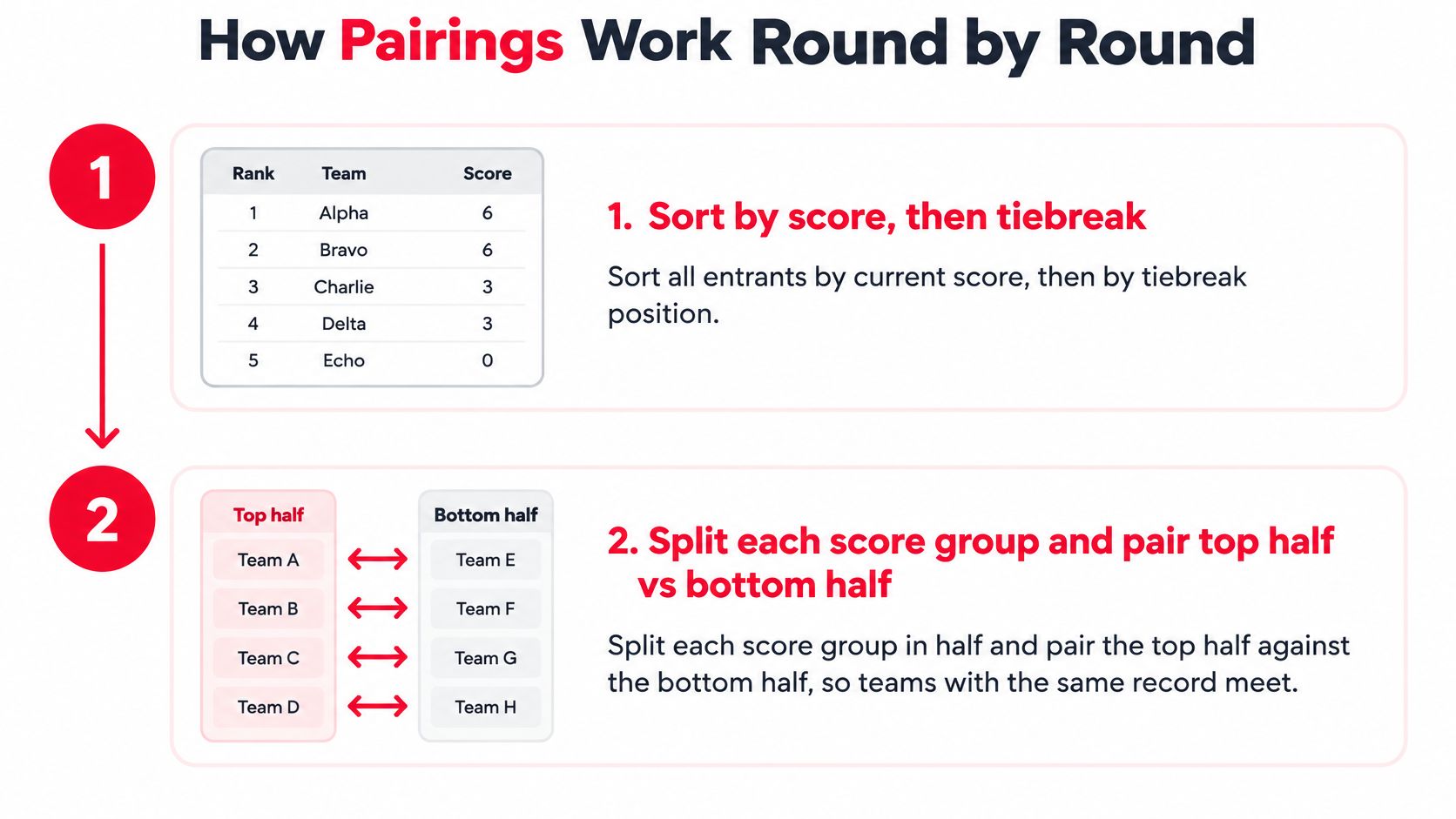
- Sort the field. Rank every entrant by current score, then by the published tiebreak order. A 2-0 team never drops below a 1-1 team because someone "looks stronger."
- Split each score group. Cut the group in half and pair the top half against the bottom half. Teams with the same record meet, and the strongest remaining record does not get a free win against the weakest team in that pack.
- Kill rematches. If those two have already played, swap one of them with the next available opponent in the same score group. Repeat until the pair is legal. Rematches are the slip that makes a "Swiss" into a messy round robin.
- Award the bye. When the count is odd, give the bye to the lowest-ranked unpaired team that has not had one, and record it as a win. Write the bye on the standings the same minute you write the other results.
- Flip the advantage. Alternate side, map, or server so the higher seed does not take the same edge every round. Note the assignment on the pairing sheet.
- Publish with a clock. Post pairings and a result deadline. Collect scores inside that window so the next sort is not waiting on one missing match.
- Recalculate and repeat. Update wins and losses, resort, and build the next round. Stop only when the published round count is done.
A round-two picture with eight teams
After round one of an eight-team community night you have four teams at 1-0 and four at 0-1. Sort the 1-0 group by tiebreak position and label them A, B, C, D. Pair A against C and B against D. Do the same inside the 0-1 group: E-G and F-H. Nobody from 1-0 plays a 0-1 team yet. That meeting happens later, once records spread.
Score the sheet as one point per win and zero per loss. Check every team's record and opponent list against the pairings before you publish round three. If the bye from round two is missing, the 1-0 group is one team short and your next split is wrong.
The usual miss is a rematch that "only happened once" or a bye that lived in chat and never hit the standings.
Publish that sheet after every round, not only at the end. Players will spot a swapped result faster than you will.
Tiebreakers That Decide Who Advances
Equal records are normal. Unequal paths are the reason a tiebreak chain exists. Two teams can both finish 3-1 and still rank in different places, because the chain looks at who they played, not only at the wins.
Publish the full order before round one. Changing it after a team is on the bubble is how you lose the room.
Buchholz comes first in most large fields. It sums the final scores of every opponent a team faced. A 3-1 team that spent the event inside the winning pack ranks above a 3-1 team that spent it against teams that kept losing. Placement can move after your own matches are done, because those opponents still have games left.
Median-Buchholz is the same sum with the highest and lowest opponent scores removed. Use it when one forfeit or one very weak entrant would otherwise swing a tight table. It protects a team from a single distorted opponent without throwing out strength of schedule.
Head-to-head is for a two-team tie, especially on the qualification line. If those two played, their match decides it. If they did not, skip to the next item in the chain. Do not invent a "they should have met" story.
Round differential counts maps or games won minus maps or games lost. It earns its place in best-of-one opens and short series, where a plain win count hides a 2-0 sweep next to a win that went the distance.
| Tiebreaker | How it is calculated | Best used when |
|---|---|---|
| Buchholz | Sum of every opponent's final score | Large fields where opponent strength separates tied records |
| Median-Buchholz | Buchholz with the highest and lowest opponent scores removed | Protecting a team from one forfeit or very weak opponent |
| Head-to-head | Result between the two tied teams | Two-team ties at the qualification line |
| Round differential | Maps or games won minus games lost | Best-of-one or short series where win counts look identical |
One three-team tie, in order
Say North, West, and East all finish 3-2, and three spots are not enough for all of them. Buchholz puts North first and leaves West and East level. Median-Buchholz still leaves them level, because their outlier opponents were similar. They played each other, West won, and head-to-head sends West through. East is the first team out. You never reach round differential.
Write that order in the rules the way careful clubs write scorecard tiebreaker procedures for club events: named, sequenced, and tested on a sample sheet before the first match. If the sample sheet cannot separate three tied teams, fix the chain now, not in the Discord after round five.
What Decides Advancement at the Cutoff
If you finish 3-2, are you through? Often, no.
Advancement depends on field size, the qualification line, the tiebreak order, and any separate playoff seeding policy. The Swiss rounds explainer from Evans Blount Tactical puts the hard part in the right place: standings commonly use Buchholz, the sum of the final scores of a player's opponents, so your placement can still move because of games those opponents play after they faced you.
Win-loss thresholds change the schedule
A lot of esports Swiss events do not give every team the same number of rounds. A team advances after a required number of wins and is eliminated after a required number of losses. Print the actual numbers. If a team advances at three wins and goes home at three losses, then a 2-0 squad is one match from qualifying while a 1-1 squad still needs two more wins to get there.
That is legal if you printed it. It is a mess if players assumed "five rounds for everyone."
Early qualifiers are the quiet version of the same problem. If they keep playing, later opponents and later tiebreaks stay comparable. If they stop, their records freeze while everyone else keeps adding points, and Buchholz stops meaning the same thing across the cut line. Pick one policy and state it.
Two teams on 3-2, one spot
Take a 32-team event, five rounds, top eight advance. After round five, six teams are clear on four wins or better, and a pack of 3-2 teams chases the last two seeds. The tiebreak order ranks that pack, and the eighth seed comes down to two names: Team Red and Team Blue.
Red's five opponents finish with final scores that add up higher than Blue's five opponents. Red's Buchholz is larger, so Red takes the eighth seed and Blue is the first team out. Same wins. Same losses. Different opponents, and those opponents kept winning after they played Red.
That is the worked example you owe players in the published rules, while they can still plan around it.
A published cutoff should state all of the following before registration closes:
- Round count. The exact number of Swiss rounds, or the win and loss numbers that end a team's Swiss.
- Qualification line. How many teams advance, and whether that line is a record, a place, or both.
- Tiebreak order. The full chain, in sequence, including what you skip when two teams never played.
- Byes and forfeits. How each one is scored, and whether a forfeited win counts in opponent sums.
- Early qualifiers. Whether they keep playing, and whether stopped teams still count in later calculations.
If the rules do not answer "what record gets me in," the event does not have a cutoff yet. It has a hope.
The cutoff also sets the playoff seeding. In the example above, the same opponent scores that put Red eighth now pair Red against the 5-0 team, so one marginal tiebreak decides both who qualifies and who meets the top seed first.
Where Swiss Stays Fair in Esports
Matching similar records feels fair. It is not the same as equal conditions.
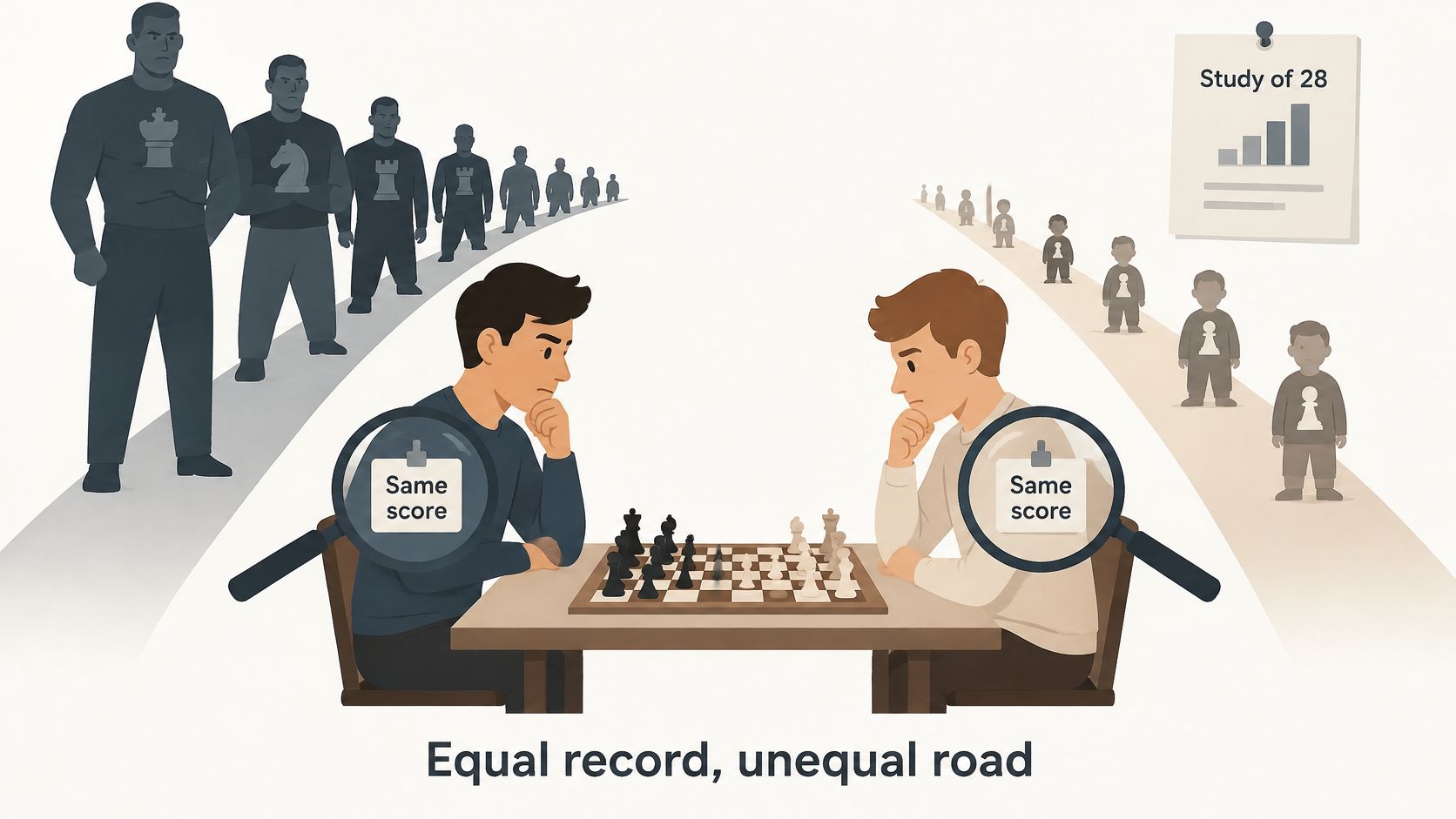
Swiss pairing reduces the chance that one loss ends a weekend. It does not, by itself, give every team the same competitive circumstances. A 3-1 record can be a strong run, or it can be a strong run plus the easier side, the closer server, and the longer rest.
What a balanced-looking table can still hide
A recent analysis of 28 prestigious chess competitions found that players who received an extra game with the advantageous color scored significantly more points, as reported in an arXiv analysis of Swiss pairings and color. The structure looked balanced. The extra favorable game still moved the scores.
Esports has the same kind of quiet edge. It just wears different names.
Side selection and map rotation decide who attacks first or who plays their best map in a best-of-one. Server location and hardware latency decide who peeks first when the event is online. Uneven rest decides who queues on three hours of sleep because their match was the late one. Best-of-one variance decides a series that a best-of-three would have slowed down.
Cross-platform opens make this sharper. A PC lobby and a console lobby are not the same input. A team in the event's home region and a team two continents away are not on the same ping. If you pair only on record, both teams can be 3-1 and still have played different games.
Can two teams with the same record have had meaningfully different competitive conditions? Yes. Ask that in the player FAQ, and answer it with the policy, not with "it's Swiss, so it's fair."
Publish the fairness policy before registration
Put these five items on the event page next to the round count:
- Map and side rotation. Who picks, who bans, and how you flip the advantage each round.
- Server selection. Which regions are legal, and what happens when the two teams disagree.
- Maximum wait. How long a team waits between matches, and what you do when the gap is longer.
- Rematch procedure. Technical pauses, rehosts, and who can call them.
- Technical losses. When a disconnect is a loss, a replay, or a no-contest, and who records it.
A short clip of how a real Swiss round is built helps players see the pairing logic before they argue with the sheet.
Check the policy before you trust a 3-1. If the page never mentions server, side, or technical losses, the record is only half the story.
Swiss Compared With Brackets and Round Robin
Elimination formats decide quickly and end a team's run after one or two losses. Swiss keeps most entrants playing for the full published schedule. You pay for that with more matches, and you still need a playoff if you want one champion.
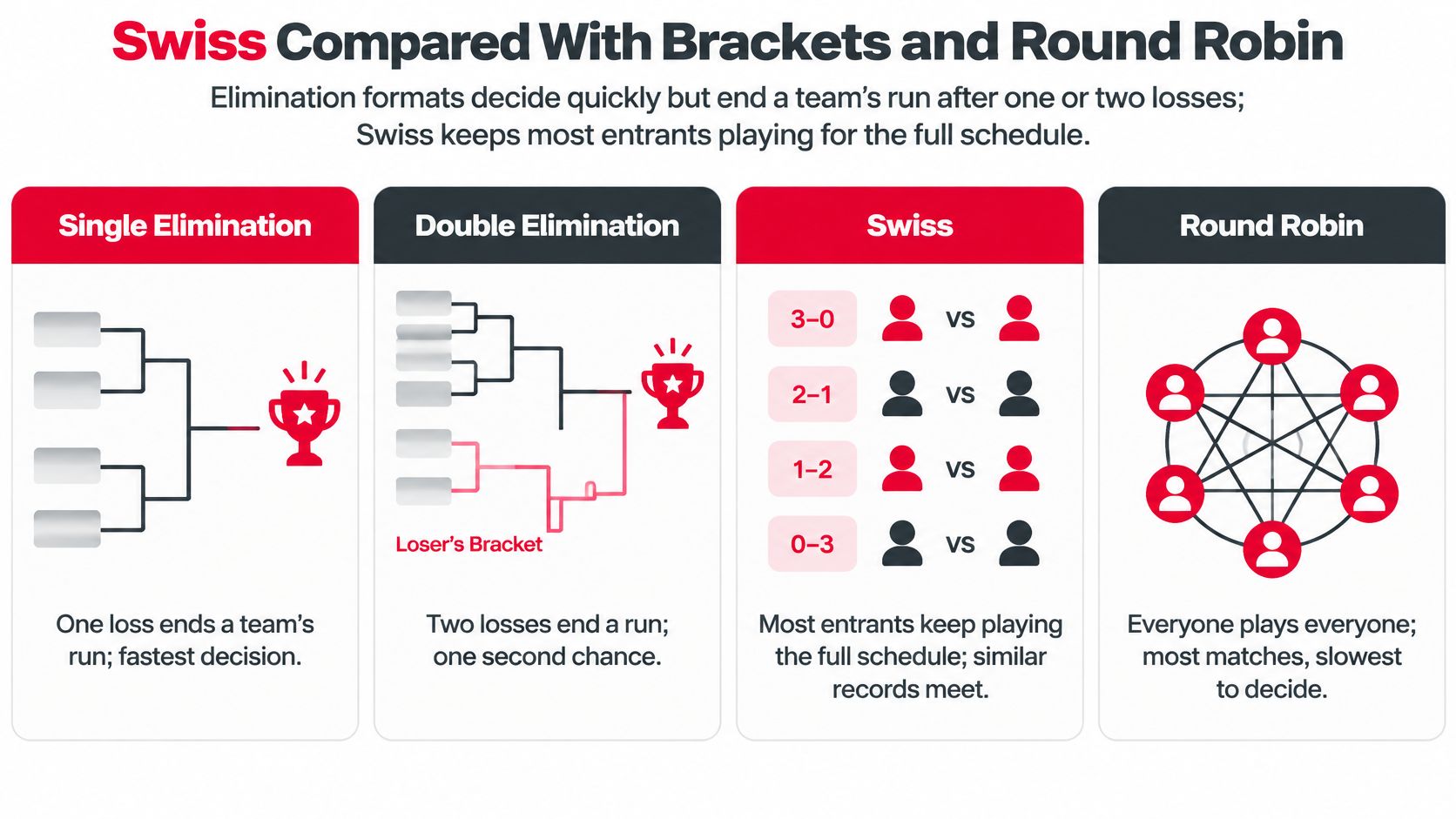
| Format | Who keeps playing | Risk of early exit | Best fit |
|---|---|---|---|
| Single elimination | Winners only | One loss ends a run | Fast events with a fixed time slot |
| Double elimination | Winners and losers brackets | One loss drops a team, not out | Mid-size events that need a second chance |
| Round robin | Every team plays every other team | Low, but match count grows quickly | Small groups of four to eight teams |
| Swiss | Every team plays a fixed number of rounds | Low, depends on the cutoff rule | Large open qualifiers with many entrants |
What you are actually buying
Single elimination is the short clock. Winners continue, one loss ends the run, and a 16-team bracket finishes in an evening if matches stay on time. It is a poor qualifier when half the field traveled for one series.
Double elimination adds a losers bracket. One loss drops a team into that bracket. A second loss ends the run. You buy a second chance and you buy extra matches, including a long grand final if the losers-bracket team wins the first championship game.
Round robin is the honest small-group format. In a group of four to eight, everyone plays everyone and the table is easy to read. Past that, the match count gets silly. Six league-stage teams belong here. Sixty-four open-qualifier teams do not.
Swiss sits between those choices. Every team plays a fixed number of rounds against similarly ranked opponents. Early losses hurt a seed. They do not end the night. The cost is real: you need more rounds than a single-elimination bracket of the same size, and the Swiss table does not name a single champion. Add a top-cut playoff when the event needs a winner, not only a ranked list.
A 64-team open qualifier is a Swiss job if you want most squads to play several matches before a top cut. A six-team league weekend is a round robin. Forcing the six-team league into Swiss just to "use the format" throws away the matches those teams can finish.
Before you pick, answer three questions and write the answers on the event page:
- How many entrants are you planning for, including a realistic no-show buffer?
- How many matches can each team play in the time slot?
- Does a playoff follow, and how many teams does it take?
If you want a wider look at how communities run these events, start with how esports tournaments are structured and match the format to the slot you really have, not the slot you wish you had.
Choose Swiss for Your Next Event
Pick Swiss when the field is large, every team should play several matches, and you need a fair qualifier before a top cut. Pick a single-day bracket when the event must finish in one slot. Pick round robin when you have four to eight teams and time for them to meet. Swiss works like a sorting table. Each round gives the standings a clearer shape, but the final table still needs a playoff if the event needs one champion.
Make the decision in this order.
- Count the entrants and take the matching round row, using the higher row when the count falls between two sizes.
- Set the qualification line and the full tiebreak order, then test both on a sample sheet.
- Publish the fairness policy and a worked cutoff example before registration opens.
- Add a playoff if the event needs one champion rather than a ranked list.
GamerPlug hosts real brackets for Apex Legends, Valorant, League of Legends and Fortnite, with Swiss alongside single elimination, double elimination and round robin. Players can register solo or with their squad, and results are tracked for them. On a Gamerplug tournament page, joining the tournament gives access to the lobby code and the tournament conversation, so check-in and match talk stay together.
If you are comparing tools, see what a tournament bracket app needs to do on event day before you pick one. A good setup keeps standings, pairings, rules and conversation close enough that players can follow the event without hunting through chats.
Keep the album link handy for after the event, and use add photos to an event album while the lobby is still active. That gives players a place to revisit the run after the standings stop changing.
Your next step is small. Enter the entrant count, match the round row, set the qualification line and publish the rules before the first team signs up. Then let the format do the sorting.