
Apex Predator is the highest rank in Apex, and it's awarded only to the top 750 players per platform, not to everyone who merely hits an RP floor. Master is the fixed ceiling at 16,000 RP, and Predator sits above it as a moving cutoff that changes as the leaderboard shifts.
That's the part most players feel in their grind. You can be one clean endgame away from Master, or you can already be sitting in Master and still have no idea whether you'll keep Predator by the end of the split. The badge looks simple from the outside, but the climb is really a ladder with a moving top.
Table of Contents
- Where You Sit on the Ranked Ladder
- The Eight Ranks From Bronze to Master
- Why Apex Predator Is a Moving Cutoff
- How Rare the Highest Rank Actually Is
- How the 2026 Ladder and Splits Changed the Grind
- Season Rewards, Badges, and What You Keep
- A Realistic Path to Chasing Predator
Where You Sit on the Ranked Ladder
You queue for one late-session game, expecting a routine climb, then notice that every placement decision carries more weight. That tension makes sense because the highest rank in Apex is not just a title at the top of a fixed staircase. Master has a defined RP threshold, while Apex Predator depends on where you stand against other players on your platform. EA's ranked rules describe that difference clearly. EA's ranked rules
The ladder is a climb, not a badge hunt
Apex's ranked system began in Season 2, July through September 2019, with six tiers named Bronze, Silver, Gold, Platinum, Diamond, and Master, followed by Apex Predator at the top end. The lower ranks work like steps with set RP requirements. Reach the required floor and you advance. Predator works differently because clearing Master only places you in the group competing for the highest leaderboard positions.
That distinction changes how you should read your rank. A player in Bronze, Gold, or Diamond can focus mainly on earning enough RP to reach the next checkpoint. A Master player has reached the final fixed RP tier, then faces a cutoff that rises or falls as other players gain and lose RP. Your position can change even when you do not queue, because the players around you are still playing.
Practical rule: Read Master as a fixed destination and Predator as a moving seat. Reaching Master proves you crossed the RP requirement. Holding Predator means staying inside the top slice while the leaderboard keeps shifting.
A live Apex ranked leaderboard makes that difference easier to understand. It shows why “high rank” and “Predator” describe separate situations. One measures progress against a fixed threshold. The other measures your place in a contest where the finish line moves with the field.
The lower ladder asks, “Have you earned enough points?” Predator asks, “Are you still high enough after everyone else's results?” That moving cutoff is what makes the highest rank difficult to hold, not merely difficult to reach.
The Eight Ranks From Bronze to Master
A ranked session can start in Bronze IV and end with you staring at the next division, wondering why the climb suddenly feels slower. Apex divides the ladder into four divisions per tier: IV, III, II, and I. Division IV is the entry point, while Division I is the final checkpoint before the next rank. Each step raises the RP requirement and usually brings tighter fights, more coordinated teams, and less room for careless decisions.
The fixed entry floors show the shape of the climb:
| Apex Legends rank tier | Division IV entry floor |
|---|---|
| Bronze | 0 RP |
| Silver | 1,000 RP |
| Gold | 3,000 RP |
| Platinum | 6,000 RP |
| Diamond | 10,000 RP |
| Master | 16,000 RP |
Within each tier, divisions advance toward the next listed floor. Bronze therefore begins at Bronze IV with 0 RP, while Silver begins at Silver IV with 1,000 RP. The exact division matters because a player near the top of Gold is closer to Platinum than a player who has just entered Gold. Treat the ladder like a staircase: the tier names mark the landings, and the four divisions are the individual steps between them.
Bronze through Gold build the basics
Bronze, Silver, and Gold give newer players room to learn how ranked points are earned and lost. Early progress is often less about perfect aim than about staying alive, taking sensible fights, and resetting before a bad position becomes a squad wipe. Loose positioning and solo peeks may go unpunished in one match, then cost the entire game in the next.
As the entry floor rises, those habits become more expensive. A team that rotates late or takes a fight without an exit plan can lose the chance to recover. Reaching Gold means you are starting to convert survival and team decisions into consistent progress, not just winning occasional fights.
Platinum and Diamond expose mistakes
Platinum is the first major wall for many players. Rotations receive more punishment, teammates need clearer timing, and raw gunskill no longer fixes every poor decision. Diamond sharpens that lesson further. A late rotate, exposed heal, or split push can end a match quickly because opponents recognize and punish openings.
Master is the final fixed floor
Master sits at 16,000 RP, the last fixed RP floor in this ladder. Crossing that threshold proves you reached the highest set requirement, but it does not guarantee Apex Predator. Master is the platform above the staircase, where players compete for a limited leaderboard position.
That distinction explains why the highest rank is difficult to hold. Master is a destination with a known floor. Predator is a moving cutoff determined by the players above and around you, so reaching Master gets you into the race, while staying near the top keeps you in the highest rank.
Why Apex Predator Is a Moving Cutoff
Your Predator badge can be secure in the morning and gone by the evening. Apex Predator sits above Master as a live leaderboard position. The cutoff covers the top 750 players per platform, so it changes whenever players around the line gain or lose RP during the split. EA ranked rules
The cutoff moves because the leaderboard moves
Consider the final day of a split. If the cutoff stands at 18,500 RP, a player at that total is inside Predator. A surge of strong sessions can push the line to 18,700 RP. The player at 18,500 is then outside the rank, even though their own RP has not fallen. A 200 RP swing can change the badge without changing the player's personal result.
The same pressure works in reverse. If players above the line lose RP or stop climbing, the cutoff can soften. That relief may be brief, because another group can start gaining points and raise it again. The line behaves like a finish line that moves as the runners approach it.
This explains why reaching Predator and holding Predator require different habits. A player can reach the required position during a strong run, then lose it after a poor streak, a break from ranked, or a weak closing week. The achievement remains part of the split's history, while the live rank belongs to whoever still occupies the qualifying places.
Useful mental model: Master is the floor you reach. Predator is the seat you keep while other players try to take it.
Plan the grind around that difference. Reaching Master shows that your results can meet the fixed requirement. Staying in Predator demands a pace that keeps up with the leaderboard, especially near the end of the split. That moving pressure makes the highest rank harder to hold than to reach.
How Rare the Highest Rank Actually Is
A player can reach Master, finish a strong session, and still be nowhere near the rank that sits above it. The badge makes the top look like a fixed destination, but Apex Predator is a moving top-750 cutoff. Its difficulty depends on how many players are still climbing and how high their RP totals rise.
Historical distribution data shows how narrow that peak can be. EA's ranked update reported 1.0% of ranked players at Apex Predator, compared with 0.2% in the prior split. Later Season 30 snapshots also place Master and Predator in very small portions of the ranked population. EA ranked update
Percentages matter more than the title
Master is already an elite result. Predator is the much smaller group that remains after players have cleared that standard and then secured one of the limited leaderboard positions. That comparison explains the difficulty better than the title alone. You are competing with the strongest part of the Master pool, not just trying to pass the average ranked player.
| Season 30 Rank Distribution by Platform | PC % | PlayStation % | Xbox % | Switch % |
|---|---|---|---|---|
| Master | not separately provided in verified data | not separately provided in verified data | not separately provided in verified data | not separately provided in verified data |
| Apex Predator | not separately provided in verified data | not separately provided in verified data | not separately provided in verified data | not separately provided in verified data |
A simple example makes the scale easier to understand. If a platform has a large ranked population, only a narrow slice can occupy the Predator positions. The qualifying line can rise while your own RP stays unchanged, so holding the rank requires continued performance rather than a single successful push.
Smurf accounts can also make lower ranks feel unusual. New or recycled accounts may alter the opponents found early in a climb, but they do not change the top-end contest for the limited Predator places. What a smurf account means in ranked games
The highest rank in Apex is therefore rare for two connected reasons: few players reach the required level, and fewer still remain above a cutoff that keeps moving with the leaderboard. Master marks a high standard. Predator is a position you must keep defending.
How the 2026 Ladder and Splits Changed the Grind
You finish a strong session at Master, log off, and return after the split to find your progress lower than expected. In 2026, the ranked climb works less like one uninterrupted race and more like a course with repeated checkpoints. EA's 2026 patch notes show that ranked ladders were added and later extended from 3-day to 5-day windows. The split rules still reset the upper ranks twice per season, with Master and above returning to Platinum I at 11,000 RP, according to EA's ranked rules.
Shorter checkpoints, harsher restarts
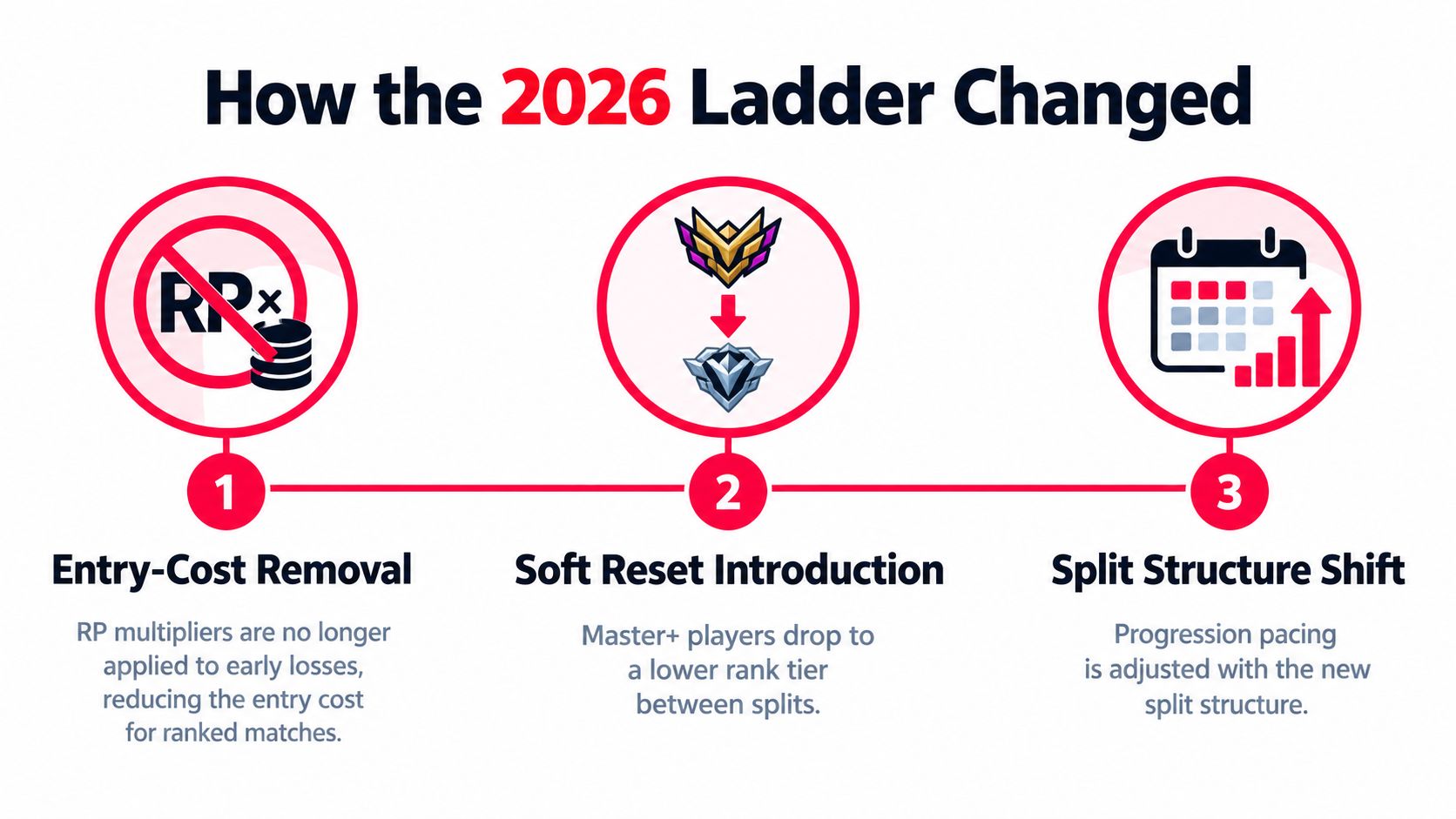
For example, a Master at 16,500 RP resets to Platinum I at 11,000 RP at the split, requiring roughly 5,000 RP to re-qualify for Master before re-entering the Predator race. That restart tests whether your results are repeatable, rather than rewarding one successful push that happened weeks earlier.
The moving Predator cutoff adds another layer. Reaching Master gives you a fixed tier, while Apex Predator depends on staying among the top 750 players on your platform. A shorter ladder window can make each session feel more valuable, because the leaderboard has less time to settle before the next checkpoint.
The removal of some early-loss pain changes how players approach the opening games of a session. Safer starts help, but they do not turn the climb into a one-night sprint. You still need consistent placement, smart fights, and enough sessions to rebuild RP after each reset.
The ladder did not soften at the top. It turned the climb into repeated proof.
That structure makes the highest rank in Apex difficult to hold. Master is a destination you can reach. Predator is a moving position that demands continued performance.
Season Rewards, Badges, and What You Keep
You reach Master in the first split, then finish Diamond in the second. Your season reward is still based on the highest rank reached in either split, so the second split does not erase the stronger result. However, the animated badge has an extra condition: you must match the first split's rank in the second split. EA ranked rules
What sticks and what resets
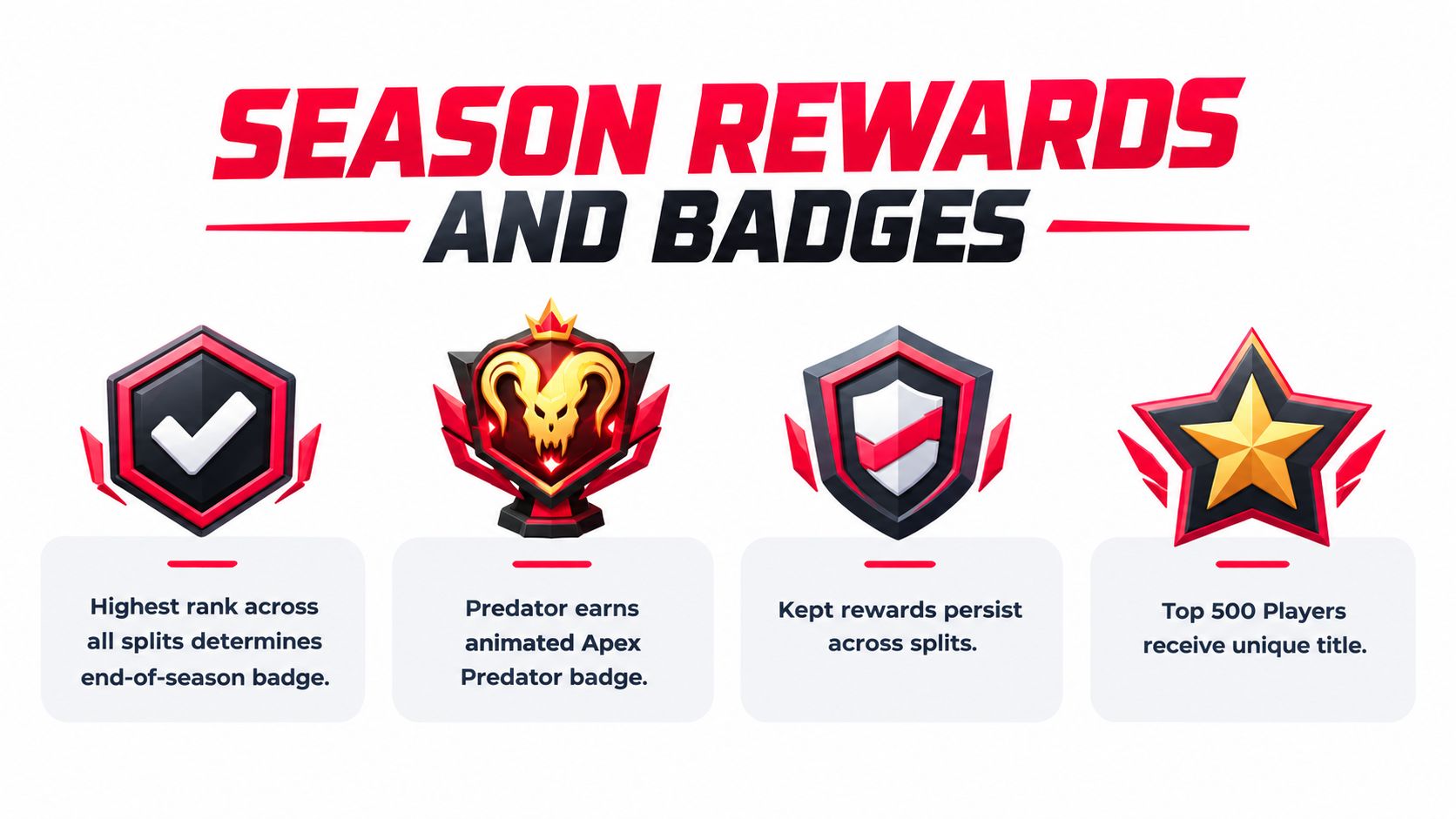
- Highest rank across splits: The highest tier you reach determines the season's badge level, even if your final split ends lower.
- Predator reward: Apex Predator earns the animated Predator badge, which displays on your profile and banner for the next season.
- Account-level keepers: Earned badges and banner frames remain on your account after the season ends. They are records of the rank you achieved, not your current RP.
- Reset items: RP and your current tier reset between splits. Split-specific progress does not carry over automatically.
- Queue separation: Rewards follow the ranked queue you played. Grinding Ranked Battle Royale does not progress Ranked Arenas rewards, because each mode tracks its own ranked identity.
The split condition matters if you want the animated version rather than only the basic badge. Reaching a high rank once can establish your season reward, but matching that rank later is what preserves the animated treatment. An older season badge also stays as earned. It does not change when you reach a higher rank in a later season.
Queue identity creates a separate decision. Before a serious push, check whether you are playing the mode tied to the reward you want. A top finish in one queue cannot be transferred to another, so “highest rank” always needs a mode attached to it. That small distinction prevents a strong grind from producing the wrong reward.
A Realistic Path to Chasing Predator
If you're sitting in Diamond or low Master, the cleanest Predator push starts with honest self-scouting. Pick the role where you actually carry fights, trim the legends that need perfect team timing if your squad doesn't give you that, and queue only when your hands and focus are already warm. The best push nights are boring at the start and disciplined at the end.
Build for consistency, not ego clips
Early kills matter less than people think if they come before you've secured a playable placement, so prioritize survival and clean rotations first. A stable three-stack usually gives you more control than solo queuing into Masters lobbies, where one weak link can snowball the whole game. If you need a place to find squadmates around your actual rank and schedule, Gamerplug's Apex teammate tools are built around that kind of matching.
Simple rule: Don't chase Predator with a random comp and a random schedule. Chase it with a role you can repeat and a squad you can trust.
Treat the final stretch of a split like your real test, because that's when the ladder thins out and the remaining players are usually the ones still pushing hard. Track your gains, stop after two ugly losses, and protect the badge if the top 750 is already slipping out of reach. If you can't realistically hold Predator, bank the Master finish and come back sharper rather than forcing a bad run into a worse one.
A little structure goes a long way here. Warm up before queueing, keep your legend pool tight, and measure success by whether you're moving up consistently, not by one flashy lobby. That mindset is what turns a Master player into a serious Predator threat.
If you're grinding Apex ranked and want teammates who match your rank, platform, and play style instead of randoms, Gamerplug gives you a place to find squadmates with verified ranks and game-specific profiles. It's a practical way to build a steadier three-stack for Predator pushes, Diamond climbs, or just cleaner ranked sessions with people who queue like they care.