You've got four people, one free Saturday, and a Discord channel where someone just dropped a tournament link. The listing says Swiss, sixteen teams, check in thirty minutes before start. Nobody in the channel can tell whether that means a two-hour evening or a five-hour one, whether a single bad map ends the run, or whether the substitute is allowed on the roster.
Those questions decide your weekend far more than the prize pool does. The same four formats used at the top of the sport are the ones running in the amateur brackets you'll enter, and once you can read the format, the rest of the listing falls into place.
Prize money at the summit is enormous. The International's pool grew from $1.6 million at its first event in 2011 to a peak of approximately $40.02 million in 2021, as the tournament's recorded history on Wikipedia) shows. None of that tells you how a bracket works or how to get a slot in one, which is the part that matters at 7pm on a Saturday.
Table of Contents
- Tournament Formats Compared and When to Choose Each
- How Single and Double Elimination Brackets Play Out
- Match Counts and Schedule Math for Common Team Sizes
- Checking a Tournament Before You Sign Up
- How Players and Teams Join a Tournament
- Tools Organizers Use from Registration to Check-In
- Confirm the Format and Register Your Team
Tournament Formats Compared and When to Choose Each
An esports tournament is an organized competition where teams or solo players are placed into a bracket, a group, or a ranking system, play a set number of matches, and a winner takes the title or the prize. The organizer decides the shape of it and publishes that shape in the listing.
Two events can advertise the same game, the same night and the same entry fee and still ask completely different things of you. One wants four hours and gives you one chance. The other wants five weeks and guarantees eight games. Team games carry the most variety: Apex Legends, Valorant, Fortnite and League of Legends events run in all four shapes below, sometimes within one weekend on one platform.
The difference between them comes down to what a loss costs you.
| Format | How It Works | Elimination Rule | Best For |
|---|---|---|---|
| Single elimination | Winners advance; each loss ends the run | One loss | Fast one-day events and cups |
| Double elimination | Losers drop to a lower bracket and can still win | Two losses | Events where one bad game should not end a run |
| Swiss | Teams play a set number of rounds and face opponents with similar records | None; ranking decides the cut | Large fields that need many games without elimination |
| Round robin | Every team plays every other team once | None; standings decide | Small groups and seeding stages |
What a loss actually costs
In single elimination, the first defeat ends your run. In double elimination, you drop to a lower bracket and keep playing, at the price of roughly double the matches and a much longer day. Swiss and round robin remove nobody: you play a fixed number of rounds, the standings sort everyone, and the event cuts to a top eight or a top four when the rounds run out.
That one rule explains most of what feels strange about a listing. A Swiss event where a 3-1 team goes home isn't unfair, it's a tiebreaker. A round robin that runs past midnight isn't badly organized, it's arithmetic catching up with the schedule.
Each shape carries a cost the organizer has to manage. A Swiss event needs a published tiebreaker and a clear cut line, because two teams on the same record will ask which one advances. Round robin needs enough hours and a scoreboard everyone can read at a glance. Brackets need a reseeding plan for the no-show that appears fifteen minutes before round one.
Formats also stack. Plenty of events run a round robin group stage on day one and cut to a single elimination bracket on day two, which is why a listing can name two formats and still be accurate.
The rule of thumb: choose a bracket when time is short and the field is small. Choose Swiss or round robin when every team should play a fixed number of games and the standings deserve to decide the winner.
Three questions to ask any listing
- How long does it run? A one-day cup and a four-week league both call themselves tournaments, and only one of them fits a busy month.
- How many games must you win? Best-of-one quarterfinals and a best-of-five final are different commitments, even inside the same bracket.
- Can a solo player enter? Some events hold free-agent slots and place you on a team. Others only accept a full roster, so a solo entry gets refused at registration.
A format isn't the same thing as a ruleset. The format tells you how matches are structured. The ruleset covers map pool, overtime, side selection and what happens when a team doesn't show up. Both live in the listing, and the format is the faster of the two to check.
How Single and Double Elimination Brackets Play Out
Think of a bracket as a tree of matches. Each winner steps one branch closer to the final, exactly like a knockout draw in a football cup, and each loser stops where they stand.
Take eight teams in single elimination. Round one is four quarterfinals. Those four winners meet in two semifinals, and the two semifinal winners play one final. That's seven matches in total, and normal seeding puts the top seed against the lowest seed so the strongest teams don't meet on day one.
The diagram below traces both routes for the same eight teams.
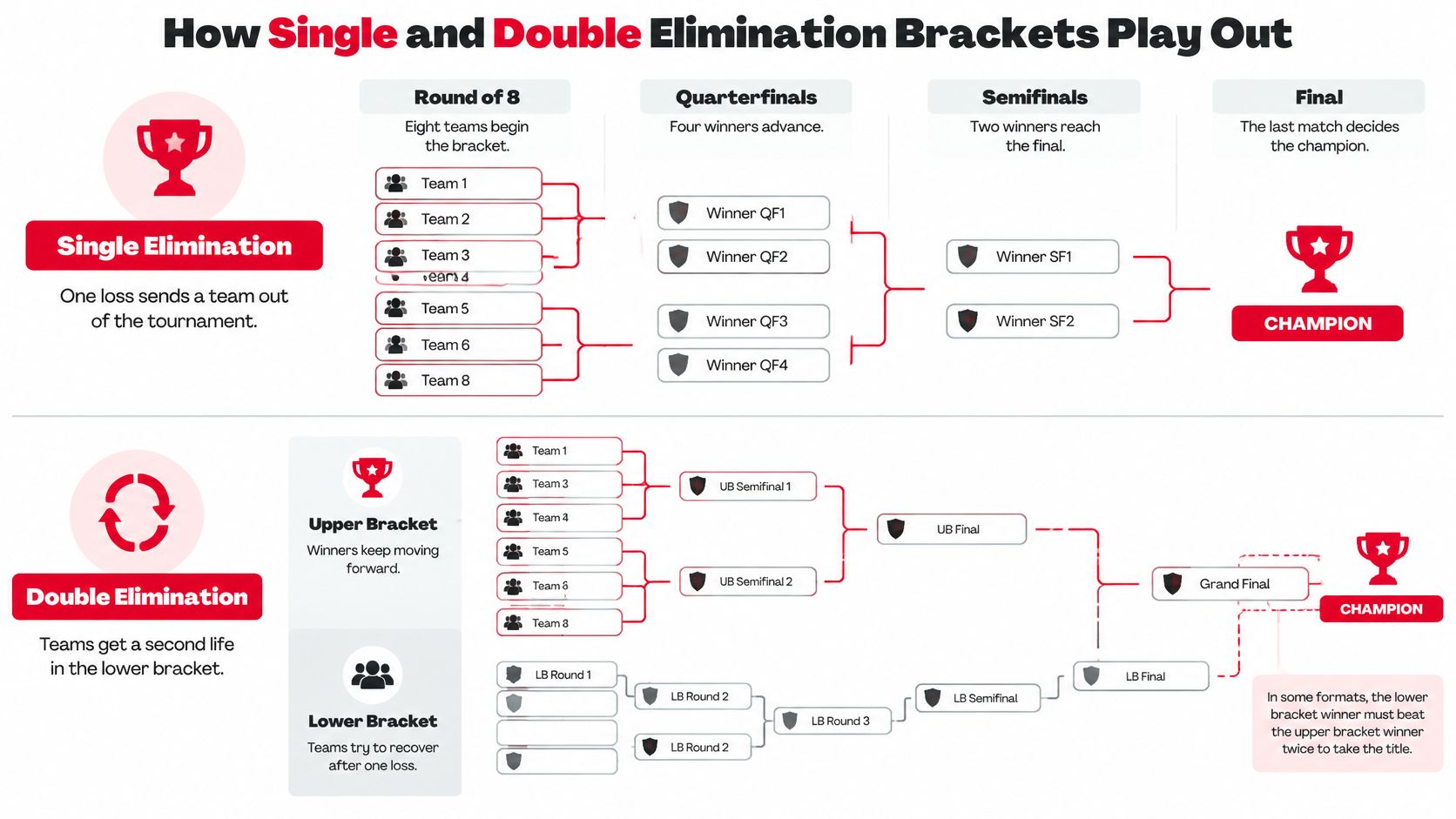
Double elimination keeps those eight teams and adds a second road. The winners bracket runs exactly as above. Anyone who loses drops into a lower bracket, fights back through it, and the two bracket winners meet in a grand final. The full event is fourteen matches, and fifteen if the organizer plays a bracket reset.
The schedule cost of a second chance
A team that loses early in the lower bracket has to win several matches in a row to reach the final. That's the trade. Double elimination doesn't only add matches, it adds a long uninterrupted run for whoever drops first, and that run usually happens late in the day when the winners bracket teams are resting.
Some events use a bracket reset. If the team from the lower bracket wins the first grand final, the two sides play again, because the team from the winners bracket hadn't lost yet. It rewards the undefeated run and it can add an hour to the night, so check whether the listing mentions it before you plan your last train home.
Tracing your own path
Find your next match on the bracket and check which side of the tree you're on. A match in the upper or winners side is a second-chance match. A match in the lower bracket is usually loss-or-out, and the label on the bracket will say so. Count the wins between your name and the final, and you know exactly how long your evening is.
Match Counts and Schedule Math for Common Team Sizes
Every format hides a fixed match count inside it, and that count is the fastest way to judge whether a listing's schedule can run. Two common field sizes show the spread.
| Teams | Single Elimination | Swiss (Rounds) |
|---|---|---|
| 8 teams | 7 | 12 (3 rounds) |
| 16 teams | 15 | 32 (4 rounds) |
How the formulas work
- Single elimination runs one match fewer than the team count. Eight teams need seven matches; sixteen teams need fifteen.
- Double elimination lands near twice that minus two. Eight teams produce fourteen, plus one if a bracket reset is played.
- Round robin works like a league season compressed into a weekend: every team plays every other team once, so the count is teams times opponents, halved so no match gets counted twice.
- Swiss puts half the field on the floor each round, and the number of rounds tracks the team count in powers of two. Sixteen teams need four rounds of eight matches.
Turn matches into hours with one number you choose yourself. Say a best-of-three takes about forty minutes including the reset between maps and the check-in before it. Seven matches across three rounds sounds small until you price it in hours. Sixteen teams in Swiss produce thirty-two matches, roughly twenty-one hours of match time on a single station, which is why Swiss events run parallel lobbies. Thirty-two teams in a round robin need 496 matches, past 330 hours, and no weekend survives that.
Parallel setups shrink the wall clock and leave the workload untouched. Four lobbies running at once divide the elapsed time by four, while the admin multiplies: four sets of results, four sets of disputes, four chances for a lobby code to land with the wrong captain.
Do this math before you register, because the listing rarely does it for you. If you're picking a bracket size rather than checking one, this guide to tournament bracket sizes walks through the same arithmetic with the cuts and byes included.
Put every clock in one zone
Mixed regions are where schedules break. A North America and Europe field can push a match into a late-night slot for one side no matter how the organizer arranges it. Publish the window in a single agreed zone, state which zone it is, and let teams convert once, in one direction.
The test before you commit: multiply the matches by the average match length, add a buffer for delays, and compare the total with the hours the event can run. Seven matches at forty minutes plus a twenty-minute buffer is a five-hour evening. A thirty-two team round robin has no answer that fits.
Checking a Tournament Before You Sign Up
The most common way to lose a Saturday isn't a bad bracket. It's a bracket you paid to enter before checking who runs it.
A published event and a verified event aren't the same thing. Published means somebody typed the listing in. Verified means the host platform knows who is behind it. On GamerPlug, organizer profiles imported from Challengermode show that organizer's public events, and those imported profiles are not official GamerPlug accounts. Treat any imported listing the same way: the event is real, the identity behind it is unconfirmed.
A due-diligence list you can run in ten minutes
- Organizer history. Does the account show past events with published results, or is this its first bracket?
- A versioned ruleset. Rules with a date and a version number can be argued against. A screenshot of rules cannot.
- Match records. Are results stored with evidence such as screenshots, server logs or score submissions from both teams?
- An appeal route. Who do you message when a result is wrong, and how long do they have to answer?
- Anti-cheat expectations. Does the listing say what is prohibited and how it's checked, or is it silent?
- Personal data. What does registration collect, where does it go, and can you ask for it back?
- Payment terms. Entry fee, refund rule and when prizes are paid, in writing.
Scale gives you a reason to care about the last three. EA's 2025 player-safety report recorded 18,754,319 reports of disruptive user-generated content, with usernames and team names producing the largest volume. That's one publisher's moderation queue, not a fraud rate for the whole scene, and it still shows how much noise surrounds competitive online play.
Lightweight checks beat heavy identity collection
More verification isn't automatically safer. Demanding government ID or a phone number at registration shuts out younger players, international players and anyone who keeps gaming separate from their real name. It also doesn't stop a determined cheat.
The signals that work are cheaper and lighter: official rank synchronisation instead of a typed rank, recent gameplay clips instead of a bio, an auditable bracket instead of a promise, and an organizer reputation built from completed events. Those raise the cost of lying without collecting a passport.
The stop rule: if you can't find the rules, the organizer's history and an appeal route, don't pay the entry fee.
How Players and Teams Join a Tournament
Joining is a short sequence, and most rejected entries fail on the first step rather than the last.
- Read the listing properly. Format, region, platform, team size and entry cost. A European cross-platform listing won't accept a North American PC-only squad, and a mismatch here is the most common reason a team is turned away.
- Confirm the roster fits the team-size rule, substitutes included. A four-player listing will not accept a three-player squad, and some organizers count the coach as roster.
- Register as a solo free agent where the event allows it, or as a full squad with one captain filling in the form. One name on the entry avoids two people submitting different rosters.
- Find the tournament conversation and lobby code after acceptance. That's usually where match rooms, map order and rule updates get posted.
- Check in before the deadline. Many events drop teams that never confirmed, and the slot goes to the waitlist without a warning.
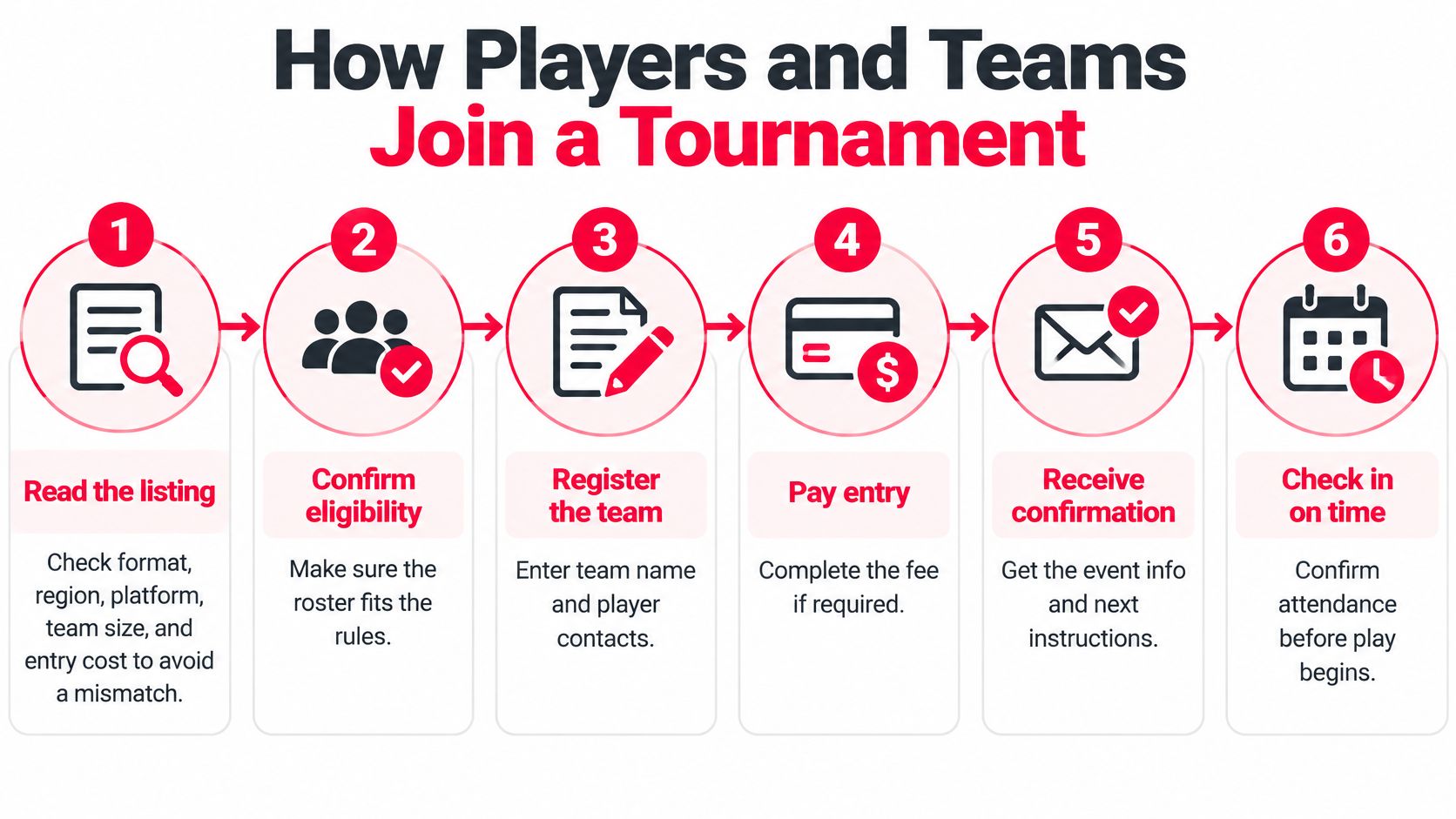
The six-step version below follows the same path from listing to lobby.
Registration is not a guaranteed spot
Being accepted and being seeded are separate events. Check-in can reorder the bracket, no-shows get replaced from the waitlist, and a captain who registers late can end up in a round one match against the top seed. Confirm your attendance early and re-read the bracket after check-in closes.
Then there's the part most guides skip. An open slot only helps if you can fill it with people at a similar rank, in a compatible time zone, on the same platform, with the right roles. The 2025 ecosystem distributed more than $270 million across over 10,500 tournaments and 100-plus titles, according to esports prize money figures for 2025, and the Esports World Cup alone awarded $70.45 million across 25 tournaments in 24 games. Bigger prizes at the top don't lower the barrier at the bottom. For most players, the bottleneck is discovery and roster formation, not a shortage of events.
If your problem is finding the event rather than reading it, browse gaming events and tournaments on GamerPlug with the format and team size already visible. Before you join anything, have three things in hand: the squad, the schedule window and the rules link.
Tools Organizers Use from Registration to Check-In
An organizer's job runs in one direction. Open registration, collect teams and contacts, build the bracket, confirm who showed up, publish results so teams can check them. Every piece of that pipeline has to exist before the first match, or the disputes start in round one.
Here's how that pipeline looks in practice on a tournament page, with registration, format choice and a live leaderboard in the same place.
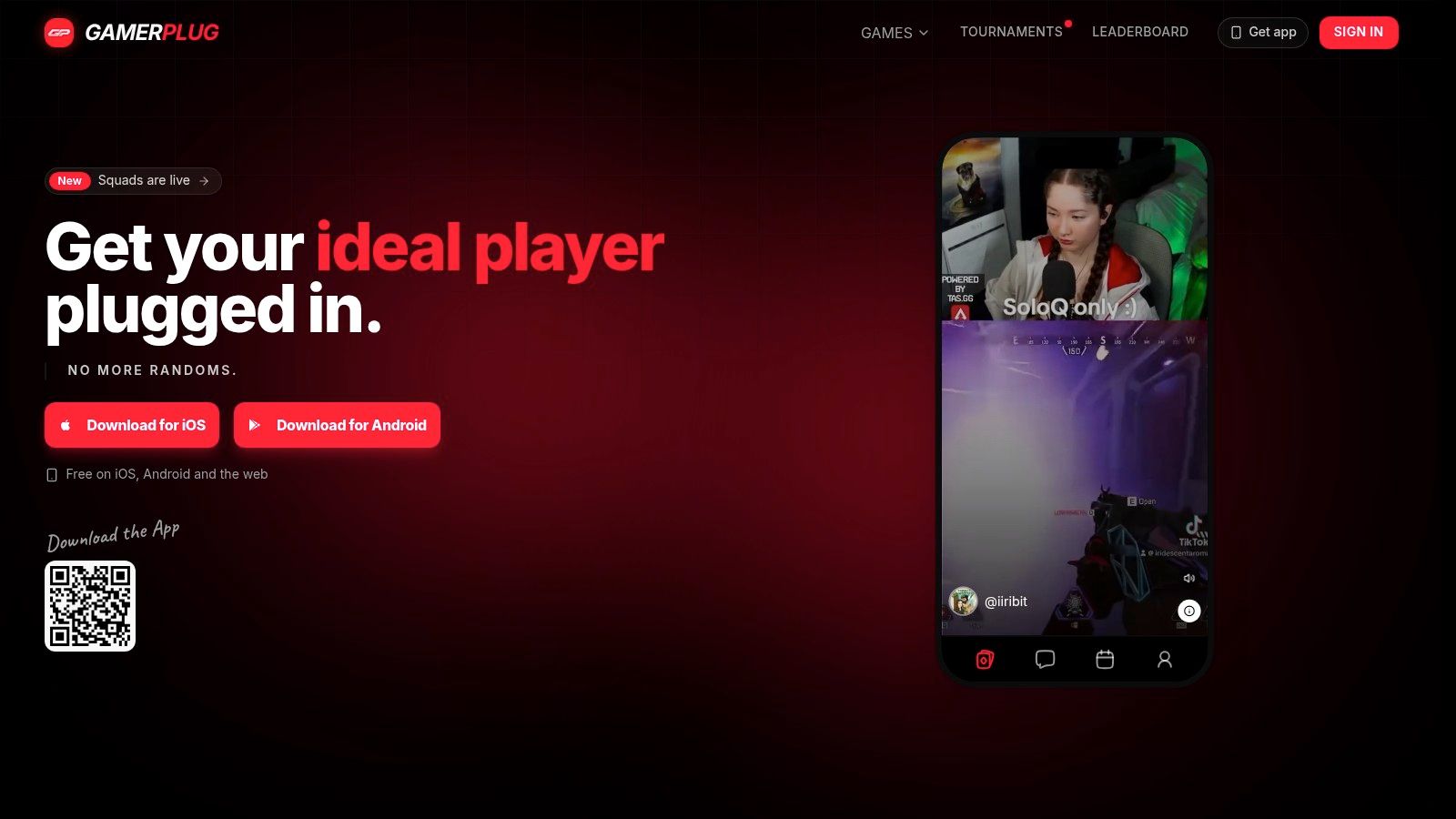
GamerPlug tournaments carry registration for solo players or squads, brackets in Single Elimination, Double Elimination, Swiss or Round Robin, and live leaderboards for Apex Legends, Valorant, League of Legends and Fortnite. Tournament host EdBoiGaming says signups, brackets and results were all in one place for their community tournament, which is the test that matters: if a result lives in a Discord screenshot and the bracket lives somewhere else, someone is going to argue about which is official.
Check-in is the step software rarely decides for you
Confirming attendance is a human job even when the tool provides the button. Set a check-in window that closes thirty minutes before round one, publish it in the listing, and hold a waitlist in order so a replacement can be called without a debate. Teams that miss the window get dropped, politely and consistently, because the alternative is a bracket full of dead matches.
Bracket changes need the same discipline. Announce a change in one place, timestamp it, and tell teams to refresh rather than screenshot. Two captains working from two versions of the bracket is the fastest way to lose an evening.
The walkthrough below covers the rest of the organizer's setup.
What to check in any tournament tool
- Format options. If the tool only does single elimination, your round robin group stage has to happen somewhere else.
- Roster rules. Team size, substitutes and restrictions need to be enforced at registration, not fixed by hand later.
- Result recording. Look for evidence attached to each result, so an appeal has something to review.
- Change communication. A way to tell every team about a bracket update at once, with a timestamp.
If you're setting an event up yourself, the guide to running an online tournament covers the sequence before registration opens.
Confirm the Format and Register Your Team
You now have the four checks that turn a listing into a decision. Run them in this order and you'll know within a few minutes whether the event is worth your time.
- Confirm the format. Single elimination, double elimination, Swiss or round robin, and what a loss costs you.
- Count the matches. Use the formula for the field size, then multiply by your best guess at match length and see whether the total fits your evening.
- Verify the roster rule and region. Team size, substitutes, platform and the time zone the schedule is published in.
- Run the trust checks. Organizer history, a versioned ruleset, an appeal route and payment terms.
Then act on the answer rather than collecting more listings. GamerPlug hosts real brackets for Apex Legends, Valorant, League of Legends and Fortnite, and you can register solo or with your squad, with results tracked for you as the bracket moves. If you're building the team as you go, squad requirements are checked against players' real stats, so a four-player listing doesn't get filled by three people and a hope.
Keep one line: pick the format first, then the listing, then the entry fee.
GamerPlug brings the whole sequence together: browse tournaments for Apex Legends, Valorant, League of Legends and Fortnite, see the format and team size before you commit, and register solo or with your squad with results tracked as the bracket runs. If you're still missing a player, profiles carry synced ranks and short gameplay clips so you can see how someone plays before you queue with them. Head to Gamerplug and find a bracket that fits your week.