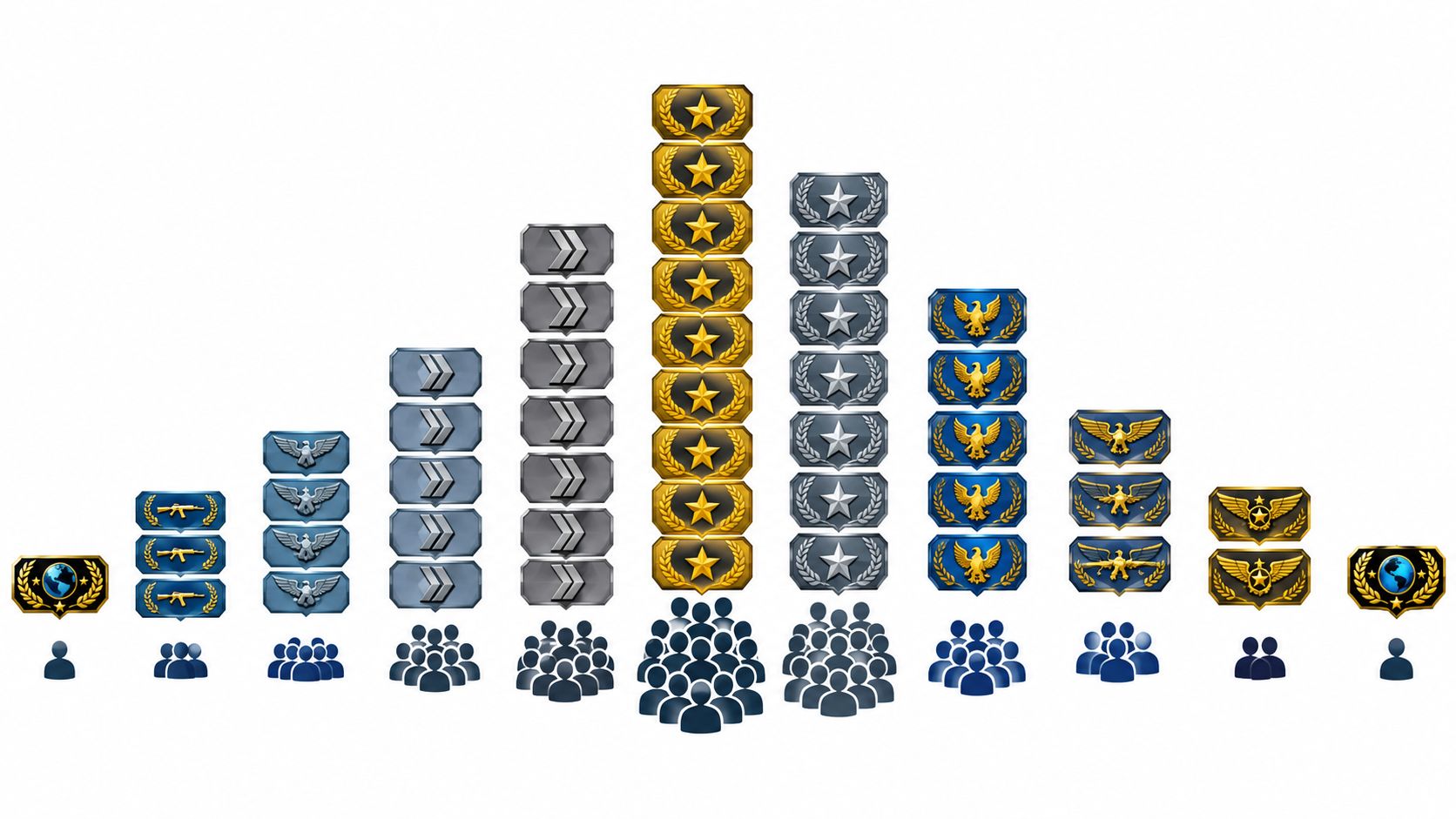
Roughly two-thirds of CS:GO Competitive players sit in Silver or Gold Nova, while Global Elite is under 1% of the ladder. That means the story of CS GO rank distribution isn't the flashy top badge. It's the huge, messy middle where most queues, most teammates, and most “why does this lobby feel so weird?” moments happen.
That one fact changes how you should read every rank chart. Most players aren't brushing up against elite tiers. They're packed into overlapping skill bands where the badge says one thing, but the match often feels like something else. Once you compare classic Competitive with CS2 Premier's crowded mid-rating plateau and FACEIT's much flatter top end, it gets even clearer: “same rank” doesn't mean the same thing across ladders, and it barely guarantees compatible teammates inside the same ladder.
Table of Contents
- What CS - GO Rank Distribution Actually Looks Like
- The 18 Competitive Ranks Explained
- CS:GO Competitive Percentile Breakdown
- How the Distribution Shifted From 2021 to 2023
- Per-Rank Percentages Inside the Middle
- Comparing Competitive, CS2 Premier, and FACEIT
- Why a Lopsided Middle Still Feels Mismatched
- Picking Teammates Using the Distribution
- What the Numbers Mean for Matchmaking and Progression
- Quick Reference Rank and Percentile Cheat Sheet
What CS - GO Rank Distribution Actually Looks Like
About 90% of CS:GO Competitive players sit below the Eagle tiers, and fewer than 1% reach Global Elite according to Upcomer's 2023 CS:GO rank distribution breakdown. The headline is not just that the top is rare. The more important pattern is how aggressively the ladder bunches players into the center, with Silver at about 32.5%, Gold Nova at about 34.4%, and Master Guardian at about 23.3%.
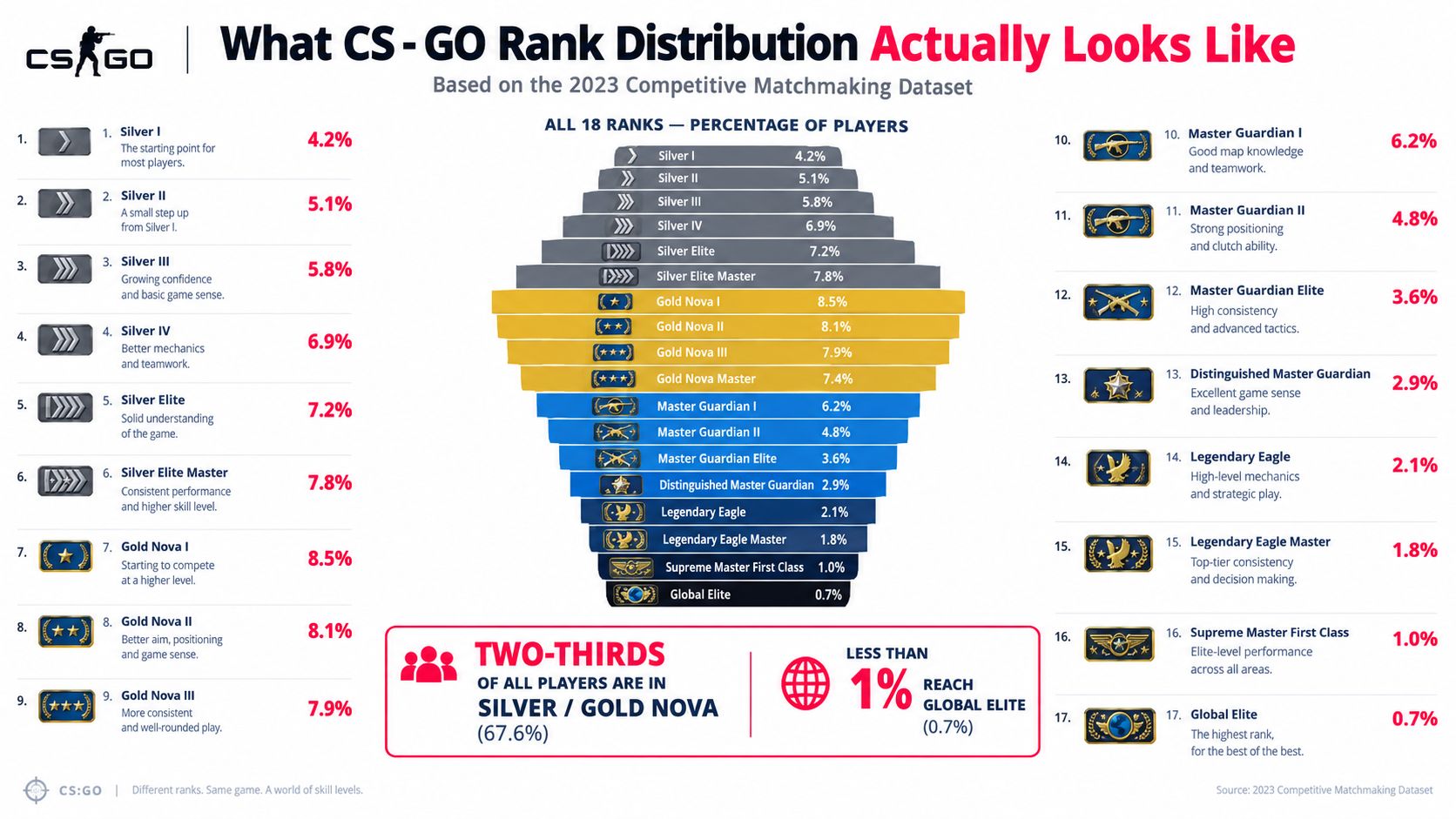
That shape matters more than the badges do.
A rank distribution is a queue map. If roughly nine out of ten players live below LE, matchmaking has to build most lobbies from dense, overlapping skill bands rather than from sharply separated tiers. That helps explain a common Competitive experience: two Gold Nova or Master Guardian players can share a badge range while differing a lot in mechanics, utility discipline, map comfort, and pace.
The contrast gets clearer if you line up the three ladders players use. Classic Competitive packs players into the low-to-mid ranks. CS2 Premier, as noted earlier in the article, also crowds the middle, but it does so with rating bands rather than named badges. FACEIT distributes skill differently again, with a less exclusive top end than Valve's old Competitive ladder. Side by side, the point is practical: a “mid-rank” player is not the same profile across these systems, so the label alone tells you less than many teammate finders assume.
That has direct queue consequences. In a top-heavy or flat system, small rating differences can point to a fairly narrow player pool. In CS:GO Competitive, the middle is so crowded that the same visible rank often covers a wider spread of real match habits. For solo queue, that means more volatility inside supposedly even games. For duos and stacks, it means rank proximity is a weak filter unless you also screen for role overlap, map pool, and tempo.
The distribution also sets better expectations for progression. Climbing out of Silver or Gold Nova is not just “getting better” in the abstract. It means outperforming the largest part of the player base where queue density is highest and where matchmaking has the most similar-looking candidates to sort. That is why the middle feels sticky, and why comparing CS:GO Competitive with Premier and FACEIT gives a better read on teammate quality than a single percentile table on its own.
The 18 Competitive Ranks Explained
The classic CS:GO Competitive ladder uses 18 individual ranks, but players usually think in tier blocks rather than single badges. That matters because the icon you see in lobby chat is only part of the story. The grouping tells you where the dense player pools begin and where they start thinning out.
The rank order from bottom to top
The full ladder runs like this:
- Silver I
- Silver II
- Silver III
- Silver IV
- Silver Elite
- Silver Elite Master
- Gold Nova I
- Gold Nova II
- Gold Nova III
- Gold Nova Master
- Master Guardian I
- Master Guardian II
- Master Guardian Elite
- Distinguished Master Guardian
- Legendary Eagle
- Legendary Eagle Master
- Supreme Master First Class
- Global Elite
Tier groupings players actually use
Here's the quick-reference version players use in conversation.
| CS:GO Competitive Rank Tiers | Rank(s) | Approx. RDR | Color |
|---|---|---|---|
| Silver | Silver I to Silver Elite Master | Qualitative only | Gray |
| Gold Nova | Gold Nova I to Gold Nova Master | Qualitative only | Gold |
| Master Guardian | Master Guardian I to Master Guardian Elite | Qualitative only | Blue |
| Distinguished | Distinguished Master Guardian | Qualitative only | Blue-Green |
| Eagle | Legendary Eagle, Legendary Eagle Master | Qualitative only | Teal |
| Supreme | Supreme Master First Class | Qualitative only | Purple |
| Global Elite | Global Elite | Qualitative only | Red |
There isn't verified data here for any exact “RDR threshold,” so it's safer to treat those as visual groupings, not fixed rating lines.
Competitive is the canonical ladder most players mean when they talk about “old CS ranks,” even though other modes use related systems.
One practical note: the rank icon is useful as a sorting tool, but the tier boundary matters more for matchmaking expectations. Silver and Nova are broad highways. Supreme and Global are narrow lanes. That difference shapes queue quality far more than most badge guides admit.
CS:GO Competitive Percentile Breakdown
In practical percentile terms, the old Competitive ladder was compressed far more in the middle than at the top. A 2023 snapshot published by CSDB.gg's rank distribution page shows the largest shares sitting in Gold Nova I at 8.76%, Silver I at 8.73%, Gold Nova II at 8.65%, and Gold Nova III at 8.08%, while Global Elite accounted for just 0.75%.
That shape matters more than the badge art. If you queue into classic Competitive, the statistically normal outcome is meeting players from the Silver through Nova bands, with a sizeable spill into early Master Guardian. Elite badges exist, but they are a thin tail, not the center of the system.
| CS:GO Competitive Percentile Breakdown | Approx. Share | What it means |
|---|---|---|
| Silver I to Silver Elite Master | About 33% | Large entry and lower-middle pool |
| Gold Nova I to Gold Nova Master | About 34% | Biggest concentration of players |
| Master Guardian I to Distinguished Master Guardian | About 23% | Strong middle-upper cluster, still common in queue |
| Legendary Eagle to Legendary Eagle Master | About 6% | Smaller advanced pool |
| Supreme Master First Class | About 2.5% | Narrow high-skill bracket |
| Global Elite | About 0.75% | Extremely small top tail |
The percentile cutoffs are more useful than the rank names
A player in Nova is not just "average" in a vague sense. In distribution terms, Nova sits inside the densest part of the ladder, which means huge variation can hide behind the same icon. One Gold Nova III player may have clean aim and weak utility habits. Another may understand rotations and spacing but lose aim duels. Competitive groups both together because the middle is broad.
That is also why badge-based squad building often goes wrong.
If you are choosing teammates for stable queues, the first useful threshold is not Global. It is whether everyone is at least inside the upper half of the population. In old CS:GO Competitive, that usually meant building around the Nova to MG line rather than accepting any player with a similar-looking badge. The distribution makes that a practical filter, not a cosmetic one.
Why this matters once you compare ladders
This middle-heavy shape is one reason Competitive often felt less precise than CS2 Premier or FACEIT. Competitive packed a massive share of players into a few adjacent bands. Premier spreads players across rating intervals, and FACEIT compresses less of the population into one visual tier. So a Nova or MG badge often described a wide skill neighborhood, while a FACEIT level or a Premier rating cut usually gave a tighter read on expected pace, utility discipline, and trade timing.
The queue implication is straightforward. In CS:GO Competitive, equal rank did not always mean equal match impact. Percentile proximity was more informative.
How the Distribution Shifted From 2021 to 2023
Across the public snapshots people still cite, the striking number is how little the top expanded. One 2021 distribution estimate from CSGO Rank Distribution put Global Elite at roughly 1% of players. A later 2023 community snapshot used earlier in this article placed Global closer to 0.8%. The headline shift was lower on the ladder.
The center of gravity moved down slightly. In the 2021 snapshot, Gold Nova I through Gold Nova Master accounted for about 32.7% of players, while Master Guardian I through Distinguished Master Guardian covered about 27.6%. In the 2023 snapshot referenced earlier, Silver sat around 32.5%, Gold Nova around 34.4%, and the Master Guardian band around 23.3%.
That pattern matters more than the usual inflation argument.
If rank inflation had meaningfully lifted the whole ladder, the upper tail would have widened and elite badges would have become easier to reach in population terms. The public snapshots do not show that. They show a queue with more weight in Silver and Nova, less in Master Guardian, and a top end that stayed narrow.
| Competitive Distribution Shift, 2021 vs 2023 | 2021 Share | 2023 Share | Direction |
|---|---|---|---|
| Gold Nova | About 32.7% | About 34.4% | Up |
| Master Guardian through DMG grouping | About 27.6% | About 23.3% | Down |
| Global Elite | About 1.04% | About 0.8% | Down |
The practical result is tighter crowding in the ranks where mixed-skill friend groups usually queue. A broader Nova band means two players with similar badges are more likely to sit farther apart in round-to-round consistency than the icons suggest. That helps explain why old CS:GO Competitive often felt blurrier than CS2 Premier or FACEIT. Those systems give more granularity near the middle, while Competitive kept packing a large share of the population into a few adjacent ranks.
There is also a useful squad-building read here. If the 2021 to 2023 shift moved population share from Master Guardian toward Silver and Nova, then using “around MG” as a shorthand for reliable pace became less stable over time. For a five-stack, the safer filter was not matching badges alone. It was finding players who sat clearly above the swollen middle, or confirming through demos and third-party ratings that same-badge teammates were not coming from very different skill percentiles.
These are still public snapshots from different trackers, not a Valve census. That limits precision. The broad conclusion holds up anyway: from 2021 to 2023, CS:GO Competitive remained middle-heavy, the middle slid a bit lower, and the top stayed rare.
Per-Rank Percentages Inside the Middle
The broad tier view is helpful, but the individual-rank view shows where the queue really bunches up. One community-derived estimate places Silver Elite Master at 7.70%, Gold Nova I at 8.52%, Gold Nova II at 8.81%, Gold Nova III at 8.73%, Master Guardian I at 7.39%, Master Guardian II at 6.30%, Master Guardian Elite at 5.25%, and Global Elite at 0.78% according to Skinwallet's CS:GO rank distribution estimate.
The crowded ranks are right where most players queue
That per-rank spread says something most percentile tables miss. The most populated individual ranks aren't exotic. They're the middle badges players often dismiss as “average.” In reality, they're crowded enough that a single-rank difference in that band doesn't tell you much by itself.
| Per-Rank Share of CS:GO Competitive Players | Approx Share | Tier |
|---|---|---|
| Silver Elite Master | 7.70% | Silver |
| Gold Nova I | 8.52% | Gold Nova |
| Gold Nova II | 8.81% | Gold Nova |
| Gold Nova III | 8.73% | Gold Nova |
| Master Guardian I | 7.39% | Master Guardian |
| Master Guardian II | 6.30% | Master Guardian |
| Master Guardian Elite | 5.25% | Master Guardian |
| Global Elite | 0.78% | Global Elite |
Why this changes how you read a badge
If three adjacent Nova ranks all sit in a tight band, the icon difference between them can reflect recent form, map comfort, stack quality, or sample variance as much as any sharp jump in overall Counter-Strike ability. That's why middle-rank matchmaking often feels noisy. The system is sampling from a very large, very mixed pool.
A Gold Nova badge tells you where someone sits in a crowded lane. It doesn't tell you which kind of Gold Nova they are.
Comparing Competitive, CS2 Premier, and FACEIT
A mid-rank Valve player, a 12k Premier player, and a FACEIT Level 10 can all look “above average” on paper while sitting in very different parts of their platform's population curve. That is the comparison that matters, because these ladders do not distribute players the same way.
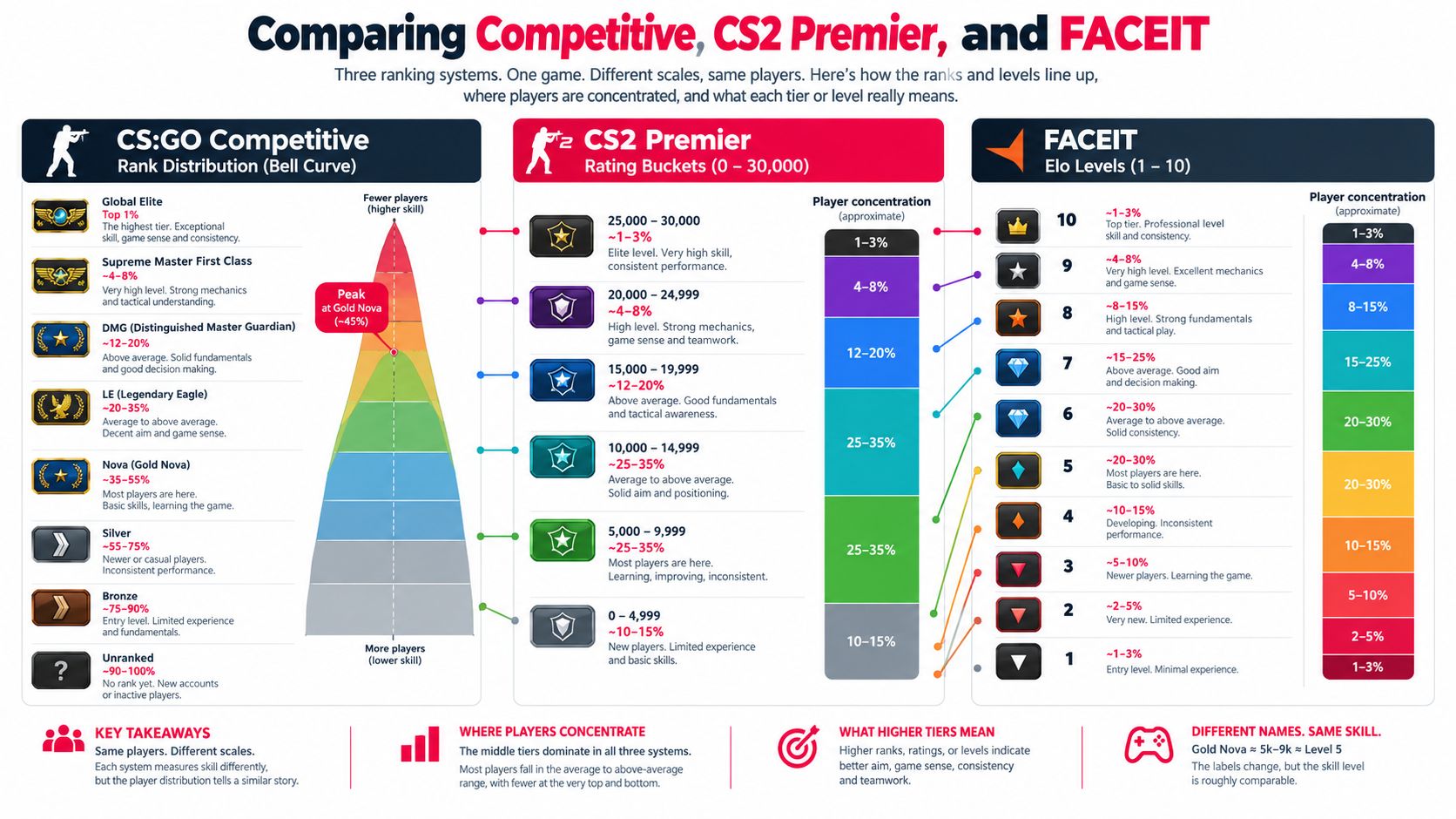
Competitive, Premier, and FACEIT sort players with different inputs and different player pools. Competitive uses 18 broad ranks. Premier gives a finer rating scale, but the player base still bunches up in the center, as noted earlier. FACEIT behaves differently because its queue is more self-selected. More of its population is trying to grind, stack, and play a stricter version of ranked.
That changes how you should read a “good” rank.
Same skill label, different percentile context
In Valve Competitive, the middle ranks absorb a large share of the player base. A Gold Nova or lower Master Guardian badge often places someone inside the biggest traffic zone in the system, not near a sharp skill cutoff. Premier recreates that pattern with numbers instead of badges. The center bands are large enough that two players with similar ratings can still bring very different match value.
FACEIT compresses less of its identity into that broad middle. Its upper levels are populated by a more ranked-focused audience, so a high FACEIT level does not map cleanly to a high Valve rank. Cross-platform comparisons break when players ignore that population difference.
Here's a visual walkthrough of how players talk about those ladders in practice:
What the shape of each ladder means in queue
The practical difference shows up in match expectations:
| Ladder | Distribution pattern | What it usually means in queue |
|---|---|---|
| Competitive | Heavy lower-middle concentration | Badge gaps inside the middle often overstate real skill gaps |
| Premier | Dense central rating bands | Rating is more precise than badges, but teammate quality still varies a lot around the median |
| FACEIT | More selective upper ladder | High levels are more likely to signal structured play, better comms, and repeatable fundamentals |
The non-obvious point is that tighter rank labels do not automatically create tighter matches. Premier can show a cleaner number than Competitive while still pulling from a huge central bucket. FACEIT can look harsher at the top while giving clearer teammate signals for players who care about utility usage, map discipline, and trading habits.
A better way to compare players across systems
If you are screening teammates, use thresholds instead of direct rank translation.
- Competitive: treat the crowded middle as a broad band, not a precise identity
- Premier: use rating as a first filter, then check role fit and map pool
- FACEIT: treat upper levels as a stronger signal of competitive intent, not just mechanics
A squad builder who treats MG, 12k, and Level 10 as equivalent will misread the pool. A squad builder who asks what percentile environment each player came from will make better picks, especially for duos and five-stacks where consistency matters more than headline rank.
Why a Lopsided Middle Still Feels Mismatched
A middle-heavy distribution sounds healthy at first. Lots of players in the center should mean balanced matches. In practice, it often produces the opposite feeling. The reason is simple: rank proximity is not the same thing as player compatibility.
Inside crowded bands like Silver Elite, Gold Nova, and lower Master Guardian, players often arrive through different strengths. One player reaches that badge through aim and opening duels. Another gets there with clean trading and decent utility. A third survives there on a narrow map pool and inconsistent mechanics. The rank groups them together, but it doesn't flatten those differences.
Same badge, different game
| Same Rank, Different Player Profiles | Skill Focus | Rank Band Impact |
|---|---|---|
| Entry aimer | Raw duels and first picks | Can look stronger than rank in loose lobbies |
| Utility support | Smokes, flashes, spacing | Often stabilizes teams without topping scoreboard |
| Map specialist | Deep comfort on one or two maps | Performance swings hard with veto or queue map |
| Tilt-prone fragger | High peaks, poor composure | Creates volatile match quality inside same badge |
Why solo queue exaggerates the problem
Queue conditions matter too. Region, ping, time of day, and whether players are stacking or soloing all change how that crowded middle behaves. In a huge band, the system can make a numerically fair lobby that still feels stylistically broken. The player with polished defaults and patient trades gets paired with teammates who dry peek every angle. Both belong in the same badge cluster. They still don't belong in the same kind of game.
The distribution is fairer than it feels, and the matches feel worse than the numbers suggest.
That's the core tension in classic Counter-Strike matchmaking.
Picking Teammates Using the Distribution
If you use rank as your only filter, you'll overrate the badge and underrate the pool size behind it. In the dense middle, a Nova or MG label should be your starting screen, not your final decision.
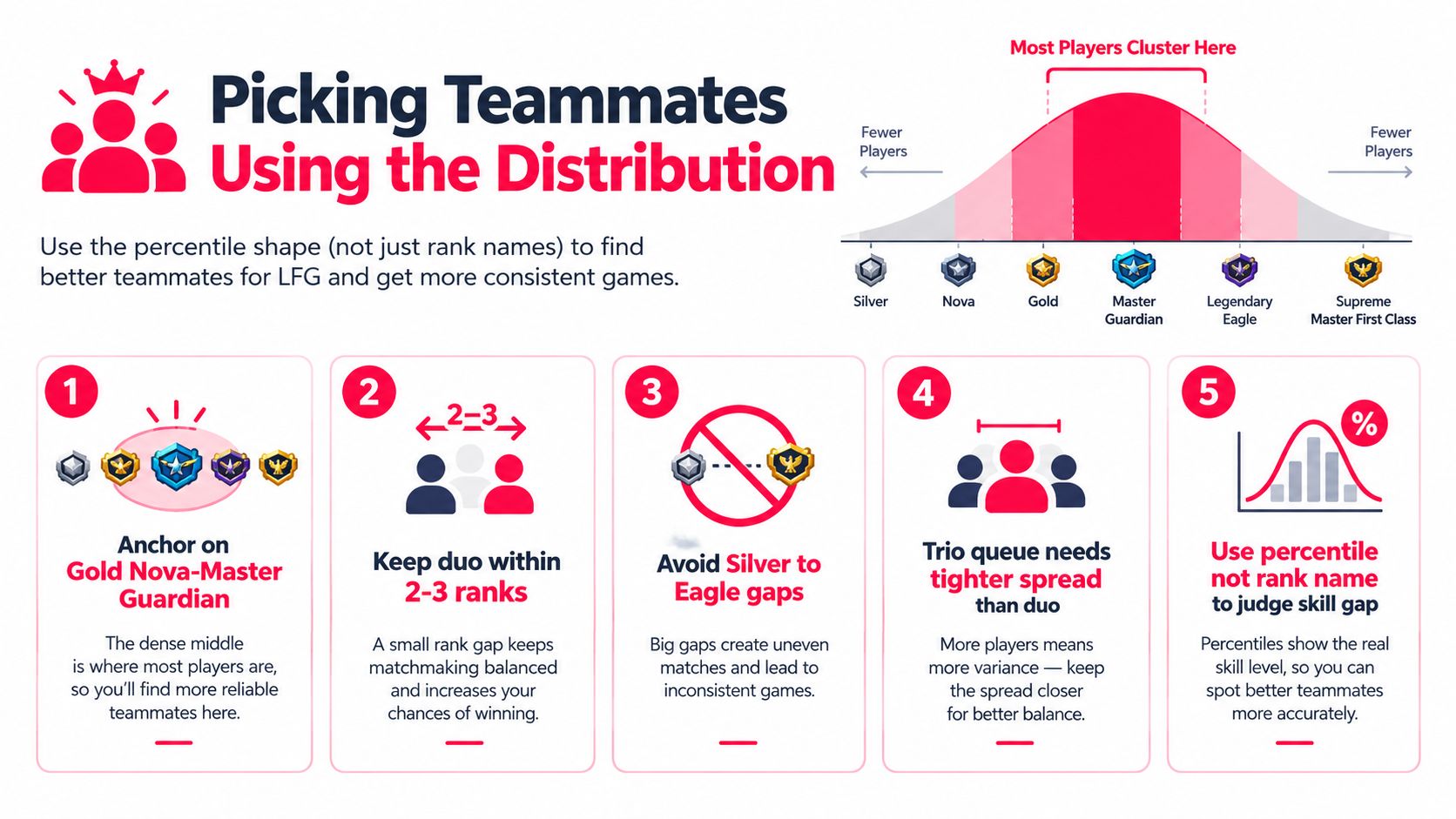
Better filters than the rank icon
A useful LFG process starts with narrow rank spacing, then moves quickly to behavior and role fit. If you want a solid primer on how structured group-finding works, this breakdown of what LFG means in practice is a good baseline.
Use filters like these:
- Keep the rank gap tight: In the crowded middle, stay close to your own sub-rank or immediate neighboring ranks if your goal is stable matchmaking.
- Check role overlap: Two lurk-heavy players can have identical badges and still sabotage each other's rounds.
- Look for utility habits: Ask for a quick clip or recent match sample that shows smoke timing, flash usage, or retake structure.
- Screen comm style: Short, clear callouts matter more than whether someone sounds confident.
- Avoid streak-only reads: A hot match history can hide a player whose floor is too low for your queue goals.
What to avoid
Don't assume “same rank” means same standard. In the biggest population bands, it usually doesn't. The best duos and trios often come from players with slightly different strengths but the same approach to pacing, trading, and communication.
Roster rule: pick for repeatable habits first, badge second.
That matters even more at the top, where the pool is smaller and a bad personality fit wastes longer queues.
What the Numbers Mean for Matchmaking and Progression
The shape of the ladder answers two common complaints. First, why does ranking up feel slow? Because you're climbing out of the most crowded part of the system. When the middle holds such a large share of players, small improvements don't always create instant visual movement.
Second, why do solo queues feel inconsistent? Because the same middle that gives the system lots of players to work with also gives it lots of player variance to sort through. A match can be numerically balanced while still feeling chaotic in execution quality, round discipline, or mental stability.
If you're trying to improve, focus on consistency more than on one-off carry games. This guide on improving your ranked gameplay lines up with that idea well. Progress usually comes from repeatable round quality, not from the occasional highlight map.
The distribution doesn't prove you're hard stuck. More often, it shows you're competing inside the widest and noisiest part of the ladder.
Quick Reference Rank and Percentile Cheat Sheet
For actual queue use, a compact reference is more helpful than another abstract bell curve. The table below uses the infographic percentages provided for the 2023 Competitive ladder as approximate rank shares.
| CS:GO Rank Percentile Cheat Sheet | Tier | Approx. Share | Cumulative Below | Queuing Implication |
|---|---|---|---|---|
| Silver I | Silver | 4.2% | 0% | Very broad beginner pool |
| Silver II | Silver | 5.1% | 4.2% | Lobby quality still swings hard |
| Silver III | Silver | 5.8% | 9.3% | Mechanics vary a lot |
| Silver IV | Silver | 6.9% | 15.1% | Slightly steadier, still noisy |
| Silver Elite | Silver | 7.2% | 22.0% | Many players start showing structure |
| Silver Elite Master | Silver | 7.8% | 29.2% | Crowded transition rank |
| Gold Nova I | Gold Nova | 8.5% | 37.0% | Huge matchmaking pool |
| Gold Nova II | Gold Nova | 8.1% | 45.5% | Center-mass rank, lots of variance |
| Gold Nova III | Gold Nova | 7.9% | 53.6% | Similar badge, different player types |
| Gold Nova Master | Gold Nova | 7.4% | 61.5% | Better habits start to matter more |
| Master Guardian I | Master Guardian | 6.2% | 68.9% | Queue pool still healthy |
| Master Guardian II | Master Guardian | 4.8% | 75.1% | More structured opponents common |
| Master Guardian Elite | Master Guardian | 3.6% | 79.9% | Mistakes get punished faster |
| Distinguished Master Guardian | Distinguished | 2.9% | 83.5% | Pool narrows noticeably |
| Legendary Eagle | Eagle | 2.1% | 86.4% | Cleaner teamplay expected |
| Legendary Eagle Master | Eagle | 1.8% | 88.5% | Queue depth thins further |
| Supreme Master First Class | Supreme | 1.0% | 90.3% | Smaller pool, longer waits possible |
| Global Elite | Global Elite | 0.7% | 91.3% | Tiny pool, badge alone tells little |
If you want to pair badge reading with better self-review, this guide on understanding which stats really matter is worth using alongside the rank table. It helps separate meaningful performance from scoreboard noise, which is exactly what crowded distributions tend to blur.
Premier ratings and FACEIT levels need their own interpretation. Their labels may look comparable from a distance, but their population shapes say otherwise.
If you're done trusting random queue luck, Gamerplug gives you a cleaner way to find teammates who fit your rank band, play style, and schedule. Instead of guessing from a badge alone, you can vet real profiles, clips, and preferences before you queue, which is exactly what a messy middle-heavy rank distribution demands.