
You queue into ranked with a familiar plan: land safely, take a sensible fight, rotate with your squad, and finish the session higher than you started. Then a random teammate pushes alone, your team loses before the match develops, and the next game feels even more expensive. The frustration gets worse when you can't tell whether the lobby is built around your actual rank or an invisible skill estimate.
The modern Apex Legends ranked system asks you to think differently. Your position on the ladder isn't just a badge at the end of a match. It affects the competitive environment around you, the pressure attached to each decision, and the amount of risk you can afford to take. Once you understand that relationship, ranked stops feeling like a hidden grind and becomes a transparent risk-and-reward game.
Table of Contents
- Understanding the Apex Ranked Ladder
- The 2024 Ranked Overhaul and Modern Mechanics
- Matchmaking Behavior and Rank Integrity
- Splits, Resets, and Competitive Checkpoints
- Why Ranked Evolution Matters for Competition
- Strategies to Climb the Ranked Ladder
- Building a Sustainable Ranked Routine
Understanding the Apex Ranked Ladder
A typical ranked session with random teammates can feel chaotic because every player may value the next decision differently. One teammate wants an early fight, another wants to loot for too long, and a third is already rotating toward the next zone. When the match ends badly, it's tempting to blame aim, matchmaking, or bad luck.
The first useful question is more basic: what does this match need to do for your position on the ladder?
Apex ranked uses a tier-and-division structure. Each rank contains four divisions, and players advance by earning Ranked Points, or RP. The RP requirement rises as you move upward, while higher-rank matches also carry larger entry costs. That means a poor result has a more serious effect in Platinum or Diamond than it does in Bronze or Silver, as explained in EA's official ranked overview.
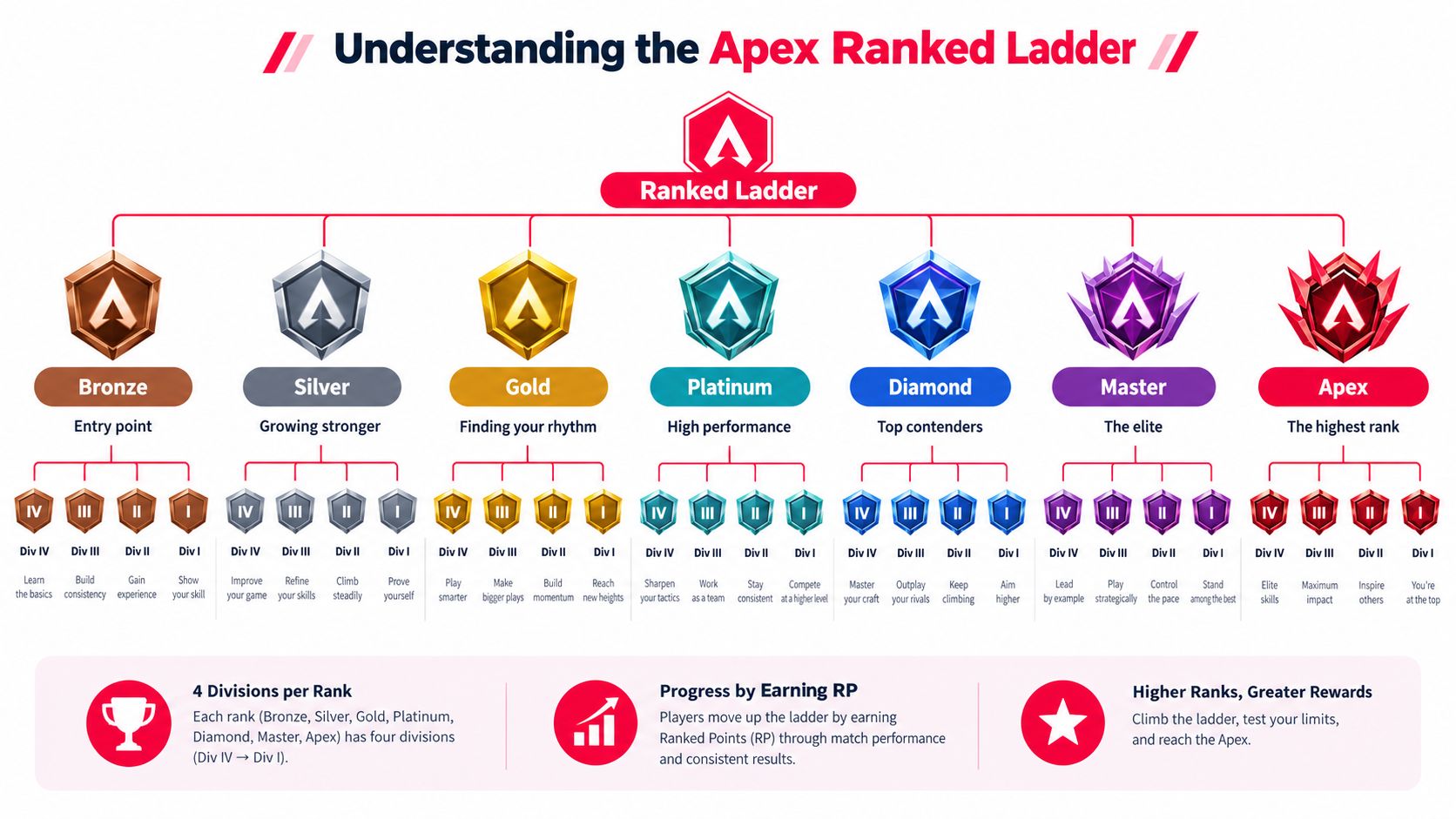
Why divisions change your decisions
Think about two players making the same call. A Bronze player can often test an aggressive route without the same immediate pressure as a Platinum player. The Platinum player has more to lose from a failed contest, especially if the squad enters the fight without a numbers advantage or a reliable escape route.
That doesn't mean higher ranks demand passive play. It means the value of a fight depends on timing, information, and recovery options, not only on whether your squad believes it can win the opening exchange.
| Ladder position | Main pressure | Better question to ask |
|---|---|---|
| Lower tiers | Build fundamentals without overreacting to one match | Can the squad take this fight cleanly? |
| Middle tiers | Balance placement, combat, and entry cost | What happens if this fight lasts too long? |
| Higher tiers | Protect RP while converting strong opportunities | Does this play improve our endgame position? |
A single poor match can feel much worse when you're close to a division threshold. You may lose ground after a late rotation, a rushed revive, or a fight taken without enough ammunition. The answer isn't to avoid every risk. It's to make sure the risks you take are connected to a clear advantage.
Practical rule: Treat every match as a sequence of decisions, not a single test of mechanical skill.
Your division also tells you how much consistency matters. A spectacular game can create momentum, but repeated avoidable losses erase that momentum quickly. Players who want a deeper explanation of the ceiling of the ladder can also review this guide to the highest rank in Apex, but the practical lesson is the same at every tier: know what progression costs before you decide how aggressively to play.
The 2024 Ranked Overhaul and Modern Mechanics
A player can finish a strong match, gain RP, and enter a tougher lobby in the next game. That immediate change captures the strategic shift behind the 2024 ranked overhaul. Season 20 changed the structure of ranked rather than adjusting a few numbers. Released in February 2024, it removed Ladder Points, restored Ranked Points, reset every player to 1 RP, removed provisional matches and promotional trials, and brought back ranked splits. The overhaul is detailed in this Season 20 ranked changes report.
The important change was visibility. RP became both the currency that measured advancement and the rank signal that directly shaped matchmaking. Players no longer had to interpret progress through a hidden system. A match produced a clear result: you earned RP, lost RP, or stayed close to the same position. That clarity turns ranked into a more transparent risk-reward game. A fight is valuable when its likely return justifies the entry cost and the chance of losing progress.
The reset made the climb more deliberate
Removing provisional matches and promotional trials made progression more continuous. Your position now reflects the repeated relationship between match decisions and RP rather than separate qualification stages. The feedback is easier to read, but climbing still requires consistent choices.
The division structure increases the pressure as you rise. The RP required to advance grows, and the entry cost becomes heavier. A Bronze loss and a Platinum loss are not psychologically equivalent, even when both matches last the same amount of time. In Platinum, a failed hot drop can erase meaningful progress earned across several careful games. In Bronze, the same mistake is usually easier to absorb.
The right response is not passive play. It is deliberate risk management. Before committing, judge the likely RP return, your squad's resources, and the recovery options if the fight fails.
Visible progress creates visible responsibility
A transparent ladder gives you better information and less room to blame unclear matchmaking. If RP keeps falling, inspect the decisions behind the result:
- Landing selection: Are you choosing a contested drop without a plan for the opening seconds?
- Rotation timing: Are you moving early enough to avoid a predictable route into the next zone?
- Fight quality: Does your squad have a knock, height, cover, or a clean third-party angle?
- Exit discipline: Can you leave once the fight stops offering a reasonable return?
The overhaul also restored a mid-season drop of six divisions. A player at Platinum 1 moved to Gold 3 at the split, creating a substantial soft reset after the climb. This checkpoint is explicit, so plan your season around it instead of treating the reset as a hidden correction.
The modern system shows your ladder position, your RP result, and the cost of each decision. Use those signals to adjust your approach. Protecting RP is not avoiding competition. It means choosing fights whose potential gain is worth the risk.
Matchmaking Behavior and Rank Integrity
Visible RP changes the meaning of a lobby. When matchmaking uses visible RP rather than hidden MMR, your rank has a direct role in forming the competitive environment. The opponents around you aren't just part of an invisible skill calculation. Their displayed ladder position helps define the pressure you should expect.
That can feel fairer because the system is easier to understand. It can also feel harsher because the consequences are clearer. If you climb quickly through strong placements or favorable fights, you may enter a bracket where your decision-making hasn't caught up with your position. The lobby then exposes the gap between short-term results and repeatable skill.

Read the lobby as feedback
Don't treat a harder lobby as an insult or a verdict. Treat it as information. Ask whether the problems come from aim, communication, positioning, pace, or the quality of your risk assessment.
Use this short process after a difficult game:
- Identify the first unrecoverable mistake. It might be a split rotation, an unnecessary chase, or a fight taken without cover.
- Separate team error from personal error. Your teammate's decision matters, but your own positioning determines whether you can survive it.
- Find the repeatable pattern. One unlucky third party is noise. The same late rotation across several games is a training target.
- Change one behavior. A single adjustment is easier to execute than a complete reinvention of your playstyle.
The visible ladder also changes how you think about new or suspicious accounts. A player with little history may not represent the level implied by the lobby, which is why understanding what a smurf account is helps you interpret unusual matches without turning every strong opponent into a conspiracy.
The split creates another pressure point
The mid-season reset means matchmaking pressure doesn't remain static throughout the season. Players who had separated themselves on the ladder are brought closer together again, and the climb begins another phase. That can create uneven experiences while players rebuild their positions.
Your response should be controlled. Don't abandon your normal fundamentals because the first games after a reset feel unusually difficult. Reduce unnecessary variance, communicate your intended rotation, and judge your own decisions separately from the final RP result. Rank integrity improves when players use the visible system to correct their behavior rather than chase one dramatic game.
Splits, Resets, and Competitive Checkpoints
A split can turn a strong position into a difficult opening session. A six-division reset may move Platinum 1 to Gold 3, so reaching a high rank before the reset does not preserve that exact position in the next phase. The drop is intentional. It creates a fresh checkpoint where players must show that their level survives a change in rank, opponents, and matchmaking conditions.
The 2024 overhaul also changed the meaning of that reset. Because rank now drives matchmaking more directly, the ladder is easier to read as a risk-reward system. A reset does not only remove progress. It places you in a new position where safe placement, selective fights, and efficient RP gains affect the quality of future lobbies. Chasing recovery through low-probability fights can restore a badge quickly, but it can also expose weaknesses that a slower climb would reveal.
Two approaches are available after a reset. You can treat the lower rank as a loss and rush to recover it, or test whether the previous climb came from repeatable decisions. The second approach feels slower, but it produces better information about your actual level.
Old access rules versus the lower threshold
Season 20 lowered the ranked entry requirement from level 50 to level 20. The previous threshold kept newer accounts out for longer. The lower threshold lets players enter ranked earlier, changing the player pool and giving inexperienced players access to the ladder sooner, as documented in the Season 20 ranked update coverage.
| Earlier access | Later access |
|---|---|
| New players can learn ranked decisions sooner | Players have more time to learn the basic game first |
| The ladder includes a wider range of experience | Early ranked matches may contain a narrower experience range |
| Newcomers learn RP and divisions earlier | The initial ranked environment may feel more established |
| More players can enter the competitive loop | Some players may queue before their fundamentals are ready |
The trade-off is practical. Earlier access lets a motivated player learn rotations, team spacing, and risk management in the environment where those decisions matter. It also means some players will enter competitive matches before they understand why a fight is unfavorable. That can make early lobbies less consistent, while giving new players a faster way to identify the habits they need to improve.
Plan around the reset
Before a split, choose a process goal alongside your rank target. Survive the first rotation, keep the squad together during transitions, or reject fights without a clear advantage. After the reset, check whether those behaviors still work against stronger opponents.
A rank drop does not require immediate compensation. Pause briefly, decide which habits to preserve, and begin the new phase at a manageable pace. A split provides another competitive checkpoint, not a promise of a faster climb. Players who adapt without abandoning discipline gain clearer evidence about when to take risk and when to protect their position.
Why Ranked Evolution Matters for Competition
Ranked updates change more than the route from Bronze to the top. They change what a rank means. If the system alters RP tuning, matchmaking conditions, or the timing of competitive ladders, players must interpret rank as a moving measure of performance rather than a permanent statement of ability.
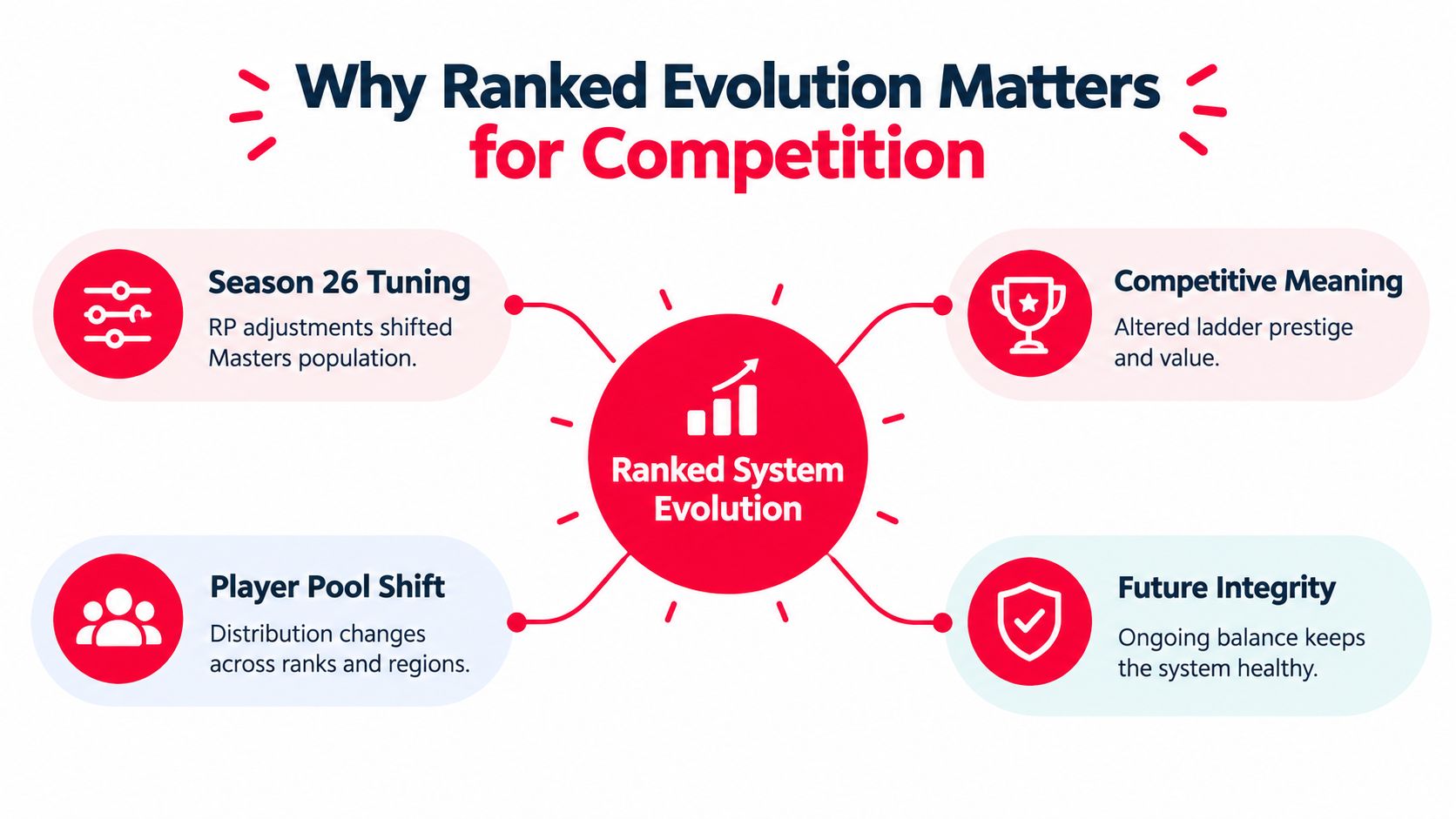
EA's later updates show that the system has continued to be reshaped. In Season 26, ranked tuning changed enough that the Masters population fell to one-third of Season 25's level, according to EA's Amped matchmaking update. Later changes added hybrid Drop Ships and Drop Zones for lobbies with 10 or more Diamond players or any Master or Predator, while Ranked Ladders were extended to five days in Season 30. These adjustments point toward a system concerned with population distribution, high-rank lobby quality, and shorter competitive windows.
Harder or easier is the wrong question
Players often ask whether a change made ranked harder or easier. That framing is too narrow. A system can make progression harder while improving the meaning of a high rank. It can also make access easier while creating a wider range of experience inside early lobbies.
The better question is: what problem is the system trying to solve?
- Inflation control: If too many players reach an elite tier, the rank may lose distinction.
- Endgame quality: If high-level lobbies contain stronger, more committed teams, final circles may better reflect competitive decision-making.
- Matchmaking integrity: If the system responds to high-rank population changes, it may be prioritizing lobbies that are coherent rather than merely quick to fill.
- Competitive timing: If ladders operate over shorter windows, players may need to perform under concentrated pressure instead of relying on a long seasonal grind.
These goals can conflict. A tighter elite population can increase prestige but make the climb less accessible. A more specialized drop system can improve flow for high-rank lobbies while making those games feel more demanding. Shorter ladder windows can reward focused preparation, but they may disadvantage players with limited playtime.
Read rank as a current signal
The result is a ranked system that increasingly measures how well you adapt to the current rules. Mechanical skill still matters, but it isn't the whole competitive product. You also need to understand the entry cost, lobby composition, timing of the split, and the style of play that produces stable results under the current tuning.
Ranked integrity isn't achieved by freezing the system. It comes from making changes that preserve a meaningful relationship between performance and position. As the ladder evolves, players who track only their badge will feel confused. Players who track how the rules shape their decisions will understand what their rank is actually testing.
Strategies to Climb the Ranked Ladder
Climbing consistently is a variance-control problem. You won't win every fight, and you shouldn't try to convert every match into a highlight reel. The stronger approach is to take fights that improve your position, preserve an exit route, and give your squad enough information to act together.

Start with a repeatable landing plan. Choose a location where your squad can collect a workable loadout and identify its first rotation. A safe opening isn't automatically good if it leaves you late to the zone with no information. An aggressive opening isn't automatically bad if your squad has a clear target, shared timing, and a way to disengage.
Match your aggression to the pressure
Your rank should influence how selective you are, but it shouldn't turn you into a passive spectator. Use a simple decision filter before committing:
- Numbers: Do you know where all members of the enemy squad are?
- Position: Do you have cover, height, or a route away from the fight?
- Timing: Can you finish quickly before another squad arrives?
- Reward: Will the fight improve your rotation or merely satisfy the urge to chase?
- Recovery: If the first knock doesn't happen, can your squad reset?
If the answers are weak, rotate. If the answers are strong, commit together rather than allowing one player to create a staggered fight.
After the opening phase, prioritize information. Scan likely approaches, listen for nearby combat, and move before the zone makes your route obvious. A squad that rotates early can choose its next fight. A squad that rotates late often has to accept whichever fight appears in front of it.
Build a session that protects decision quality
The best climbing strategy fails if fatigue turns every setback into a revenge queue. Set a stopping rule before you play. Stop after a run of matches in which your communication collapses, your rotations become rushed, or you're taking fights mainly to recover lost RP.
Track more than your final rank. Note your first-death cause, whether your squad reached the next zone together, and whether your losses came from bad fights or unavoidable third parties. Those observations tell you what to practice far better than a single strong game.
A compatible teammate can also reduce variance by making calls at the same pace as you. One practical option is Gamerplug's ranked gameplay tips, which can support a review of your habits alongside your own match notes.
Watch the embedded gameplay with one question in mind: which decisions preserve options, and which decisions remove them?
Don't copy a high-level player's aggression without copying the information behind it. A fast push may look reckless from the outside, but it can be correct when the player has tracked enemy positions, damage, escape routes, and third-party timing. Your goal isn't to imitate the visible action. It's to reproduce the reasoning that makes the action safe enough.
Building a Sustainable Ranked Routine
A sustainable ranked routine starts before the first queue. Choose a small focus for the session, such as cleaner rotations, better cover usage, or calmer comms after a teammate is knocked. One focus keeps practice concrete and prevents a bad match from turning into a vague judgment about your entire ability.
Use the split as a planning marker. Before it arrives, review which decisions helped you climb and which habits produced avoidable losses. After the reset, treat the new phase as a fresh test of those habits rather than an emergency race back to your old position.
A player who improves steadily may not look spectacular in every session. They land with a plan, leave losing fights earlier, and review why the squad died instead of only counting kills. Over time, that player builds a stronger connection between decision quality and RP. Mechanical improvement matters, but patience, communication, and repeatable positioning often determine whether that skill survives a difficult lobby.
Track three practical signals: your first-death pattern, your squad's rotation discipline, and the quality of your fight selection. If those improve, rank becomes a useful outcome of the process rather than the only measure of progress.
If random teammates keep breaking your ranked routine, use Gamerplug to find Apex Legends squadmates through synced ranks, gameplay profiles, and LFG filters for the mode and rank range you want. Build a party around compatible skill, communication, and schedule before you queue, then turn the ranked ladder into a team process instead of a solo gamble.