You queue into ranked looking for four teammates and get a familiar mix: one player has impressive kills but never speaks, another locks a third entry operator, and a fourth disappears after the first lost round. Everyone may sit near your rank, yet the squad falls apart before the match develops.
That's the central problem with Rainbow Six Siege LFG. Rank can narrow the search, but it can't tell you whether someone drones, trades, follows calls, manages frustration, or shows up when they said they would. A reliable stack comes from checking those habits before ranked points are on the line.
Table of Contents
- Why Most Rainbow 6 Siege LFG Searches Fail
- Best Platforms for Rainbow 6 Siege LFG
- How to Write an LFG Post That Gets Replies
- Screening and Trial Tactics Before Ranked Queue
- Crossplay, Input Fairness, and Rank Compatibility
- Building a Repeatable Squad Routine
Why Most Rainbow 6 Siege LFG Searches Fail
Rainbow Six Siege has enough scale to make finding players seem easy. Ubisoft reported 20 million registered players by August 2017, including more than 2.3 million daily players at that point, and the game reached 85 million unique registered players across platforms by September 2022. Independent reporting based on Ubisoft financial disclosures indicates that Siege maintained approximately 30 million monthly active users across four consecutive fiscal years through FY2024–25 (background on Siege's audience and commercial scale). The audience is global, but a large player pool doesn't automatically produce compatible squads.
The usual failure starts with a post like “need players for ranked.” It says nothing about platform, playlist, role, region, microphone, start time, or whether the group wants a serious climb or a relaxed session. You can answer it, join the party, and discover that your idea of “team play” means structured calls while theirs means silent roaming until the round ends.
Practical rule: Treat rank as an entry filter, not a final compatibility check.
A visible rank doesn't verify communication quality, operator depth, tilt tolerance, or schedule reliability. A high-frag player can still waste utility, refuse trades, duplicate roles, or leave after a bad round. Meanwhile, a quieter support player may create more winning situations through drones, denial, information, and disciplined repositioning.
The hidden filters that matter
A useful search separates mechanical ability from squad behavior. Before inviting someone, establish whether they can:
- Communicate with purpose: Short location, health, utility, and timing calls beat constant chatter.
- Accept a role: A stack needs entry, hard breach, support, flex, flank watch, and information work, not five players competing for first contact.
- Follow a plan: Players don't need to obey every call blindly, but they should understand defaults and adapt together.
- Stay through the session: A teammate who finishes planned games is more valuable than a stronger player who quits after one loss.
- Review mistakes constructively: Post-round habits reveal whether the group learns or turns every death into blame.
The competitive ecosystem reinforces this need for coordination. The Six Invitational 2024 grand final reached 521,349 peak viewers, exceeding the previous Siege tournament peak of more than 316,000 concurrent viewers, while reported prize pools rose from $500,000 in 2018 to $3 million in 2020 and later listed years (tournament history and viewership context). Ordinary ranked teams aren't professional rosters, but the same principle applies: coordinated behavior outperforms five disconnected scorecards.
Best Platforms for Rainbow 6 Siege LFG
No single LFG channel solves every problem. The right choice depends on whether you need a casual fill-in, an active community, or a roster built around verified information.
| Platform | Best For | Verification Level |
|---|---|---|
| In-game tools | Fast, local queues and casual fill-ins | Low |
| Discord communities | Community events, scrims, and quick replies | Varies by server |
| GamerPlug | Structured ranked recruitment and compatibility details | Higher profile detail, with verification features |
In-game tools are fast because there's little setup. They're also thin on context. You may see a username and broad rank, but usually not a reliable picture of role preference, schedule, comms habits, or how someone behaves across several matches. That makes them useful when you need one more player immediately, not when you're building a repeatable five.
Discord gives you more activity and more specialized communities. You can find regional channels, platform groups, tournament organizers, and players looking for scrims. The trade-off is noise and trust-building. Posts can disappear quickly, and a server role or self-reported rank still doesn't prove that the applicant fits your pace or team habits.
GamerPlug approaches the search through player profiles and LFG listings. Its profiles can include gameplay clips up to 90 seconds, while its LFG tools let players specify mode, rank range, platform, microphone requirement, and open slots. That structure is useful when you want to inspect how someone plays before committing to a ranked session. Players comparing clip-based communities or creator workflows may also find this guide to compare short-form video tools useful, especially when reviewing gameplay clips as evidence rather than decoration.
For a serious search, combine a structured listing with a short trial. Use Discord when the objective is a community event or scrim, in-game tools for casual gap-filling, and a dedicated profile-based service when role, schedule, and play style need to be visible before contact. This guide to finding an esports team covers the broader roster-building problem, but the same principle applies to a Siege stack: define the fit before inviting the player.
How to Write an LFG Post That Gets Replies
A strong LFG post gives the right player enough information to self-select. “Need chill teammates” attracts everyone and filters nobody. Your listing should make the playlist, expectations, and practical constraints obvious before anyone joins voice chat.
Start with the facts that eliminate bad matches:
- Playlist and rank band: State ranked, standard, or unranked, then give a narrow current rank or RP range.
- Platform and region: Include the platform, input context when relevant, and server region.
- Microphone policy: Say whether a working mic is required, preferred, or unnecessary.
- Roles needed: Name the gap, such as hard breach, support, flank watch, flex, or shot-caller.
- Session commitment: State the expected start time, approximate length, and minimum number of games.
- Team behavior: Explain whether you expect default calls, post-round discussion, and limited experimentation.
Ubisoft explains that ranked progression uses Rank Points, which change after matches according to the result and matchmaking difficulty, and that PC and console matchmaking ranks are separate (Ubisoft's ranked matchmaking documentation). That makes “same broad rank” too loose for a serious listing. A narrow band gives applicants a clearer expectation and makes the trial easier to evaluate.

A practical post template
Ranked, PC, EU servers. Looking for support, hard breach, and flex players in a close RP range. Mic required, clear English calls, available at the stated start time. We'll play a standard trial first, then a ranked block if comms and pacing fit. Bring a primary operator pool, a fallback role, and commitment to finish the planned session.
Ask applicants to reply with their primary operators, microphone status, usual start time, region, and willingness to follow default calls. That small amount of friction improves the quality of replies because players who ignore the requirements reveal their reliability before the queue starts.
Avoid promising wins or demanding a perfect K/D. You're looking for a group that trades, adapts, and completes sessions. A detailed post may receive fewer replies than a vague one, but the replies are more likely to come from players who understand the assignment.
Screening and Trial Tactics Before Ranked Queue
A player can match your rank, lock the right operator, and still fail the squad by missing calls or disappearing after an early death. Screen those habits before ranked play. The application is only the first filter. The actual test begins when players communicate while choosing operators, setting up the site, and reacting to an unexpected push.
Use a two-stage trial. Start with one unranked or standard match, then enter ranked only if the group shows clear communication and coordinated utility. Judge the process, not just the result. A lost match can expose strong structure, while a win can conceal habits that collapse when opponents counter them.
Stage one tests habits
Before loading in, ask each applicant for a primary role and fallback operators. Confirm the region, microphone, expected start time, and minimum commitment. During the match, listen for calls that arrive early enough to matter. Check whether players acknowledge information from drones, cameras, and teammates instead of repeating or ignoring it.
Watch for behavior the scoreboard cannot show:
- Role acceptance: Does the player fill the missing job, or force another entry role?
- Information discipline: Do they drone and share useful details, or fill comms with guesses?
- Trading and refragging: Do they stay close enough to convert a teammate's death?
- Adaptation: Do they change the plan after an opponent counters the first setup?
- Round recovery: Do they stay engaged after an early death?
Also note post-round habits. Strong candidates explain a missed timing, accept a correction, and return with a concrete adjustment. Players who blame teammates, stop communicating, or replay the same failed idea are poor fits even when their mechanics look sharp.
A player does not need perfect aim to pass this stage. Their decisions need to be clear enough for teammates to support.
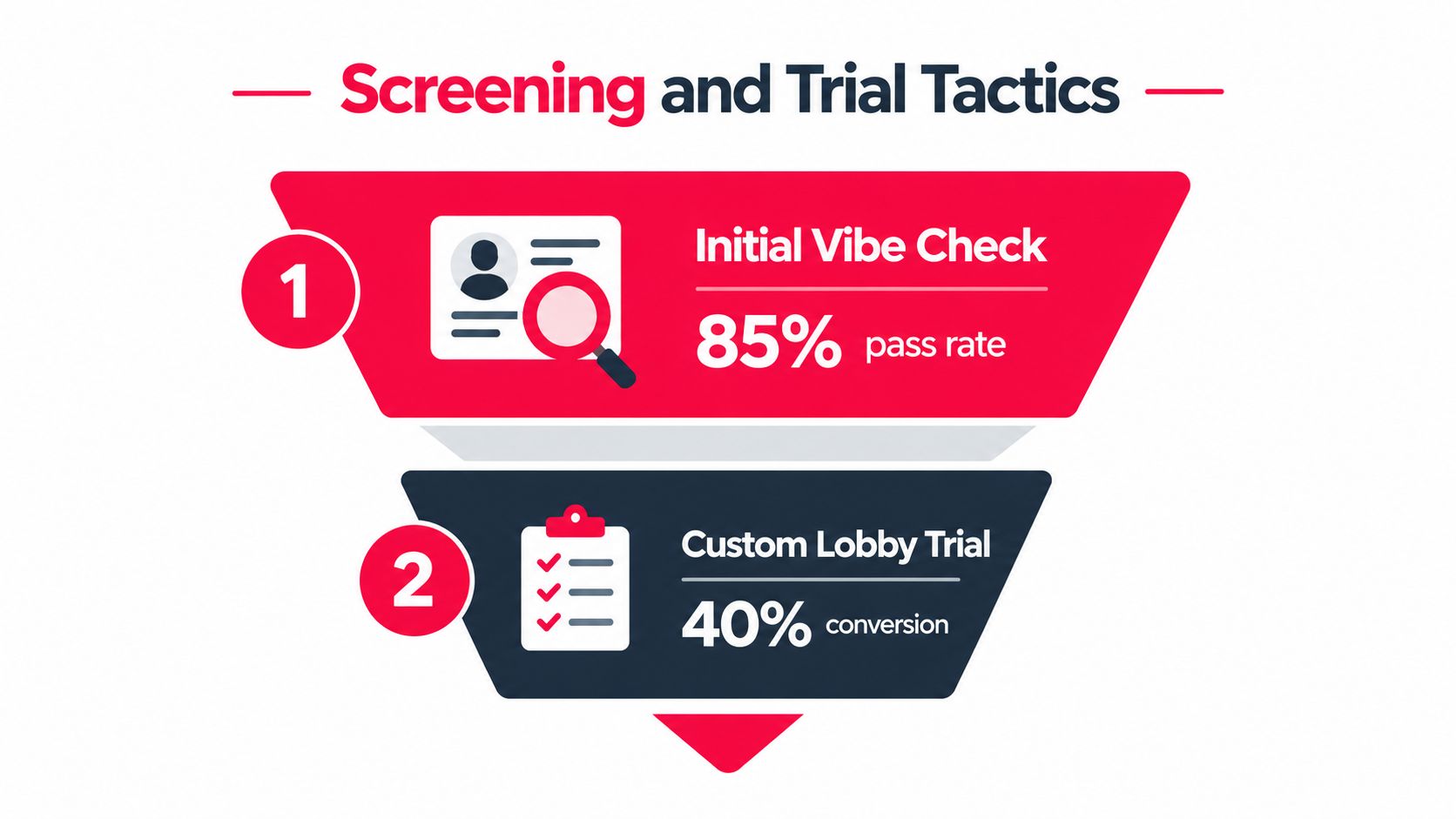
Stage two tests repeatability
Move into ranked only after the group maintains clear calls and coordinated utility across trial rounds. Ubisoft's Ranked 3.0 update describes squad-level balancing and explains that large rank gaps can affect how the team is evaluated. One player's visible rank therefore cannot prove that the entire group fits.
Track repeated behavior across games, using round win rate, first-death frequency, trade percentage, objective participation, and completed sessions. These measures can stay simple. A short note after each session can reveal patterns hidden by one highlight clip or a single strong match.
If an applicant's identity or skill history seems unclear, review this explanation of what a smurf account is. Keep the trial mutual and transparent. Applicants should know the expectations, and everyone should be free to leave if the fit is poor.
Crossplay, Input Fairness, and Rank Compatibility
Crossplay isn't a simple yes-or-no setting for an LFG group. Platform, input method, matchmaking pool, voice setup, region, and rank context all affect whether the squad is entering the same competitive environment.
Ubisoft states that crossplay settings differ by platform, and that console players entering PC matchmaking can have a separate PC rank from their console rank. Ubisoft has also been developing input-based protections that can move detected mouse-and-keyboard console players into PC matchmaking. Its documentation further explains that squad balancing is calculated at the squad level and that large rank gaps can cause the system to weight the team toward the higher-ranked player (Ubisoft's cross-play and cross-progression guidance).
Ask these questions before forming the squad
- Which platform are you using? Don't assume every console and PC player enters the same pool.
- Which input method applies? A controller and mouse-and-keyboard setup can create different expectations.
- Which rank is current? A console rank may not represent the player's separate PC matchmaking context.
- Is the group comfortable with the resulting pool? Discuss fairness expectations before ranked play.
- Are voice tools compatible? Confirm the party and communication setup before inviting everyone.
- Does the rank spread stay narrow? Keep the trial clean by avoiding extreme differences.
A player can be mechanically excellent and still be a poor fit if the group disagrees about input fairness or matchmaking context. Put those details in the LFG listing instead of discovering them after the party forms. Platform verification and gameplay clips can support the conversation, but they don't replace an explicit agreement about where and how the squad will play.
For a more detailed treatment of platform compatibility and squad formation, use this Rainbow Six Siege cross-platform guide. The practical takeaway is simple: show the relevant platform and rank context, not just the highest visible badge.
Building a Repeatable Squad Routine
A squad can look promising in the first queue, then fall apart when someone roams alone, stops making calls, or leaves after a lost round. Reliable teams avoid that pattern with the same intake, trial, review, and retention process each time they recruit.
Publish the playlist, platform, region, rank band, microphone requirement, preferred roles, availability, and minimum session commitment. Ask candidates for their primary operators, fallback role, input method, and approach to comms. A player who will not answer basic questions has already shown how they may handle team agreements.
A routine that survives bad sessions
Before the queue, confirm the playlist, matchmaking pool, platform, input method, current rank context, region, and start time. Assign complementary roles, including entry, support, information gathering, and roaming responsibilities. This prevents five players from competing for the same fragging position while nobody handles the round plan.
During the trial, use an unranked or standard match to test pacing and communication. Keep calls concise, establish who owns the default plan, and watch whether players trade, drone, adapt, and stay involved after dying. Check whether they respect the agreed input setup rather than treating mechanical skill as the only measure of fit. The first match should feel like a normal game, because forced behavior rarely survives ranked pressure.
During the ranked block, track behaviors that predict repeatability. Review the group across at least 10 games, focusing on completed sessions, round decisions, objective involvement, trades, and avoidable first deaths. A short winning run can hide poor habits, while a loss can expose whether players adjust or blame one another.
Keep the review behavioral: “We lost two rounds because the breach opened late” produces a fix. “You're bad” produces another argument.
When to keep, coach, or rotate
Keep a player who communicates clearly, accepts a role, finishes sessions, and responds to feedback, even when mechanics fluctuate. Coach someone whose habits show promise but remain inconsistent, especially if they review rounds and adjust their operator pool. Rotate a player out when they repeatedly ignore calls, quit early, refuse the team role, or recreate the same avoidable problem after a clear discussion.
The process protects your time and reveals compatibility that rank cannot show. A squad does not need identical personalities, operators, or highlight reels. It needs honest platform information, compatible expectations, reliable availability, and enough shared discipline to make the next round easier than the last.
Start with a specific listing, run the trial before ranked, and retain players who fit the routine. If you want gameplay clips, rank details, and structured LFG listings in one place, Gamerplug provides that setup on iOS, Android, and the web. Use those details to reduce guesswork, then judge the squad by how it communicates and adapts in actual rounds.