You type "esports tournaments near me" into a search bar and get three different species of answer back. A weekly Street Fighter local at a game store twenty minutes away. An online Valorant bracket that only filters by region. A listing for a LAN that got cancelled last spring and never came down. All three match the query. None of them match the question you're asking.
Split the search into three jobs before you click anything. A radius search answers "what's close enough to drive to." A region and time-zone filter answers "what can I play from my desk tonight." A squad tool answers "who's my fourth." Most players run one of those three, get a mismatched result, then blame the listings.
Seven places are worth checking, ordered from tightest radius to most squad-dependent. One note for anyone on the organizing side: a printed flyer at the venue still outperforms a pinned Discord message, and this complete guide to leaflet printing covers stock and sizing if you're doing a run.
Table of Contents
- 1. FindMyFGC
- 2. start.gg
- 3. Battlefy
- 4. Toornament
- 5. FACEIT
- 6. Challengermode
- 7. GamerPlug
- Which platform fits a local or regional tournament search
- Pick the Search That Matches How You Compete
1. FindMyFGC
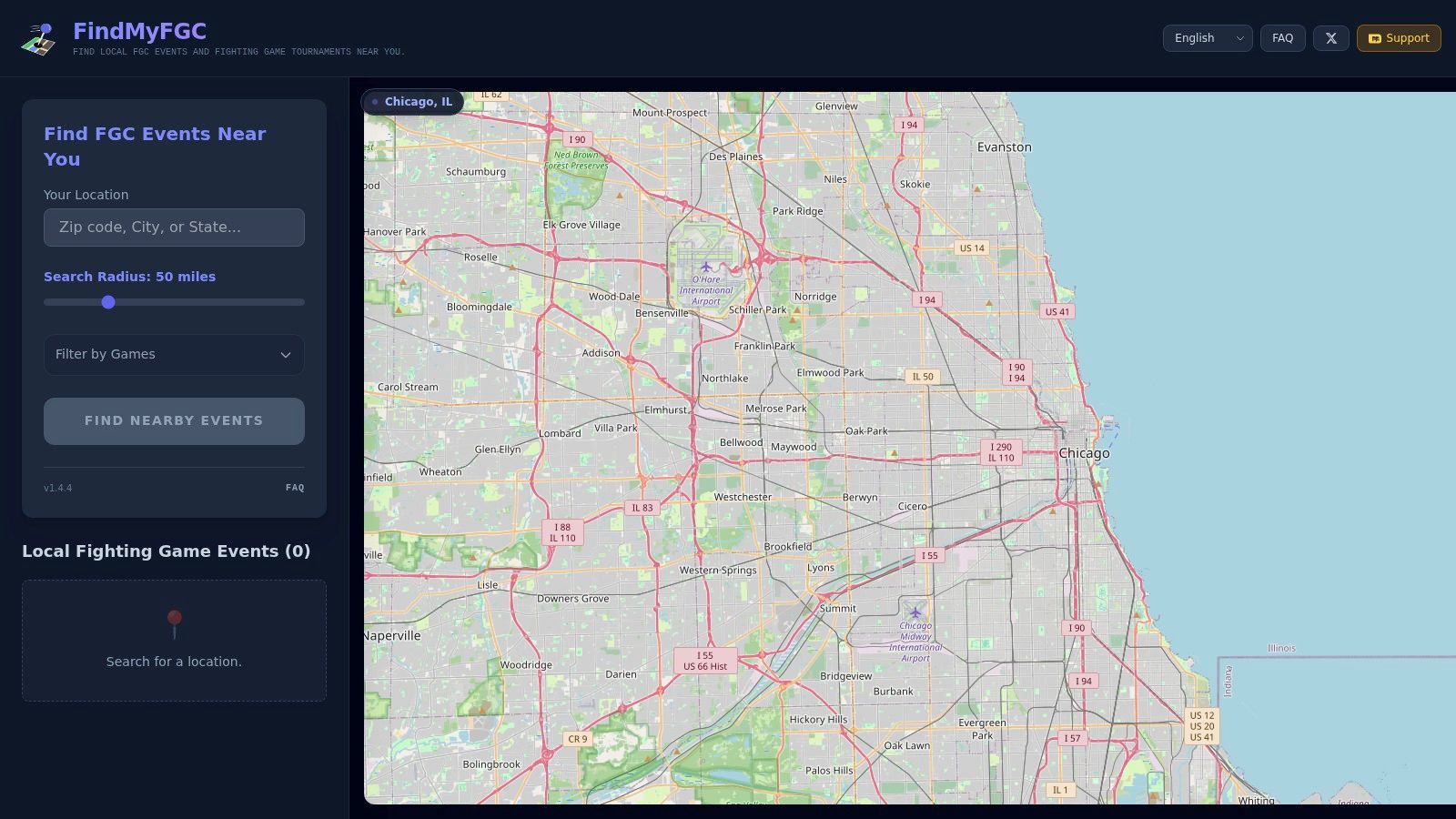
Fighting-game locals are the one category where distance decides whether you show up. FindMyFGC is built for that single job. Search by city, ZIP code or neighborhood, set a travel radius you'd drive, and it returns upcoming events pulled from start.gg listings. No account needed, and the FindMyFGC site says the location you enter is used for the lookup and isn't retained after the session.
Where it earns its place
- Genre focus: Street Fighter, Tekken, Smash and the rest of the FGC calendar, not a general-purpose event firehose.
- Radius as the primary filter: you see what's reachable first, then judge whether the game is worth the trip.
- No cost, no signup: nothing sits between you and a venue address.
The limit is the one every aggregator hits. If an organizer never posted to start.gg, the event doesn't exist here, and plenty of weeklies live only in a bar's Instagram or a university Discord.
A 45-minute radius is a plan. A two-hour radius is a fantasy you cancel on Friday.
Proximity also isn't access. A University of Waterloo survey of Call of Duty League spectators recorded attendees asking for better transportation, more convenient public transit, improved parking, local esports arenas, retrofitted community centers and regular grassroots tournaments. Use that as your pre-trip checklist: parking, transit, whether setups are provided, and whether you're hauling your own fight stick across town.
2. start.gg
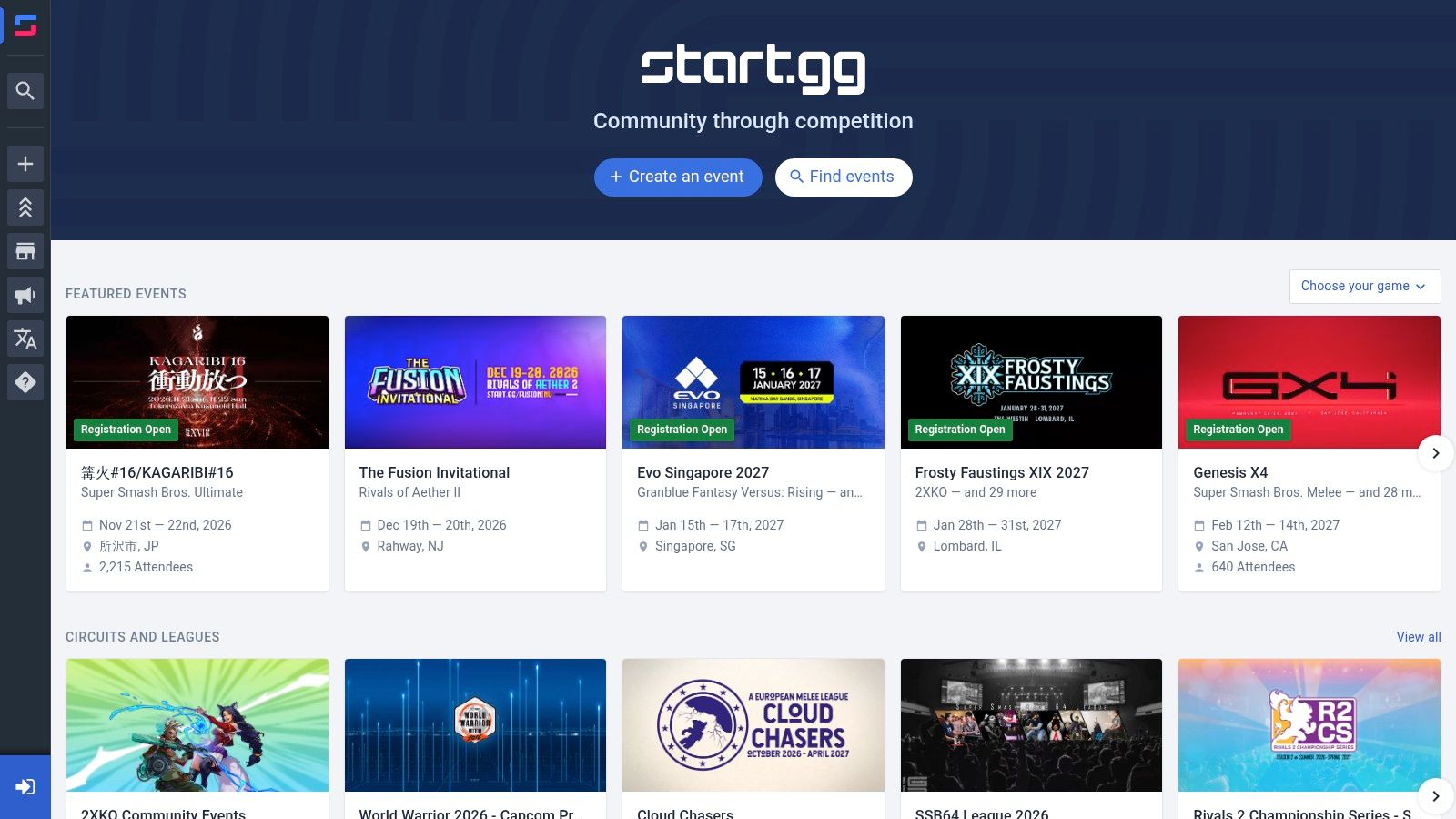
start.gg is the bracket backbone of the grassroots scene. Filter by location and game, open an event page, and you get schedule, format, entry fee and a registration flow organizers manage. Fighting games dominate, but Rocket League, Pokémon and team titles all run through it.
Read the event page, not the listing
A listing tells you an event exists. The event page tells you whether you can play it. Check three things before registering. The check-in window, because many brackets close check-in 15 to 30 minutes before start and drop no-shows without a refund. The format, because double elimination gives you a second life while Swiss means five or six rounds no matter how you're doing. And who's already registered, since a 40-person bracket with eight killers and 32 first-timers is a very different Saturday than the reverse.
The production layer has trickled down too. The 2024 League of Legends World Championship final between T1 and Bilibili Gaming reached 6,941,610 peak concurrent viewers according to esports viewership tracking, and locals now publish live brackets and standings because the same free tooling exists.
Where it falls short: listings only exist if someone posted them, so smaller events slip through, and paid registration can carry a platform fee. Event costs and requirements vary. If bracket formats are new to you, our guide to esports tournaments breaks down what each one demands from a first-timer. Everything else is at start.gg.
3. Battlefy
Battlefy is the filter-heavy option, and that's its whole value. Set region, platform, date and bracket format, and you get a shortlist instead of a scroll marathon. Organizers range from a Discord server running its first cash cup to established groups running season-long circuits.
The filters that earn their keep
- Region: cuts events you'd lag out of or can't legally enter.
- Platform: stops you registering for a PC-only bracket on a console.
- Format: separates a one-night single-elim sprint from a Swiss league that eats six weeks.
- Date window: the only filter that matters if you work weekends.
The trade-off is trust. Most tournaments are independently run, so rules, payout timing and moderation are the organizer's problem, not Battlefy's. Read the rulebook tab before paying, and note that some events require a second check-in on Discord or another site.
Registration isn't entry. Half the no-shows in a typical amateur bracket never finished the check-in step the organizer buried in a pinned message.
Audience scale explains why listings exist at every level. The global esports audience reached approximately 640.8 million viewers in 2025, up 5% year over year, split almost evenly between 318.1 million enthusiasts and 322.7 million casual viewers, according to esports attendance statistics. That split is why the same platform hosts beginner cups and semi-pro qualifiers side by side. Know which one you're entering before you commit a Saturday. Start at battlefy.com.
4. Toornament
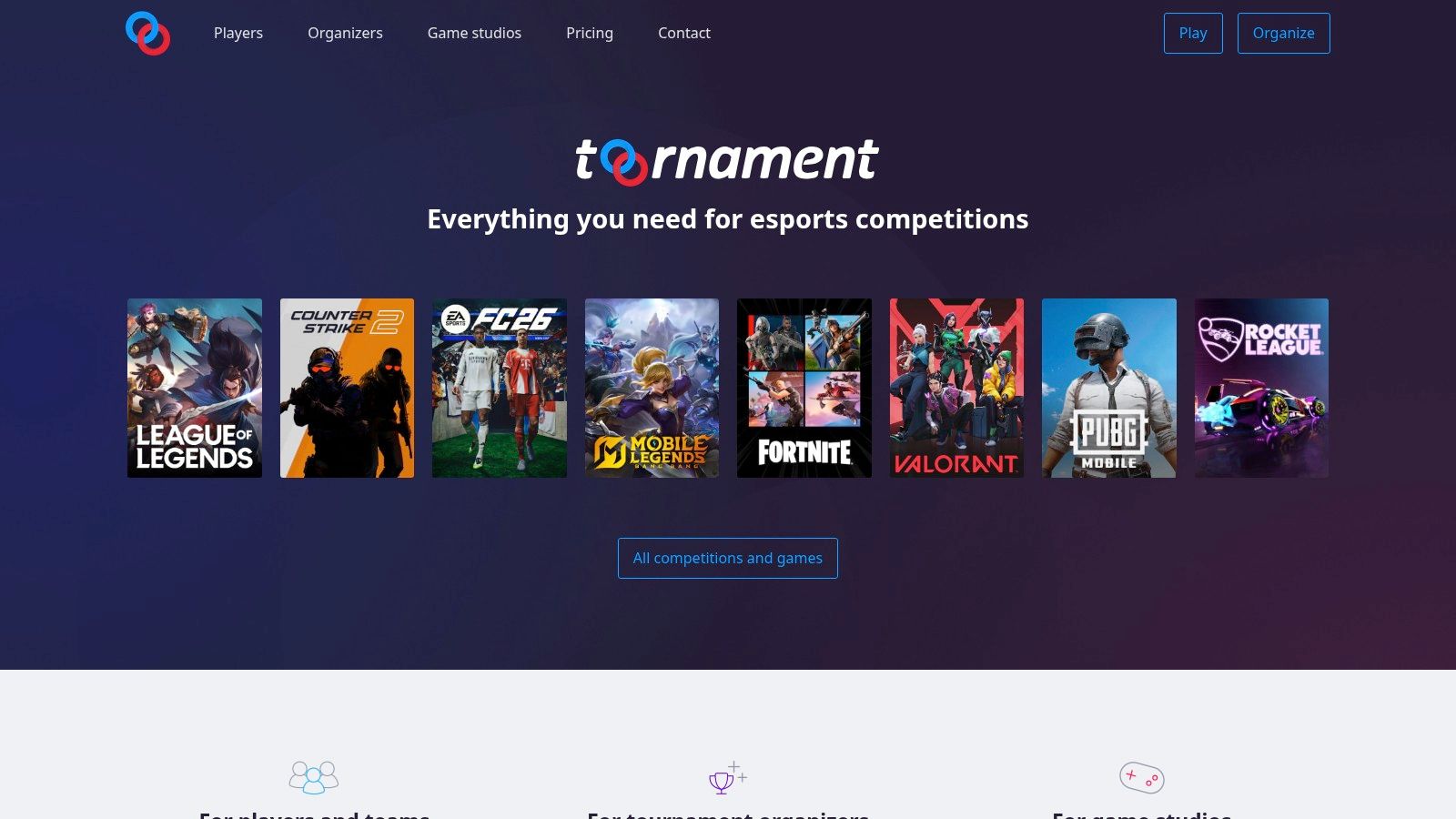
Toornament isn't a local-events tool and doesn't pretend to be. Organizers publish open tournaments across a wide range of titles, and participants browse, register, check in and report results. Before you commit, the event page lists platform, region, language and time zone, which matters far more than proximity when the bracket is online.
The four fields that decide an online bracket
A CET-scheduled Valorant cup is a different proposition from one starting at 2 a.m. your time. A PC-only rule kills a console entry no matter how good your aim is. Language tells you whether the lobby comms will work. Time zone tells you whether you can play the whole bracket before work.
What works: broad game coverage, free for participants, and enough metadata to filter yourself out of a bad fit early. What doesn't: availability depends entirely on organizer activity, and some organizers push sign-up to an external page or a Discord where their own conditions and fees apply, so check the event page rather than assuming Toornament handles it.
The scale behind those listings is genuine. A 2024 industry compilation of the 100 highest-ranked esports titles found roughly $1.72 billion in prize money distributed across 52,451 tournaments involving 131,543 players, per esports prize money records. Most of those weren't world championships. The same record set notes Dota 2's The International 2021 at a $40,018,195 total prize pool, funded heavily by community crowdfunding rather than publisher budgets alone. The ladder is wide, and there's a rung with your name on it at toornament.com.
5. FACEIT
Can you enter alone? Almost no listing answers that directly, and it's the question that stops people. Recent New Zealand esports survey data puts skill confidence as the largest participation barrier at 56%, followed by uncertainty about entry processes at 38% and team-formation problems at 29%, with cost affecting 17%, according to NZ Esports' 2025 growth report. Three of those four are information problems, not talent problems.
FACEIT attacks the roster half. Matchmaking, clubs, leagues and tournaments sit in one account. Some events allow solo entry or party entry, region and skill filters do part of the sorting, and a few offer prizes with details on the tournament page. Play a handful of ranked matches and you arrive at an event with a level, not a claim.
Where it works: repeatable competition, a schedule you can plan around, and solo queues that put you in a team without a tryout. Where it doesn't: game support and tournament availability vary, some brackets still require a full roster and their own check-in steps, and premium access changes what you can enter.
Solo entry is the feature, not the compromise. Take it, play five matches, then decide whether you want a fixed roster.
If you'd rather build the roster before the bracket, an esports team finder that filters by rank and schedule saves the trial-and-error. The competition side is at faceit.com.
6. Challengermode
Online is where the volume sits. Online tournaments represented 58.4% of the estimated $3.8 billion global esports tournament market in 2025, and amateur competitors accounted for about $1.52 billion, or 40.0% of tournament revenue, according to esports tournament market research. That shapes how you pick a platform. Most of what you'll enter this year is a scheduled online bracket, not a LAN.
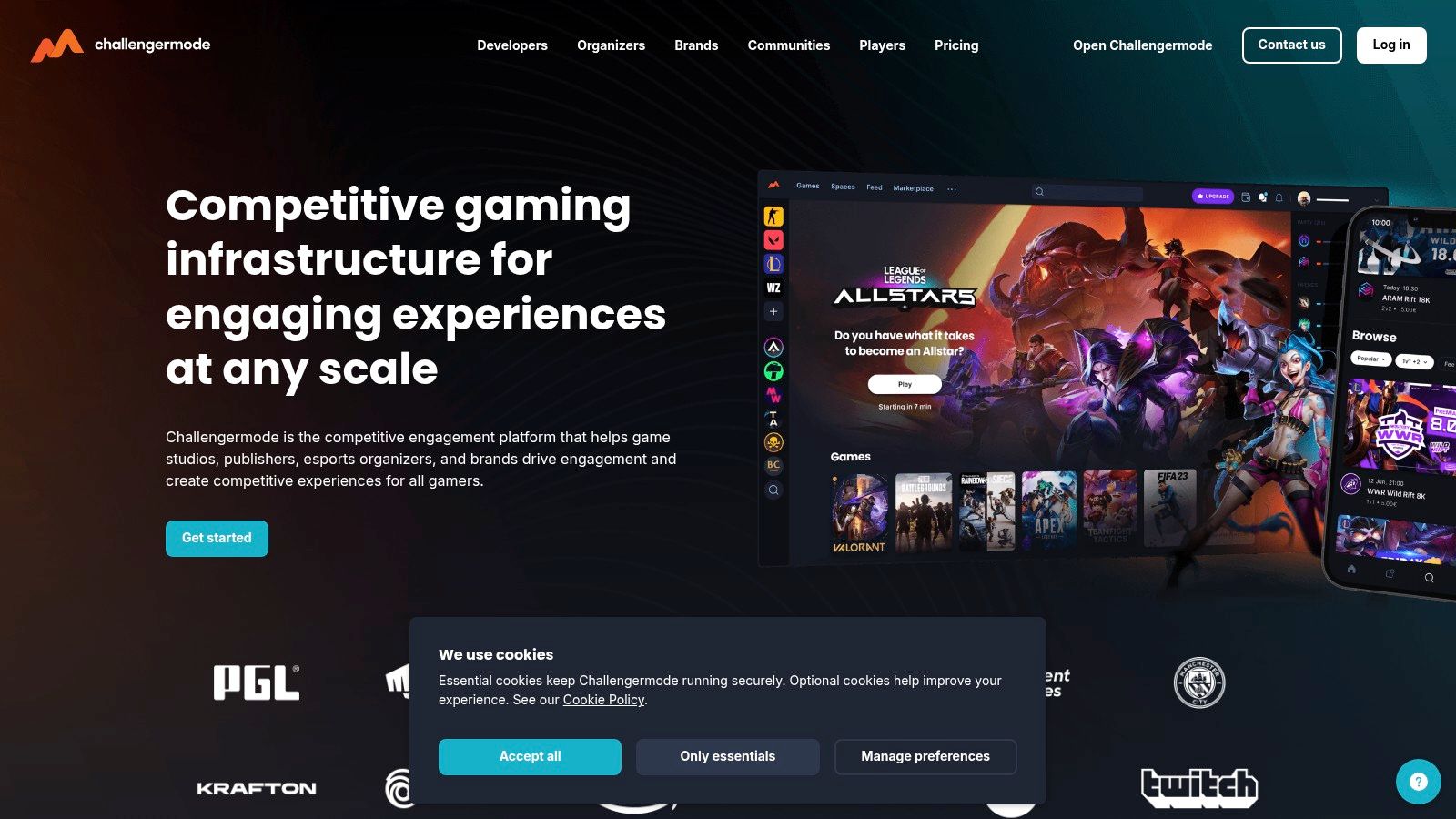
Challengermode runs tournaments, leagues, ladders and leaderboards across Counter-Strike 2, League of Legends, Dota 2, Valorant and PUBG. Two things separate it from a pure bracket host. Team Finder lets you post or join a roster inside the account you compete with, and Community Spaces give organizers a home base so the same group runs events week after week. Most tournaments are free to enter, though paid competitions require a deposit.
Ladders versus scheduled brackets
They reward different habits. A ladder lets you play when you want and climb across weeks, which suits an unpredictable schedule. A scheduled bracket concentrates everything into one evening and punishes a late check-in with elimination. Pick by your calendar, not by the prize.
The gap is proximity. This isn't a tool for finding a LAN in your city, in-person discovery is thin, and region and team-size options vary by event. Game-account connection is required for most competitions. Use it when you already know your game and format, at challengermode.com.
7. GamerPlug
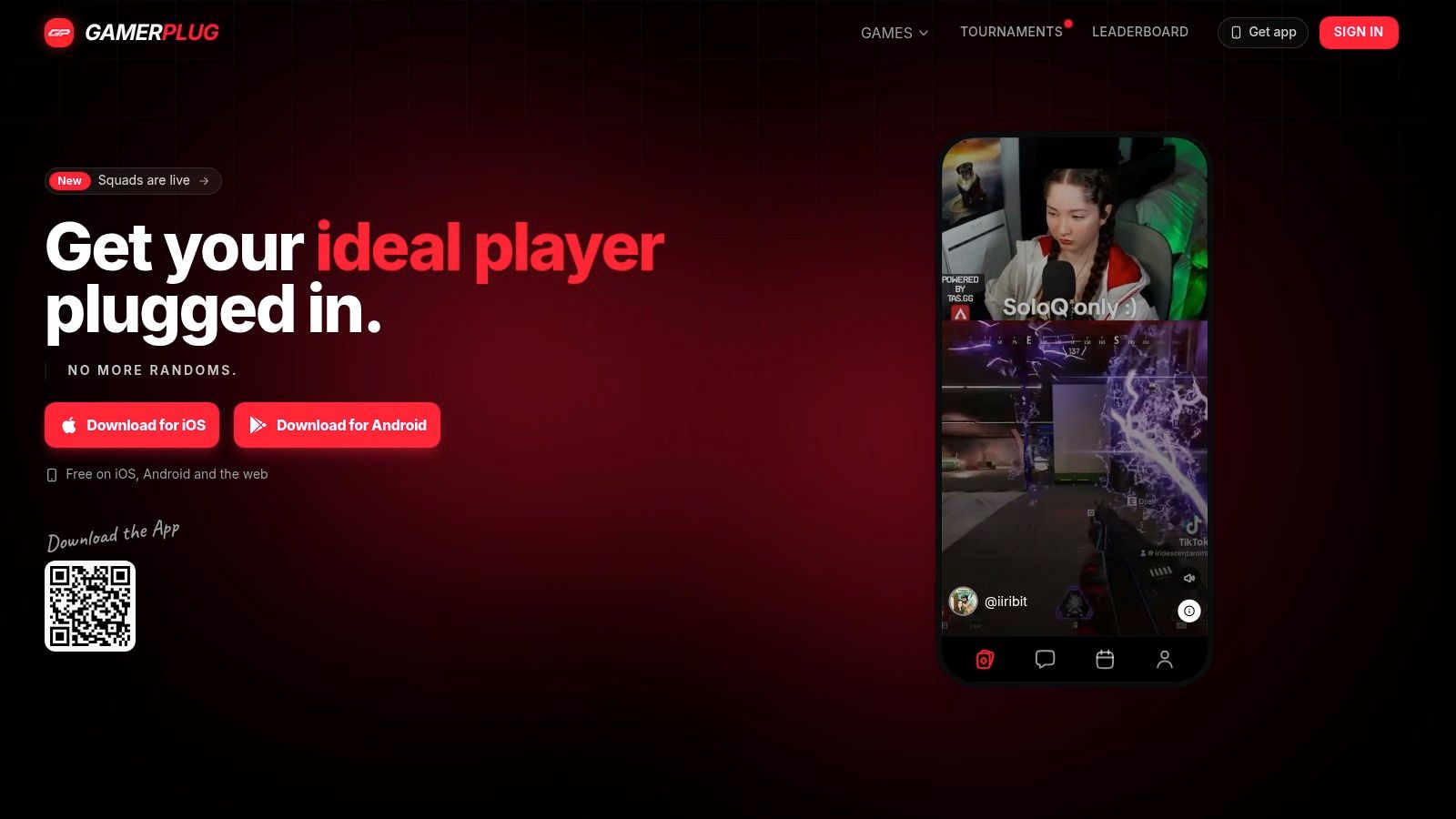
Sometimes you've found the event and the problem is the roster. GamerPlug puts tournament listings and teammate-finding in the same place. Event pages carry game, format, platform, start time, available slots, prizes and rules, and you register solo or with a squad, with results tracked for you. Brackets run across Apex Legends, Valorant, League of Legends and Fortnite in Single Elimination, Double Elimination, Swiss and Round Robin formats, with live leaderboards.
The squad post is the piece most listings lack. When you post, you set the game mode, rank range, platform and whether a mic is required, then fill the open slots. Profiles open on gameplay clips instead of a username and a rank badge, and ranks for Apex Legends, Fortnite and League of Legends sync from official game APIs. League ranks come from Riot using your Riot ID, and you never enter a password.
That's the check that saves a night. A few clips tell you more about whether someone holds an angle or over-peeks than any tag. Supported titles include Call of Duty, Overwatch 2, Rocket League, PUBG and NBA 2K, with availability depending on your game and region, and entry fees or eligibility rules set per event.
The listing gets you to the bracket. The teammate search gets you through round one.
It's free on iOS, Android and the web. Browse the tournament listings to see how events are laid out, and the platform itself is at gamerplug.app.
Which platform fits a local or regional tournament search
| Item | Best for | How location works | Entry cost pattern | Team tools |
|---|---|---|---|---|
| FindMyFGC | Finding local fighting-game events | Search by city, ZIP code, or neighborhood and set a travel radius | Free to search; event costs vary | No dedicated team tools |
| start.gg | Finding grassroots tournaments across games | Search and filter by location and game | Event costs vary; paid registrations may include a platform fee | Organizers can publish events and manage registrations |
| Battlefy | Finding community and organized tournaments across games | Filter by region, date, platform, and format | Event costs vary; some require an account | No dedicated team tools |
| Toornament | Browsing tournaments across a wide range of games | Review event region and other details; location filters are not specified | Free for participants on Toornament; external fees may apply | No dedicated team tools |
| FACEIT | Structured, repeat competition in supported games | Some listings offer region filters | Account access and event costs vary | Clubs, matchmaking, and some solo-entry or team-matching options |
| Challengermode | Online tournaments, leagues, and ladders | Region options vary by event; nearby in-person discovery is not central | Most tournaments are free; some require a deposit | Team Finder and Community Spaces |
| GamerPlug | Finding tournaments and teammates in one place | Event availability depends on game and region | Described as free; event-specific fees may apply | Squad posts, player profiles, and chat |
Pick the Search That Matches How You Compete
The three jobs barely overlap, and that's the point. A radius tool such as FindMyFGC is the right call for fighting-game locals, because the only variable that matters is whether you'll drive there. A region and time-zone filter on Toornament or Battlefy handles online brackets, where "near me" really means a server that won't spike your ping and a start time that fits your evening. A squad tool earns its place when you've found the event and still can't field five.
Then run the boring checks before you hit register. Confirm the game and platform, since a PC-only rule voids a console entry. Confirm the check-in window, because organizers drop no-shows without a refund. Confirm whether entry needs a separate Discord step, a deposit, or organizer approval of your roster. Confirm the format, because a six-round Swiss bracket is a different commitment from a single-elimination cup that ends in two matches.
If you're hosting rather than entering, the same rules apply to your own listing. Put check-in time, format, rank band and platform in the first two lines and you'll field fewer questions and fewer empty slots. If you want something to sell at the door without a custom-order minimum, wholesale blank hats for small businesses plus your own printed logo is the cheap route.
GamerPlug is one place that keeps listings and squad-finding together, with brackets for Apex Legends, Valorant, League of Legends and Fortnite and profiles built on gameplay clips and synced ranks. Use whichever tool matches the job you're doing, and check the event page before you pay anyone.
The gap between "I found a tournament" and "I'm registered with a full team" is usually one or two players, and that's the part GamerPlug handles. Post a squad with your mode, rank range, platform and mic requirement, or browse the tournament listings for Apex Legends, Valorant, League of Legends and Fortnite and register solo or with your team while results track themselves. It's free on iOS, Android and the web, so head to Gamerplug and fill the slot before check-in closes.