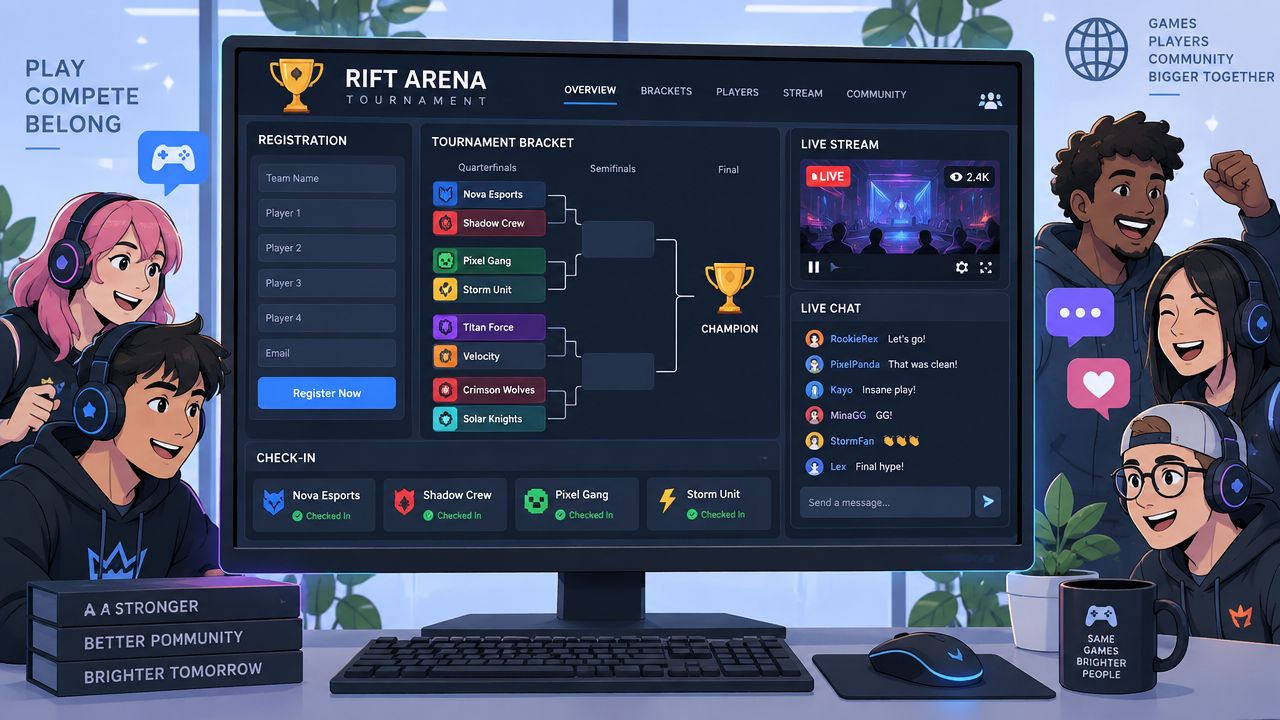
The worst advice in esports is still the loudest, pick one platform and force every event through it. That sounds tidy, but grassroots reality is messier. A weekend bracket needs fast registration and clean check-in. A Discord community needs low-friction signups and chat that players use. A recurring league needs roster continuity, dispute handling, and maybe payouts. A player-discovery layer needs something else entirely, a place where people can find gaming teammates before the bracket even starts.
That's why the right online tournament organizer depends on the workflow you're trying to solve, not the brand name everyone repeats. The category is big enough now to be tracked at scale. Esports Charts tracks 91,215 tournaments and events, 377,309 matches, and 56,778 unique entities in its organizer database, which shows how far this space has moved beyond hobby tools into core esports infrastructure, with names like Riot Games, ESL, Epic Games, Tencent, Garena, Blizzard Entertainment, EA, Twitch, and BLAST all appearing in the same ecosystem Esports Charts organizer database. In other words, bracket software, event ops, and community discovery now overlap.
So this comparison focuses on practical fit. Some tools are better for fast brackets. Some are built for Discord-native weeklies. Some handle complex multi-event operations, recurring circuits, or monetization. GamerPlug is included here as the player-discovery and tournament-community option, not as a universal replacement for every dedicated bracket suite. If your real bottleneck is finding reliable players, building rosters, and keeping your community connected, that matters more than feature checklists.
Table of Contents
- 1. GamerPlug
- 2. Battlefy
- 3. Challonge
- 4. Toornament
- 5. start.gg
- 6. Challengermode
- 7. FACEIT Organizers and Hubs
- 8. Game.tv
- 9. Community Gaming
- 10. Matcherino
- Top 10 Online Tournament Organizers, Feature Comparison
- Build the Tournament Stack That Fits Your Community
1. GamerPlug
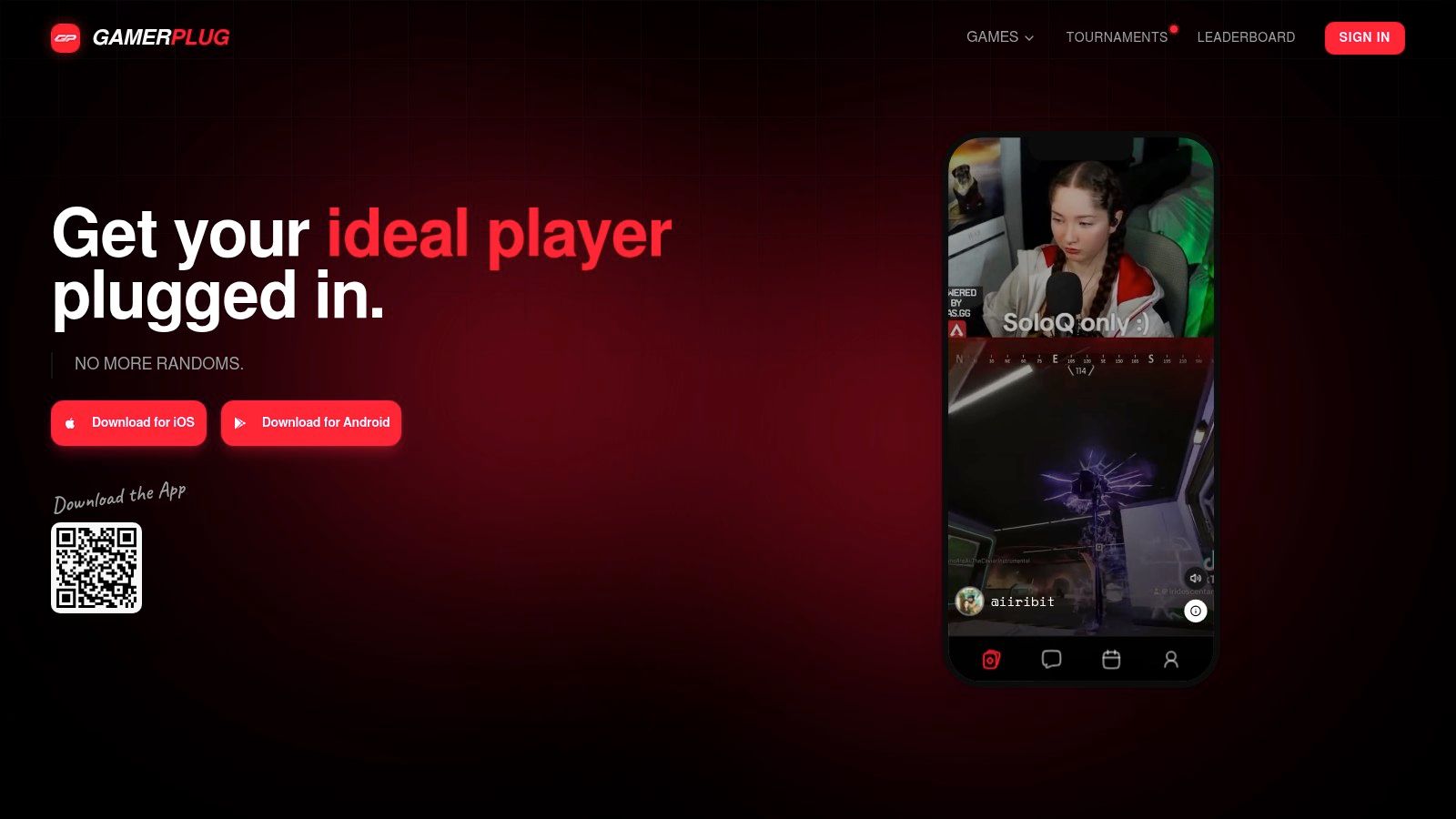
GamerPlug makes the most sense when the problem isn't “how do I run a bracket?” but “how do I stop assembling randoms five minutes before signup closes?” It's a free, cross-platform LFG app built around verified profiles, gameplay clips, and squad discovery across iOS, Android, and web. That's a different job than a classic bracket suite, and for a lot of amateur organizers it's the more important one.
Why it fits grassroots team building
The value is simple, you see more than a username. GamerPlug centers profiles around real gameplay clips up to 90 seconds and verified ranks that sync from official APIs for games like Apex Legends, Fortnite, and League of Legends. That makes it useful for anyone trying to find gaming teammates without relying on trust-by-bio alone. The app also leans into role fit, mic use, schedule overlap, and playstyle, which is the stuff amateur teams usually figure out too late.
It also supports LFG/Squads posts, persistent chat, low-latency voice, and bracket play in-app with formats like Single Elim, Double Elim, Swiss, and Round Robin. For a community lead, that means one place to discover players, spin up a squad, and keep tournament communication moving. The trust layer matters too, since clip-based profiles, optional World ID badges, reputation signals, and reporting reduce some of the usual fake-profile noise.
Practical rule: Use GamerPlug when roster quality is the bottleneck. Use a heavier bracket tool when your main pain is event administration at scale.
The platform is also a fit for creators and collegiate communities because it's already positioned around those use cases, including a collegiate partnership and an affiliate program. If you're trying to create a repeatable community around Valorant teammates, a Fortnite squad finder, or a League of Legends duo finder workflow, that's a stronger angle than trying to make it behave like a full enterprise ops suite. The internal tournament flow is also easy to inspect before you commit, especially if you want to create a new event inside the app through GamerPlug's tournament setup flow.
Pros
- Verified profiles that are harder to fake, which helps when you're screening for reliable players.
- AI matching that looks at roles, schedule, and playstyle, not just raw rank.
- Built-in chat, voice, and squad saving, so good groups don't disappear after one session.
- Tournaments and leaderboards in the same app, which helps bridge discovery and competition.
- Free and cross-platform, with safety features for communities that want a lower-friction stack.
Cons
- Still new in mobile form, so niche titles and smaller regions may feel thinner than older ecosystems.
- Best results require more setup, including linked accounts or clips.
- Not a universal bracket replacement, especially if you need very deep enterprise operations.
For grassroots organizers, that's the point. GamerPlug solves the front end of the tournament stack, player discovery, team formation, and community retention. If your event lives or dies by whether the right five people can find each other, it's a legitimate first stop.
2. Battlefy
Battlefy is the safest pick when you need a platform that already speaks esports fluently. It's built for organizers who want registration, check-in, bracket flow, dispute handling, and match chat without stitching together half a dozen separate tools. That makes it a better fit for communities that expect some chaos, but still need control.
The platform's strongest trait is operational familiarity. Battlefy has been used across grassroots cups and larger official qualifier-style programs, and that matters because organizer mistakes usually show up in the messy middle of an event, not on the homepage. It also has a documented knowledge base, which is a real advantage when the staff running the event changes from week to week. If you're managing community brackets for several games, that institutional memory saves time.
Where it wins, and where it doesn't
Battlefy is best when your workflow includes public signups, check-in windows, direct match pages, and audited result reporting. If a dispute comes up, there's a clear path for staff to work through it. If you're running a community cup that may grow into a sponsored series later, Battlefy gives you a runway that lighter tools often don't.
The tradeoff is that it's not the fastest first-time setup for a casual organizer. It can feel like a serious esports admin product because that's what it is. Advanced pricing and enterprise-style features also aren't the kind of thing most small organizers will love if they just want to run a weekend bracket and move on.
Good for organizers who want to standardize process first, then scale the event.
If your community is already somewhat mature, Battlefy's depth can be the difference between a one-off event and a repeatable ops system. If your main goal is to find gaming teammates and fill a roster quickly, it's probably more platform than you need.
3. Challonge
Challonge is the opposite of overbuilt. It's the platform you use when the event has to go live fast, the bracket shape is straightforward, and nobody wants to spend an hour learning a new admin console. For weeklies, monthlies, and simple online cups, that speed is the whole argument.
What makes it useful is restraint. Challonge supports common formats like single-elimination, double-elimination, round robin, and Swiss, and it gives organizers a clean way to centralize tournaments, stats, and announcements. If you're running a neighborhood-size gaming event or a small amateur league, that can be enough. You don't need an enterprise stack just to seed eight players and keep the bracket visible.
Best for quick-turn events
Paid registrations are handled through the organizer's own Stripe account, which keeps payment flow under your control. That matters if you don't want your tournament money trapped in a complicated ecosystem. It also makes Challonge a decent fit for organizers who want to collect fees without moving into a heavier monetization platform.
Its biggest advantage is cognitive load. New organizers can usually stand up a bracket without much hand-holding. The downside is equally clear, it's lighter on native automation for in-match logistics than the esports-first suites above it. That means more manual work if you need layered check-in, advanced staff roles, or complex dispute handling.
For small community leaders, that tradeoff is usually fine. For larger recurring programs, you may eventually feel the ceiling.
4. Toornament
Toornament is the right call when your event isn't just a bracket, it's a branded program. Agencies, publishers, and communities use it when they need multi-tournament projects, embeddable website components, and white-label presentation that doesn't look like a generic bracket page. That changes the organizer's job from “run this one event” to “operate a repeatable event hub.”
The structure is the selling point. Toornament supports advanced registration and check-in flows, a website builder, embeddable widgets, and API access on certain plans. If you're managing multiple events under one umbrella, that setup is a lot cleaner than duplicating a new tournament page every time. It's also one of the better fits for organizers who want their own brand front and center instead of the platform's.
When branding matters more than speed
Toornament's Community plan also supports paid registrations with 0% Toornament fee, which makes it attractive for organizers who want more control over their economics. That said, the deeper API and white-label options sit behind paid tiers or sales contact, so this is not a bare-minimum tool if all you need is a quick weekend cup.
The platform is strongest when you already know your workflow. If you're building a season, an agency-managed campaign, or a publisher hub, it gives you the pieces to present events in a more professional way. If you're a solo TO with a tiny player pool, the setup depth may feel like a lot.
Use Toornament when the tournament itself is part of the brand. Use something lighter when the event is the whole job.
5. start.gg
start.gg still has serious weight in complex competitive scenes because it handles the parts of tournament work that break simpler tools, pools, seeding, staff permissions, and scheduling across long event days. It started in the fighting game community, but its usefulness now stretches well beyond Smash and similar scenes. That broader reach is what makes it one of the more respected online tournament organizer options for high-structure events.
The platform is especially good for pools and wave scheduling, which matter when a tournament day has too many moving pieces for a single simple bracket. That's where a lot of amateur organizers get burned, they can run one bracket, but not three concurrent stages with staggered arrival times and staff permissions. start.gg has the muscle for that.
If you need a second opinion on how player discovery can feed into tournament operations, GamerPlug's esports team finder context shows the same principle from the roster side. Good events start before round one.
Strongest for layered event days
The tradeoff is learning curve. start.gg has depth, and depth always costs time. Paid entries also carry a registration processing and platform fee, which matters if you're trying to keep low-budget community events accessible.
Still, if you're running majors, multi-title weekends, or layered amateur circuits, the system is designed for the kind of admin overhead that less mature tools struggle to absorb. It's not the most casual pick, but it's one of the most battle-tested for serious event structure.
6. Challengermode
Challengermode fits organizers who think in circuits, not one-off cups. Its branded Spaces model is built for leagues, ladders, recurring tournaments, and communities that want a persistent home for competition. It's also one of the few tools on this list that treats monetization and payouts as part of the organizer workflow instead of an afterthought.
The big advantage is the combination of automation and economy. The platform's tournament wizard supports formats like single-elimination, double-elimination, round robin, Swiss, and group play. Add the integrated wallet for prize distribution and payout handling, and you get a stack that's more comfortable with recurring competition than with one-off novelty events. Developer APIs, embeddable features, and webhooks make it even more useful for organizers who want automation.
Best for recurring communities with money moving through the system
That makes Challengermode especially relevant for organizer groups that run memberships, paid entries, or structured rewards. If your community has a cadence, weekly ladders, seasonal resets, sponsor-backed prize pools, this platform gives you an operating model instead of just a bracket page.
There's still a catch. Some advanced formats and features can depend on organizer verification or a partner relationship, and mobile feedback isn't always as strong as the web workflow. For TOs, that usually means the browser is the safer home base.
If your goal is to keep a competitive community running week after week, Challengermode is one of the sharper options. If your goal is only to find players for tonight's scrim block, it's too much platform for the job.
7. FACEIT Organizers and Hubs
FACEIT is built around organized PC competition, and that focus shows in how its organizer pages and always-on Hubs work. For private ladders, cups, and leagues that need a persistent home, it fits better than a generic bracket tool. For FPS communities, especially CS2 and R6 players, that workflow is a strong match.
The platform's advantage is how it handles repeated play. FACEIT already understands matchmaking, lobbies, and ongoing competition, so it suits events that behave like an environment rather than a one-off tournament page. Hubs can support recurring play and, in some cases, subscriptions that let players support the organizer directly.
Access is not fully even across the platform. The organizer and partner program can open more formats and discovery features, while some capabilities stay tied to a relationship instead of a simple signup. That keeps FACEIT practical for supported organizers, but less open than general-purpose tools.
A FACEIT Hub example shows the kind of setup it handles well, a recurring shooter space with a clear competitive loop and a defined player base.
Best for supported shooter ecosystems
If your community is centered on supported PC shooters, FACEIT can feel like the least awkward home. If you organize across console, mobile, and mixed-title communities, it is narrower. That is a design choice, not a flaw.
For event managers who want one place to host recurring shooter activity, FACEIT is hard to ignore. For broader amateur esports stacks, it works better as a specialist layer inside a larger workflow.
8. Game.tv
Game.tv makes sense if your community already lives in Discord and you don't want to drag people into a heavier admin interface just to sign up. Its Tourney bot handles signups, check-ins, and bracket progression inside servers, which lowers friction in a way most tournament platforms still don't.
That bot-first approach is the point. Organizers can auto-create lobbies, clone repeatable templates, and run recurring events without rebuilding the same setup every week. There's also a companion app for publishing and managing events outside Discord, so you're not trapped in one surface if the event gets bigger.
Why Discord-native matters
For creator-led communities, Discord is where the players already are. Meeting them there reduces drop-off. It also works well for mobile titles and casual competitive events where the expectation is speed, not complex staff hierarchy.
The limitation is obvious. If you need deep white-label control, heavy monetization, or advanced tournament logic, the bot-first UX can feel cramped. Still, for communities that want to launch fast and keep participation inside the server, Game.tv is one of the most practical options.
Discord-native tools don't just reduce friction, they reduce excuses. If players can sign up where they already talk, they're more likely to show up.
9. Community Gaming
Community Gaming stands out because it treats payouts as a first-class feature, not just a post-event chore. That's useful for organizers running prize pools, sponsor activations, or community quests where payment flow has to be clean and visible. It supports both stablecoins/USDC on-chain and fiat payouts via Stripe, which gives organizers more than one way to handle reward distribution.
It also mixes event-page functionality with live updates, embedded streams, and tournament chat. That means players don't have to jump across multiple tools to follow what's happening. For weeklies and sponsored community events, that combination can be enough to keep the whole experience coherent.
A hybrid fit for modern communities
The platform's biggest strength is flexibility around payment rails. If part of your audience wants traditional payouts and another part is comfortable with crypto-native systems, Community Gaming can bridge the gap. That's not for everyone, and it shouldn't be forced on a strictly traditional community.
It's better viewed as a monetization and event layer than a pure bracket specialist. If your event lives or dies on live leaderboard complexity or deep staff workflows, another tool may fit better. If your issue is how to distribute rewards without making prize handling a headache, it deserves a close look.
10. Matcherino
Matcherino is the clearest example of a platform that solves the money side of esports more than the bracket side. Organizers use it to crowdfund prize pools, sell tickets and merch, handle tax and KYC concerns, and automate payouts. That makes it a strong companion tool when your bracket platform is fine, but your monetization workflow is a mess.
The value is that it can sit beside almost any bracket system. If you already like your registration or competition setup, Matcherino can handle the sponsor and payout layer without forcing a platform switch. That flexibility matters for small organizers who want to add prizing without rebuilding the whole event stack.
Best as a monetization layer
It also helps with sponsor activation, which is one of the easiest places for amateur events to underperform. Sponsor money can raise prize pools, but only if the process is clean enough that a sponsor wants to participate again. Matcherino helps organize that part of the event more professionally.
The limitation is straightforward. It's not primarily a bracket sophistication product. If your main pain is seeding, pools, or match logistics, look elsewhere. If your main pain is prize management, compliance, and revenue flow, it fits the job very well.
Top 10 Online Tournament Organizers, Feature Comparison
| Tool | Core features | UX & Trust ★ | Price / Value 💰 | Target 👥 | Standout ✨ |
|---|---|---|---|---|---|
| GamerPlug 🏆 | Clip-based profiles, auto-sync ranks, AI role matching, swipe Discover, LFG/Squads, in-app tournaments & chat | ★★★★☆, verified clips & World ID | 💰 Free (iOS / Android / web) | Competitive & casual gamers 18–34, TOs, creators | ✨ Real gameplay previews + AI matching + built-in brackets |
| Battlefy | Registration/check-in, match pages, audit trails, scale for big events | ★★★★, battle-tested at scale | 💰 Enterprise / contact sales | Publishers, large organizers, community cups | ✨ Deep ops docs & proven large-scale reliability |
| Challonge | Fast bracket creation, many formats, Stripe payments, community pages | ★★★★, quick & reliable | 💰 Free tier; paid Organized Play | Weeklies, small TOs, casual online cups | ✨ Instant setup + organizer-controlled Stripe payments |
| Toornament | Multi-event projects, embeddable widgets, white-label, API | ★★★★, professional multi-event tooling | 💰 Free tier + paid plans (API on paid) | Agencies, publishers, branded event hubs | ✨ White-label widgets & multi-tournament Projects |
| start.gg | Deep registration, pools, seeding, wave scheduling, staff tools | ★★★★, industry standard for complex events | 💰 Free account; platform fees on paid entries | FGC, majors, complex multi-event TOs | ✨ Templates, advanced scheduling & seeding workflows |
| Challengermode | Spaces for branded leagues, integrated wallet & payouts, APIs | ★★★★, strong for recurring circuits | 💰 Paid/partner tiers; wallet fees apply | Leagues, recurring tournaments, publishers | ✨ Built-in wallet & payout automation for monetized circuits |
| FACEIT (Orgs & Hubs) | Organizer pages, always-on Hubs, automations, partner program | ★★★★, strong FPS automations | 💰 Free core; partner features gated | FPS communities (CS2, R6), competitive ladders | ✨ Continuous Hubs + lobby/match automations |
| Game.tv (Tourney) | Discord Tourney bot, one-click templates, companion app | ★★★★, seamless for Discord-first groups | 💰 Free core; premium bot tiers | Discord communities, creators, mobile titles | ✨ Bot-driven signups & ultra-fast repeatable cups |
| Community Gaming | Organizer dashboard, fiat + USDC payouts, live embeds & chat | ★★★☆, niche web3 + traditional blend | 💰 Partner pricing; supports fiat & crypto | Communities wanting crypto payouts & sponsor events | ✨ On-chain stablecoin payouts + embedded live match updates |
| Matcherino | Crowdfunding, ticketing, sponsor activations, compliance & payouts | ★★★★, focused monetization & compliance | 💰 Fees vary (platform + processor) | TOs needing prize funding, sponsors, global payouts | ✨ Crowdfund prize pools + sponsor activation & KYC handling |
Build the Tournament Stack That Fits Your Community
The cleanest way to choose an online tournament organizer is to start with the job that keeps breaking. If you need fast, straightforward brackets, Challonge is the easy answer. If you need broader esports operations, documented workflows, and branded programs, Battlefy or Toornament fit better. If your event involves pools, wave scheduling, and more complicated multi-event days, start.gg is the stronger specialist. If your community lives in Discord, Game.tv removes a lot of friction. If your scene is mainly supported PC shooters, FACEIT gives you an organizer layer that matches the way those games already run. If you're building a recurring circuit with monetization and payout flow, Challengermode is hard to beat. If prize distribution and sponsor funding are the pressure point, Community Gaming or Matcherino may be the fix. And if the bottleneck is finding reliable players, building rosters, or keeping tournament communities active between events, GamerPlug belongs in the stack.
That last point matters more than people admit. A lot of amateur event problems are roster problems disguised as bracket problems. If the players aren't reliable, the match flow gets messy before the first round is even posted. GamerPlug is useful because it helps you find gaming teammates, build squads, and keep tournament communities connected before your bracket tool ever has to do its job.
The practical checklist is still the same. Define the format first, then map registration and check-in around it. Test match reporting with real players before you open the event. Decide how streams and chat will be embedded so nobody has to hunt for links mid-series. Write down your dispute process so staff aren't improvising under pressure. Then run a small pilot before you scale the event. That's the difference between a bracket that looks good on paper and a tournament your community wants to come back to.
If you're trying to find players who fit your rank, role, and schedule before your next event, GamerPlug gives you a faster way to build real squads instead of gambling on randoms. It's a strong match for grassroots tournament communities that need discovery, chat, and bracket support in one gamer-native flow. Visit GamerPlug and see how it fits your next tournament stack.
Enhanced by Outrank tool